
Italian Venison Braised in Barolo | Cervo Brasato al Barolo
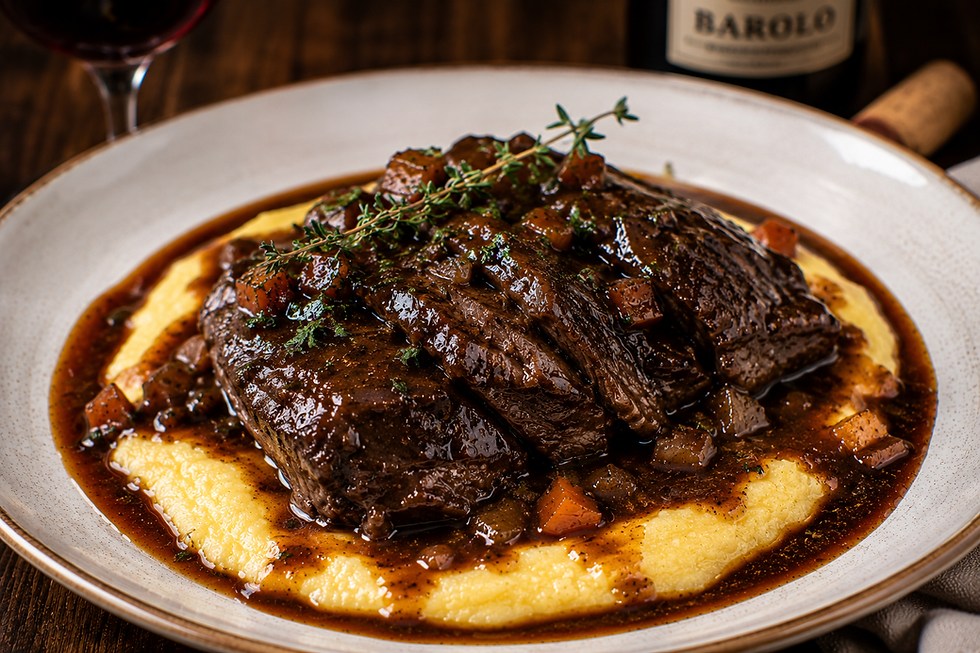
Cervo brasato al Barolo is built on two things from the same hills: a deer taken in the woods above the vineyards, and a bottle of the most tannic red wine in Italy. The meat goes into the wine raw overnight, then cooks for three hours until it gives way under a spoon, and the liquid it cooked in is reduced to a dark jus that tastes of iron, dried fruit and wood smoke.
What separates venison from every beef braise is not toughness. It is the almost complete absence of fat inside the muscle, and an iron content far above anything in a steer. Those two facts decide how the dish is built: fat has to come from outside, and the wine has to be reduced properly, because Barolo tannin and venison iron react in a way that leaves the plate drying and metallic if the reduction is rushed. Soft polenta goes underneath, as the Langhe serves it.
Yield: 4 servings. Prep: 40 minutes. Marinate: 12 to 24 hours. Cook: 3 hours 30 minutes. Rest: 20 minutes. Difficulty: intermediate. Course: secondo. Region: Piedmont, the Alpine valleys of Cuneo.
The Story
Hunting season in the Alpine valleys of Cuneo runs through autumn, exactly when the cellar is full and the previous vintage has become drinkable. A hunter brought down a deer, the family could not eat it fresh in a week, and the cellar held the one free preservative: wine, with enough acid and alcohol to hold raw meat for a day or two in a cold room. Marinating venison in red wine was storage first, and the flavour came with it.
The use of Barolo is a later refinement and a slightly deceptive one. Farm families rarely opened a labelled bottle for the pot: what went in was the wine of the house, the same Nebbiolo from the same slopes but not aged the way a Barolo is aged. The dish carried the name of the district, not the bottle.
Venison and beef were never interchangeable here. Brasato made with manzo is the Sunday dish of the plains around Alba and Bra. Cervo belongs to the higher ground, Valle Stura and Valle Maira, where the animal was wild and had run all summer. The lardo pushed into the meat is the signature of the mountain version, and it is there because the animal brought no fat of its own.
Ingredients
For the venison
Venison shoulder or haunch, boneless, in one piece, 3 lb (1.35 kg)
Lardo or fatty pancetta, in strips for larding, 3 oz (85 g)
Fine sea salt, 2 tsp (12 g)
Freshly ground black pepper, 1 tsp (2 g)
Butcher twine, for tying
For the Barolo marinade
Barolo DOCG or another Nebbiolo based red, 1 bottle, 3 cups (750 ml)
Yellow onion, quartered, 1 large
Carrot, in thick rounds, 1 large
Celery stalk, in pieces, 1
Garlic cloves, crushed, 3
Bay leaves, 2
Fresh rosemary sprig, 1
Fresh sage leaves, 6
Juniper berries, crushed, 10
Whole cloves, 3
Black peppercorns, 12
Cinnamon stick, small, 1
For the braise
Extra virgin olive oil, 3 tbsp (45 ml)
Unsalted butter, 2 tbsp (28 g)
Pancetta, diced small, 3 oz (85 g)
Yellow onion, finely diced, 1 medium
Carrot, finely diced, 1 medium
Celery, finely diced, 1 stalk
Tomato paste, 1 tbsp (16 g)
All purpose flour, 2 tbsp (16 g)
Beef or game stock, unsalted, 2 cups (480 ml)
Dried porcini, 1/3 oz (10 g), soaked in warm water
Fine sea salt, to taste
For finishing the jus
Unsalted butter, cold, cubed, 2 tbsp (28 g)
Chestnut honey, 1 tsp (7 g)
Red wine vinegar, 1 tsp (5 ml)
Bitter cocoa powder, unsweetened, 1/4 tsp (0.5 g), optional
For the soft polenta
Coarse stone ground cornmeal, 1 1/4 cups (200 g)
Water, 5 cups (1.2 l)
Fine sea salt, 2 tsp (12 g)
Unsalted butter, 3 tbsp (42 g)
Grated Parmigiano Reggiano, 1 1/2 oz (40 g)
For finishing the plate
Fresh thyme leaves, a small pinch per plate
Flaky sea salt, a few grains
Extra virgin olive oil, a few drops
Preparation
Larding and tying the meat
Trim the silverskin but leave the muscle whole. Cut the lardo into pencil thick strips and drive them into the meat along the grain with a larding needle, spaced about two inches apart, so the fat sits inside the muscle rather than on it. Tie the piece at intervals so it holds shape through three hours of cooking, then season all over.
The overnight marinade
Put the vegetables, garlic, herbs and spices in a deep non reactive bowl, set the tied venison on top and pour over the whole bottle, adding water if the meat is not covered. Refrigerate 12 hours, up to 24 for a large piece, turning twice. The meat darkens to near black: that is myoglobin reacting with the wine acid, not spoilage.
Drying and searing
Lift the meat out and strain the marinade, keeping liquid and solids separate. Blot the venison dry and leave it uncovered for 30 minutes, because wet meat steams instead of browning. Heat the oil and butter in a heavy Dutch oven over medium high heat, lay the venison in and leave it alone 4 minutes, then turn and repeat on every surface, 12 to 15 minutes in all. Leave the fond in the pot.
Soffritto and the wine reduction
Render the pancetta in the same pot for 4 minutes, then add the onion, carrot and celery with a pinch of salt and cook 10 minutes until soft and just golden. Stir in the tomato paste and cook 2 minutes until it darkens, then the flour, one minute more. Add the marinade solids and the strained wine, bring to a brisk simmer and reduce by a third, scraping the bottom clean. The alcohol and the raw tannin have to go here, not in the closed pot.
The long braise
Return the venison, add the stock, the porcini and their strained soaking water, and bring back to a bare simmer. The liquid should come two thirds up the meat. Cover tightly and cook at 300°F (150°C) for 3 hours, turning every 45 minutes. It is done when a skewer meets no resistance and the centre reads 195°F (90°C). Rest it loosely covered 20 minutes.
Finishing the Barolo jus
Strain the braising liquid through a fine mesh sieve, pressing the vegetables firmly. Skim the fat and reduce over medium heat until it coats a spoon, about 1 1/2 cups (360 ml). Taste it: if it is astringent on the finish, keep reducing. Correct with honey and vinegar a few drops at a time, then off the heat whisk in the cold butter cube by cube until glossy.
Soft polenta
Boil the water with the salt and rain the cornmeal in through your fingers, whisking so it does not lump. Drop to the faintest simmer and cook 45 minutes, stirring and scraping the corners. Add hot water whenever it stiffens: it should stay loose enough to spread by itself. Beat in butter and Parmigiano off the heat.
Plating
Warm the plates: a cold one dulls the polenta and breaks the shine on the jus within a minute. A wide shallow bowl works better than a flat plate, because it holds the polenta and the sauce together.
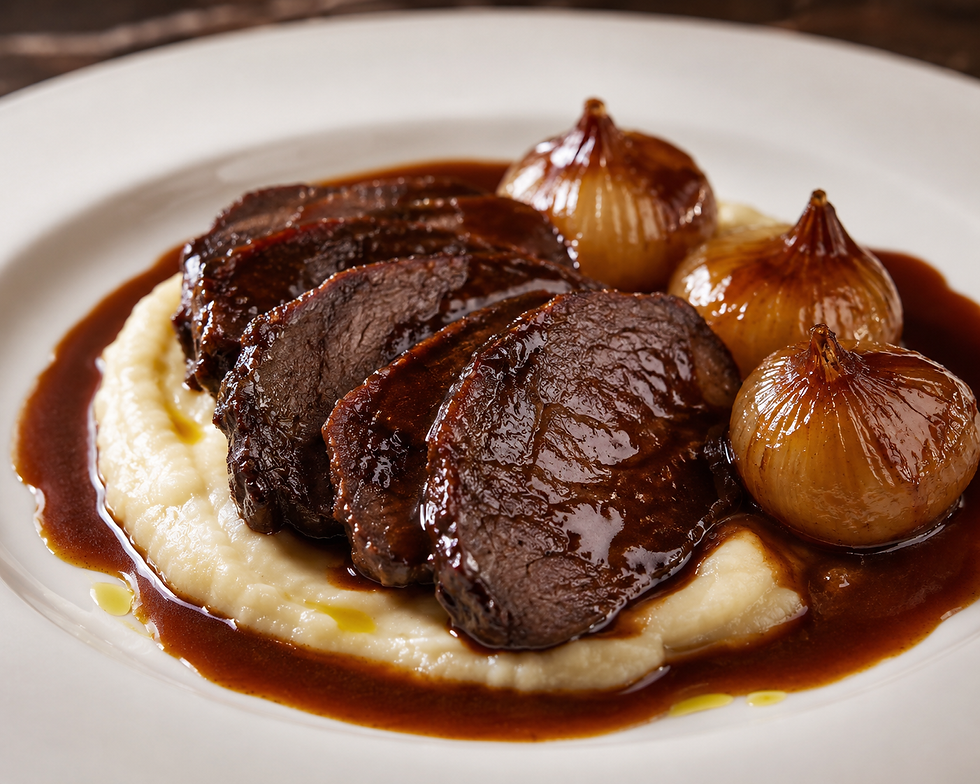
Slice the rested venison across the grain, about half an inch thick. The slices will be dark brown throughout with no pink centre, which is correct here: a rosy interior on venison shoulder means it is not cooked through.
Spoon the polenta into the centre and let it find its own level. Lay two or three slices overlapping on top, then spoon the hot jus over the meat and let it pool at the edge of the polenta instead of flooding it. Finish with thyme, flaky salt and three drops of good olive oil. Nothing else belongs on this plate.
Professional Technique
The technical problem here is not tenderness. Venison is the flesh of a wild animal that has run all summer, and it carries almost no intramuscular fat: where a well marbled beef chuck runs 8 to 15 percent fat inside the muscle, deer shoulder sits closer to 2 percent. Its iron and myoglobin content is far above beef, and that is what gives venison its very dark colour and its ferrous, faintly bloody flavour. The collagen turns to gelatin in three hours whatever you do, so the meat will be tender. What it will not be, without intervention, is moist.
Fat therefore has to come from outside, at three points. The lardo driven into the muscle melts inside the meat and lubricates fibres that have nothing of their own, which is why larding cannot be replaced by a sheet of fat tied on the surface. The rendered pancetta puts cured pork fat into the liquid, where it carries the aromatics of juniper and porcini that will not dissolve in water. The cold butter whisked into the jus coats the tongue. Remove one of the three and the braise reads as dry even while the meat falls apart.
The second half of the technique is the reaction between Barolo tannin and venison iron, and it is chemistry rather than a figure of speech. Condensed tannins bind readily to iron and to proteins, which is why a tannic red tastes softer with rare meat than alone. In the pot that works for you: the tannin latches on to the iron rich proteins of the venison and to the gelatin leaching out of the collagen, and the harshness drops. Tannin left in the liquid with nothing to bind to does not, and that surplus is the drying astringency you taste after you swallow. The remedy is mechanical. Reduce the wine hard before the lid goes on, so the alcohol leaves and the tannins polymerise into larger, softer molecules, then reduce the strained liquid again until it coats a spoon. Butter and honey soften what is left; they cannot rescue unreduced wine.
Texture and Moisture Control
The braise passes through three stages governed by temperature. Up to about 140°F (60°C) the muscle proteins contract and squeeze water out, which is why every braise looks tight and dry for a while. Between 160°F and 195°F (70°C and 90°C) the collagen converts to gelatin, and that gelatin holds water in a way the meat no longer can. Venison needs the top of that range, around 195°F (90°C) at the centre, long enough to finish the conversion. Pull it at 170°F (77°C) and it will be dry and tough at once.
The oven temperature matters more than the total time. At 300°F (150°C) with the lid on, the liquid sits at a bare simmer. Push it to 375°F (190°C) to save an hour and the outer inch shreds while the centre is still contracting, and the fibres separate into dry strands. If steam is escaping the lid, the oven is too hot whatever the dial says.
The 20 minute rest is not optional either. Gelatin that is fully liquid at cooking temperature sets as the meat cools, and it is that setting gelatin which holds juice inside the slices instead of releasing it onto the board. Use the rest to reduce the jus. The polenta does its own work: its starch binds residual tannin.
Professional Mise en Place
A two day dish with one busy hour at the end. The marinade goes on the day before and only the polenta and the mounting of the sauce happen near service.
Equipment and tools
Heavy Dutch oven with a tight lid
Larding needle or thin boning knife, and butcher twine
Fine mesh conical sieve
Instant read thermometer and a heavy saucepan for the polenta
Prepared ahead
Venison larded, tied and in the marinade, 12 to 24 hours ahead
Soffritto vegetables diced and covered
The whole braise cooked a day ahead, meat left unsliced in its strained liquid
Service setup
Polenta on the lowest heat with hot water beside it for slackening
Jus reduced and held warm, butter still cold until the last moment
Meat rested, sliced only as plates go out
Plates warm, thyme and flaky salt within reach
Chef Tips
Ask the butcher which animal it is and how long it has hung. Farmed red deer is milder, fattier and more forgiving; wild deer, especially an older stag taken late in the season, needs the full 24 hours.
Cook it the day before you serve it. This is one of the few dishes genuinely better on the second day: the meat sits in its strained liquid overnight and slices far more cleanly cold.
Use a wine you would drink, but not the expensive bottle. A real Barolo loses its aromatics entirely in three hours of cooking and what survives is tannin and acidity, so a young Nebbiolo gives the same structure for a third of the price.
Taste the jus three times: before reducing, halfway, and after the butter. If the sauce dries your tongue after you swallow it needs more reduction, not more butter, and only once that is gone should you correct with honey and vinegar.
Common Mistakes
Skipping the larding. Tying a sheet of fat around the outside is no substitute: surface fat renders into the liquid and never reaches the interior. The strips driven into the muscle are the only fat inside the meat when you slice it, and a braise without them is tender and dry at once.
Putting wet meat into the pot. Venison lifted out of a marinade is saturated, and that water has to evaporate before browning starts. The meat goes grey, the pot never builds a fond, and the sauce loses its deepest layer of flavour.
Not reducing the wine before the lid goes on. This is what produces the harsh, drying brasato people blame on the venison. A bottle of raw Nebbiolo in a closed pot keeps its alcohol and its unpolymerised tannin, and three hours under a lid drives off neither.
Pulling the meat at beef temperatures. A skewer that meets resistance means the collagen has not finished converting. Venison shoulder needs about 195°F (90°C) at the centre, and undercooked braise is tough and dry.
Adding the butter over heat. Whisked into a simmering sauce the emulsion breaks and the fat separates into an oily film within a minute. Take the pan off the flame, then add the butter in cubes, moving the pan constantly.
Wine Pairing
Barolo DOCG: The wine in the pot and the wine on the table, working by the same chemistry as the braise. Its tannin binds to the iron rich proteins of the venison and to the gelatin in the sauce, so a bottle that tastes austere alone turns supple against the meat, while its acidity cuts the butter mounted jus and its tar and dried cherry find the juniper. Choose one with six years on it.
Barbaresco DOCG: The same grape from lighter soils a few miles east, and the better choice if the venison is farmed rather than wild. It carries less tannin and matures earlier, giving it more perfume and a finer texture against a dish already dense. The ferrous note still has structure to bind to, but the wine leaves room for the porcini and the honey.
Nebbiolo d'Alba DOC: The everyday Nebbiolo of the same district and the honest weekday answer. It gives the grape's acidity and dried cherry fruit with the tannin dialled back. Its lighter body will not stand up to a jus reduced very hard, so pour it with a sauce kept a touch looser.
Alto Adige DOC Lagrein: The Alpine pairing, from valleys where game is cooked this way with different wine. Lagrein has deep colour, firm acidity and a bitter almond finish, with less tannin than Nebbiolo but more freshness, and that acidity is what it brings to a braise that could sit heavily. Serve it at 61°F (16°C).
Storage & Reheating
Store the meat and the liquid together and leave the piece whole if you can. Covered by enough strained braising liquid, the venison keeps 4 days in the refrigerator and improves for the first two, because the fibres reabsorb liquid they released in the pot. Keep the mounted jus in its own container, since a butter emulsion does not survive reheating.
To reheat, slice the cold meat, lay the slices flat in a pan with a ladle of unmounted liquid, cover, and bring it up over the lowest heat for 8 to 10 minutes. Never reheat in a dry oven and never let the pan simmer: both drive out the water the gelatin is holding.
The braise freezes for up to 3 months, always submerged in its liquid, and thaws overnight in the refrigerator. Soft polenta does not reheat as soft polenta: pour any left over into an oiled tray, chill until firm, then cut it into slices and grill them the next day, which is what the Langhe does anyway.
Nutrition
Per serving, based on 4 servings with polenta:
Calories: 780 kcal
Total Fat: 36 g
Saturated Fat: 17 g
Trans Fat: 0.5 g
Unsaturated Fat: 17 g
Cholesterol: 210 mg
Sodium: 980 mg
Total Carbohydrates: 48 g
Fiber: 4 g
Total Sugars: 6 g
Added Sugars: 1 g
Protein: 62 g
Lactose: 1 g
Principal micronutrients: iron, zinc, selenium, vitamin B12, niacin, vitamin B6, phosphorus, potassium
These figures are estimates. Venison is very high in iron and protein and very low in fat, so almost all the fat here comes from the lardo, the pancetta and the butter.



Comments