
Italian Barolo Braised Beef Heart with Celeriac Purée and Borettane Onions | Cuore di Manzo Brasato al Barolo con Purea di Sedano Rapa e Cipolle Borettane
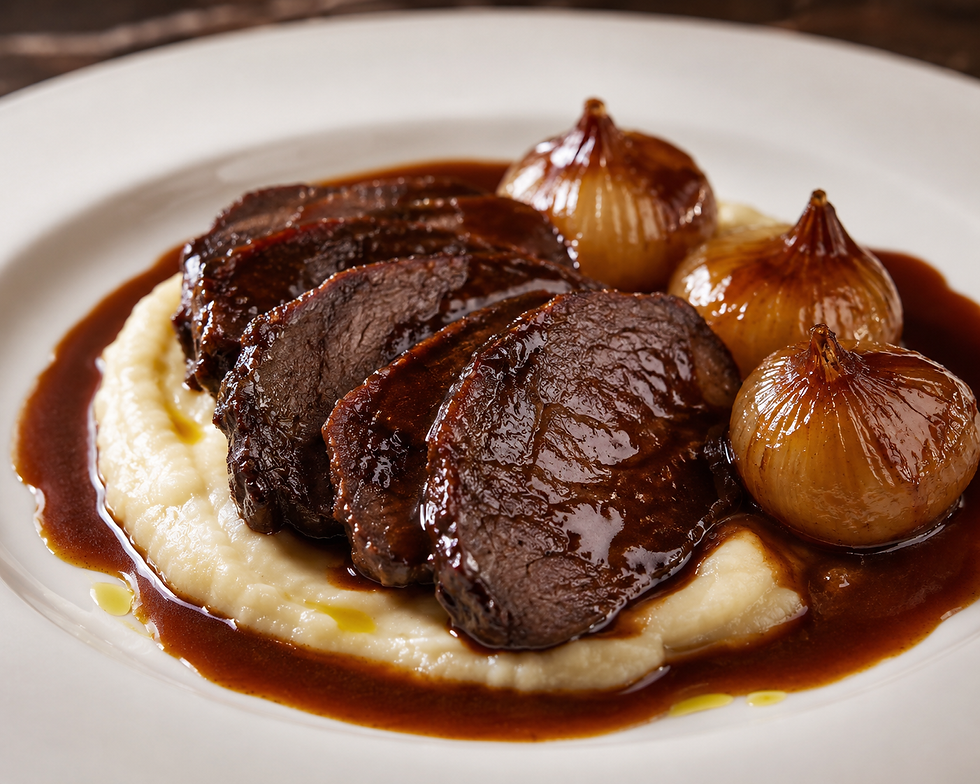
Beef heart is the cut Piedmont never advertised and never stopped cooking. It costs almost nothing, it leaves the butchery as a single dense fist of dark muscle, and for two centuries it fed the families who sold the ribs and the fillet to somebody else. Brasato al Barolo is the aristocratic dish of the same region, usually built on shoulder. Putting the two together is not a modern conceit: it is what a Langhe kitchen did on a Monday with the wine already open.
What makes the pairing work is chemistry rather than nostalgia. Heart is the most iron dense muscle on the animal and it tastes of it, mineral and faintly bloody. Barolo brings high tannin, and tannin has a particular affinity for iron: left alone, the two amplify each other into something metallic. Three hours together, over a sweet vegetable with no acidity, turn them into one of the deepest flavours a braise can reach. That is the job of the celeriac purée, and it is structural rather than decorative.
Yield: 6 servings. Prep: 45 minutes. Cook: 3 hours 30 minutes. Rest: 30 minutes in the braising liquid. Total: about 4 hours 45 minutes. Difficulty: intermediate to advanced. Course: secondo piatto. Region: Piedmont, the Langhe and the Roero.
The Story
The quinto quarto, the fifth quarter, is what Italian butchery calls everything that is not one of the four quarters of the carcass. Every Italian city has a repertoire built on it, and Turin's is among the oldest and the least exported. Heart, lung, spleen and tripe were the protein of the working districts around Porta Palazzo, cooked with wine because wine was the one thing a Piedmontese family always had.
Brasato al Barolo dates from the nineteenth century, from the moment Barolo stopped being a sweetish table wine and became the dry structured red it is now, largely through Cavour's estate at Grinzane and the oenologist Louis Oudart. Once the wine had tannin, it had a use in the pot. The classic version takes a piece of shoulder; the heart version belongs to the same kitchens but never reached the cookbooks, because nobody photographs a heart.
Celeriac grows well in the cold plain between Turin and Cuneo and runs through Piedmontese winter cooking as a purée or a gratin. The Borettane onion takes its name from Boretto on the Po: flat, small and unusually high in sugar, which is why Italians glaze it rather than fry it.
Ingredients
For the beef heart
Whole beef heart, 4 lb (1.8 kg) raw, about 3 lb (1.35 kg) after cleaning
Coarse sea salt, 2 tsp (12 g)
Freshly ground black pepper, 1 tsp (2 g)
All purpose flour, 2 tbsp (16 g)
Extra virgin olive oil, 3 tbsp (45 ml)
Unsalted butter, 1 tbsp (14 g)
For the braising liquid
Barolo DOCG or another Nebbiolo, 3 cups (710 ml)
Beef stock, 2 cups (475 ml)
Yellow onion, diced, 1 large
Carrot, diced, 1 medium
Celery stalk, diced, 1
Garlic cloves, crushed, 3
Tomato paste, 1 tbsp (16 g)
Fresh thyme sprigs, 4
Fresh rosemary sprig, 1 short
Bay leaves, 2
Black peppercorns, 1 tsp (3 g)
Whole cloves, 2
Strip of orange zest, 1, about 2 in (5 cm)
For the celeriac purée
Celeriac, peeled and cubed, 2 lb (900 g) trimmed
Whole milk, 1 1/2 cups (360 ml)
Water, 1/2 cup (120 ml)
Unsalted butter, 3 tbsp (43 g)
Heavy cream, 1/4 cup (60 ml)
Fine sea salt, 1 tsp (6 g)
Ground white pepper, to taste
For the Borettane onions
Borettane onions, peeled, 12 oz (340 g)
Unsalted butter, 1 tbsp (14 g)
Granulated sugar, 1 tsp (4 g)
Red wine vinegar, 1 tbsp (15 ml)
Beef stock or water, 1/2 cup (120 ml)
Fine sea salt, 1 pinch
For finishing
Cold unsalted butter, cubed, 2 tbsp (28 g)
Fresh thyme leaves, 1 tsp
Flaky sea salt, to taste
Extra virgin olive oil, a few drops per plate
Preparation
Cleaning the heart
Open the heart along the natural line of the chambers with a thin flexible knife and lay it flat. Cut away the valves, the tough white cords that held them, every visible blood vessel and the hard waxy pad of fat at the top. Strip the silverskin from both faces, sliding the knife just under it. Rinse and pat completely dry. Cut into pieces of about 2 in (5 cm). Expect to lose a quarter of the raw weight.
Seasoning and searing
Season with the coarse salt and pepper, rest 20 minutes, then dust very lightly with the flour and shake off everything loose. Heat the oil and butter in a heavy braising pot over medium high heat until the foam subsides, and sear the pieces in two or three batches, about 3 minutes a side, until each face carries a real dark crust. Never crowd the pot, and keep the resting juice.
Building the base and deglazing with the Barolo
Lower the heat, add the onion, carrot and celery to the same pot and cook 10 minutes, scraping up the fond. Add the garlic for a minute, then the tomato paste, and stir it 2 minutes until it darkens from red to brick. Pour in the wine, raise the heat and reduce it by about one third, roughly 12 minutes. Do not skip that reduction: raw Nebbiolo tannin is harsh and unusually reactive with the iron in the heart, and a braise built on unreduced wine finishes metallic however long it cooks.
The long braise
Return the heart and its juices, add the stock, thyme, rosemary, bay, peppercorns, cloves and orange zest, and bring to a bare simmer. The liquid must cover the meat by half an inch. Cover and cook in a 300°F (150°C) oven for 3 hours, checking at two hours. It is ready when a skewer meets no resistance and a piece pulls apart under a fork. Switch the oven off and let it rest in the covered pot for 30 minutes.
The celeriac purée
While the braise cooks, simmer the cubed celeriac in the milk, the water and half the salt for 20 to 25 minutes, until a cube offers no resistance. Drain, keeping the milk. Blend hot with the butter, the cream and a few tablespoons of that milk until smooth, then pass it through a fine mesh sieve. Season and hold warm over a low bain marie.
Glazing the onions and finishing the jus
Put the peeled onions in a wide pan with the butter, sugar, vinegar, stock and salt and simmer uncovered for about 18 minutes until the liquid is a syrup that clings. Meanwhile lift out the heart and keep it warm, strain the braising liquid, pressing the vegetables, and reduce it hard until about 1 1/2 cups (360 ml) remain and it coats a spoon. Off the heat, swirl in the cold butter a cube at a time.
Plating
Warm the plates to about 140°F (60°C): everything here is hot and fat rich, and the purée sets and dulls the moment it meets a cold surface. Spoon three tablespoons of purée slightly off centre and spread it into a wide shallow bed. Set two or three pieces of heart on it, whole or cut across the fibres into thick slices, never along them, and tuck three or four glazed onions into the gaps.
Spoon the buttered jus over the meat and let it pool at the edge of the purée, where the dark sauce against the pale root is most of the visual interest the plate needs. Finish with thyme leaves, a little flaky salt on the meat only and a few drops of olive oil, and nothing else.
Professional Technique
Everything unusual about cooking heart follows from one fact: it is cardiac striated muscle, not skeletal muscle, built for a different job. A thigh contracts hard and occasionally; a heart contracts moderately and never stops. So its fibres are far finer than those of any cut from the leg, it carries essentially no intramuscular fat to marble it, and its cells are packed with mitochondria and with myoglobin at a density no other muscle on the animal approaches. Myoglobin is an iron bearing protein, and that concentration is what gives raw heart its almost violet colour and cooked heart its unmistakable ferrous taste.
The cleaning follows from the same anatomy. A heart is a pump, so most of what you cut away is plumbing: the valves, the cords that held them, the coronary vessels through the wall, and the waxy cap of pericardial fat that never renders. None of it softens. A braise that finishes with rubbery threads in it was not overcooked, it was under trimmed.
The critical thing is that heart has a double cooking window, exactly like cuttlefish, and nothing usable in between. Two minutes in a screaming pan, served rare, and it is tender because the fine fibres have barely contracted. Three hours at a bare simmer and it is tender again because the connective tissue through the wall has fully converted to gelatin. Between those points, from about four minutes to about ninety, the fibres have seized and the collagen has not yet given way, and the meat eats like rubber. There is no middle path and no rescue for a heart taken out early: the only fix is another hour.
The last piece is the tannin and iron problem, and it is why this plate needs the purée. Tannin binds readily to iron, and heart delivers more iron than any other cut while Barolo delivers more tannin than almost any Italian red. Unmanaged, the two produce a flat metallic astringency people describe as tasting of coins. Three corrections defeat it: reduce the wine by a third before the meat returns; keep the braise below a simmer, since hard boiling strips more tannin out of the wine; and serve the meat on something sweet with no acidity at all.
Texture and Moisture Control
Heart cannot baste itself. A chuck roast carries enough intramuscular fat to lubricate its own fibres through a long cook and heart carries almost none, so every bit of succulence comes from gelatin and from the braising liquid. That changes two rules: the meat must stay submerged for the whole three hours, so check the level at two hours and top up with hot stock, and the resting has to happen in the liquid rather than on a board, where the fibres simply dry.
The crust is worth protecting. Searing gives Maillard flavour that braising cannot produce, but heart has a wet surface and little surface sugar, so it browns reluctantly unless it is bone dry and barely floured. The purée is a water problem: celeriac is about 88 percent water and turns gluey if overworked, so blend it hot and briefly and finish the smoothness with a sieve. Cold butter added to the jus off the heat is what makes it cling and shine, and putting the pan back on the flame breaks the emulsion within seconds.
Professional Mise en Place
This dish is almost entirely make ahead. The braise is better on the second day, and only the purée, the onions and the buttering of the jus need attention at service.
Equipment and tools
Heavy braising pot with a tight lid, 6 qt (5.7 l) or larger
Thin flexible boning knife, and a sharp slicing knife
Wide saucepan for the jus, a second for the onions
High speed blender and a fine mesh conical sieve
Bain marie for holding the purée
Prepared ahead
Heart cleaned, trimmed and cut, up to 1 day ahead
The whole braise, up to 2 days ahead, refrigerated in its liquid
Braising liquid strained and reduced, buttered only at service
Celeriac purée, up to 1 day ahead, rewarmed gently
Borettane onions glazed on the day, held in their syrup
Service setup
Purée warm over a low bain marie, covered, slackened with warm milk
Heart warming gently in a little of its liquid, never uncovered
Reduced jus at a bare simmer, cold cubed butter beside the pan
Onions warm in their glaze, thyme picked, salt and oil to hand
Plates warmed to about 140°F (60°C)
Chef Tips
Order the heart whole and fresh rather than pretrimmed, which is usually trimmed badly and costs more. Fresh heart is deep purple red, with a clean mineral smell and a firm surface. Anything brown, slack or faintly sour goes back.
Cook this the day before you serve it. The braise improves overnight and it is far easier to lift cleanly once the fat has set on top.
Do not use your best Barolo, and do not use cooking wine. A young Nebbiolo d'Alba or a Langhe Nebbiolo has the same tannic structure at a third of the price, and three hours in the oven erases the nuance you pay for in a Riserva.
If you cannot find Borettane onions use small cipollini or the smallest shallots you can get, but never frozen pearl onions. They carry too much water, refuse to glaze, and turn the syrup back into a liquid.
Common Mistakes
Pulling the heart out early. A heart at two hours is not partly done, it is at its toughest. Give it the full three hours and test with a skewer rather than by the clock.
Leaving the silverskin and the vessels in. None of that tissue softens, however long the braise runs. It finishes as rubbery threads through otherwise tender meat.
Adding the wine without reducing it. Unreduced Nebbiolo tannin reacts with the iron and locks the braise into a metallic astringency that no amount of salt or butter will lift out.
Boiling the braise instead of simmering it. A visible boil squeezes the fibres of a lean muscle hard and pulls extra tannin from the wine. If your oven runs hot at 300°F (150°C), drop it to 285°F (140°C).
Slicing the meat with the grain. The fibres are fine but long and strongly aligned, so a slice along them eats stringy even when the braise is perfect.
Wine Pairing
Barolo DOCG: The wine in the pot, and the safest bottle on the table if you open an older one than you cooked with. Eight or ten years resolves Nebbiolo tannin into something fine grained and dusty, which is what you want against the iron: young tannin sharpens the mineral edge instead of wrapping it.
Barbaresco DOCG: The same grape in the warmer Tanaro valley, and the better choice if the braise came out very concentrated. It drinks earlier, with more perfume in a slightly softer tannic frame, and its acidity is what cuts the butter in the jus and in the purée.
Gattinara DOCG: Nebbiolo from the volcanic porphyry of northern Piedmont, leaner and higher in acidity than the Langhe versions, with a wet stone and iron note of its own. It meets the ferrous quality of the heart head on rather than softening it.
Valtellina Superiore DOCG: Nebbiolo on Alpine terraces in Lombardy, where it is called Chiavennasca, and the most elegant option here. Altitude gives it lighter body, high acidity and fine dry tannin, with sour cherry and mountain herb notes that pick up the thyme and rosemary in the braise.
Barbera d'Asti DOCG: What a Langhe family would actually have poured with heart. Very high acidity and notably low tannin make it the safest bottle where iron is concerned, since there is little tannin available to bind with it, and the sour cherry fruit refreshes against the gelatin.
Storage & Reheating
This braise is better the next day, so treat leftovers as an improvement. Cool the pot uncovered for about an hour, then refrigerate the meat submerged in its unstrained liquid, sealed, for up to 3 days: the fat sets as a white cap that lifts off easily. Keep the purée separately for up to 2 days and the glazed onions for up to 3. The braise freezes in its liquid for up to 2 months, portioned, thawed overnight in the refrigerator. The purée does not freeze, since the starch and the dairy separate and it comes back grainy.
Reheat the meat gently and always in liquid: a covered pan with a ladle of the braising liquid over low heat for 12 to 15 minutes, or 20 minutes in a covered 285°F (140°C) oven. Never reheat heart uncovered, in a hot oven or in a microwave, because a lean muscle with no marbling dries out within a minute. Rewarm the purée over a bain marie with a splash of milk, and butter the jus only when everything else is ready.
Nutrition
Per serving, based on 6 servings, including purée, onions and jus:
Calories: 560 kcal
Total Fat: 27 g
Saturated Fat: 12 g
Trans Fat: 0.4 g
Unsaturated Fat: 14 g
Cholesterol: 235 mg
Sodium: 780 mg
Total Carbohydrates: 22 g
Fiber: 4 g
Total Sugars: 9 g
Added Sugars: 1 g
Protein: 48 g
Lactose: 4 g
Principal micronutrients: iron, vitamin B12, coenzyme Q10, riboflavin, zinc, selenium, phosphorus
These figures are estimates. Heart is exceptionally lean and high in protein, iron and coenzyme Q10, of which it is the richest dietary source of any food, and most of the fat above comes from the butter and cream.


Comments