
Apulian Focaccia | Focaccia Pugliese

Focaccia Pugliese is the tray bread of Bari: a tall, golden slab with a crisp, oily base, an open tender crumb and a top pressed with cherry tomatoes, olives and oregano. The secret is a boiled potato worked into the dough, which keeps the crumb soft for days and lets you push the water far higher than flour alone would allow. This is the full method, from the potato to the brine.
Yield: 12 squares. Active work: 45 minutes. Rise: 10 to 14 hours in all. Bake: 25 to 30 minutes. Difficulty: intermediate. Region: Puglia, Bari.
The Story
Ask anyone in Bari what they eat at ten in the morning and the answer is a square of focaccia, still warm, handed over in a sheet of paper that turns translucent with oil before you reach the corner. The city has baked it in wood fired ovens for centuries, and the forno on the corner has always been more than a shop: households once carried their own trays there to be baked, and the smell of the oven still defines the old town's narrow lanes around the basilica of San Nicola.
Puglia is the durum wheat heartland of Italy, with the great grain plains of the Tavoliere and the stony Alta Murgia plateau behind the coast, and its bakers have always leaned on semola rimacinata, the finely reground durum flour that also gives Altamura bread its golden crumb. The potato entered the Barese dough later and for a practical reason. It stretched the flour in lean years, it made a large tray of bread stay soft until the next day, and it turned out to give a crumb no plain dough could match. What began as economy became the signature.
The topping is the landscape in miniature. Small sweet tomatoes ripened under the southern sun are pressed into the dough so their juice runs into the crumb, olives come from the groves of the Murgia and the plain of Foggia, and oregano is picked from the hillsides. Nothing is added to disguise the bread. Oil, salt, tomato, olive and herb are all that Bari asks of a focaccia, which is why the dough must carry the whole dish. The result sits between a pizza and a loaf, thick like one and rich like the other, and it is eaten at breakfast, at the beach and at any hour in between.
Every family in Bari has an opinion about the potato. Some add a little, some add a lot, and neighbors argue over whether the tomatoes must be pressed in or merely set on top. What everyone agrees on is the oil, which must be generous, and the base, which must crackle. A good focaccia is judged by turning it over: the bottom should be as golden as the top, and it should sound almost hollow when tapped. The same dough, thinner and with onions, becomes a different bread in other towns, but in Bari it is this one, and the city guards it.
Ingredients
Weigh by grams whenever you can, because this dough is wet and small errors show. In baker's terms the added water is 80 percent of the flour, the semola is 20 percent of the total flour, and the potato is about half the weight of the flour.
For the dough
Bread flour, strong, 12 to 13 percent protein, 3 1/4 cups (400 g)
Semola rimacinata, finely reground durum wheat flour, 2/3 cup (100 g)
Yellow potato such as Yukon Gold, boiled whole in its skin, peeled and riced cold, 9 oz (250 g)
Cold water, straight from the tap, 1 2/3 cups (400 ml)
Instant yeast, 2 1/4 tsp (7 g)
Fine sea salt, 2 tsp (12 g)
Extra virgin olive oil, 3 tbsp (45 ml)
For the pan
Extra virgin olive oil, 1/4 cup (60 ml)
Semola rimacinata, for dusting, 1 tbsp (10 g)
For the topping
Ripe cherry tomatoes, Pugliese if possible, halved, 12 oz (340 g)
Cerignola or other pitted green olives, drained, 3/4 cup (85 g)
Dried oregano, on the branch if possible, crumbled, 1 tsp (1 g)
Water, 2 tbsp (30 ml)
Extra virgin olive oil, 2 tbsp (30 ml)
Fine sea salt for the brine, 1/2 tsp (3 g)
For finishing
Flaky sea salt, 1/2 tsp (2 g)
Crushed red pepper flakes, optional, 1/4 tsp (0.5 g)
Extra virgin olive oil, a light drizzle
Preparation
Step 1: Boil and rice the potato
Boil the whole unpeeled potato in unsalted water for 25 to 30 minutes, until a knife slides in without resistance. Drain, peel it while still hot with a towel to protect your fingers, and push it through a ricer or a fine sieve straight away. Spread the purée on a plate and let it cool completely, about 30 minutes. You want it cold and fluffy, not gluey, so never blend it. A blender or food processor breaks the starch cells open and releases a sticky paste that will make the whole dough gummy.
Step 2: Mix the dough
Whisk both flours with the yeast in a large bowl. Add the water, the cold potato and the olive oil and mix with a wet hand or a dough hook for 3 minutes until no dry flour remains. Rest 20 minutes, then add the salt and mix 2 minutes more. The dough will be very loose and sticky, and that is correct. Cover the bowl with a damp towel or a plate so the surface does not form a skin.
Step 3: Fold during the first rise
Leave the dough at room temperature for 1 hour. Wet your hand, lift one side and fold it over the center, turning the bowl a quarter each time, four folds in all. Repeat three times at 30 minute intervals. The dough tightens, smooths and gains bubbles with every fold, and you will feel it change from a shaggy batter into an elastic, glossy mass. Refrigerate it for 8 to 12 hours.
Step 4: Oil the pan and stretch
Coat a 9 by 13 inch (23 by 33 cm) metal pan with the pan oil and dust with semola. Tip the cold dough in, turn it once to coat the top, and stretch it gently toward the corners. If it springs back, rest 15 minutes and stretch again. Do not force it. Pulling hard tears the gluten and leaves thin, uneven patches that burn.
Step 5: Proof at room temperature
Cover and let the dough rise for 2 to 3 hours, until it is puffy, jiggly and has nearly doubled. Heat the oven with a baking steel or stone on the lowest rack to 450°F (230°C) for at least 45 minutes.
Step 6: Dimple and dress
Whisk the water, oil and salt for the brine. Oil your fingertips and press straight down to the bottom of the pan in rows. Pour the brine over the dough so it pools in the dimples. Press the tomatoes in cut side up, add the olives, and scatter the oregano. Leave a little space between the toppings so the crumb can rise around them.
Step 7: Bake until deep gold
Bake on the steel for 25 to 30 minutes, until the edges are dark gold and the center reads 205°F (96°C). The bottom should be crisp when you lift a corner with a spatula. If the top colors too quickly, move the pan up a rack for the last 5 minutes. Do not open the oven in the first 15 minutes, when the dough is still rising.
Step 8: Finish and release
Slide the focaccia out onto a rack within 2 minutes of leaving the oven, so steam cannot soften the base. Drizzle with oil, add the flaky salt, and rest 10 minutes before cutting into 12 squares.
Plating
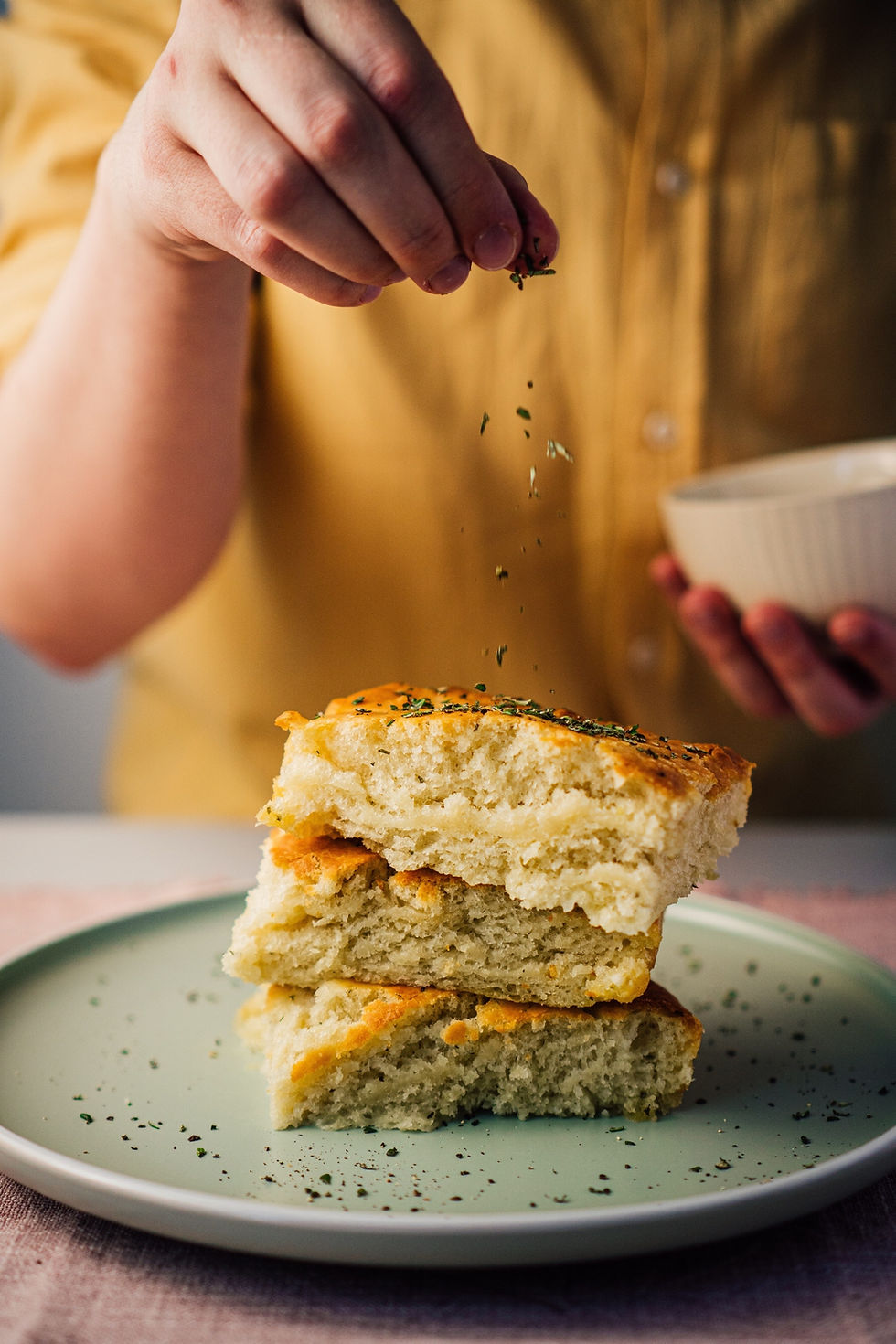
Serve warm, not hot, on a wooden board or a plain white platter, with the tray still lined in the crumbs and oil that fall away when it is cut. Use a serrated knife and long confident strokes to make squares about 3 inches (8 cm) across, so every piece carries a tomato and an olive. Bari sells it by weight in paper, and at home a sheet of parchment under each square does the same job.
For a table setting, pair it with a few slices of Puglian burrata, a handful of wild rocket dressed with lemon, or thin slices of cured meat. Keep the plate spare. The focaccia is the dish, and a small dish of your best olive oil on the side is the only condiment it needs.
Professional Technique
The technical heart of this bread is the boiled potato, and it works through starch. When a potato cooks, its starch granules swell and burst, a process called gelatinization, forming a gel that holds many times its weight in water. Flour alone cannot hold that much, so a dough pushed to very high hydration turns to soup. With the potato present, the water stays trapped in the gel, the dough remains workable, and in the oven it is released slowly, which keeps the crumb moist for days.
Temperature matters at both ends. Rice the potato while hot, when the starch is fully open and the cells break into fine flakes instead of paste. Then chill it completely before it meets the dough, because a warm potato wakes the yeast too early and gives a sour, overproofed bread. Boil it whole and unpeeled so it absorbs no extra water.
The potato also changes the arithmetic. About 78 percent of its weight is water, so 9 oz (250 g) adds roughly 195 g of water and 55 g of starchy solids. Count both. Here 400 g of added water plus 195 g gives 595 g of liquid against 555 g of dry matter, a hydration near 107 percent, yet the dough handles like 80 percent. Without the potato, cut the water to 360 g.
The semola does a different job. Durum wheat is coarser and yellow, so it adds chew, a nutty flavor and golden color, and it absorbs water slowly, balancing the wet potato. Bread flour supplies the gluten for lift, and the semola gives the bite.
Texture and Moisture Control
A great Barese focaccia has three textures: a fried crackling base, a soft open crumb, and a top slightly juicy where the tomatoes sit. The base comes from the oil in the pan, which fries the underside as the dough bakes. Use a metal pan, never glass or ceramic, and set it on a preheated steel so the bottom gets a burst of heat before the dough sets.
The crumb depends on the long cold rise. Eight to twelve hours in the refrigerator lets enzymes convert starch into sugars, which brown the crust, and lets the gluten relax so it stretches without tearing. When the dough jiggles like set custard it is ready. Underproofed dough bakes dense, and overproofed dough collapses and tastes acidic.
Tomatoes release juice as they bake, so press them in cut side up, where the exposed surface roasts instead of leaking into the crumb. Too much brine leaves a soggy top. Cool the focaccia on a rack, never in the pan, so steam escapes from underneath and the base stays crisp for the first hour after baking.
Professional Mise en Place
This is a bread that is won the day before. Almost all the work is done ahead and cold, and the final hour is only stretching, dressing and baking. Set the timeline back from the moment you want to serve, and remember that the oven needs 45 minutes to charge the steel.
Equipment and tools
9 by 13 inch (23 by 33 cm) metal baking pan
Ricer or fine mesh sieve, large mixing bowl with a lid or plate, bench scraper, digital scale
Baking steel or stone, wire rack, serrated knife, oven thermometer, instant read probe
Prepared ahead
Potato boiled, riced and chilled, up to 1 day ahead
Dough mixed and folded the evening before, resting cold overnight in the covered bowl
Tomatoes halved and drained on paper, olives pitted, brine whisked, all refrigerated
Service setup
Oven and steel at full temperature for 45 minutes before baking
Dressed tray ready to slide in the moment the oven is hot, with the dough already proofed
Rack cleared and board ready for the finished bread, oil bottle and flaky salt within reach
Chef Tips
Weigh everything. With a dough this wet, a few spoonfuls of water more or less change the outcome, and the potato weight must be exact. Use a starchy yellow potato such as Yukon Gold and boil it whole, since a waxy one turns gummy.
Oil your fingers, the pan and the scraper generously. The dough is meant to be sticky, and adding flour to fix it will ruin the crumb. Wet hands work too.
Dimple deeply, all the way to the pan, because shallow dimples close up in the oven and the dough puffs up like a plain loaf. Make sure the tomatoes and olives are pressed halfway in, so they cannot slide off when cut.
Bake on the lowest rack to fry the bottom, and give it the last few minutes higher if the top needs color. Rotate the pan halfway through, since most home ovens run hotter at the back.
Common Mistakes
Adding warm potato. Warm purée raises the dough temperature and wakes the yeast too early, and the bread proofs too fast and tastes sour. Chill it fully before mixing.
Ignoring the potato water. If you fix the hydration on the flour alone and forget the 195 g of water in the potato, the dough turns to batter and spreads flat. Always count it in the total.
Working the dough too hard. Kneading a high hydration dough tears the delicate gluten and pushes out gas. Use gentle folds, and let time do the work instead.
Using a glass pan. Glass conducts heat too slowly to fry the base, so you get a pale, soft bottom. A dark metal pan is the right tool for a crisp crust.
Skipping the brine. Without the oil and salt water in the dimples, the top dries and the tomatoes taste flat. The brine keeps the surface glossy and seasoned.
Cutting it too soon. Slice while the crumb is still steaming and it compresses and turns gummy. Wait 10 minutes so the starch sets.
Wine Pairing
Locorotondo DOC: The white of the Itria Valley, made from Verdeca and Bianco d'Alessano and dry, pale and lemony. Its crisp acidity cuts through the olive oil in the crumb, while a gentle almond bitterness echoes the olives. Served cold, it refreshes the palate between squares and mirrors the Pugliese origin of the bread, since the vines grow on the same limestone hills. Choose a young bottle with no oak, so nothing competes with the oil.
Cerasuolo d'Abruzzo DOC: A dry cherry pink rosato from Montepulciano grapes with red fruit and a savory edge. The tomatoes on the top find their match in its ripe strawberry notes, and its fine tannin and acidity balance the rich oil. A very natural bottle for a picnic, and it stays lively even when the focaccia has cooled to room temperature.
Salice Salentino DOC: A dry red of Negroamaro with plum, dried herbs and a slightly bitter finish. Its soft tannin meets the oregano and the salty olives, and the medium body never overwhelms the bread. Serve it slightly cool, at about 60°F (16°C), which keeps the alcohol from feeling heavy against the salt.
Trento DOC: A classic method sparkling wine with fine bubbles, brisk acidity and a toasty note from lees aging. The bubbles lift the oil from the palate, and the yeasty character mirrors the crust. Excellent as an aperitivo with warm squares, and it suits the baked crust.
Storage & Reheating
Thanks to the potato, focaccia keeps well. Wrap cooled squares in a clean kitchen towel and store them in a paper bag at room temperature for up to 2 days. Avoid the refrigerator, which speeds up staling and hardens the crumb. If the surface softens, a few minutes in a hot oven restores the crunch.
For longer storage, freeze cut squares in a single layer, then transfer to an airtight bag for up to 3 months. Thaw at room temperature for 1 hour. Reheat on a rack in a 400°F (200°C) oven for 8 to 10 minutes, or in a dry cast iron skillet for 3 minutes per side, until the base is crisp again. Do not use a microwave, which makes the crust rubbery and the crumb tough within seconds. Leftover squares also make an excellent sandwich split and filled with mortadella or ricotta.
Nutrition
Per serving, based on 12 squares:
Calories: 260 kcal
Total Fat: 9 g
Saturated Fat: 1.4 g
Trans Fat: 0 g
Unsaturated Fat: 7.5 g
Cholesterol: 0 mg
Sodium: 540 mg
Total Carbohydrates: 37 g
Fiber: 2 g
Total Sugars: 2 g
Added Sugars: 0 g
Protein: 5.5 g
Lactose: 0 g
Principal micronutrients: potassium, iron, B vitamins, vitamin C, lycopene, vitamin E
These figures are estimates and vary with the oil retained by the crust.


Comments