
Italian Braised Baby Octopus with Peas | Moscardini con i Piselli
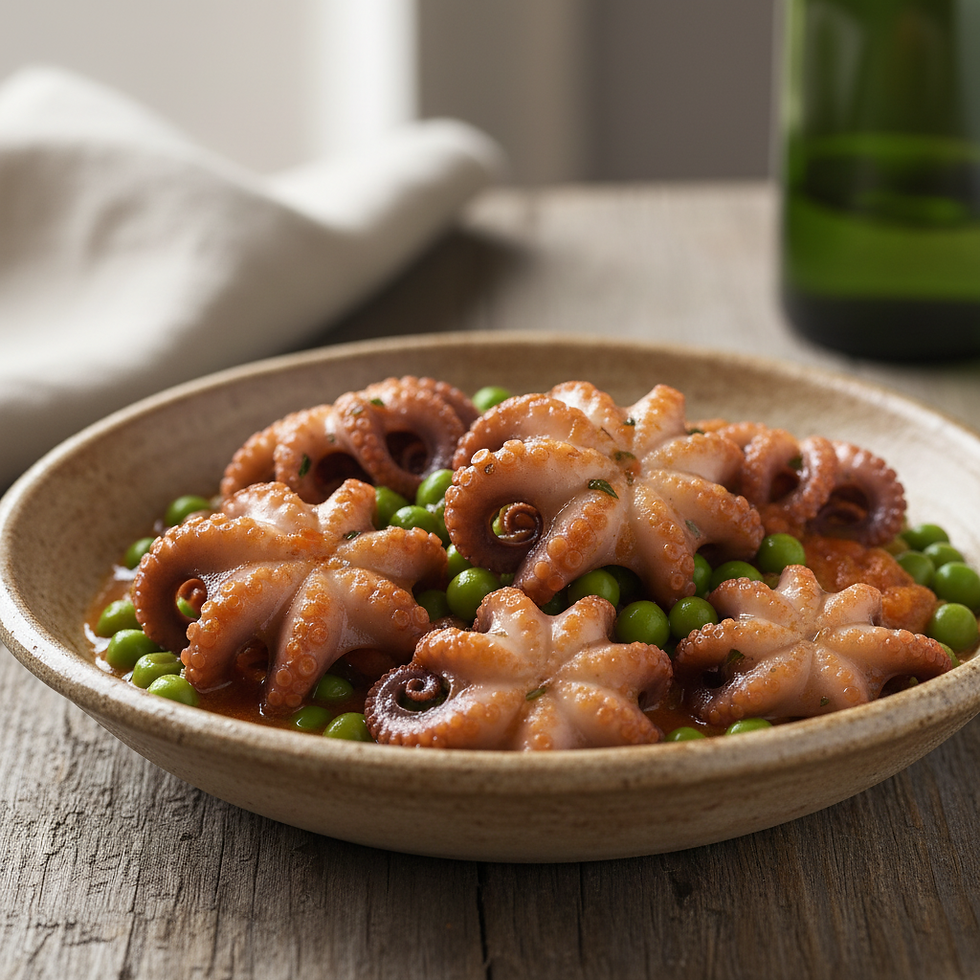
Moscardini con i piselli looks like nothing on paper and depends entirely on knowing what you are cooking. Small whole octopus go into a wide pan with olive oil, garlic and a dried chilli, take white wine and very little tomato, and finish with peas. What binds the dish is the liquid the moscardini release in the first ten minutes, reduced with the tomato into a short glossy fondo that stains the peas and soaks the bread.
Before anything else: a moscardino is not a small polpo. It is a different animal, Eledone moschata or Eledone cirrhosa, and the difference is written on the arms. A moscardino has ONE row of suckers per arm; the common octopus, Octopus vulgaris, has two. That is how fishmongers tell them apart, and it matters in the pan: moscardini carry far less of the connective tissue that forces a polpo into an hour of slow cooking. They are tender in twenty to twenty five minutes and ruined at forty.
Everything below follows from that. The cooking is short, the lid stays on only for a window, the peas go in near the end, and the parsley never sees heat.
Yield: 4 servings. Prep: 25 minutes. Cook: 35 minutes. Total: about 1 hour. Difficulty: intermediate. Course: secondo di mare. Region: coastal Italy, in Sardinia, Liguria and along the Adriatic.
The Story
Moscardini have always belonged to the small boats. They are an inshore catch, taken close to the coast over sand and mud in pots, traps and by trawlers on the shallow grounds. Small, sold by the kilo in mixed sizes and impossible to present as a luxury, they never reached the prices polpo commands, so they went straight into the family kitchen and the pots of the fishermen themselves. That is the whole economic reason the dish exists.
Two species reach the slab. Eledone cirrhosa, the white moscardino, is paler and common in the northern Mediterranean. Eledone moschata, the musky moscardino, gave the animal its name: freshly caught it smells distinctly of musk, and moschata comes from exactly that. Cooks in Sardinia and on the Adriatic say the musky one has more flavour, though garlic, wine and tomato narrow the gap. Neither should ever smell of ammonia.
The season marries the two halves of the plate. Moscardini are best from the cold months into early spring, when the flesh is firm, and fresh peas arrive in Italy from March, first in Sicily and Campania, then north. For a few weeks they overlap. In Sardinia this is a Sunday family dish, cooked in terracotta and carried to the table in the pan with bread; Liguria uses barely a spoonful of tomato, the Adriatic adds chilli. All three agree the peas go in last.
Ingredients
For the moscardini
Whole moscardini, baby octopus, cleaned, 2 lb (900 g)
Extra virgin olive oil, 1/4 cup (60 ml)
Garlic cloves, thinly sliced, 3
Dried red chilli, small, 1, or crushed red pepper flakes, 1/4 tsp (0.5 g)
Dry white wine, 1/2 cup (120 ml)
Fine sea salt, 1/2 tsp (3 g), added late
Freshly ground black pepper, to taste
For the tomato base
Ripe plum tomatoes, peeled and crushed by hand, 1 cup (240 g), or good canned San Marzano
Tomato paste, 1 tsp (6 g)
Light fish stock or water, 1/2 cup (120 ml), only if the pan runs dry
For the peas
Fresh shelled peas, 1 1/2 cups (225 g), or frozen peas, thawed
Spring onion, white part only, finely sliced, 1
For finishing
Flat leaf parsley, coarsely chopped, 3 tbsp (10 g)
Extra virgin olive oil, 1 tbsp (15 ml)
Country bread, thick slices, 4, for the scarpetta
Preparation
Step 1
Clean the moscardini. Under cold running water, turn each head inside out and pull the viscera and ink sac away in one piece. Find the small hard beak at the centre of the underside where the arms meet and push it out with your thumb from the other side; it pops free. Take out the two eyes with a knife point, rinse the head cavity and rub the arms, since grit hides in the suckers.
Step 2
Leave the skin on and do not blanch them. Polpo recipes often rub off the outer membrane after a preliminary boil. On a moscardino that membrane is thinner, holds the colour, and dissolves into the fondo, giving it body and its brick red tint. A blanch would also pour away the marine liquid the recipe is built on. Leave them whole if small, halve the largest.
Step 3
Dry them, then start the oil, garlic and chilli. Pat the moscardini dry and press lightly inside the heads, which trap water; wet ones steam instead of colouring. Put the oil, sliced garlic and chilli in a wide heavy pan over medium low heat and take the garlic to pale gold, no darker, since burnt garlic turns bitter and nothing here hides it. Width matters more than depth: piled up they stew rather than sear.
Step 4
Sear them. Raise the heat to medium high and add them all at once. They hiss, tighten and curl immediately. Leave them a minute, then stir and let them go over lively heat for three or four minutes in total, until the surfaces are flecked with colour. Do not season yet: salt now pulls water out early and drops the pan to a simmer before any browning happens.
Step 5
Deglaze with the white wine. Pour it around the edge of the pan, let it bubble hard and scrape the base to lift everything stuck to it. Keep the heat high a minute or two so the raw alcohol burns off. Its acidity cuts the sweetness of the moscardini, which are markedly sweeter than polpo.
Step 6
Cover the pan and let them release their water. Lower the heat and leave it eight to ten minutes. They will give up enough liquid to half cover themselves, greyish first and then glossy. Keep all of it and add no stock: this water is the foundation of the dish and carries more marine flavour than any stock you could buy. Resist lifting the lid more than once.
Step 7
Add the tomato, then judge the tenderness. Cook the tomato paste against the base for thirty seconds to lose its tinny edge, then add the crushed tomatoes. One cup for two pounds looks like too little, and that is the point: tomato gives acidity, colour and a light binding, not a sauce. Cover and simmer fifteen to twenty minutes, adding stock only if the pan dries. Total time from the sear is twenty to twenty five minutes. A paring knife should enter the thickest part of an arm with almost no resistance while the arms still hold their curl.
Step 8
Add the peas late, season, reduce, finish off the heat. Scatter in the spring onion and peas, uncover, and give them five to seven minutes fresh or three to four frozen. They cook in the fondo rather than water, which is why they come out savoury and not merely sweet. Season now, tasting first, because moscardini are naturally saline. Let the liquid tighten two or three minutes until it coats rather than swims, then off the heat stir through the raw parsley and the last spoon of oil.
Plating
This is a pan dish and it is honest about it. In Sardinia and on the Adriatic it goes to the table in the cooking vessel. For plated service use warm shallow bowls, never flat plates and never cold ones: the fondo needs somewhere to gather and turns to paste on a cold surface.
Spoon the moscardini into the centre with their arms visible and facing upward rather than buried, since the curl of the arms is the only visual signature the dish has. Scatter the peas around and between them so both colours read at once, add two spoonfuls of fondo and a thread of raw oil. Nothing else: no basil, no microherbs, no lemon wedge. Bread is part of the recipe, so toast thick slices dry, one per person, and let the scarpetta finish the plate.
Professional Technique
The technical centre of this recipe is one piece of knowledge: moscardini and polpo are not interchangeable, and the timing that governs one destroys the other. Octopus vulgaris has thick arms and a high proportion of collagen in the muscle sheaths, and needs sixty to ninety minutes of moist heat to convert it to gelatin. Eledone is small, thin walled and far lower in connective tissue, so the polpo timetable takes it straight through tenderness into disintegration, with no collagen left to hold the structure. Twenty to twenty five minutes is the window, and the single row of suckers confirms on the slab that this is a moscardino and not a juvenile polpo.
The second technique is using the octopus water as the only cooking liquid. Covering the pan after the wine traps the moisture the moscardini expel as their proteins contract, and concentrating it later gives the dish its depth. Fish stock here dilutes a better ingredient with a lesser one. The tomato is measured against that liquid rather than the reverse, which is why one cup is enough.
The third is the timing of the peas. Added at the start they turn olive drab and floury, because chlorophyll degrades under prolonged heat and acid while their sugars convert to starch. Added in the last five to seven minutes, into a concentrated tomato and octopus fondo, they act like a sponge, taking salinity and acidity from outside while keeping their own sweetness. That exchange, sweet pea against saline fondo, is the flavour the dish is built on, and it only happens if they arrive late.
Texture and Moisture Control
Three textures have to arrive together: moscardini tender but holding their shape, peas firm enough to pop, and a fondo with enough body to coat. Each fails differently. The moscardini fail past about thirty minutes, when the arms shed their suckers and the flesh goes woolly. The peas fail by going in too early. The fondo fails by staying covered too long, so it never reduces and the dish arrives as a thin soup.
Moisture moves one way and then reverses, and managing that turn is most of the skill. Under the lid the level rises; uncovered it must come back down. Off too early and you lose the water before gaining the tenderness, on to the end and you concentrate nothing. Uncover when the moscardini are almost tender, which is when the peas go in.
Drag a spoon across the base: the fondo should close slowly behind it rather than rushing back, and a moscardino lifted out should come up glossy. Serve hot but not scalding, around 150°F (65°C) in the bowl, since olive oil and marine sweetness read muted above that.
Professional Mise en Place
Almost nothing here can be done far in advance, because the cooking is short and the peas and parsley belong at the very end. What you organise is the sequence, so nothing is being chopped while the pan runs.
Equipment and tools
Wide heavy pan or low casserole with a lid, holding the moscardini in one layer
Colander and a tray lined with kitchen paper
Paring knife for cleaning and testing tenderness
Wooden spoon and a ladle for the fondo
Prepared ahead
Moscardini cleaned and refrigerated on a rack, up to 1 day ahead
Peas shelled and kept covered, on the day
Parsley chopped at the last minute, since it darkens quickly
Bread sliced, to toast dry while the fondo reduces
Service setup
Bowls warming, never flat plates and never cold ones
Wine measured out beside the pan, since the deglaze happens fast
Peas and spring onion in one dish, parsley and oil in another
Lid off for the last five minutes, pan watched, since the fondo tightens fast
Chef Tips
Count the rows of suckers before you buy. One row per arm means moscardino and a twenty five minute cooking; two rows mean polpo and an hour and a half. Small polpo are occasionally sold as moscardini, and on this recipe they come out tough however carefully you work.
Buy them all the same size. Moscardini are sold mixed, and a pan holding pieces that range from tiny to twice that cannot finish evenly. Ask for the most uniform in the tray, or halve the biggest.
Salt late. The moscardini carry seawater salinity and the fondo concentrates by roughly half while uncovered, so anything salted at the start is seasoned twice. Taste once the peas are in. Frozen moscardini are often lightly salted in processing.
If they are still firm at twenty five minutes, add a splash of water, cover and give them five minutes more. Do not raise the heat: larger Eledone cirrhosa simply need longer, and a hard boil tightens the flesh permanently.
Common Mistakes
Cooking them like polpo. Moscardini have far less connective tissue than Octopus vulgaris and are done in twenty to twenty five minutes. Given an hour they do not soften further, they shred and lose their suckers.
Adding the peas at the start. Twenty five minutes in acidic liquid turns them grey and floury. They need five to seven minutes at the end, in the finished fondo.
Drowning it in tomato. One cup for two pounds is correct. A full can turns the pan into generic tomato stew and buries the sweetness of the animal.
Adding stock before they release their own water. The liquid that comes out under the lid is more flavourful than any fish stock, and stock dilutes the one irreplaceable ingredient here. Use it only if the pan genuinely dries.
Serving the fondo unreduced. A watery pan means no coating on the moscardini, pale peas and bread that collapses instead of wiping. The last two or three minutes uncovered are not optional.
Wine Pairing
Vermentino di Gallura DOCG: The first choice and a genuinely saline wine, grown on decomposed granite in sight of the sea. That salinity meets the brine of the moscardini head on instead of being swamped by it, and the firm citrus acidity handles the tomato without turning sharp. The bitter almond finish suits the peas.
Riviera Ligure di Ponente Pigato DOC: The Ligurian answer, from the coast that cooks this with the least tomato. Pigato has more body and a rounder texture than most coastal whites, with a herbal, faintly resinous note that picks up the parsley and the oil. Enough weight for a reduced fondo, enough acidity to stay clean.
Verdicchio dei Castelli di Jesi Classico Riserva DOCG: The Adriatic bottle for the Adriatic version. A Riserva has the structure and savoury depth to stand up to a concentrated tomato and octopus fondo where a lighter white disappears. Its acidity cuts the oil and its bitter finish echoes the chilli rather than fighting it.
Cerasuolo d'Abruzzo DOC: A serious rosato from Montepulciano, deeply coloured and not a pale afterthought. Choose it when the tomato is forward: red fruit that meets tomato on its own terms, plus a touch of tannic grip no white can offer. Serve it properly cold, around 50°F (10°C).
Bardolino DOC: The lightest red on the list and the only kind of red that works with something this delicate. Low in tannin, high in cherry fruit and acidity, it behaves almost like a rosato served cool at 55°F (13°C), flattering the tomato and the peas without clashing with the seafood.
Avoid sweet wines entirely. The peas and the moscardini already carry their own sweetness, and residual sugar pushes the plate toward the cloying while leaving the tomato acidity exposed.
Storage & Reheating
Moscardini in umido keeps well and is arguably better on the second day, which is unusual for seafood and is down to the fondo. Put the whole dish, moscardini, peas and liquid together, into an airtight container, cool it quickly, and refrigerate up to 2 days. Never store the moscardini out of their fondo: away from the liquid they dry and tighten within hours.
Reheat covered over low heat with a tablespoon of water to replace what the cold took, just to steaming and no further. A second boil is the fastest way to turn tender moscardini rubbery and the peas grey. Add fresh parsley afterward, since the parsley from the day before will have gone dull.
Freezing suits the moscardini and the fondo but not the peas, which go mushy on thawing. Stop before the peas and freeze the rest in its liquid up to 2 months, then thaw overnight, reheat gently and add the peas then. Raw cleaned moscardini freeze very well up to 3 months, and thawed ones beat fresh that have sat on ice for three days.
Nutrition
Per serving, based on 4 servings, excluding the bread:
Calories: 340 kcal
Total Fat: 17 g
Saturated Fat: 2.5 g
Trans Fat: 0 g
Unsaturated Fat: 14 g
Cholesterol: 120 mg
Sodium: 590 mg
Total Carbohydrates: 18 g
Fiber: 5 g
Total Sugars: 7 g
Added Sugars: 0 g
Protein: 30 g
Lactose: 0 g
Principal micronutrients: iron, copper, selenium, vitamin B12, vitamin C from the peas, vitamin K, potassium, phosphorus, niacin
These figures are estimates. Sodium varies most, since moscardini carry their own seawater salinity. Each slice of bread adds roughly 120 kcal and 24 g of carbohydrate.


Comments