Vegan Neapolitan Carnival Chiacchiere with Chocolate Cream, Reinterpreted | Chiacchiere Napoletane Vegane Rivisitate

Chiacchiere are the great fried sweet of the Italian Carnival: thin ribbons of dough, rolled almost transparent, fried until they puff into crisp golden blisters and buried under powdered sugar. In Naples they come to the table with a bowl of thick, dark chocolate cream for dipping, and this recipe follows that Neapolitan custom. Many family recipes enrich the dough with lard and egg yolks, and the cream is made with whole milk; this recipe is a vegan reinterpretation of the classic. The dough is made only with flour, sugar, extra virgin olive oil, dry white wine and a spoonful of grappa, so it is fully plant-based, and the chocolate cream is built on dark chocolate, cocoa, cinnamon and candied citron, with a plant milk in place of cow's milk. The result is light, fragile and deeply aromatic, the taste of Carnival in a Neapolitan pastry shop.
Yield: 8 servings, about 60 chiacchiere. Prep: 50 minutes. Cook: 30 minutes. Rest: 1 hour for the dough, 2 hours for the cream. Course: dessert. Region: Campania.
The Story
Every region of Italy fries a version of this sweet in the weeks before Lent, and each gives it a different name. They are chiacchiere in Lombardy, Campania and much of the South, frappe in Rome, cenci in Tuscany, bugie in Piedmont and Liguria, crostoli in Veneto and Friuli, sfrappole in Emilia. Chiacchiere means chatter or gossip, a fitting name for a light, crackling sweet eaten in company during the noisiest days of the year. Many food writers link the whole family to the frictilia of ancient Rome, sweet fritters fried in fat, and the idea of frying dough before the lean days of Lent has deep roots across the Mediterranean.
Carnival is the season of excess before the fast. For centuries Lent meant forty days without meat and animal fats, and the days before Ash Wednesday were the time to use up rich ingredients and to fry. In Naples, Carnival had a particular splendor, with processions, masks and a table full of sweets. The chiacchiere sold in the pastry shops of the city are rolled very thin, fried and dusted with sugar, and they are almost always eaten with sanguinaccio, a dense chocolate cream flavored with cinnamon, vanilla and candied fruit.
That pairing is the heart of this recipe, and its history must be told honestly. The original sanguinaccio of Naples was not only chocolate: it was made in winter, when families slaughtered the pig, and it included fresh pig's blood, mixed with chocolate, sugar and spices. Italian health rules later ended the sale of pig's blood for this use, so the sanguinaccio sold in Neapolitan shops today is a chocolate cream without it that keeps the old name. This recipe follows the modern Neapolitan cream and makes it fully plant-based, with oat milk and cornstarch in place of cow's milk.
The chiacchiere themselves vary from house to house. Many traditional family recipes enrich the dough with lard and beaten eggs, and many use a liqueur or a white wine. This version uses extra virgin olive oil for tenderness and dry white wine with a little grappa for the blistering: the alcohol evaporates violently in the hot oil and lifts the dough into bubbles. It keeps the traditional thinness, the bubbles and the snow of sugar, and adds precision where it counts: the hydration of the dough, the rolling thickness, the oil temperature and the set of the cream.
Ingredients
Use a soft wheat flour, Italian type 00 or all-purpose, with moderate protein: a very strong flour makes the dough elastic and hard to roll thin. A dry, crisp white wine such as a Falanghina from Campania gives the right acidity. Choose a dark chocolate with at least 60 percent cocoa solids and check the label, because some dark chocolates contain milk solids. Use a neutral, high smoke point oil for frying, peanut or high oleic sunflower, and a good, mild extra virgin olive oil in the dough. Candied citron, cedro candito, is the classic candied fruit of Neapolitan pastry.
For the chiacchiere
Italian 00 flour or all-purpose flour, 2 1/4 cups (280 g), plus extra for rolling
Granulated cane sugar, 2 tbsp (25 g)
Fine sea salt, 1/4 tsp (1.5 g)
Baking powder, 1/4 tsp (1 g)
Finely grated lemon zest, 1 tsp (2 g)
Extra virgin olive oil, mild, 3 tbsp (40 ml)
Dry white wine, cold, 1/2 cup (120 ml)
Grappa, 1 tbsp (15 ml)
For the chocolate cream
Oat milk, unsweetened, 2 cups (480 ml)
Granulated cane sugar, 1/2 cup (100 g)
Unsweetened cocoa powder, 1/3 cup (30 g)
Cornstarch, 3 tbsp (24 g)
Ground cinnamon, 1/2 tsp (1 g)
Fine sea salt, 1 pinch
Dark chocolate, 60 to 70 percent, finely chopped, 5 oz (140 g)
Pure vanilla extract, 1 tsp (5 ml)
Candied citron, finely diced, 2 tbsp (25 g)
For frying and finishing
Peanut or high oleic sunflower oil, for frying, 2 quarts (1.9 l)
Powdered sugar, for dusting, 1/2 cup (60 g)
Preparation
Step 1

Make the dough. In a large bowl mix the flour, sugar, salt, baking powder and lemon zest. Make a well, pour in the olive oil, the cold wine and the grappa, and stir with a fork, drawing the flour in from the sides. When the dough comes together, turn it onto the board and knead for 8 to 10 minutes, until it is smooth, firm and elastic, with no dry spots. It should feel firmer than bread dough and slightly tacky. The long kneading develops just enough gluten to let the dough stretch paper-thin without tearing; the oil coats part of the flour and keeps the fried pastry tender rather than tough.
Step 2

Rest the dough. Wrap it tightly in plastic and leave it at room temperature for 1 hour. During the rest the gluten relaxes and the flour absorbs the liquid evenly, so the dough stops shrinking back each time you roll it. A dough rolled without rest fights the pin, tears and comes out thicker than it should, and a thick chiacchiera fries hard and greasy instead of light and blistered.
Step 3

Make the chocolate cream. In a saucepan, whisk the sugar, cocoa, cornstarch, cinnamon and salt together, then whisk in the oat milk a little at a time to avoid lumps. Bring to a simmer over medium heat, whisking constantly and scraping the bottom, and cook for 2 minutes after the first bubbles, until thick and glossy. Off the heat, add the chopped chocolate and the vanilla and whisk until smooth. Fold in the candied citron. Pour the cream into a bowl, press plastic wrap directly onto the surface and chill for at least 2 hours. The cornstarch must boil briefly to reach its full thickening power and to lose its raw, chalky taste.
Step 4

Roll the dough paper-thin. Cut the dough into four pieces and keep the others wrapped. Flatten one piece and pass it through a pasta machine, starting at the widest setting, folding it in three and passing it again twice, then roll it through progressively thinner settings down to the second thinnest, about 1/32 inch (1 mm). By hand, roll it on a lightly floured board until you can see the grain of the wood through it. Thinness is the secret of chiacchiere: only a very thin sheet blisters into large bubbles and fries crisp in seconds.
Step 5

Cut the shapes. With a fluted pastry wheel, cut the sheet into rectangles about 2 1/2 by 5 inches (6 by 12 cm). Make one or two short cuts lengthwise in the center of each rectangle; you can pass one end through the slit to form a loose knot, as many Neapolitan families do. Lay the pieces on a lightly floured tray in a single layer, without overlapping, and cover them with a clean towel so they do not dry out. Roll and cut the remaining dough the same way.
Step 6

Fry the chiacchiere. Heat the oil in a wide, heavy pot to 340 to 350°F (170 to 175°C), checked with a thermometer. Fry three or four pieces at a time for 30 to 45 seconds in total, turning them once with a slotted spoon or chopsticks, until they are pale gold and covered with blisters. Lift them out, hold them over the pot for a few seconds to drain and lay them on a tray lined with paper towels. The alcohol and water in the dough turn to steam instantly in the hot oil, and that expanding steam raises the bubbles. Below 330°F (165°C) the dough absorbs oil before it can puff; above 360°F (180°C) it browns before it crisps and tastes bitter.
Step 7

Cool, dust and serve. Let the chiacchiere cool completely on the paper, standing them on their edges after a minute so the steam escapes from both sides. Just before serving, stack them loosely on a platter and dust them generously with powdered sugar through a fine sieve. Whisk the chilled chocolate cream for a few seconds to make it smooth and glossy again, then spoon it into a serving bowl. Sugar dusted on warm chiacchiere melts and turns sticky, so wait until they are fully cool.
Plating
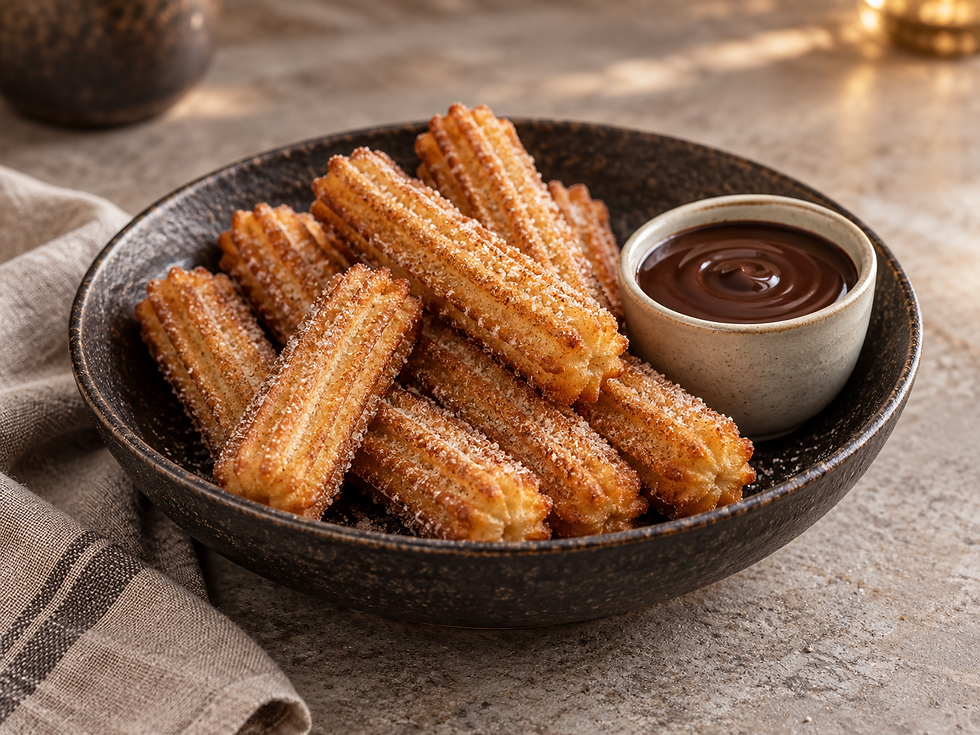
Serve the chiacchiere at room temperature and the chocolate cream cool, at about 50°F (10°C), taken out of the refrigerator 15 minutes before service so it softens to a thick, spoonable texture. In Naples they are piled high on a large tray or a round platter, almost like a small mountain, under a white layer of sugar, with the bowl of cream in the center or at the side. That generous, informal look is part of the dish.
For individual plates, arrange four or five chiacchiere overlapping in a loose fan, dust them with sugar, and place a small bowl or a generous quenelle of chocolate cream beside them, finished with a few cubes of candied citron and a pinch of cinnamon. The guest breaks a chiacchiera, dips it in the cream and eats it in one bite: the pastry should crackle and shatter, and the cream should cling to it without dripping.
Professional Technique
The key number is the hydration. For 280 g of flour, the 120 ml of wine, 15 ml of grappa and 40 ml of oil give a firm dough of about 60 percent liquid by weight. That is drier than a bread dough and close to a fresh pasta dough, firm enough to roll paper-thin without sticking and still elastic enough not to tear. A softer dough sticks to the rollers and absorbs more oil in the fryer; a drier one cracks at the edges.
The hidden variable is the oil temperature during frying, not only before. Each batch of cold dough lowers the temperature of the oil, and if you add too many pieces at once it can drop by 30°F (15°C) in seconds. Fry only a few pieces at a time, keep the thermometer in the pot and let the oil recover to 340°F (170°C) between batches. Steady temperature gives chiacchiere that are pale gold, dry to the touch and never greasy.
The doneness test is visual and audible. A finished chiacchiera is evenly pale gold, with no white patches of raw dough and no brown spots, its surface covered in bubbles. Once cool, it should snap cleanly and shatter like glass in the mouth. If it bends instead of snapping, it was rolled too thick or fried at too low a temperature.
Thinness and Blistering Control
The bubbles of a chiacchiera come from steam. The dough holds water and alcohol, and when it meets oil at 340°F (170°C) these liquids vaporize at once. In a thin sheet the steam has very little dough to push against, so it lifts the surface into large, separate blisters. In a thick sheet the steam escapes slowly, the dough cooks into a dense, cracker-like layer, and the pastry absorbs oil instead of puffing. The thinner the sheet, the lighter and crisper the result.
Alcohol helps in two ways. It evaporates at a lower temperature than water, around 173°F (78°C), so it starts creating steam earlier and more violently. It also limits the development of gluten during kneading and leaves the dough more tender. Wine contributes its acidity, which further tenderizes the gluten and gives the pastry a clean, dry taste. Neither the alcohol nor its flavor remains noticeable after frying.
The rest and the rolling protect the bubbles. A relaxed dough rolls evenly, without thicker zones that stay pale and soft. Keep the cut pieces covered, because a dry surface forms a skin that blocks the steam and gives flat, hard chiacchiere. Fry them within an hour of cutting.
Professional Mise en Place
Make the chocolate cream first, even the day before, so it has time to set. Organize the frying station so the work moves in one direction: raw pieces, oil, draining tray, cooling rack.
Equipment and tools
Pasta machine or long rolling pin, fluted pastry wheel
Wide, heavy pot at least 4 inches (10 cm) deep, frying thermometer
Slotted spoon or long chopsticks, trays lined with paper towels, wire rack
Saucepan, whisk, fine sieve for the powdered sugar, plastic wrap
Prepared ahead
Chocolate cream cooked and chilled, up to 2 days ahead
Dough kneaded and rested for 1 hour, wrapped
Shapes rolled and cut, kept under a towel, fried within 1 hour
Candied citron diced, cinnamon and powdered sugar ready
Service setup
Cooled chiacchiere on a large platter or tray
Powdered sugar in a fine sieve, dusted at the last moment
Chocolate cream whisked smooth in a bowl, at about 50°F (10°C)
Extra candied citron and cinnamon for the cream
Chef Tips
Roll the dough with a pasta machine whenever possible. Folding the sheet in three and passing it twice through the widest setting aligns the gluten and makes a smoother, more even sheet, which fries with more regular bubbles. Dust the rollers and the sheet lightly with flour, never heavily, because excess flour burns in the oil and darkens it.
Test the oil with a scrap before the first batch. A small piece of dough should sink briefly, rise within 2 seconds surrounded by lively bubbles and turn pale gold in about 20 seconds. If it browns faster, lower the heat; if it stays pale and still, wait for the oil to come back up to temperature.
For a lighter, baked version, lay the cut pieces on a lined tray, brush them very lightly with olive oil and bake at 375°F (190°C) for 6 to 8 minutes, until pale gold. They do not blister like the fried ones and are closer to a crisp cracker, but they are still good with the cream.
Strain and reuse the frying oil once. Let it cool, filter it through a paper towel into a clean jar and keep it in a dark place for another batch of sweets within a week. Never top up old oil with fresh: the old oil speeds the breakdown of the new.
Common Mistakes
Rolling the dough too thick. Thick dough fries into hard, flat crackers that soak up oil. Roll it until you can almost see through it, about 1/32 inch (1 mm).
Skipping the rest. An unrested dough shrinks back and tears, and you cannot roll it thin enough. Let it rest for 1 hour, wrapped.
Frying in oil that is too cool. Below 330°F (165°C) the dough absorbs oil before it puffs, and the chiacchiere turn greasy. Use a thermometer and keep the oil at 340 to 350°F (170 to 175°C).
Crowding the pot. Too many pieces drop the oil temperature and stick together. Fry three or four at a time and let the oil recover.
Frying them dark. Brown chiacchiere taste bitter and lose their delicate flavor. Lift them out as soon as they are pale gold.
Dusting them warm. Powdered sugar melts on warm pastry and turns into a sticky glaze. Dust only when they are completely cool.
Boiling the cream too briefly. Cornstarch that has not boiled stays thin and tastes floury. Cook the cream for 2 minutes after the first bubbles, whisking.
Wine Pairing
Greco di Bianco DOC: A rare sweet wine from the Ionian coast of southern Calabria, made from dried Greco Bianco grapes, with notes of candied citrus, apricot, dried fig and herbs. Its sweetness and its citrus peel mirror the candied citron and the sugar on the pastry. Serve it at about 50 to 54°F (10 to 12°C).
Brachetto d'Acqui DOCG: A sweet, gently sparkling red from Piedmont with aromas of rose and strawberry. Its red fruit is one of the classic matches for chocolate, and its bubbles refresh the palate after the fried pastry. Serve it at about 46 to 50°F (8 to 10°C).
Recioto della Valpolicella DOCG: A sweet red from dried Corvina grapes in the hills north of Verona, with cherry jam, cocoa and spice. Its depth stands up to the dark chocolate and the cinnamon of the cream. Serve it at about 57 to 61°F (14 to 16°C).
Marsala DOC: Choose a Superiore Dolce from western Sicily, with dried fruit, caramel and walnut notes. Its warmth and oxidative character suit the cocoa and the crisp, fried dough. Serve it at about 54 to 57°F (12 to 14°C).
Storage & Reheating
Chiacchiere keep for up to 5 days at room temperature in an airtight tin or a paper bag sealed inside a plastic box, without the sugar, which you add just before serving. Humidity is their enemy: in the open air they absorb moisture and lose their snap within hours. Freezer: not recommended, because they soften as they thaw. The chocolate cream keeps for 3 days in the refrigerator with plastic wrap pressed on its surface; it does not freeze well, since cornstarch creams turn spongy and weep when thawed.
Chiacchiere are never reheated in oil. If they have softened, spread them on a tray and crisp them in the oven at 300°F (150°C) for 3 to 4 minutes, then let them cool completely before dusting with sugar. The chocolate cream is served cool; if it has become too firm, whisk it briefly, or warm it gently over a pan of hot water for 1 minute, stirring, until it is smooth and spoonable again.
Nutrition
Per serving, based on 8 servings (about 7 chiacchiere and 1/3 cup of cream):
Calories: 410 kcal
Total Fat: 19 g
Saturated Fat: 5 g
Trans Fat: 0 g
Unsaturated Fat: 13 g
Cholesterol: 0 mg
Sodium: 110 mg
Total Carbohydrates: 52 g
Fiber: 4 g
Total Sugars: 26 g
Added Sugars: 24 g
Protein: 6 g
Principal micronutrients: iron, magnesium, copper, manganese, vitamin E, calcium from fortified oat milk
These figures are estimates, calculated on the quantities listed and rounded to the nearest whole number, assuming that each chiacchiera absorbs a small amount of frying oil. They vary with the thickness of the dough, the frying temperature and the amount of sugar and cream served.


Comments