
Italian Bluefin Tuna Tartare Crostino with Avocado, Lime and Caviar | Crostino con Tartare di Tonno Rosso, Avocado, Lime e Caviale
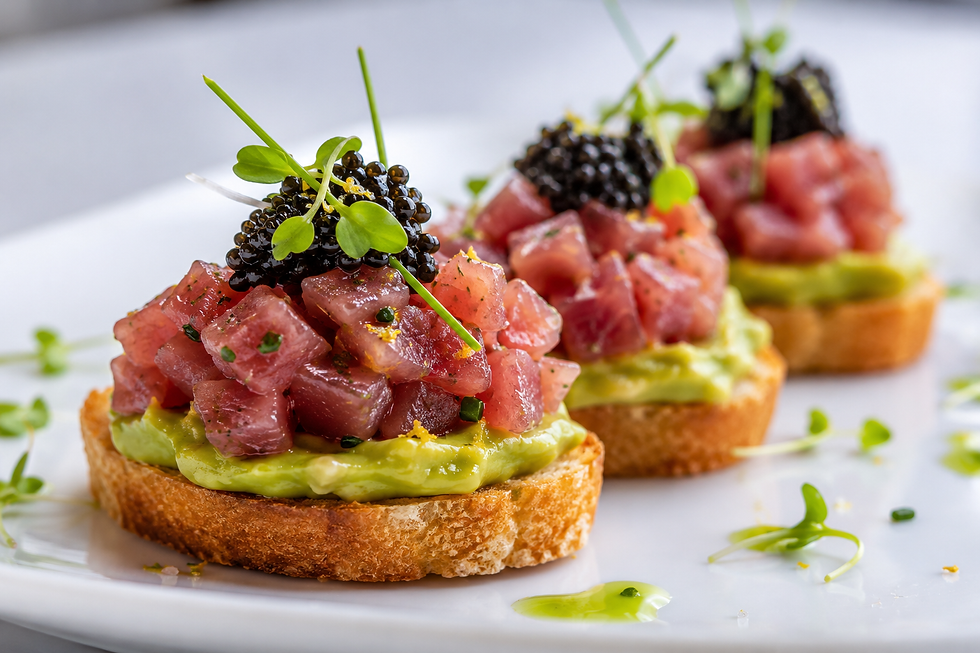
Italian Bluefin Tuna Tartare Crostino is a two bite appetizer built on contrast: cold hand cut tuna, creamy avocado, a sting of lime, a pearl of caviar and a slice of bread dried until it snaps. Nothing is cooked, so every ingredient must be excellent and every step exact.
Yield: 16 crostini, 4 servings. Prep: 40 minutes. Bake: 12 minutes. Total: 55 minutes. Difficulty: intermediate. Course: antipasto.
The Story
Bluefin tuna is one of the oldest foods of the Italian sea. For centuries the tonnare, the fixed net traps of western Sicily and southern Sardinia, caught the fish as it migrated into the Mediterranean each spring. At Favignana, Bonagia and Carloforte the harvest was a ritual known as the mattanza, and the catch was salted, packed in oil or braised for hours, because nobody could eat fresh what arrived by the thousand in a single week. Raw tuna was never part of that tradition, and for most of Italian history the idea would have seemed wasteful.
The crostino belongs to a different Italy, the Tuscan and central Italian one, where stale bread is sliced, dried or toasted and used as a platform for whatever the kitchen has: chicken liver, tomato, beans, lard. It is the humblest form of the antipasto, and its function has never changed. It is a small edible plate that delivers a strong flavour in one bite, beside a glass of wine, before the meal begins.
This dish is a modern meeting of the two. Serving bluefin raw reached Italian restaurants only in recent decades, through the crudo movement of the Adriatic coast and the influence of Japanese and Peruvian kitchens, and it fitted naturally: the fish was already prized, the sea was already close, and the Italian instinct is to add very little. Avocado and lime are newcomers too, though not foreign to the south. Avocado groves now grow in eastern Sicily and Calabria, and Sicilian citrus is a fixture of every coastal kitchen, so the green cream and the sharp zest are less exotic than they first appear.
The caviar has an Italian address as well. Sturgeon farms in Lombardy, around Brescia, have produced caviar for decades and supply many of the best restaurants in Europe. A spoonful on tuna is a luxury, but a quiet one: it adds salt, clean brininess and a small pop, not a flavour that competes. It is there to accent the tuna, never to hide it, and the dish works only when it is treated that way.
One practical note belongs here. Atlantic bluefin is managed under strict international quotas, so buy from a fishmonger who can name the source, or choose responsibly farmed fish, and ask for a loin sold for raw service. That small conversation at the counter is the first step of the recipe, and the most important one.
Ingredients
Serves 4, makes 16 crostini. Measures are US first, metric in parentheses.
For the crostini
Baguette, 16 slices, 1/4 inch (6 mm) thick, 10 1/2 oz (300 g)
Extra virgin olive oil, 2 tbsp (30 ml)
Fine sea salt, 1/4 tsp (1.5 g)
For the tartare
Sashimi grade bluefin tuna loin, blast frozen and thawed, center cut, 1 lb (450 g)
Limes, 2 whole, about 5 oz (140 g), for juice and zest
Extra virgin olive oil, 2 tbsp (30 ml)
Fine sea salt, 3/4 tsp (4 g)
White pepper, freshly ground, 1/4 tsp (0.5 g)
Chives, finely sliced, 1 tbsp (4 g)
For the avocado
Ripe but firm avocados, 2 whole, about 14 oz (400 g)
Flaky sea salt, 1/4 tsp (1.5 g)
For finishing
Caviar, Italian farmed sturgeon, lightly salted, 2 oz (55 g)
Extra virgin olive oil, a few drops, for gloss
Lime wedges, from 1 lime, for serving, optional
Ice water with a squeeze of lime, 2 cups (475 ml), as a holding bath for the cut avocado during long service
Buying notes: choose a firm baguette with a thin crust and an open crumb, one day old if possible. Ask for tuna that is deep red and glossy, with no rainbow sheen or fishy smell. Choose avocados that give slightly under the thumb. Use fresh limes, never bottled juice, and keep the caviar refrigerated until service.
Preparation
Step 1: Dry the bread into crostini
Heat the oven to 375°F (190°C). Arrange the baguette slices on a tray, brush both sides lightly with the 2 tablespoons of oil and season with the fine salt. Bake for 10 to 12 minutes, turning once at the halfway mark, until pale gold and dry all the way through. Cool them completely on a rack, because warm bread will soften the topping the moment it touches it. The slices should ring slightly when tapped, and any that are still soft in the centre go back for 2 more minutes.
Step 2: Trim and chill the tuna
Remove any silver skin and the dark bloodline from the loin with a thin flexible knife, then square the piece into a neat block. Wrap it and set it in the freezer for 20 to 25 minutes, until the outside is stiff and the centre is still yielding. Put a mixing bowl in the refrigerator beside it, and chill a second, larger bowl of ice to sit the first one on. A cold board helps too, so keep it in the refrigerator until the moment you start cutting.
Step 3: Cut the tuna into cubes
Work on a cold board with a very sharp knife. Slice the block into planks 1/4 inch (6 mm) thick, stack them, cut into strips and then across into cubes of the same size. Slide the cubes straight into the chilled bowl set over ice, cover with film pressed on the surface and return it to the refrigerator until the last few minutes. Work quickly, and if the cubes start to feel soft under the blade, put everything back in the freezer for 5 minutes before continuing.
Step 4: Prepare the citrus and the chives
Zest one lime finely and set the zest aside for the finish. Juice both limes and strain out the pulp. Slice the chives thinly. Measure the oil, salt and pepper into a small bowl beside the tuna so that nothing needs to be measured later. Taste the juice, because limes vary in sharpness, and keep a little extra in reserve for correcting the seasoning at the end.
Step 5: Cut the avocado at the last moment
Halve and stone the avocados, then score the flesh into 1/4 inch (6 mm) cubes and scoop them out with a spoon. Toss gently with 2 teaspoons of the lime juice and the flaky salt. If service will be slow, hold the cubes in the ice water bath and drain them well on a cloth before using. Handle the cubes as little as possible, since they are soft, and use a spoon rather than a knife to lift them from the skin so the edges stay clean.
Step 6: Dress the tartare and build the crostini
Fold the oil, the remaining lime juice, the fine salt, the pepper and half the chives into the tuna with a spoon, using three or four gentle turns, and move immediately to assembly. Place a spoonful of avocado on each crostino, press lightly, top with a mound of tartare, add a small spoonful of caviar, a little zest and the remaining chives. Finish with a few drops of oil and carry the plates to the table straight away, with the bread still crisp and the topping cold.
Plating
Serve on chilled plates or a cold slate, kept in the refrigerator for 20 minutes beforehand. Set four crostini in a straight line on each plate, evenly spaced, with a little breathing room so that nothing touches or slides. The bread should sit at room temperature and the topping cold.
Use a mother of pearl or plastic spoon for the caviar, because metal can taint the taste, and place it gently without pressing so the pearls stay whole. Add the lime zest last, from a fine grater held over the plate. A few chive rings are enough. A lime wedge on the side is optional, but keep the plate quiet: the fish and the caviar are the point. Wipe any drips from the rim before serving.
Professional Technique
This recipe is decided by one gesture: the tuna is cut by knife and it stays cold until the last moment. Chopped with a mezzaluna or pulsed in a food processor, the muscle fibres are crushed rather than severed, the flesh weeps liquid and the tartare turns into a pale paste that clings to the tongue. A knife with a razor edge slices between the fibres and leaves every cube distinct, glossy and firm.
Temperature is what makes a clean cut possible. Take the loin from the freezer when it reads 28 to 32°F (minus 2 to 0°C) at the surface, stiff to the touch and almost icy, with the centre just giving under a finger. At that point the fat is solid, so the blade does not smear it, and the flesh holds its shape under the edge. Cut into cubes of 1/4 inch (6 mm), regular on every side, and use a long pull of the blade instead of sawing.
Keep the cubes in a bowl over ice from the first cut until service, and do not let the fish rise above 41°F (5°C) at any point.
Salt and acid come last, and only then. Both denature the surface proteins, which is the same reaction that cooks ceviche. Within a few minutes the red flesh dulls to a brownish grey, turns opaque at the edges and loses moisture to the bowl. So dress the tartare no more than 2 minutes before it is plated, and put the finished crostini in front of the guest within 3 minutes of dressing, so that the whole window from seasoning to the first bite stays under 5 minutes.
Texture and Moisture Control
Three textures have to arrive together: a bread that snaps, a filling that is cool and silky, and caviar that bursts. Each is lost to moisture in a different way. The crostino is the most fragile. Drying it in the oven until it is glass hard and brushing it with oil seals the crumb, and the avocado layer acts as a fat barrier between the bread and the tartare. Even so, the bread has about 10 minutes before it starts to soften, so assemble in small batches close to service.
Avocado gives the creaminess, and it depends on ripeness. Choose fruit that yields slightly under the thumb but is not soft, because a fully ripe avocado turns to mash when it is cubed and the cubes lose their shape. Lime juice and cold water both slow browning, but they cannot reverse it, so cut late.
Caviar is protected by handling. Pearls burst if they are stirred into the tartare or pressed onto the topping, and they release salty liquid that spreads across the plate. Place them as the last layer, unpressed. Keep the whole dish cool but not frozen: very cold fish numbs the flavour, and a little warmth from the plate would blur it.
Professional Mise en Place
Almost everything can be done ahead, but the fish and the avocado are cut close to service. For a party of eight or more, build the crostini in rounds of 16 rather than all at once.
Equipment and tools
A very sharp slicing knife and a cold board that does not move
Two mixing bowls, one set over ice
Fine grater, small spoons, a mother of pearl spoon for the caviar, and a cloth for drying the avocado
Chilled plates or a cold slate
Prepared ahead
Crostini baked and cooled, kept in an airtight tin for up to 2 days
Limes juiced, strained and zested, chives sliced
Tuna trimmed and wrapped, chilled until needed, and never cut more than 30 minutes before service
Plates cleaned and placed in the refrigerator to chill for 20 minutes
Service setup
Tuna cut and held in the refrigerator over ice
Avocado cut last and dressed, or held in the ice bath
Caviar tin open on ice beside the pass
Crostini laid out in rows on a tray, ready to build in about 90 seconds
A clean damp cloth at hand for wiping the edges of the plates
Chef Tips
Buy the tuna from the middle of the loin, the most uniform and least sinewy part, and ask that it be sold for raw service. A lean cut from the tail works, but the belly is where the fat and flavour are, so a small piece of it will lift the whole dish. Ask the fishmonger for the trim and use it in a pasta or a sandwich the next day.
Taste the caviar before seasoning. If it is lightly salted, reduce the salt in the tartare by a quarter and skip the flaky salt on the avocado. If it is very mild, keep both.
Slice the baguette on a slight diagonal and keep the thickness uniform, so all the crostini brown at the same speed. Use day old bread if you can, because it slices cleanly and dries more evenly.
Build one crostino first and taste it. Adjust the lime and salt for the next fifteen, not the other way around.
Common Mistakes
Assembling too early. A crostino that sits topped for more than 10 minutes loses its crunch. Bake the bread ahead but build within minutes of serving.
Using avocado that is too ripe or too green. Overripe fruit mashes and browns, while hard fruit is bitter and rubbery. Choose one that gives slightly under a gentle press.
Overpowering the fish with lime. Two limes are enough for the whole dish. The juice should sharpen the tuna, and the zest should perfume it, not make it taste sour.
Salting on top of salty caviar. Caviar carries its own salt. If the tartare is already seasoned generously, the finished bite tastes harsh.
Serving on warm plates or in a warm room. Warmth softens the avocado and dulls the fish. Chill the plates and serve quickly.
Cutting the baguette too thick. A slice thicker than 1/4 inch (6 mm) turns into a hard, chewy base that shatters into crumbs and overwhelms the topping. Slice thin, and keep every slice the same.
Wine Pairing
Franciacorta DOCG: The classic partner for caviar. Its fine bubbles and brisk acidity lift the richness of avocado and olive oil, while the yeasty, bready notes of long lees ageing echo the toasted crostino. Dry Brut or Satèn is the right choice, served well chilled in a tall glass.
Trento DOC: A mountain metodo classico with high acidity and a mineral, lemony edge that runs alongside the lime. The bubbles cleanse the palate of oil and salt between bites, and its crisp finish keeps the raw tuna tasting clean. It is the more mineral, sharper alternative to Franciacorta.
Etna Bianco DOC: Grown on volcanic soil, this Carricante based white has a saline, smoky mineral note that mirrors the sea. Its sharp acidity meets the lime, and its firm structure supports the richness of bluefin without covering it. It is the choice for guests who prefer a still wine.
Vermentino di Gallura DOCG: A dry Sardinian white with salty, coastal freshness and citrus peel aromas that echo the zest. It has enough body to stand up to the avocado, and a touch of bitter almond on the finish keeps the pairing lively. Serve it cold but not icy, so the aromas open.
Cerasuolo d'Abruzzo DOC: A dry rosé with cherry fruit, soft tannin and lively acidity, made for tuna, the most meaty of raw fish. It gives a little more weight than the whites, and it is served cold to match the plate. It is the best choice if you want a pink wine on the table.
Storage & Reheating
This is a dish to be eaten at once. Never store assembled crostini, and never keep dressed tartare: discard any that is left after 30 minutes. Undressed cubes of tuna, covered with film pressed on the surface and set over ice in the refrigerator, keep for up to 4 hours, and the whole loin is best kept intact until needed.
The crostini keep for 3 days in an airtight tin at room temperature. To refresh them, warm at 325°F (165°C) for 3 minutes and cool completely before topping. An opened tin of caviar keeps for 2 days in the coldest part of the refrigerator, tightly covered. Do not freeze the tartare or the avocado. Fresh tuna can be frozen whole in the loin at 0°F (minus 18°C) for up to a month and thawed overnight in the refrigerator, but it should never be reheated.
Nutrition
Per serving, based on 4 servings of 4 crostini:
Calories: 620 kcal
Total Fat: 33 g
Saturated Fat: 6 g
Trans Fat: 0 g
Unsaturated Fat: 27 g
Cholesterol: 95 mg
Sodium: 1050 mg
Total Carbohydrates: 46 g
Fiber: 6 g
Total Sugars: 2 g
Added Sugars: 0 g
Protein: 36 g
Lactose: 0 g
Principal micronutrients: omega 3 fatty acids, vitamin B12, selenium, niacin, potassium, vitamin K
These figures are estimates.


Comments