
Italian Piedmontese Fontina Fondue with Alba White Truffle | Fonduta Piemontese al Tartufo Bianco d'Alba

Fonduta is not a fondue in the Swiss sense. There is no wine in it, no kirsch, no starch and no burner at the table. It is a bound cheese cream: Fontina soaked in cold milk for hours, melted very gently, then finished with egg yolks and butter until it turns glossy and just pourable. Piedmont eats it from a warm bowl with a spoon, and in autumn under a snowstorm of white truffle from Alba.
The dish turns on one number. Fonduta must never pass 150°F (65°C). Below that the yolks thicken the cheese into a glossy emulsion. Above it the yolk proteins set into grains and the Fontina throws its butterfat out as a yellow pool that no stirring will take back. That is why the pot never touches direct heat and the yolks go in off the stove.
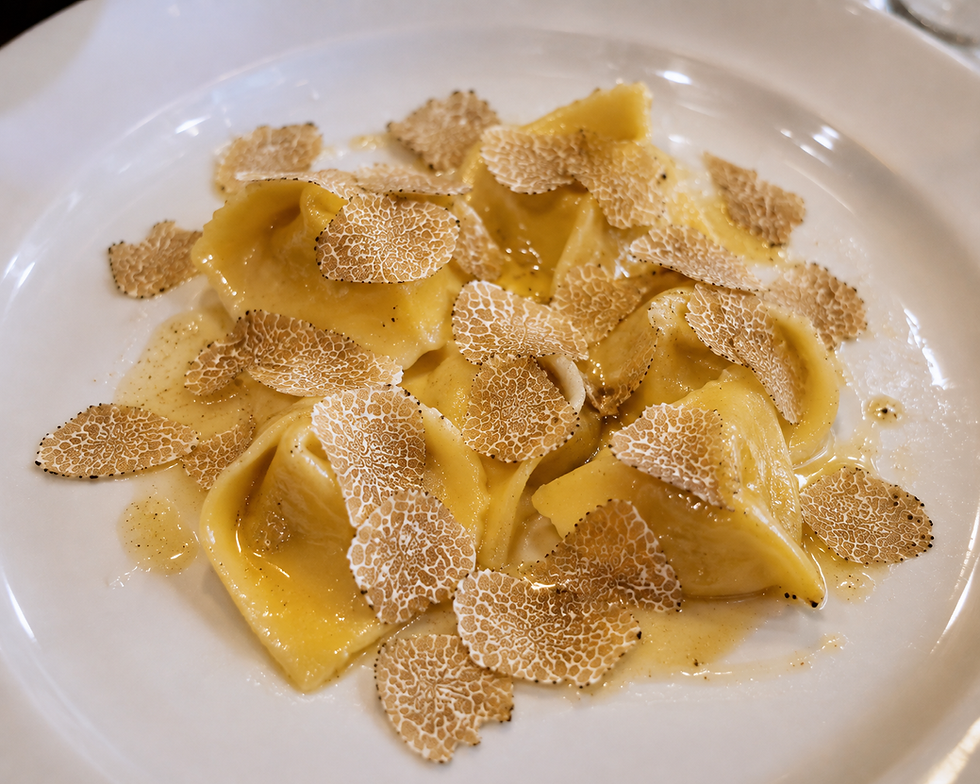
The truffle rule is just as absolute. Tuber magnatum Pico, the white truffle of Alba, is never cooked and never warmed in butter. It is shaved raw over the hot fonduta in front of the guest, and the steam rising off the bowl is all the heat it is allowed.
Yield: 4 servings as a first course. Prep: 20 minutes plus 4 hours soaking. Cook: 45 minutes. Difficulty: intermediate, with no margin on temperature. Region: Piedmont, the Langhe around Alba, with Fontina from the Valle d'Aosta.
The Story
Alba sits where the Tanaro divides the Langhe from the Roero, and its wealth has long come out of the ground in two forms: Nebbiolo and truffles. The white truffle grows wild in marl soils under oak, poplar, willow and hazel, and it cannot be farmed. Every gram of it is found. The men who find it are the trifolau, and they work at night with a trained dog, because damp cold air carries the scent better and because a productive tree is a family secret. The season runs from late September to the end of January.
The Fiera Internazionale del Tartufo Bianco d'Alba began in 1929 and turned a local trade into a global one. Its architect was Giacomo Morra, a hotelier who understood that a truffle sent to a famous name was worth more in publicity than in cash, and who posted the season's largest specimen to heads of state and film stars for years.
Fonduta comes from the far side of the mountains. Fontina is a Valle d'Aosta cheese, made from the raw milk of Valdostana cows and aged at least three months, and its semi cooked paste melts more evenly than any other alpine cheese. Piedmont and the Valle d'Aosta spent centuries inside the same Savoy state, and the dish travelled down into the Canavese, where cooks made it with their own Toma when Fontina was scarce. Giovanni Vialardi, cook to the Savoy court, recorded the cheese and yolk preparation in the middle of the nineteenth century, and Piedmont has claimed it ever since. What fixed the truffle pairing was geography: hot Fontina cream is the most efficient vehicle for that aroma ever devised, because fat carries the volatile compounds and warmth releases them.
Ingredients
For the fonduta
Fontina Valle d'Aosta DOP, rind removed, cut into 1/2 inch cubes, 1 lb 2 oz (500 g)
Whole milk, cold, 1 1/2 cups (360 ml), plus 2 tbsp (30 ml) in reserve
Egg yolks, large, 4
Unsalted butter, cold, 2 tbsp (30 g)
Freshly ground white pepper, to taste
Fine sea salt, only if needed
For the truffle
Fresh Alba white truffle, Tuber magnatum Pico, 3/4 to 1 oz (20 to 30 g)
For the polenta crostini
Water, 3 cups (720 ml)
Coarse stone ground yellow cornmeal, 3/4 cup (120 g)
Fine sea salt, 3/4 tsp (5 g)
Unsalted butter, 1 tbsp (15 g)
Clarified butter for the griddle, 1 tbsp (15 ml)
For finishing
Unsalted butter, 1 tsp (5 g) per bowl
Freshly ground white pepper, to taste
Preparation
Soaking the Fontina in milk
Take the rind off the Fontina generously, since the outer millimetres will not melt with the rest, then cut it into 1/2 inch cubes. Cover them with the cold milk and refrigerate for at least 4 hours and up to 12. The milk softens the paste, so the cheese needs far less heat later to turn fluid.
Cooking the polenta
Bring the water to a boil with the salt, then rain in the cornmeal in a thin stream while whisking so no lumps form. Drop the heat until the surface only blips and cook for 40 minutes, stirring and scraping the bottom. Beat in the butter at the end.
Setting and griddling the crostini
Pour the hot polenta onto an oiled tray about 3/4 inch deep, leave it to firm for an hour, then cut it into rectangles. Griddle them in clarified butter over medium high heat for 2 to 3 minutes a side, until a thin crust forms and the inside stays soft. Hold them warm in a low oven, uncovered.
Cleaning and holding the white truffle
Brush the truffle dry, working the soil out of the folds, and use a barely damp cloth only where the brush cannot reach. Never wash it under a tap: white truffle absorbs water in seconds and the aroma goes with the drying. Keep it in absorbent paper in a sealed jar in the refrigerator, and take it out 15 minutes before service.
Melting the cheese over the bain marie
Drain the cubes, keeping the soaking milk. Set a stainless bowl over water at a bare simmer, base clear of the water, add the cheese with half the reserved milk and stir slowly and continuously. The cheese passes through an alarming ropy stage where it clings in strings; keep stirring and it will pass. Keep the mass between 130°F and 145°F (55°C and 63°C). This takes 12 to 15 minutes and cannot be hurried.
Binding the fonduta with the yolks
Lift the bowl off the water when the cheese is smooth. Beat the yolks with the last of the milk, then pour them into the cheese in a thin stream while stirring hard. Return it over the water, off the boil now, and stir for 2 to 3 minutes until it thickens and turns glossy. Check the probe constantly: 150°F (65°C) is the ceiling. Take it off, beat in the cold butter in two pieces and grind in white pepper. Taste before salting, because Fontina brings enough of its own.
Holding at service temperature
Hold the fonduta over warm water at around 140°F (60°C) under a round of buttered paper, stirring every couple of minutes. It thickens as it stands, so loosen it with a teaspoon of warm milk at a time until it flows thickly off the spoon. It holds like this for about 20 minutes and no longer. Keep the serving bowls in a low oven until you fill them.
Grating the truffle at the table
Spoon the fonduta into the warm bowls, set two griddled crostini alongside each, and carry them out immediately. Shave the truffle over each bowl at the table with a slicer set fine, holding the blade close to the surface so the slices land flat and the steam catches them. Divide it evenly and hold nothing back. Everything else in this recipe exists to deliver the next thirty seconds.
Plating
Use small deep bowls of about 6 fluid ounces, warmed until you notice the heat through a cloth, and fill them barely more than half. A shallow plate loses temperature in a minute and cools the fonduta below the point where it releases the truffle aroma, which is the reason the dish exists.
Keep the composition severe: fonduta, two warm polenta crostini leaning on the rim, a grind of white pepper and nothing else. White truffle is defeated by any other aromatic on the plate, so a garnish here is a way of spending money badly. A soft poached egg belongs in the Valdostana version, not in this one. Shave at the table in one generous pass, cutting the slices close to translucent so they cover the surface. Serve spoons, not forks, and tell the guests to eat straight away.
Professional Technique
Fonduta is an emulsion problem dressed up as a cheese dish. Fontina is roughly a third fat and a quarter protein, and when it melts the casein network releases that fat. Milk supplies water and casein micelles that hold the fat in suspension, and the yolks supply lecithin that stabilises it permanently. The technique consists of assembling those three things in an order that never lets the yolk proteins reach their setting point, which begins around 65°C and is not negotiable.
That is why the cheese melts first, alone with the milk, and the yolks arrive last and off the heat. Yolks dropped into cheese still over a flame set at the point of contact, while pouring them in a thin stream into a mass already off the water tempers them over several seconds. The cold soak does the other half of the work: cheese that has taken up milk melts fluid at a lower temperature than a dry cube, and that difference is the safety margin the yolks need. The cold butter at the end runs the same logic backwards, dropping the temperature a few degrees at the most fragile moment while its fat tightens the gloss.
Texture and Moisture Control
The finished fonduta should fall from a spoon in a thick continuous ribbon and coat the back of it evenly, closer to a warm custard than to melted cheese. Three faults account for almost everything that goes wrong. Grainy texture means the yolks set. A yellow film of oil on the surface means the emulsion broke. Both are temperature failures. A fonduta that is stiff and sullen is simply short of liquid, and it is the only one you can fix, by working in warm milk a teaspoon at a time.
Moisture has to be managed in both directions. Too little and the cheese needs more heat to move, which pushes you toward the ceiling. Too much and it is a thin soup that runs off the polenta. Judge it by flow, not volume, and keep it covered and stirred, because a skin forms within a minute. Temperature at the table is part of texture: serve at about 140°F (60°C), warm enough to volatilise the truffle and keep the cream fluid, cool enough that the fat stays bound. The crostini need dry heat instead, held uncovered so the crust stays crisp against the cheese.
Professional Mise en Place
Everything but the binding and the shaving is done in advance, and the service window is about 20 minutes wide.
Equipment and tools
Stainless bowl that sits clear of the water, or a double boiler
Instant read probe thermometer, checked against boiling water
Silicone spatula and a small whisk for the yolks
Heavy griddle pan and a tray for setting the polenta
Truffle slicer with an adjustable blade, set fine
Prepared ahead
Fontina cubed and soaking in cold milk, 4 to 12 hours ahead
Polenta cooked, poured, set and cut, up to 1 day ahead
Truffle brushed clean and wrapped in fresh paper in a sealed jar
Yolks separated and covered, at room temperature 30 minutes before service
Serving bowls warming in a low oven
Service setup
Water in the bain marie held at a bare simmer, never a rolling boil
Probe, warm milk and cold butter within arm's reach
Crostini griddled and holding uncovered in a low oven
Truffle and slicer on a tray ready for the table
Guests seated before the yolks go in, not after
Chef Tips
Buy Fontina Valle d'Aosta DOP and refuse anything sold as fontal or generic fontina, pressed industrial cheeses with none of the melting behaviour. If real Fontina is unavailable, a young Toma Piemontese DOP is the historically correct Piedmontese substitute and behaves similarly, though it is milder and wants more pepper.
Weigh the truffle in front of you and smell it before you pay. A good Alba specimen is firm under the thumb with no soft patches and aromatic from an arm's length away. Buy it for the day you use it: one bought on Monday for Saturday is a poor investment however carefully it is stored.
Calibrate the thermometer first: boiling water reads 212°F (100°C) at sea level, and a probe 5 degrees optimistic will break the fonduta while showing a safe number.
If the fonduta stiffens while you hold it, add warm milk rather than cold and never put it back over direct heat. Milk at body temperature disappears into the emulsion, while cold milk tightens the fat and makes the surface look curdled when nothing has broken.
Common Mistakes
Letting the fonduta pass 150°F (65°C). The only mistake that cannot be corrected. The yolks coagulate into visible grains and the Fontina releases its butterfat as a yellow layer. Keep the pot off direct heat and the probe in your hand.
Skipping the cold milk soak. Dry cubes need more heat before they flow, and that extra heat is what kills the yolks. Four hours in cold milk is the minimum and overnight is better.
Adding the yolks over the heat. Even over a bain marie the cheese is close enough to the limit that yolks dropped straight in set on contact. Take the bowl off the water, pour them in a thin stream into a mass you are stirring, then return it.
Cooking the truffle. Shaving truffle into the pot or warming it in butter destroys most of the aroma you paid for. It goes on at the table, raw, and never before. For the same reason, never wash it under a tap.
Treating it as a Swiss fondue. Wine, kirsch, cornflour and a caquelon over a burner belong to another dish. Wine and acid curdle a cheese and yolk emulsion, and a naked flame guarantees you pass the ceiling within a minute.
Wine Pairing
Roero Arneis DOCG: The white grown on the opposite bank of the Tanaro from Alba, and the most natural bottle here. Arneis has the body to stand beside a cheese cream without being flattened, and its stone fruit and white flower aromatics sit alongside white truffle rather than competing. Its acidity is moderate rather than piercing: a sharper white would cut across the fat and leave the truffle stranded.
Alta Langa DOCG: Piedmont's own metodo classico, from Pinot Noir and Chardonnay grown in the high hills behind Alba. The fine persistent bead scours the fat off the palate between spoonfuls, while the bread and hazelnut notes from long lees ageing run into the truffle. A bottle with four or five years on the lees has the weight this dish needs; a lean young sparkler does not.
Nebbiolo d'Alba DOC: The red the Langhe would actually open, and the argument is aroma rather than structure. Nebbiolo with five or six years behind it smells of dried rose, tar and undergrowth, uncannily close to the register of white truffle. Its tannin is fine and its acidity high, so it cuts the cheese cleanly. Serve at about 61°F (16°C) and choose an older bottle, since fresh tannin clashes with melted cheese.
Barbaresco DOCG: The most serious pairing here, and it needs real bottle age. A mature Barbaresco, a decade or more from harvest, has resolved its tannin into silk and developed the leather, dried flower and forest floor aromas that meet white truffle on its own ground. Lighter and quicker to open than Barolo, it suits a dish this delicate; anything still tannic tastes metallic against the Fontina.
Storage & Reheating
Fonduta is a service dish and does not keep well, so scale it to the table. Leftovers refrigerate in an airtight container for up to 2 days and set into a firm block. Never freeze it: the emulsion separates irreversibly on thawing. Never store it with truffle shavings in it either, because they turn dull within hours.
To reheat, cut the cold fonduta into pieces and warm it over water held below a simmer, stirring constantly and adding warm milk a teaspoon at a time until it flows again. Stay under 140°F (60°C) on the second pass, since the yolks have been cooked once and have less tolerance left. A microwave breaks it in seconds. If it does break, stop rather than persist: cold set fonduta is excellent spread on toast and browned under a grill. Set polenta holds refrigerated for 3 days wrapped tightly and freezes for 2 months. Fresh white truffle keeps 5 to 7 days at best, in paper changed daily in a sealed jar; never store it in rice, which draws out its aroma.
Nutrition
Per serving, based on 4 servings with two polenta crostini each:
Calories: 690 kcal
Total Fat: 49 g
Saturated Fat: 29 g
Trans Fat: 1 g
Unsaturated Fat: 17 g
Cholesterol: 310 mg
Sodium: 980 mg
Total Carbohydrates: 28 g
Fiber: 2 g
Total Sugars: 5 g
Added Sugars: 0 g
Protein: 34 g
Lactose: 2.5 g
Principal micronutrients: calcium, phosphorus, vitamin A, vitamin B12, riboflavin, zinc, selenium
These figures are estimates. Fontina carries most of the fat, the saturated fat and the sodium. The truffle contributes aroma and almost nothing measurable.




Comments