Italian Neapolitan Pasta and Potatoes | Pasta e Patate alla Napoletana
Updated: Oct 24

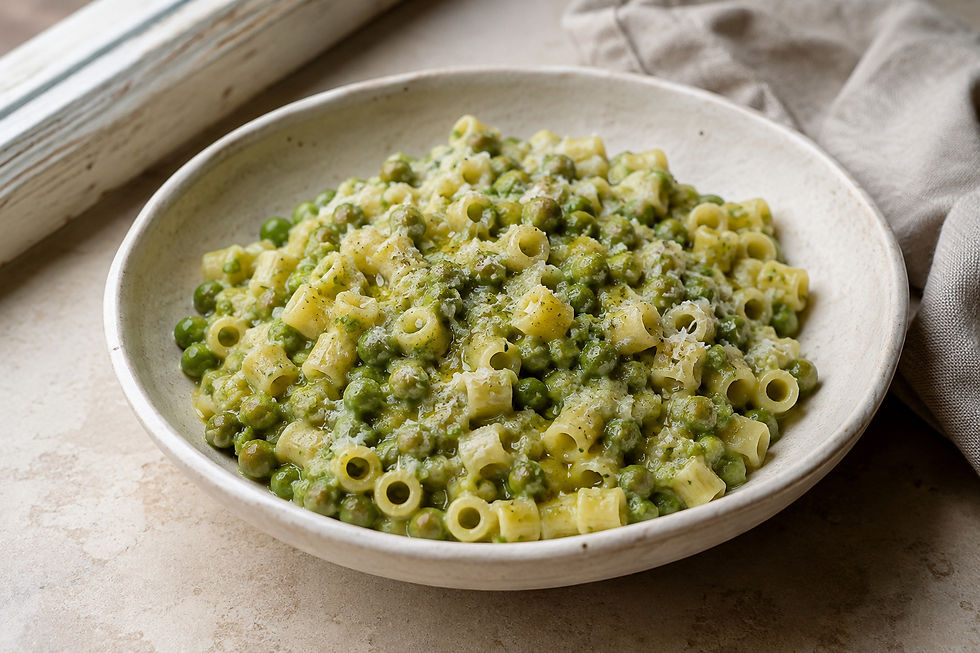
This is pasta e patate in its plain form, the pot cooked on an ordinary Neapolitan weekday, with no cheese folded through at the end. The richness comes from three cheap things: potato starch, pasta starch and a scraped rind of Parmigiano that sits in the pan for the whole cooking time. What reaches the bowl is dense, savoury and quietly sweet.
Naples judges it by one word, azzeccata, meaning stuck together. Pasta and potato have to bind into a single thick mass that holds the track of the spoon. That happens only if the pasta cooks in the pan with the potatoes rather than being boiled and drained, because the starch that builds the sauce is exactly what a colander throws away. No cream, no flour, no blender.
The plain version is the harder one. With no melted cheese to carry it, the pot has nowhere to hide, and the size of the potato dice, the amount of liquid and the last two minutes of reduction all show up in the bowl.
Yield: 4 servings. Prep: 20 minutes. Cook: 45 minutes. Rest: 3 minutes. Total: about 1 hour 10 minutes. Difficulty: easy to intermediate. Course: primo piatto. Region: Campania, Naples and the Vesuvian countryside.
The Story
The potato arrived in the Kingdom of Naples as an official project rather than a popular taste. Bourbon administrators pushed it through the late eighteenth century as insurance against grain failure, and the city refused it for decades as food for animals. The famines that followed settled the argument, and by the middle of the nineteenth century the pot in which a potato met a handful of pasta was the cheapest hot meal in the vicoli.
What the city adopted, the countryside supplied. The volcanic soil on the slopes of Vesuvio, dark and full of potash, grows a potato with dense flesh and a distinct sweetness, and the fields around Terzigno, Ottaviano and Sant'Anastasia sent it into Naples by cart. That tuber breaks down into a sauce that is creamy without being watery, which is exactly what this dish needs.
The plain pot also carries the argument Naples has never settled: bianca or rossa. One side leaves the tomato out and serves an almost ivory dish. The other adds a spoonful, never more, for colour and a trace of acidity. This recipe follows the second, and it keeps the habit of a kitchen that wasted nothing, the cheese rind dropped in at the start and fished out at the end.
Ingredients
For the base
Extra virgin olive oil, 3 tbsp (45 ml)
Yellow onion, finely diced, 1 small, about 5 oz (150 g)
Carrot, finely diced, 1 small, about 4 oz (120 g)
Celery stalk, finely diced, 1, about 2 oz (60 g)
Garlic clove, peeled and lightly crushed, 1
Crushed tomatoes, 1/2 cup (120 ml)
Parmigiano Reggiano rind, scraped clean, 1 piece about 2 oz (60 g)
Fresh basil stalk or a small rosemary sprig, 1
For the pasta and potatoes
Waxy yellow potatoes, peeled, 2 lb (900 g)
Pasta mista, or two or three short shapes broken together, 10 oz (280 g)
Hot light vegetable stock or water, about 4 cups (950 ml), added in stages
Fine sea salt, about 1 1/2 tsp (9 g), added late
Freshly ground black pepper, to taste
For finishing
Parmigiano Reggiano, finely grated, 1 1/2 oz (45 g)
Extra virgin olive oil, raw, 1 tbsp (15 ml) per plate
Freshly ground black pepper, to taste
Preparation
Step 1

Warm the olive oil in a wide heavy pan over medium low heat and add the onion, carrot and celery with a pinch of salt. Cook for 10 to 12 minutes, stirring, until they are soft and sweet and none has taken colour. Add the crushed garlic for the last two minutes. Browning here pushes the pot toward a ragu and buries the potato.
Step 2

Cut the peeled potatoes into two sizes and add them to the softened vegetables: two thirds into 1/2 inch (12 mm) cubes, the rest into 1/4 inch (6 mm) dice. Turn them through the flavoured oil for 3 or 4 minutes until every face is coated and the edges look glassy. Never rinse cut potato, since the surface starch is the thickener.
Step 3

Stir in the crushed tomatoes and cook for 2 minutes, until the colour darkens from bright red to brick and the raw smell goes. Half a cup is the whole quantity. This is a dish in the rosso tradition, which in Naples means a trace of tomato for depth, not a tomato sauce with potatoes in it.
Step 4

Drop in the scraped Parmigiano rind and the basil stalk. The rind needs the full cooking time to soften and give up its salt and its glutamates, so it goes in now. Push it under the vegetables so it sits on the base of the pan, and remember it is there, because it has to come out at the end.
Step 5

Pour in enough hot stock to come just above the potatoes, about 2 1/2 cups (600 ml), and bring the pan to a gentle simmer rather than a hard boil. The liquid must go in hot: cold stock stalls the pan and lets the potato surface firm up again. Hold back all the salt, because the rind is salty and the pan will reduce by a third.
Step 6

Simmer uncovered for about 15 minutes, until the small dice have dissolved and the large cubes give under a spoon but keep their corners. The liquid should have turned from clear to cloudy and slightly thick. That cloudiness is amylose leaving the potato, and it is the first half of the sauce. Scrape the base so nothing catches.
Step 7

Raise the heat until the pan bubbles steadily and add the dry pasta with all of its broken pieces and dust. Stir it in well so nothing clumps. From here you work as you would with a risotto, adding the remaining hot stock one ladle at a time whenever the surface tightens and stops moving under the spoon.
Step 8

Keep stirring and scraping the bottom for the next 10 to 12 minutes, adding hot stock in small amounts. Each addition should be just enough to keep the mixture loose for two or three minutes. The pan should look wetter than you intend to serve it throughout this stage, because it tightens sharply once the heat goes off.
Step 9

Start tasting two minutes before the shortest cooking time on any of the shapes. Stop when the pasta is al dente, the small potato has vanished and a spoon dragged across the base leaves a channel that closes slowly. Season with the salt and plenty of pepper, then remove the rind and the basil and lift the pan off the heat.
Step 10

Let the pan stand for 60 seconds, then beat in the grated Parmigiano with a few firm turns so it melts into the starch instead of sitting on top. Rest for 2 minutes before serving, which lets the starch set to the consistency you want in the bowl. Loosen it with a ladle of hot stock if it goes past that point.
Plating
Serve pasta e patate in a warm shallow bowl rather than on a flat plate. The mixture is thick but it still moves, and a rim keeps it where you put it. Warm the bowls to about 140°F (60°C) and no hotter. A cold bowl sets the starch within seconds, and the plain version shows that fault at once as a stiff crust around the edge.
Spoon it into the middle and leave it slightly domed instead of spreading it out. The surface should read matte and dense, with a few large potato cubes visible and a faint orange tone rather than a red one. If liquid separates around the rim within a minute, the pot was too loose.
Finish each bowl with a tablespoon of raw olive oil poured in a spiral, a heavy grinding of pepper and more grated Parmigiano handed round separately. Nothing else belongs on it: no parsley, no chilli, no fried breadcrumb. Send it the moment it is plated, because this dish is at its best for about four minutes.
Professional Technique
The first technique is the cheese rind used as a cooking ingredient rather than a scrap. A Parmigiano rind is roughly a third protein and carries a high concentration of free glutamate, and 45 minutes in a simmering pan draws that out along with salt and milk fat. In a pot with nothing melted through it at the end, the rind is the only concentrated savoury element, and without it the dish stays flat in a way extra salt cannot correct.
The second is managing two potato starches at once. Amylose, the straight chain fraction, leaches out of cut surfaces during the simmer and thickens the liquid, while amylopectin stays inside the cell and holds the large cubes together. Cutting a third of the potato small drives one fraction into the sauce early; the big cubes, protected by lower surface area and the coating of oil, survive whole. A uniform dice gives one result or the other, never both.
The third is the mantecatura off the heat, which here is an emulsion of starch, hard cheese and oil. Grated Parmigiano beaten into a pot that has dropped below about 180°F (82°C) disperses through the starch gel and stays there. Beaten in over the flame, the casein contracts, the fat separates and the surface turns grainy and oily. The 60 second pause is the whole difference.
Texture and Moisture Control
Everything depends on how much liquid is in the pan when the pasta reaches al dente. Too much and the starch is diluted and the dish becomes a soup with pasta in it. Too little and the pasta finishes chalky because there was nothing left to absorb. The stock quantity in the list is approximate: shape, pan width and heat move it by a cup either way.
Add liquid in small amounts and always hot, and read the surface rather than the clock. The pot tightens four separate times: in the last minute of cooking, during the rest, when the grated cheese goes in, and again on the way to the table. Finish it looser than you want to eat it, by about the width of a ladle.
Residual heat is a real ingredient. A wide pan of starch and potato keeps cooking the pasta for two or three minutes after the flame is out, so the al dente point has to be judged early and stopped with a definite bite left. A stiff pot comes back with hot stock beaten in hard; a loose one goes back over low heat for a minute, stirred constantly.
Professional Mise en Place
This is a one pan dish with a demanding final ten minutes, so everything that can be cut, weighed or heated should be ready before the oil goes in.
Equipment and tools
Wide heavy based pan, about 11 inches (28 cm)
Saucepan holding the stock at a bare simmer, with a ladle in it
Flat edged wooden spoon that can scrape the base of the pan
Sharp knife and board for the two potato cuts
Warm shallow bowls at about 140°F (60°C)
Prepared ahead
Soffritto cooked, cooled and refrigerated, up to 2 days ahead
Cheese rinds scraped and kept in the freezer
Pasta shapes broken and mixed, weighed into one bowl
Stock made and ready to bring back to a simmer
Potatoes cut at the last minute, never held in water
Service setup
Hot stock at a simmer within reach of the pan
Grated Parmigiano weighed into a small bowl
Salt held back and tasted only in the last two minutes
Bowls warming, pepper mill and good oil at the pass
Timer set to the shortest cooking time among the shapes
Chef Tips
If you cannot buy pasta mista, build it. Take three short shapes of different thickness, a tubetto, a small rigatone and a broken spaghetto, and mix them by equal weight. Do not try to match their cooking times: the pieces that overcook are the ones giving up the starch that thickens the pan.
Keep scraped cheese rinds in the freezer, cut to the size of a matchbox. Use a real Parmigiano or Grana rind and never a waxed or coated one, which will not soften and can taint the liquid.
Choose a waxy yellow potato, and one grown on volcanic soil if you can find it. A floury variety collapses completely and turns the pan into mash with pasta buried in it. The collapse here has to be partial and deliberate, created by the knife rather than by the variety.
Cook it in a wide pan rather than a tall pot. Width gives evaporation, and evaporation is what concentrates the starch into a sauce in the last few minutes. A thick base gives the margin of error you need once the mixture has thickened, because at that stage starch on a hot surface catches in seconds.
Common Mistakes
Boiling the pasta separately. Draining pours away the surface starch that binds the pan, and what is left is potato soup with noodles in it. The pasta goes in dry, straight into the potatoes.
Cutting the potato all one size. A uniform dice gives either intact cubes in a thin liquid or a uniform mash, and the dish needs both textures at once. Cut two thirds large and one third small.
Salting at the start. The rind is salty, the grated Parmigiano is saltier, and the liquid reduces by a third while the pasta cooks. Salt in the last two minutes, after tasting, or the pot cannot be corrected.
Adding cold liquid to the pan. Cold stock drops the temperature sharply, stalls the cooking and lets the potato surface set again. Keep the stock at a simmer in a second pan and ladle it across hot every time.
Stirring the grated cheese in over the flame. Casein contracts above roughly 180°F (82°C) and squeezes out its fat, leaving a grainy pot with oil on the surface. Take the pan off the heat, wait a minute, then beat the cheese through.
Letting the pan dry out and catch. Starch on a hot base scorches in seconds and the burnt note runs through the whole pot with no way to remove it. Keep the mixture loose and moving and scrape the bottom as you stir.
Wine Pairing
Falanghina del Sannio DOC: The everyday white of the Campanian hills and the most natural bottle here. Its brisk green apple and citrus acidity lifts a pot that is dense and starchy from the first spoonful, and the faintly bitter almond finish runs alongside the Parmigiano rind rather than fighting it.
Lacryma Christi del Vesuvio DOC: Grown on the same volcanic slopes that supply the potatoes, which makes it the geographically exact match. The white, built on Coda di Volpe and Verdeca, is dry, broad in the middle and finished with a smoky mineral bite that answers the trace of tomato. Serve it at about 50°F (10°C).
Greco di Tufo DOCG: The most structured Campanian white and the choice when the pot is the whole meal. Greco has real weight, a sulphurous mineral streak from the tuff soils of Irpinia and acidity that holds through a long finish, so it stands up to a thick dish that would flatten a lighter white.
Fiano di Avellino DOCG: Softer and more aromatic than the Greco, with hazelnut, pear and a waxy texture that sits alongside the starch instead of cutting through it. That makes it the gentler pairing, suited to a pot cooked with very little tomato. Give it a year or two in bottle, because young Fiano is tight and gives away almost nothing.
Aglianico del Taburno DOCG: The red option, from the slopes of Monte Taburno north of Naples. Its sour cherry fruit and grainy tannin need starch and olive oil to soften them, which is what this bowl provides. Serve it at around 60°F (16°C), opened half an hour ahead.
Storage & Reheating
Cooled quickly in an airtight container, pasta e patate keeps in the refrigerator for 2 days. It sets almost solid once cold, which is normal and reversible, because the starch has retrograded rather than spoiled. Spread it in a shallow container so it cools fast, and do not cover it until it stops steaming.
Reheat it in a wide pan over medium low heat with 2 or 3 tablespoons of hot water or stock per portion, stirring gently until it loosens and moves again. The pasta is already cooked, so warm and reloosen it rather than cook it further. Finish with fresh grated Parmigiano off the heat, pepper and raw oil.
Do not freeze it. Cooked potato turns grainy and weeping on thawing and the pasta breaks apart. The traditional use for a cold pot is better anyway: chill it overnight until solid, cut it into squares, flour them lightly and fry them crisp on both sides, then eat them hot.
Nutrition
Per serving, based on 4 servings:
Calories: 585 kcal
Total Fat: 17 g
Saturated Fat: 4 g
Trans Fat: 0 g
Unsaturated Fat: 13 g
Cholesterol: 12 mg
Sodium: 690 mg
Total Carbohydrates: 91 g
Fiber: 7 g
Total Sugars: 6 g
Added Sugars: 0 g
Protein: 19 g
Lactose: 0.2 g
Principal micronutrients: potassium, vitamin C, vitamin B6, phosphorus, calcium, niacin
These figures are estimates. Sodium depends almost entirely on the rind and on how much Parmigiano goes in at the end.




Comments