
Italian Trieste Goulash | Gulasch Triestino

Gulasch Triestino is beef braised for hours with an almost equal weight of onions, sweet paprika, marjoram and caraway, until the onions dissolve entirely and become the sauce. There is no flour, no roux and no cream. What thickens the pot is the collagen from the beef and the collapsed onion, and the finished dish should be dark, glossy and thick enough to cling to the meat without ever feeling pasty.
Two decisions govern the result. The first is the onion to meat ratio: too little onion and there is no body, too much added liquid and the onions never concentrate. The second is the paprika, which contains sugars that scorch in seconds and turn irreversibly bitter. Get those right, use a collagen rich cut, and keep the braise below a simmer, and the rest is patience.
Yield: 6 servings. Prep: 30 minutes. Cook: 3 hours. Rest: 15 minutes. Total: about 3 hours 45 minutes.
The Story
Trieste spent more than five centuries as a Habsburg city and, from 1719, as the free port of the entire empire. Ships and railways brought Hungarian, Slovenian, Croatian, Austrian, Greek and Jewish merchants to a small strip of coast between the Karst plateau and the Adriatic. Its kitchen is the residue of that traffic, and gulyas travelled down the same routes as the paprika it depends on.
What arrived from the Hungarian plain was a herdsman's soup, thin and full of liquid. What Trieste made of it was something else: a dense braise, closer to the Viennese Saftgulasch, in which the onions are cooked down until they disappear. Local cooks abandoned the soup format and the flour thickening entirely, and the dish moved from the pot on the fire to the tavern plate.
Its home is the buffet, the Triestine institution that is neither bar nor restaurant, where boiled pork, cotto caldo, sausages and gulasch are served all day at a marble counter to dockworkers, office staff and insurance clerks alike. The buffets are where the dish acquired its rules: made in a large pot the day before, better on the second day, ladled over polenta or with bread, never dressed up.
The Italian name keeps the German spelling with a final vowel, gulasch, which tells you exactly which route it took. Marjoram and caraway come from the Austrian side, the generosity with onion from the Hungarian, the olive oil and the readiness to serve it beside polenta from the Italian. It is one of the few Italian dishes whose whole biography is legible in its ingredient list.
Ingredients
For the beef
3 lb (1.36 kg) beef chuck, shoulder or shin, cut into 2 in (5 cm) cubes
Kosher salt and freshly ground black pepper
3 tbsp (45 ml) extra virgin olive oil, or 2 tbsp (30 g) lard plus 1 tbsp (15 ml) olive oil
For the onion and spice base
1 3/4 lb (800 g) yellow onions, thinly sliced
2 tbsp (18 g) sweet Hungarian style paprika
1/2 tsp hot paprika, optional
1 tbsp (18 g) tomato paste
3 garlic cloves, minced
1 tsp dried marjoram
1/2 tsp caraway seeds, lightly crushed
For the braise
1 cup (240 ml) dry red wine
2 cups (475 ml) unsalted beef stock, added gradually
2 bay leaves
Preparation
Step 1
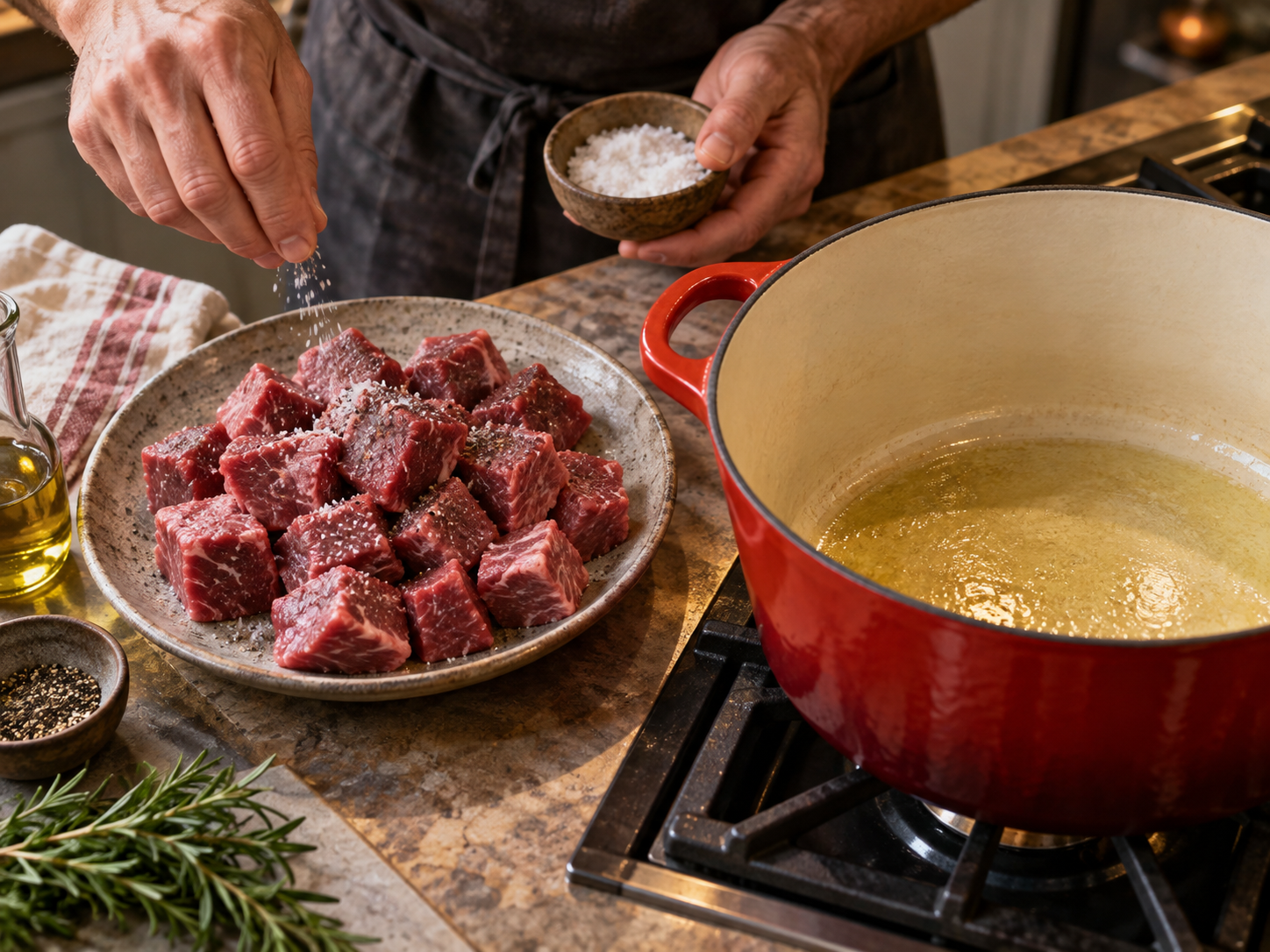
Trimming and Drying the Beef. Cut the chuck into even 2 in (5 cm) cubes, leaving the connective seams in place rather than trimming them away; they are what will thicken the sauce. Pat every piece thoroughly dry and season with salt and pepper. Set a heavy cast iron or enamelled pot over medium high heat and let it come fully up to temperature before anything goes in.
Step 2
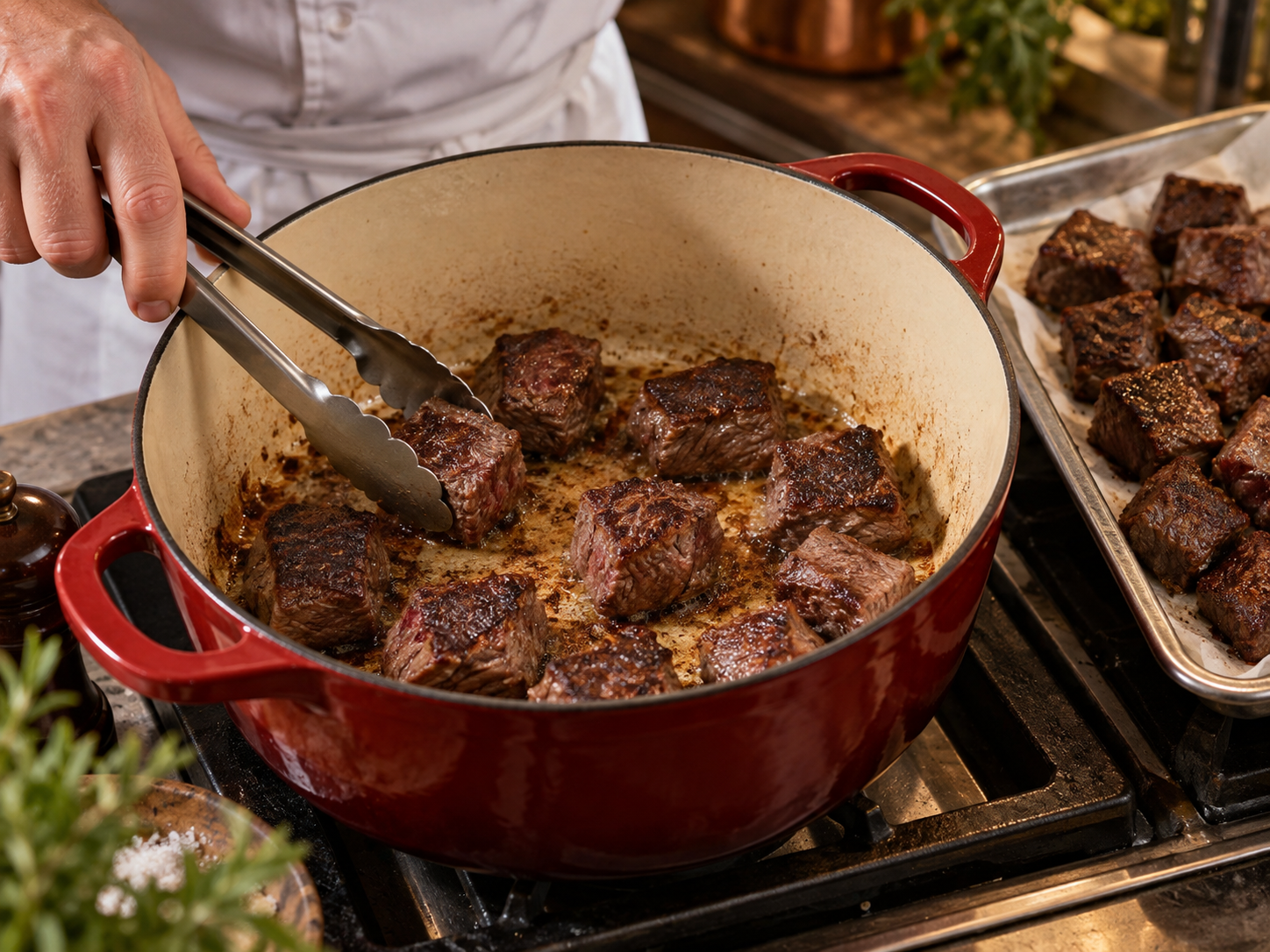
Browning in Batches. Add the fat and brown the beef in three or four small batches, leaving clear space between the cubes and turning them only once a dark crust has formed, about six to eight minutes per batch. Move each batch to a tray as it is done. Crowding drops the pan temperature, the meat releases its juices and steams grey, and the fond that gives the sauce its depth never forms.
Step 3
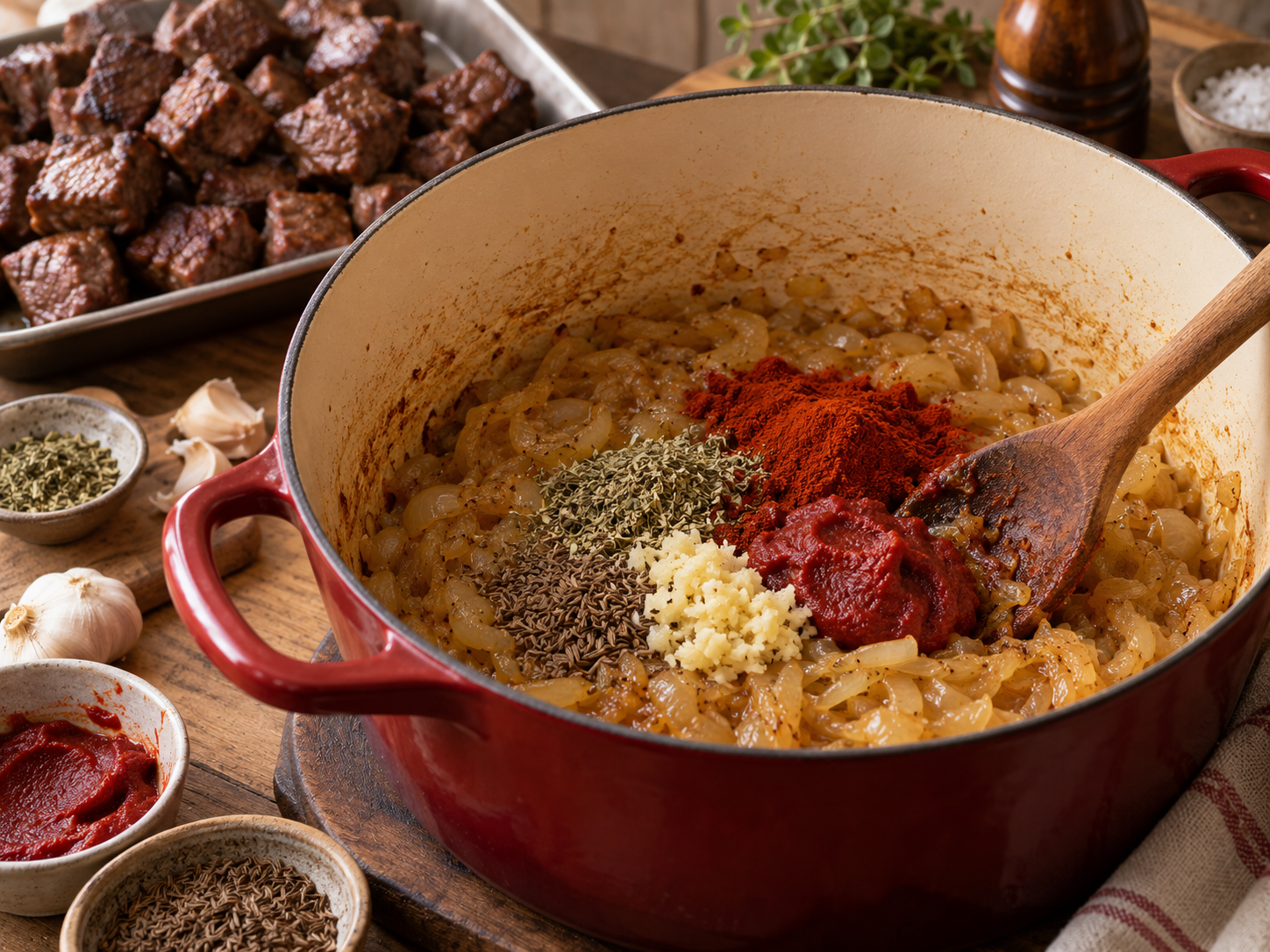
Cooking the Onions and Blooming the Paprika. Lower the heat to medium low, add the sliced onions with a good pinch of salt and cook 30 to 40 minutes, stirring often, until they have completely collapsed, lost their raw smell and turned pale gold. This is the longest and most important stage and it cannot be rushed. Then take the pot off the heat entirely before stirring in the garlic, marjoram, caraway, both paprikas and the tomato paste.
Step 4
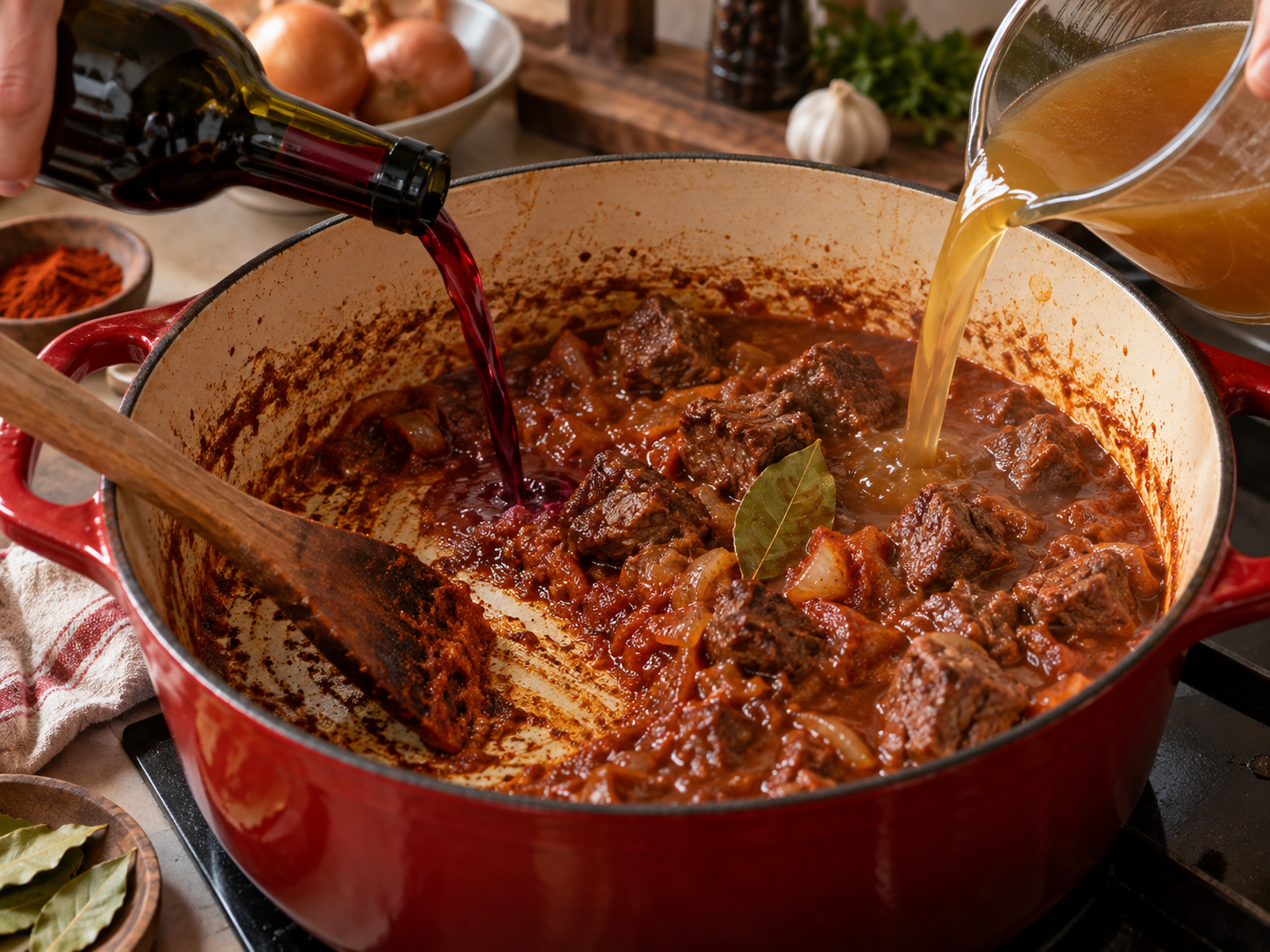
Deglazing and Assembling. Return the pot to the heat, pour in the red wine and reduce it by half, scraping the base clean as it bubbles. Put the beef back with any juices from the tray, add the bay leaves, and pour in hot stock only until it reaches just below the top of the meat, roughly 1 1/2 cups (360 ml) to start. Hold the rest back; the onions still need to concentrate.
Step 5
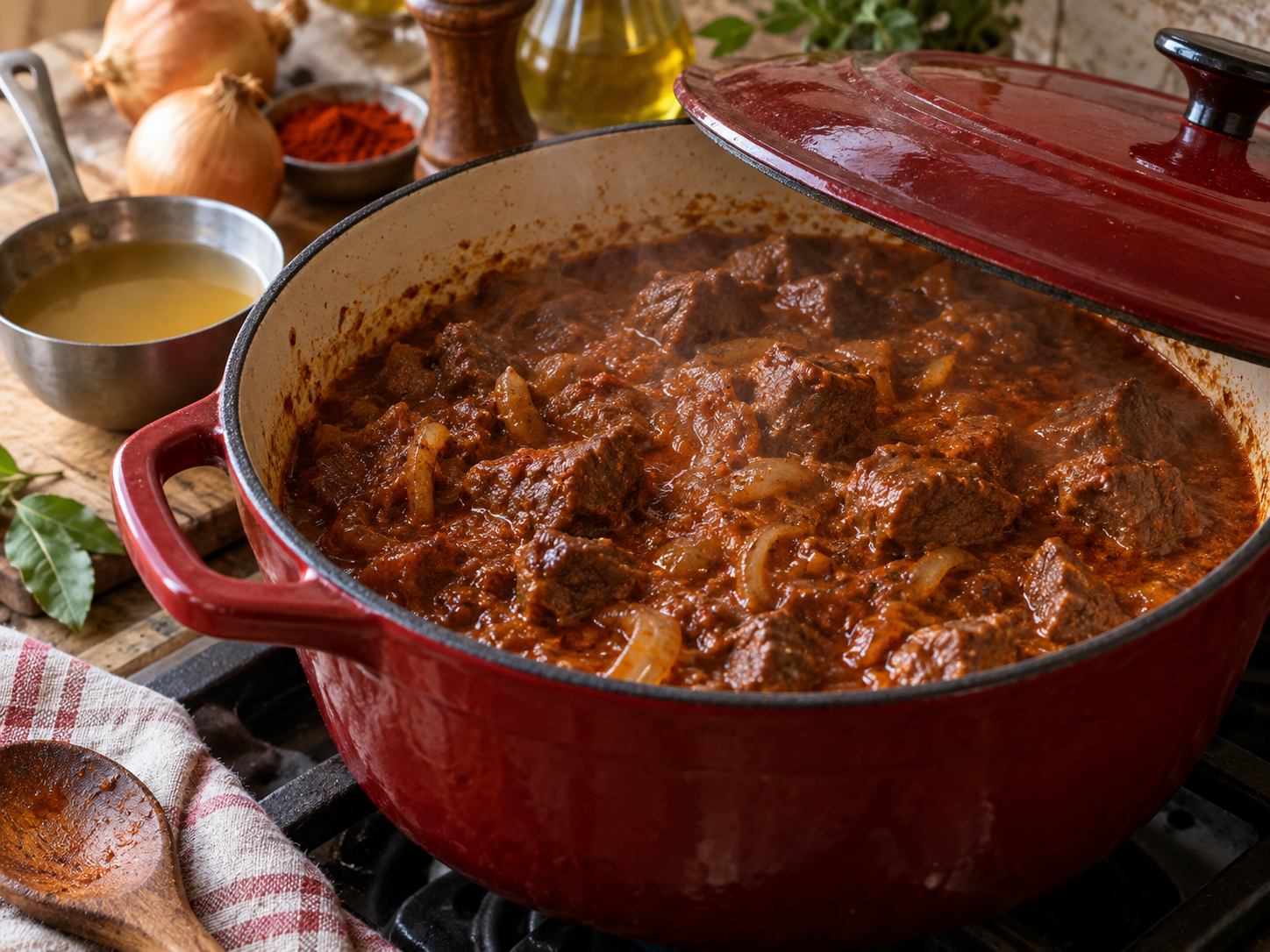
Braising Slowly. Set the lid slightly ajar and cook at the barest simmer, around 190°F (88°C), for 2 to 2 1/2 hours. Stir every 30 minutes, checking that the base is not catching, and add small amounts of hot stock only when the pot looks genuinely dry. The beef is ready when a fork slides in with no resistance but the cubes still hold their shape; by then the onions should have vanished into the liquid.
Step 6
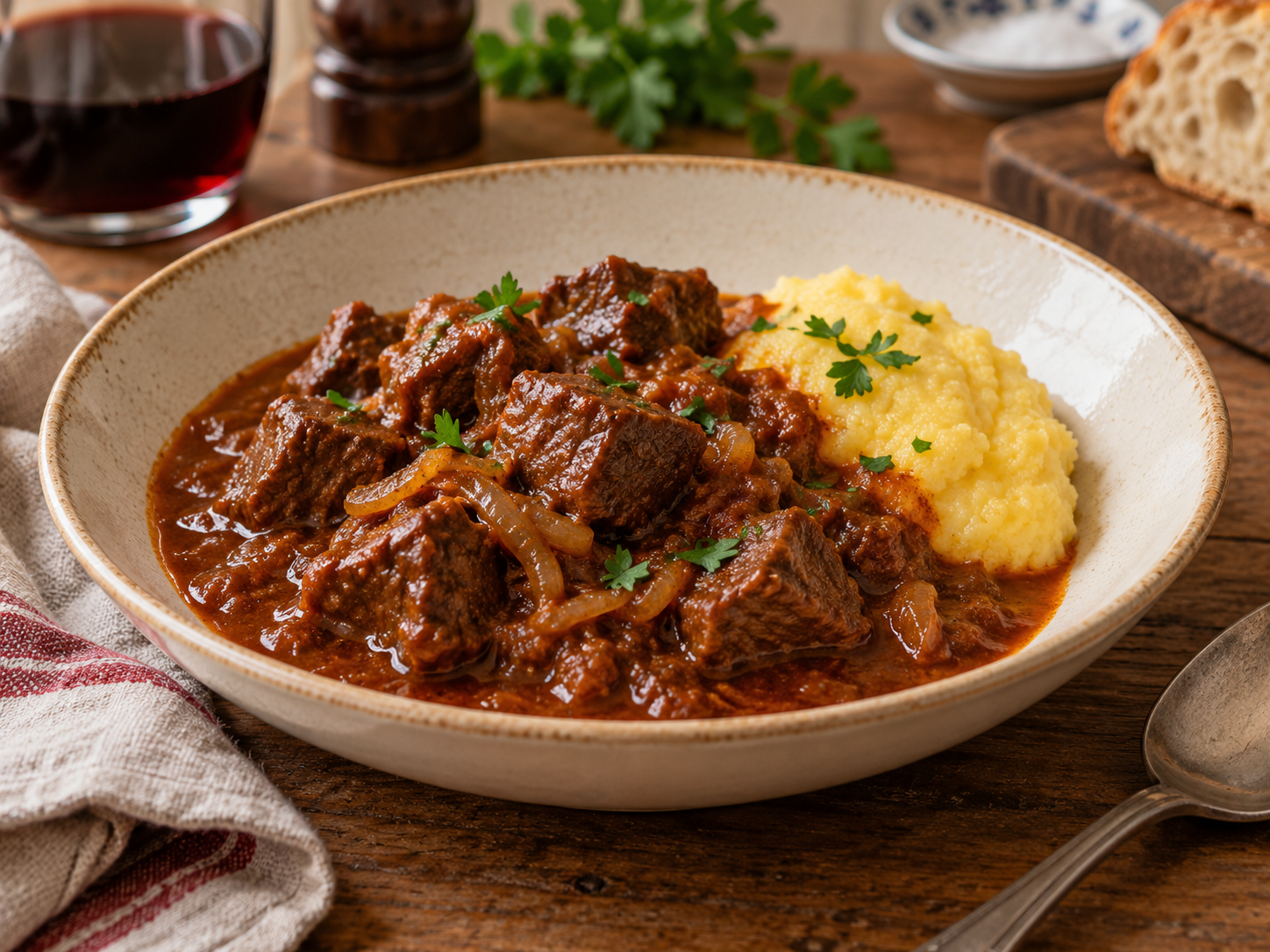
Reducing and Resting. Remove the lid and let the sauce reduce over medium low heat until it is dark, glossy and coats the beef rather than pooling around it. Fish out the bay leaves, skim any fat that has risen, and take the pot off the heat. Rest 15 minutes before serving: the sauce sets slightly, the meat relaxes, and only now should you make the final salt adjustment.
Plating
In Trieste this is served in a warm shallow bowl with soft polenta, either spooned alongside or underneath the meat. Keep the two components distinct: the polenta should still read as polenta, not as a bed soaked into a single mass. Four or five cubes of beef per person with enough sauce to glaze them is a portion; more sauce than that and the plate turns into soup, which is precisely what the Triestine version is not.
Boiled potatoes are the other classic accompaniment, and bread is offered separately rather than placed on the plate. A very small amount of chopped parsley is acceptable and traditional in some buffets, but nothing more: no sour cream, no cheese, no oil drizzle. Warm the plates properly, since a thick, gelatin rich sauce stiffens fast on a cold surface.
Professional Technique
The onion is a structural ingredient here, not an aromatic. Slice it evenly so it cooks at one rate and give it the full 30 to 40 minutes before any liquid arrives. Properly softened onion breaks down during the braise, releasing pectin and sugars that build a naturally thick, glossy sauce; rushed onion stays in separate pieces and leaves you reaching for flour to fix a problem that should never have existed.
Paprika is the fragile element. Its sugars and volatile aromatics burn within seconds in hot fat, and burnt paprika is bitter in a way that no sugar, tomato or extra stock can rescue. Pull the pot off the heat completely, stir the paprika into the warm onions so it blooms in residual heat, then bring liquid in almost immediately. This single move separates a red, sweetly fragrant gulasch from a brown, acrid one.
Choose beef for its connective tissue, not its grade. Chuck and shin carry collagen that converts to gelatin over three hours and gives the sauce a mouthfeel starch cannot imitate; tenderloin or sirloin will be dry and stringy long before the onions have done their work. Cut the cubes generously large, because they lose a third of their volume, and never trim the silverskin seams away.
Texture and Moisture Control
Liquid management is the whole game. Adding all the stock at the start dilutes the onions and stops them concentrating, so the sauce never gains body and you end up boiling it down at the end, which over salts it. Add stock in small amounts, only when the pot genuinely threatens to catch, and accept that a correct gulasch looks alarmingly dry halfway through.
Temperature decides whether the beef is tender or merely cooked. Hold the braise at a bare simmer where a bubble breaks the surface every few seconds. A hard boil agitates the cubes, squeezes water out of the muscle faster than collagen can dissolve, and shears the rendered fat into the sauce as a greasy emulsion that will not skim off cleanly.
Judge the finish by how the sauce behaves on a spoon. It should coat the back of it and leave a clean line when you draw a finger through, glossy rather than sticky. If it is thin, uncover and reduce gently; if it has gone past and turned pasty, loosen it with a little hot stock off the heat. Correct texture first, then taste for salt at serving temperature.
Professional Mise en Place
Slice all the onions before you start cooking; 1 3/4 lb (800 g) is a great deal of onion and stopping mid recipe to cut more will cost you the pan temperature. Cube and dry the beef, weigh the paprika and spices into one small bowl so they can go in together the instant the pot leaves the heat, and have the stock hot in a saucepan so it never chills the braise.
This dish is genuinely better on the second day, which is how every buffet in Trieste runs it. Braise it completely, cool it rapidly in a shallow container, and refrigerate overnight. The fat sets into a removable sheet, and the onion, paprika and beef flavours knit together in a way a fresh pot never quite achieves in three hours.
For service, portion the beef only once it has cooled in its sauce, then reheat each portion with enough sauce to glaze it. Make the polenta à la minute or hold it soft over a water bath. Keep the main pot covered and off high heat during service, and never reduce a holding pot further: what concentrates during a long service is salt, not flavour.
Chef Tips
Buy paprika that is bright red and smells sweet, and buy it in small quantities: the powder oxidises within months and stale paprika contributes colour without aroma, which is why some versions taste flat despite two full tablespoons. Weigh the onions rather than counting them, since the ratio to meat is the recipe. Take the pot off the heat before the paprika goes in, every time, without exception. If the sauce tastes sweet rather than savoury when you reduce it, the answer is pepper and a little stock, never sugar or more tomato paste. And make it the day before if you possibly can, then lift the set fat off in one sheet before reheating.
Common Mistakes
Using too little onion, which gives a thin sauce and forces a flour thickening the dish should never need. Weigh out the full 1 3/4 lb (800 g).
Frying the paprika in hot fat, which scorches it in seconds. Remove the pot from the heat first and let residual warmth bloom it.
Cutting the onion stage short. Undercooked onion stays in visible strands instead of dissolving; give it the full 30 to 40 minutes.
Adding all the stock at once, which dilutes the onions and delays concentration. Add only what the meat needs, in stages.
Choosing lean stewing beef. Without collagen the meat dries out and the sauce has no body. Chuck or shin with visible seams only.
Boiling hard to shorten the cook, which dries the beef and breaks fat into the sauce. Keep it barely trembling for the full time.
Serving straight from the stove. Fifteen to twenty minutes of rest improves both the sauce texture and how the seasoning reads.
Wine Pairing
Refosco dal Peduncolo Rosso Friuli DOC: the regional red and the natural partner. Its dark plum and blackberry fruit sits over a firm, slightly bitter almond finish and unusually high acidity, which is exactly what a sauce this rich and onion sweet needs. The tannin has enough grip to handle three hours of braised chuck without drying the palate.
Schioppettino Friuli Colli Orientali DOC: the most precise match for the spicing. Schioppettino is naturally peppery, with a green peppercorn and violet aroma that meets the caraway and marjoram head on, while its bright red fruit acidity lifts the heaviness of the collapsed onion. Medium body, so it partners the dish rather than competing with it.
Pignolo Friuli Colli Orientali DOC: for a second day gulasch, reduced and at its most concentrated. Pignolo is the most tannic and longest lived of the Friulian reds, dense with dark fruit, tobacco and sweet spice; that structure needs the gelatin and fat of the braise to soften it, and the exchange works in both directions. Give it a decade of age and a decanter.
Collio Friulano DOC: the white the buffets actually pour, and a better idea than it sounds. Friulano is full bodied and low in aromatic sweetness, with a signature bitter almond close and a waxy texture that stands up to fat. Its acidity scours the palate between forkfuls, which matters more with a dense braise than tannin does. Serve it at 54°F (12°C).
Ribolla Gialla Collio DOC: the sharpest contrast on the list, all citrus zest, green apple and cutting acidity. It works when the gulasch is served in a lighter portion as a lunch plate, where a big red would end the afternoon. A skin contact bottling adds grip and a faint tannic edge that bridges the gap toward the paprika.
Storage & Reheating
Cool the gulasch rapidly in a shallow container and refrigerate it in its sauce, covered, for up to four days at 39°F (4°C). It genuinely improves overnight. Lift the set fat off the top in one sheet before reheating, which both cleans the sauce and lets you judge its true consistency.
Reheat slowly on the stovetop over low heat, covered, stirring occasionally, and loosen with a splash of hot stock only if the sauce has tightened too far overnight. Do not let it return to a boil and do not reheat the same portion twice: repeated hard heating dries the beef and can break the sauce.
It freezes very well, better than most braises, because there is no dairy or starch to separate. Pack it in portion sized airtight containers with the sauce covering the meat and freeze for up to three months. Thaw overnight in the refrigerator and reheat gently; never thaw at room temperature or in a hot pan.
Nutrition
Estimated nutrition per serving, based on 6 servings of the goulash alone, without polenta or bread:
Calories: 520 kcal
Total Fat: 28 g
Saturated Fat: 9 g
Trans Fat: 0 g
Unsaturated Fat: 18 g
Cholesterol: 135 mg
Sodium: 690 mg
Total Carbohydrates: 18 g
Fiber: 3 g
Total Sugars: 9 g
Added Sugars: 0 g
Protein: 45 g
Lactose: 0 g
Main micronutrients: iron 5 mg; zinc 8 mg; potassium 850 mg; vitamin B12 3 mcg; vitamin A 900 IU from the paprika
Values are estimates and vary with exact ingredient brands, trimming, cooking loss and portioning.


Comments