
Italian Braised Lamb with Tomato and Onions | Agnello al Pomodoro con Cipolle

Italian Braised Lamb with Tomato and Onions is the recipe that sits underneath all the regional lamb braises of Italy. It is not the Sicilian version with olives and capers, and it is not the Lucanian version with peppers and pecorino. It is the plain architecture those dishes are built on: bone in lamb, a great deal of onion, tomato, a little wine, and time.
Everything rests on technique instead of geography. You choose shoulder and collar for the collagen and the bone. You brown in batches because a crowded pan steams instead of searing. You let the onions dissolve completely, because here the onion is not a flavouring, it is the body of the sauce. And you stop when the meat pulls away from the bone on its own, a signal you feel rather than a time you read off a clock.
Serves 4 to 6. Active time 45 minutes. Braising time 2 1/2 to 3 hours. Total about 3 3/4 hours. Equipment: one heavy Dutch oven, 5 to 6 quarts.
The Story
Lamb is the meat Italians eat when the calendar says something important is happening. Across the whole peninsula, from the Alpine valleys to the Sicilian interior, the animal arrives at Easter because of the season rather than any regional tradition. Lambs born in late winter reach the right size in spring, the pastures are at their best, and the Christian feast landed on top of a much older set of spring rites.
What varies is the treatment, and the variation is almost entirely what a given landscape had lying around. Shepherds in the central Apennines had fire, rosemary and little else, so they grilled small chops fast. Places with a strong tomato culture stewed the tougher cuts for hours. Coasts with a salt and caper trade folded those in, and areas with sheep dairies finished with hard cheese and egg. The decision was never aesthetic.
This version deliberately refuses to belong to any of those places. It is the braise reduced to its mechanics, what every regional recipe shares before the local additions arrive, and a slowly collapsed onion base under a long tomato braise is the most widespread way of cooking tough lamb in Italy.
Ingredients
For the lamb
Bone in lamb shoulder, cut into 2 inch pieces, 2 1/2 lb (1.15 kg)
Bone in lamb neck or collar, cut into thick rounds, 1 1/2 lb (680 g)
Fine sea salt, 2 tsp (12 g)
Freshly ground black pepper, 1 tsp (2 g)
Extra virgin olive oil, 4 tbsp (60 ml)
For the onion base
Yellow onions, thinly sliced, 2 lb (900 g), about 5 medium
Garlic cloves, thinly sliced, 5
Extra virgin olive oil, 2 tbsp (30 ml)
Fine sea salt, 1/2 tsp (3 g)
For the braising liquid
Dry white wine, 1 cup (240 ml)
Canned San Marzano tomatoes, crushed by hand, 2 1/2 cups (600 g)
Tomato paste, 2 tbsp (32 g)
Water or light chicken stock, 1 cup (240 ml)
Fresh rosemary sprigs, 2
Fresh thyme sprigs, 4
Bay leaves, 2
Crushed red pepper flakes, 1/4 tsp (0.5 g), optional
For finishing
Extra virgin olive oil, 2 tbsp (30 ml)
Flat leaf parsley, chopped, 3 tbsp (10 g)
Lemon zest, finely grated, from 1/2 lemon
Flaky sea salt, to taste
A note on the cuts, because this is the one decision that determines whether the dish works. Buy bone in shoulder and, if your butcher will sell it, neck: both are worked muscles laced with connective tissue, and both carry bone that releases gelatin into the sauce. Leg dries out, and boneless shoulder leaves the sauce thin.
Preparation
Step 1
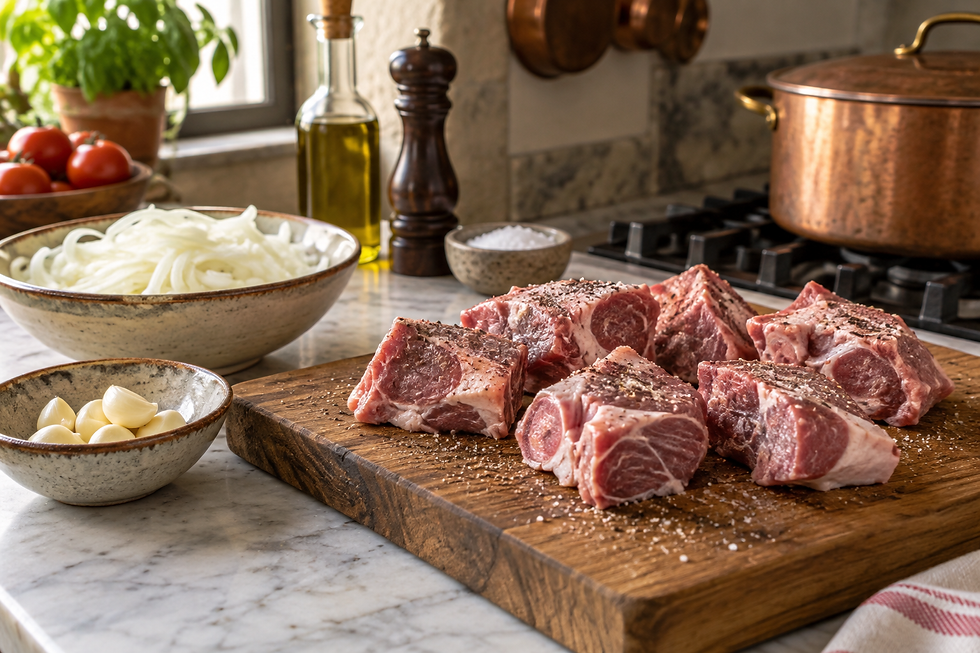
Season the meat and let it sit
Pat every piece of lamb thoroughly dry, then season on all sides with the salt and pepper. Set the meat on a rack in a single layer and leave it at room temperature for 30 to 40 minutes. Dry surfaces brown; wet surfaces steam.
The rest seasons below the surface, and the meat loses the fridge chill so it does not cool the pan.
Step 2

Brown in batches, never crowding the pan
Heat 2 tbsp (30 ml) of the oil over medium high heat until it shimmers. Add only enough lamb to cover the base with clear gaps between the pieces, about a third, then leave it alone for 4 to 5 minutes.
This is the step people ruin. A packed pan cannot shed moisture fast enough, so water pools, the temperature collapses below the browning threshold, and the lamb turns grey in its own juices. Work through three or four batches. It is where most of the flavour comes from.
Step 3

Dissolve the onions into a base
Lower the heat to medium low and add the remaining 2 tbsp (30 ml) oil with the sliced onion and the 1/2 tsp (3 g) salt. Scrape the browned residue off the bottom as the onions release their water, which deglazes the pan for you. Cook 25 to 30 minutes, adding the garlic in the last 3.
You want collapse, not merely softened onions: pale gold, completely limp, the slices no longer holding shape. Two pounds reduces to a quarter of its volume. The onion is the thickening body of the sauce, so every minute cut short is a thinner sauce later.
Step 4

Build the tomato base and set the ratio
Stir in the tomato paste and cook 2 minutes until it darkens from bright red to brick, which removes the raw tinned edge. Pour in the wine, raise the heat and let it bubble hard for 3 to 4 minutes until the sharp alcohol smell is gone.
Add the crushed tomatoes, the water or stock, the rosemary, thyme, bay and the chilli if you want it. The ratio matters more than the quantity: two and a half parts tomato to one part thin liquid, enough water to conduct heat for three hours and enough tomato solids to finish as a coating sauce rather than a broth.
Step 5
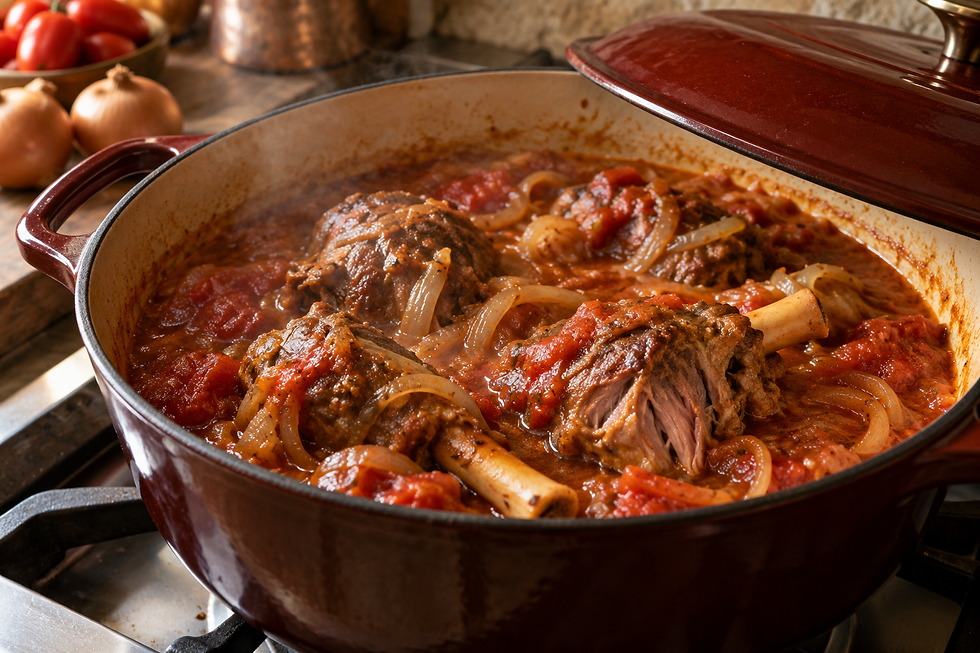
Return the lamb and settle it in
Tip the lamb back in with every drop of juice collected in the bowl, which is concentrated flavour you already paid for, and arrange the pieces in a single crowded layer.
The liquid should come two thirds of the way up the meat, not cover it. A braise is not a boil: the exposed tops sit in hot steam and keep some of their colour.
Step 6

Braise low until it yields
Bring the pot to the barest simmer, one bubble every second or two, then cover and hold it there on the lowest burner or in a 325°F (165°C) oven for 2 1/2 to 3 hours. Turn the pieces once halfway and add water only if the sauce is catching.
The signal for doneness is physical, not chronological. Lift a piece of collar with tongs and shake it lightly: when the meat separates from the bone under its own weight, the collagen has become gelatin. If it clings, give it another 20 to 30 minutes.
Step 7

Rest, skim and finish the sauce
Take the pot off the heat, uncover it and let it stand 20 minutes. The meat reabsorbs juice and the rendered fat rises into a clear layer you can lift off with a wide spoon. Pull out the herb stems and bay leaves, which turn bitter if they keep steeping.
If the sauce is loose, lift the meat onto a warm plate and reduce over medium heat for 5 to 10 minutes until it drags behind the spoon. Off the heat, stir in the finishing oil, parsley and lemon zest, which makes the plate taste lighter than it is.
Plating
Warm the plates to around 140°F (60°C). Braised lamb loses heat fast because the sauce is thin compared with a roast, and a cold plate takes the dish to lukewarm before it reaches the table. Wide shallow bowls beat flat plates, because they hold the sauce in a pool around the meat.
Portion by the piece, not by weight, and give each person a mix: one piece of shoulder, which holds together and reads as meat, plus a round of collar, which is looser and more gelatinous. Keep the bones in. Spoon sauce over and around, not enough to bury the lamb.
For accompaniment choose something plain and absorbent: soft polenta, mashed potatoes, white beans dressed only with oil, or grilled bread rubbed with garlic. Their job is to carry sauce, so avoid anything with a strong sauce of its own. A bitter green with lemon gives relief. Finish with a drizzle of raw olive oil at the table and nothing else, because this dish does not want a garnish.
Professional Technique
The technique that defines this recipe is the use of onion as a structural ingredient rather than an aromatic one. In most braises the onion is chopped, sweated briefly and forgotten. Here you use two pounds of it, sliced thin and cooked until it loses all structure, and what you get is a purée that never needed thickening. As the cells break down they release pectin and sugar into the liquid, and that dissolved material is what makes the sauce cling to the meat. No flour, no roux, no starch, because the body is already in there.
That is why the onion step cannot be shortened, and why slicing matters. Thin even slices break down uniformly, while a rough chop leaves chunks still recognisably onion after three hours, turning the sauce lumpy.
The second point is that browning and braising are separate flavour systems and you need both. Browning gives Maillard compounds on the surface; braising converts collagen and extracts everything from the bone. A braise on unbrowned meat tastes flat. Treating the sear as decorative is the error: it is half the flavour.
Texture and Moisture Control
Shoulder and collar are full of collagen, and collagen is the entire reason this dish takes three hours. Below about 160°F (71°C) it stays tough. Held above roughly 175°F (80°C) with moisture present, it hydrolyses into gelatin, and gelatin is what makes braised meat feel succulent even though the fibres have squeezed out most of their water. The meat is not moist because it retained water, but because it is coated in dissolved gelatin.
That is why a hard boil does so much damage. At 212°F (100°C) the agitation tears the softening fibres apart, leaving meat that is dry inside and shredding at once. A bare simmer keeps the pot in the conversion window without the violence.
The last texture question is the sauce, and the tool is the back of a spoon. Drag it across the pot: the sauce should close slowly behind it and coat the spoon in a thin even film. Too thin and it slides off the lamb; too thick and it tastes of concentrated tomato.
Professional Mise en Place
Equipment and tools
Heavy Dutch oven, 5 to 6 quarts, with a well fitting lid
Sharp knife or mandoline for slicing 2 lb (900 g) of onion evenly
Tongs and a wide shallow spoon for skimming fat
Instant read thermometer for the braising liquid and the plates
Two large bowls, one for browned meat and its juices, one for the onion
Prepared ahead
Slice all the onion and garlic before you light the stove, because once browning starts you have no free hand
Crush the tomatoes by hand and measure the wine, water and paste separately
Tie the rosemary, thyme and bay into a bundle so you can pull them out in one movement
Season the lamb first and let it rest while you do everything else
The whole braise can be made a day ahead and will be better for it
Service setup
Reheat gently, covered, with the fat layer on top, and lift the fat off just before serving
Hold the pot on the lowest heat or in a 200°F (95°C) oven while the plates warm
Keep the parsley, lemon zest and finishing oil to the last minute
Warm bowls to 140°F (60°C) and plate one piece of shoulder and one of collar each
Chef Tips
Save the fat you skim off. Strained into a jar and kept in the fridge, that rendered lamb fat is the best thing you will ever roast potatoes in, and it keeps a couple of weeks.
Cook it the day before you eat it. This braise improves overnight more than almost any other lamb dish: the gelatin sets, the tomato loses its edge, and the fat solidifies so it lifts off cleanly.
If your tinned tomatoes are aggressive, add a pinch of sugar rather than more salt. Half a teaspoon takes the sharp edge off without making the sauce taste sweet.
Do not swap the lemon zest for juice. The zest adds aroma without acidity, which is what a long cooked tomato braise needs; juice adds acid on top of tomato acid and makes the sauce taste thin.
Common Mistakes
Crowding the pan during browning. The most common failure. Meat packed tight releases water faster than the pan can evaporate it, the temperature drops below the browning threshold and the lamb boils grey. Use three or four batches with visible gaps.
Buying boneless leg instead of bone in shoulder. Leaner cuts have less collagen and no bone, so the sauce never develops body and the meat dries out instead of tenderising. If shoulder and collar are unavailable, bone in shanks beat any boneless cut.
Undercooking the onions. Ten minutes of softening is not thirty minutes of collapse. If the slices still have shape when the tomato goes in, you have no thickening body, and the sauce stays watery however long you reduce it.
Cooking to the clock instead of to the bone. Three hours is a guide, and the difference between lamb that gives and lamb that fights is often twenty minutes. Shake a piece of collar with tongs: it is ready when the meat drops off the bone on its own.
Wine Pairing
Braised lamb in tomato needs a dry red with real acidity and moderate tannin. The fat asks for tannin, the tomato asks for matching acidity, and the gelatin will flatten anything too soft. These four come from outside the regions that own the other lamb braises on this site.
Montepulciano d'Abruzzo Colline Teramane DOCG: The most natural partner here, because Montepulciano gives dark plum fruit and a round, slightly dusty tannin that meets braised lamb without scraping at it. The Colline Teramane hills push the grape to a firmer structure, so there is enough grip to cut the fat that renders out over three hours.
Conero DOCG: A Marche red built on Montepulciano with a little Sangiovese, and that blend's acidity is what a tomato and onion braise wants. Sour cherry and a saline finish lift the sweetness the onions developed, so the sauce tastes brighter rather than jammier. The tannin is firm enough for bone in meat and soft enough not to dry the gelatin.
Valpolicella Ripasso DOC: The ripasso method leaves more body and a touch of dried fruit sweetness than a straight Valpolicella, which bridges well when the tomato has been reduced hard. That echo of raisin runs alongside the softened onion, while Corvina keeps the acidity high enough to leave every mouthful clean.
Alto Adige DOC Lagrein: The outsider choice, dark, tart and faintly bitter, with violet and black plum over a tannin that grips the tongue. That bitterness counterweights the concentrated tomato, and the high acidity resets the mouth after fatty pieces of collar. It is a deliberately northern pick, which keeps this base version distinct from a Sicilian or Lucanian lamb.
Storage & Reheating
In the refrigerator, keep the lamb submerged in its own sauce and leave the solidified fat cap in place, because it seals the surface. It keeps 4 days and is better on day two and three than on the day you cooked it. Never store the meat dry and separate from the sauce, or it will be leathery within a day.
This braise freezes very well, which is not true of every lamb dish. Portion it with plenty of sauce into rigid airtight containers, leaving half an inch of headspace, and freeze up to 3 months. Thaw overnight in the refrigerator, never in the microwave, since a fast thaw tears the fragile fibres. The sauce alone keeps 6 months.
To reheat without drying the meat, work gently and always in liquid. Put the lamb and sauce in a covered pot over low heat with 2 to 3 tbsp (30 to 45 ml) of water and bring it back slowly over 20 to 25 minutes, turning once. The lid and the added water keep the surface humid. Avoid the microwave, which toughens the outside before the centre is warm. Add fresh parsley and lemon zest before serving, because both fade in storage.
Nutrition
Per serving, based on 6 servings and including the sauce, with visible fat skimmed before serving.
Calories, 520
Total Fat, 32 g
Saturated Fat, 11 g
Trans Fat, 0.4 g
Unsaturated Fat, 19 g
Cholesterol, 125 mg
Sodium, 690 mg
Total Carbohydrates, 17 g
Fiber, 3 g
Total Sugars, 9 g
Added Sugars, 0 g
Protein, 38 g
Lactose, 0 g
Micronutrients as a share of the daily reference intake: vitamin B12 around 110 percent, zinc 60 percent, selenium 55 percent, niacin 45 percent, iron 25 percent, potassium 20 percent, vitamin C 20 percent, vitamin A 15 percent. All figures are estimates and shift with the cut of lamb and how much fat you skim.


Comments