
Italian Tuscan Farro Salad | Insalata di Farro della Garfagnana
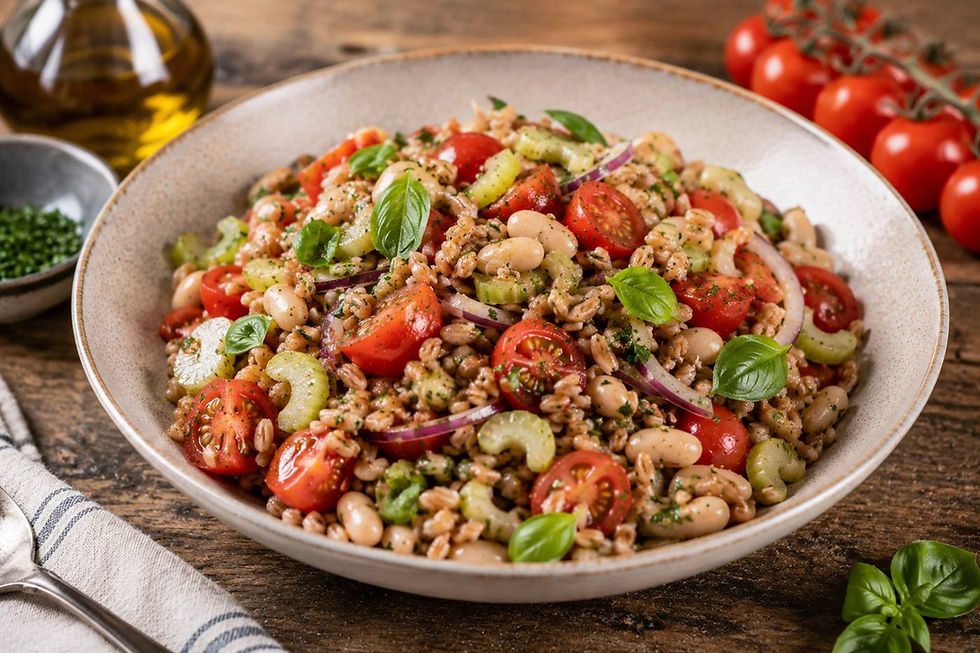
This is the mountain version of an Italian grain salad, and it belongs to one valley. Farro della Garfagnana is emmer grown on the terraces above the Serchio, in the strip of Tuscany between the Apuan Alps and the Apennine ridge, and it behaves differently from the farro sold as a national commodity: smaller, darker at the crease, keeping a nutty bite long after softer wheats have surrendered. Everything here is built to let that bite stay audible.
The supporting cast is the pantry of the valley rather than a summer garden: cannellini cooked with sage, ripe tomatoes, celery, carrot, red onion and a dressing of Tuscan olive oil and red wine vinegar sharpened with rosemary. No mozzarella, no basil in handfuls, no lemon. The result is heavier and more savoury than the coastal farro salads, which is what you want when it has to stand up beside grilled meat or a plate of salumi.
The one real technique is knowing when to stop cooking the grain and when to dress it. Farro della Garfagnana is dressed warm, so the grain takes the vinegar and the oil into itself while the starch is still open. Dress it cold and the dressing stays on the outside.
Yield: 4 side servings. Soak: 8 hours for the beans. Prep: 25 minutes. Cook: 50 minutes. Rest: 30 minutes. Difficulty: easy. Course: contorno or piatto unico. Region: Tuscany, the Garfagnana.
The Story
The Garfagnana is the northern corner of the province of Lucca, a narrow valley held between the marble of the Apuan Alps and the Tuscan Apennines, and it has grown farro continuously for longer than almost anywhere else in Italy. The grain is Triticum dicoccum, emmer, the hulled wheat that fed the Roman legions and was then abandoned in favour of higher yielding soft wheats. It survived here for the least romantic of reasons: the valley is cold, wet, steep and poor, emmer tolerates all four, and nothing better would grow at 1,000 to 2,300 feet (300 to 700 m) on those slopes.
What kept it alive as a crop rather than a curiosity was recognition. Farro della Garfagnana received IGP status in 1996, the first farro in Europe to be protected, and the consortium fixed the rules: local emmer, grown without irrigation or chemical fertiliser in a defined list of communes around Castelnuovo di Garfagnana, at a yield that is low by design. The grain still passes through the valley mills, several of them water driven on the tributaries of the Serchio, where the hull is removed by abrasion rather than polished away. That is why Garfagnana farro is semiperlato at most and never pearled white.
In Lucchese kitchens farro is a winter grain first, in the thick zuppa di farro with beans and pork, and this salad is the summer face of the same larder. It is farmer food in the plainest sense: grain and beans stored dry, vegetables from the orto, the whole thing built to be carried to the fields in the morning and eaten at noon without reheating. The version on Lucca menus today has barely changed, which is unusual and worth saying.
Ingredients
For the grain and beans
Farro della Garfagnana IGP, semiperlato, 1 1/4 cups (250 g)
Dried cannellini beans, 2/3 cup (125 g), soaked 8 hours
Fresh sage leaves, 4
Garlic clove, whole and unpeeled, 1
Bay leaf, 1
Fine sea salt, 1 tsp (6 g), divided
For the vegetables
Ripe plum tomatoes, seeded and diced, 10 oz (285 g)
Celery stalks from the pale heart, in fine dice, 2
Carrot, in fine dice, 1 medium
Red onion, in fine dice, 1/2 medium
Flat leaf parsley, chopped, 3 tbsp (10 g)
For the dressing
Tuscan extra virgin olive oil, 6 tbsp (90 ml)
Red wine vinegar, 2 1/2 tbsp (37 ml)
Fresh rosemary, very finely chopped, 1 tsp (1 g)
Garlic clove, grated to a paste, 1 small
Fine sea salt, 3/4 tsp (5 g)
Freshly ground black pepper, to taste
For finishing
Pecorino Toscano stagionato, shaved, 2 oz (55 g)
Extra virgin olive oil, a thread per plate
Preparation
Cook the cannellini with sage and garlic
Drain the soaked beans and put them in a saucepan with cold water to cover by 2 inches (5 cm), the sage, the unpeeled garlic and the bay leaf. Bring to the barest simmer and hold there 45 to 60 minutes, never letting the water move hard. Salt with half the teaspoon in the last 10 minutes only. Cool them in their own liquid, which keeps the skins intact, and drain just before they are needed.
Rinse and cook the farro
Rinse the farro under cold water until it runs clear, removing the fine flour left by the mill abrasion. Bring a large pan of water to the boil, salt it with the remaining half teaspoon and add the grain. Garfagnana farro takes 25 to 35 minutes, longer than pearled farro from the plains because less bran has been taken off. Do not soak it first: it is semiperlato and soaking pushes it towards mush.
Judge the grain and spread it to cool
Start tasting at 25 minutes. The grain is ready when the outside is tender and the centre still gives a clear resistance under the tooth, like al dente rice but chewier, never soft all the way through. Drain it, do not rinse it, and spread it in one layer on a wide tray so the steam escapes instead of gluing the grains together. Leave it 10 minutes, until warm rather than hot.
Cut the vegetables
Seed the tomatoes and cut them into dice of about 1/3 inch (8 mm), then leave them in a sieve 10 minutes so the loose juice drains away. Cut the celery, carrot and red onion much finer, around 1/8 inch (3 mm), so no spoonful is dominated by raw onion or hard carrot. The size difference is deliberate: tomato is the soft element and should read as pieces, the aromatics as texture.
Build the rosemary and red wine vinegar dressing
Whisk the vinegar, grated garlic, rosemary, salt and pepper together and let them sit 5 minutes, which takes the raw edge off the garlic and lets the rosemary oil bleed into the acid. Then add the olive oil in a steady stream, whisking, until it thickens slightly. The proportion is about two and a half parts oil to one of vinegar, sharper than a table vinaigrette, because a great deal of starch is about to absorb it and blunt it.
Dress the warm grain and rest the salad
Tip the warm farro into a wide bowl and pour over two thirds of the dressing, folding with a spatula until every grain is coated. Fold in the drained beans, then the celery, carrot, onion and tomato, then the parsley. Add the rest of the dressing if it looks dry. Rest the salad 30 minutes at room temperature, then taste once more for salt, because farro absorbs seasoning as it stands.
Plating
This salad is served at cool room temperature, never chilled. Refrigeration hardens the starch and solidifies the olive oil, and both faults are obvious on the tongue. If it has been in the refrigerator, take it out a full 45 minutes before the table and stir it once.
Use a shallow bowl rather than a flat plate, because the dressing collects at the bottom and a flat plate lets it run to the edge. Spoon it in loosely and let it settle into a low mound without pressing: a pressed grain salad looks compacted and eats the same way. Finish with shaved Pecorino Toscano and a thread of olive oil, added at the table rather than in the bowl so the cheese stays dry.
As a contorno it belongs beside grilled meat, roast pork or Tuscan salumi, and it is one of the few salads that holds its own next to bistecca. As a piatto unico for two rather than four, it needs only bread.
Professional Technique
The defining technique is dressing the grain while it is still warm, and the reason is physical. During boiling the starch granules swell and take on water; as the farro cools they retrograde, the chains realign and the surface closes. Dressing in that open window, at roughly 120°F (50°C), lets the vinegar and oil migrate into the outer layer rather than sit on it. The same salad dressed cold tastes of two things, grain and vinaigrette, instead of one.
The second is the choice not to pearl and not to soak. Garfagnana farro comes semiperlato, hull abraded but most of the bran left in place, and that bran is why the grain holds its shape in a dressing for two days. Soaking it, as many recipes instruct for spelt, hydrates the bran ahead of the endosperm and collapses the structure you are paying for. Rinsing is enough.
The third is cooking the beans separately. Cannellini boiled with the grain release starch into the same water and coat everything in a floury film, and they break apart long before the farro is ready. Cooked apart at a bare simmer, with the aromatics whole so they can be pulled out, they finish intact and cool in their liquid, which stops the skins splitting as they contract.
Texture and Moisture Control
The enemy here is free water, and the tomato is the main source. Diced tomato left in a bowl releases two tablespoons of liquid within twenty minutes, thinning the dressing and turning the bottom of the salad into soup. Seeding it and draining the dice in a sieve removes most of that, and costs nothing in flavour, because the jelly around the seeds carries the sourness rather than the sweetness.
The grain has the opposite problem. Farro left in a heap keeps steaming itself, the surface starch turns sticky and the grains clump. Spreading it on a tray in one layer lets the steam leave, which is the difference between a salad of separate grains and one that moves in lumps. Never rinse cooked farro under cold water to speed this up: it washes away the surface starch that helps the dressing cling.
Over the next day the salad keeps absorbing. That is a feature rather than a fault, but seasoning has to be checked twice, when it is dressed and after the 30 minute rest, and a third time if it is served the following day. Keep a spoonful of dressing aside for that. The correct texture is loose enough to fall off a spoon, with no liquid pooling underneath.
Professional Mise en Place
This salad is almost entirely prepared in advance, which is why it is useful for service. Only the cheese and the final oil go on at the pass.
Equipment and tools
Large pan for the farro, smaller heavy saucepan for the beans
Wide sheet tray for spreading and cooling the grain
Fine sieve for draining the tomato dice
Small whisk and narrow bowl for the dressing
Vegetable peeler for shaving the pecorino
Prepared ahead
Beans soaked overnight, cooked the morning of service, held in their liquid
Dressing whisked up to 2 days ahead, refrigerated, brought back to room temperature
Vegetables diced up to 4 hours ahead, tomato kept separate and draining
Farro cooked, spread, dressed and rested up to 1 day ahead
Service setup
Salad out of the refrigerator 45 minutes before service
Reserved dressing and salt within reach for the correction
Pecorino in one piece, shaved to order
Shallow bowls at room temperature
Chef Tips
Buy the grain by its full name. A bag marked simply farro tells you nothing: it may be spelt, einkorn or perlato from anywhere, and all three cook in different times. The IGP mark and the words della Garfagnana are the only guarantee that the cooking window here applies.
Keep the bean cooking liquid. A tablespoon or two stirred in at the end loosens the salad without adding more oil or acid, and carries the sage and garlic through the bowl. It is also the right correction the next day, when the grain has drunk the dressing and tightened.
Chop the rosemary far finer than feels necessary, almost to a powder. It is resinous, and a whole needle in a cold salad is unpleasant to bite, but reduced to dust it perfumes the oil and disappears. If you are nervous, steep the needles whole in warmed oil for ten minutes and lift them out.
Change the salad with the season rather than the cuisine. In autumn the Garfagnana adds chestnuts or cooked borlotti, in spring young fava beans and wild fennel. What does not belong is mozzarella, sweetcorn or tuna, all of which appear in commercial farro salads and turn this into a dish from somewhere else.
Common Mistakes
Soaking the farro before cooking. Semiperlato grain does not need it and soaking hydrates the bran first, so the grain splits and goes pasty in the pan. Rinse it and put it straight into boiling water.
Dressing the farro cold. Once the starch has retrograded the grain will not absorb the vinegar or the oil, and the dressing stays on the surface. Dress it while it is still warm to the hand, at around 120°F (50°C).
Leaving the tomato seeds in. The jelly around the seeds is the wettest and the sourest part of the fruit, and it leaks into the bowl for hours. Seed the tomato, dice it and let the dice drain in a sieve before it joins the salad.
Cooking the beans with the grain. They break before the farro is ready and they release starch into the same water, which coats every grain in a floury film. Cook them separately at a bare simmer and cool them in their liquid.
Serving it straight from the refrigerator. Cold hardens the starch and clouds the olive oil, and the salad tastes of nothing at all. Bring it back to cool room temperature for 45 minutes and correct the salt before it goes out.
Wine Pairing
Riviera Ligure di Ponente Pigato DOC: The neighbour over the mountain and the most natural white here. Pigato has a broad, almost oily texture and a herbal, faintly saline finish that sits against rosemary and Tuscan olive oil rather than being flattened by them, with acidity firm enough for the red wine vinegar without turning shrill.
Cinque Terre DOC: From the coast the Garfagnana drains towards, a blend led by Bosco with Albarola and Vermentino. Lean, mineral and low in aromatic noise, it suits a salad whose flavours are savoury rather than fruity. The saltiness picks up the pecorino, and the light body keeps the wine off the beans.
Cerasuolo d'Abruzzo DOC: A properly dry rosato with more grip than most, and the best choice when the salad is the whole plate. Its cherry and pomegranate fruit reads against the tomato instead of competing with it, and the trace of tannin from the short maceration pushes against the starch of the farro and the fat of the oil.
Chianti Rufina DOCG: The Tuscan red that works here, because Rufina sits at altitude and keeps a nervier acidity and lighter frame than Sangiovese from the warmer zones. That acidity matches the vinegar in the dressing instead of fighting it. Serve it around 59°F (15°C), which keeps the tannin from hardening against the beans.
Rosso di Montalcino DOC: For a fuller table, where the salad is a contorno beside grilled meat. Younger and less structured than its Brunello sibling, it carries sour cherry and dried herb notes that meet the rosemary and pecorino without overwhelming a vegetable dish. Choose little or no new oak: vanilla and toast pull against everything in this bowl.
Storage & Reheating
This is one of the rare salads that improves overnight. Airtight in the refrigerator it holds 3 days, and by day two the grain has taken the dressing completely and the raw onion has lost its edge. Tomato is the limiting ingredient: after 48 hours it breaks down and releases water, so when cooking ahead deliberately, dress the farro and beans on day one and fold the tomato in on the day of service.
Nothing here is reheated. Bring the container out 45 minutes before serving, stir once, loosen with a spoonful of bean liquid or a little olive oil, and correct the salt, which always needs it after a night in the cold. If the grain has tightened badly, a tablespoon of warm water worked through relaxes it without diluting the seasoning.
The dressed salad does not freeze: the tomato collapses and the grain turns mealy on thawing. Plain cooked farro freezes very well for up to 3 months, spread flat on a tray until solid and then bagged, which makes the next version a twenty minute job. Cooked cannellini freeze equally well in their liquid.
Nutrition
Per serving, based on 4 side servings:
Calories: 480 kcal
Total Fat: 24 g
Saturated Fat: 5 g
Trans Fat: 0 g
Unsaturated Fat: 18 g
Cholesterol: 10 mg
Sodium: 560 mg
Total Carbohydrates: 54 g
Fiber: 9 g
Total Sugars: 5 g
Added Sugars: 0 g
Protein: 16 g
Lactose: 0.2 g
Principal micronutrients: magnesium, iron, zinc, phosphorus, niacin, folate, potassium
These figures are estimates. Fibre and protein are unusually high for a salad because emmer and cannellini both carry a great deal of both, and sodium depends on how hard the beans were salted.



Comments