
Italian Riviera Salad | Insalata Nizzarda
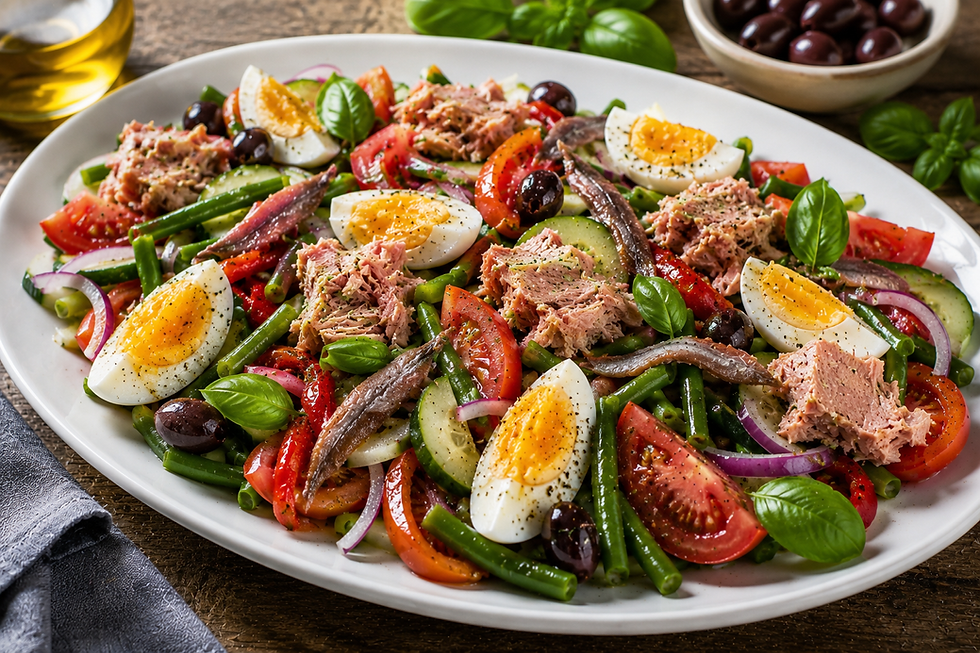
Insalata nizzarda is the salad of a border that moved. Until 1860 Nice and its county belonged to the Kingdom of Sardinia, and the coast running from Ventimiglia to the mouth of the Var was one kitchen speaking one language. The Treaty of Turin handed the city to France, the border slid west, and the same salad carried on being made on both sides of it under two names.
The two versions part company over one question, whether cooked vegetables belong in the bowl. The purists of Nice say no, loudly. Liguria says yes, and adds small waxy potatoes and green beans without apology, because on this side of the border the salad was a working meal rather than a summer idea. That is the version built here, dressed with oil from the Taggiasca groves behind Imperia.
Everything else is quality and restraint. Tuna preserved in olive oil, eggs cooked so the yolk is set but still bright, tomatoes that have seen real sun, olives with their stones left in, and a dressing of nothing but Ligurian oil, red wine vinegar, salt and pepper. No mayonnaise, no mustard. The salad is composed rather than tossed, and dressed at the last possible moment.
Yield: 4 servings as a side dish, 2 as a light main. Prep: 30 minutes. Cook: 25 minutes. Rest: 20 minutes while the potatoes cool. Total: about 1 hour 15 minutes. Difficulty: easy. Course: contorno or piatto unico. Region: Liguria, the western riviera between Imperia and Ventimiglia.
The Story
The county of Nice was Savoyard and then Sardinian territory for close to five centuries, and changed hands only in 1860, when Vittorio Emanuele II traded it together with Savoy to Napoleon III in return for French support against Austria. Giuseppe Garibaldi, born in Nice, denounced the transfer in parliament as the sale of his birthplace. Borders on paper move faster than borders in kitchens, and the cooking of the Ligurian ponente and of the Nice hinterland stayed one thing, built on olive oil, salted anchovy, wild herbs and the vegetables of steep terraces.
The oil is the part Liguria will not compromise on. The Taggiasca olive takes its name from Taggia, in the Argentina valley behind Sanremo, and tradition credits the Benedictine monks of San Colombano with spreading the cultivar through these valleys from the eleventh century onward. It yields a small dark olive with a high stone to flesh ratio, and an oil that is sweet, low in bitterness and almost free of the peppery catch you get from Tuscan or Apulian oils. That gentleness matters here, because an aggressive green oil would trample the tuna and the egg.
The potato question still starts arguments. Jacques Medecin, mayor of Nice and author of the 1972 book that fixed the city cuisine in print, ruled that no cooked vegetable may enter a salade nicoise. Across the border nobody consulted him: in the trattorie of Bordighera and Ventimiglia the salad arrives with potatoes and beans both, because it descends from what a fisherman ate at midday.
Ingredients
For the vegetables
Small waxy potatoes, 12 oz (340 g)
Green beans, topped, 8 oz (225 g)
Ripe tomatoes, medium, 3, about 14 oz (400 g)
Spring onion or sweet white onion, small, 1
Tender celery heart stalk, 1
Small green bell pepper, 1/2
Butter lettuce leaves, 3 oz (85 g)
For the protein
Tuna preserved in olive oil, drained, ventresca if available, 7 oz (200 g)
Eggs, large, 4
Salted anchovy fillets, rinsed, 6
Taggiasca olives in brine, stones left in, 1/2 cup (80 g)
For the dressing
Extra virgin olive oil, Riviera Ligure, 1/3 cup (80 ml)
Red wine vinegar, 2 tbsp (30 ml)
Fine sea salt, 1 tsp (6 g)
Freshly ground black pepper, to taste
For finishing
Fresh basil leaves, small, 10 to 12
Flat leaf parsley, chopped, 1 tbsp (3 g)
Coarse sea salt, for the potato water and the tomatoes
Extra virgin olive oil, a few drops per plate
Preparation
Boil the potatoes in their skins
Wash potatoes of roughly equal size without peeling them. Put them into cold salted water, bring to a gentle simmer and cook for 18 to 22 minutes, until a thin knife slides into the centre with no resistance and the skin has not split. Starting them cold is not a formality: dropped into boiling water the outside cooks while the centre is raw, and that layer disintegrates into the salad. Peel them hot in a cloth, cut them into rounds about 1/3 inch (8 mm) thick and dress them at once with a spoonful of the oil and a pinch of salt.
Blanch and shock the green beans
Bring a wide pan of well salted water to a fast rolling boil, drop the beans in all at once and cook uncovered for 4 to 6 minutes, until they bend without snapping but still resist the tooth. Taste one rather than trusting the clock. Lift them into iced water, leave them one minute only, then drain and dry them on a cloth. The ice bath sets the chlorophyll; any longer and they take the water on and the dressing slides off.
Cook the eggs to a set but bright yolk
Lower the eggs into water already at a simmer and cook them for exactly 9 minutes. That is where the white is firm and the yolk is set through but still deep yellow and faintly moist at the core. An egg driven to 12 minutes turns chalky and develops the grey green ring. Cool them under cold water for 2 minutes, peel them under the tap, then quarter them lengthwise with a thin blade wiped between cuts.
Salt and drain the tomatoes
Cut the tomatoes into wedges, six or eight per fruit, and lay them in a single layer on a plate. Salt them lightly, leave them 10 minutes, then tip away the liquid collected underneath. Tomatoes are mostly water and surrender it the moment salt touches them. Doing this on a separate plate rather than in the bowl is the single most effective thing you can do to stop the dish turning into a pool of pink liquid at the table.
Tame the onion
Slice the onion as thinly as you can and leave it 10 minutes in cold water with a splash of the vinegar, then drain and pat it dry. Raw onion in a salad that sits keeps getting stronger, and the sulphur compounds responsible are water soluble, which is why this short soak works. Slice the celery and the green pepper very thinly at the same time and keep them dry.
Flake the tuna and clean the anchovies
Drain the tuna but do not press it dry, and break it into generous flakes with your fingers rather than a fork, which shreds it. If you are working from whole salted anchovies, rinse off the salt crust, open them along the belly, lift the spine out in one movement and pat the fillets dry. Leave the Taggiasca olives whole with their stones in: pitted olives bleed brine and go soft.
Mix the dressing
Dissolve the salt in the vinegar first, stirring until you cannot feel a grain, then add the oil and the pepper and whisk for a few seconds only. The ratio is about four parts oil to one part vinegar, leaner than a standard vinaigrette because the anchovies and olives already bring salt. Do not emulsify it into a stable cream: this dressing is meant to separate, so some mouthfuls arrive round and oily and others sharp.
Plating
Insalata nizzarda is composed, not tossed. Line a wide shallow bowl with lettuce leaves, torn rather than cut. Lay the dressed potato rounds over them first: they anchor everything above. Then the green beans in loose bundles, the tomato wedges around the outside, the celery, pepper and onion scattered across, and the tuna in flakes through the middle. Egg quarters go on last, leaning rather than lying flat, with the anchovies draped between them and the olives dropped into the gaps.
Spoon the dressing over the whole surface from a little height, moving across the bowl, instead of pouring it into one spot, and do not turn the salad afterwards. Basil torn at the last second, a scattering of parsley, a few drops of raw oil and a grind of pepper finish it. Serve at cool room temperature on plates that have not been near the refrigerator: cold flattens olive oil and mutes tomato, and this salad depends on both.
Professional Technique
The technical heart of a composed salad is that its components are cooked, cooled and seasoned on separate timelines and meet exactly once. Potatoes are dressed hot because a warm starch cell wall is permeable and draws oil and vinegar into the slice, where the same potato dressed cold takes seasoning only on its surface. Green beans are the opposite case and are dressed at the last moment, because acid strips magnesium out of chlorophyll and a bean sitting in vinegar goes olive drab within fifteen minutes.
Salt does three separate jobs here. In the potato water it seasons from the inside, the only chance a whole boiled potato ever gets. On the sliced tomatoes it works osmotically, drawing out water that would otherwise dilute the dressing. In the vinegar it is dissolved before the oil goes near it, because salt dissolves in water and not in fat, and salt added after the oil stays as crystals that land on the tongue in bursts.
Texture and Moisture Control
Every failure of this salad is a failure of water management. The tomatoes purge, the beans carry blanching water, the lettuce holds droplets in its folds, the olives leak brine. Left unchecked it all collects at the bottom of the bowl, the dressing floats on top and a bright composed plate becomes soup with things in it. Purge the tomatoes on a separate plate, dry the beans on a cloth, pat the lettuce until no water transfers to your hand and drain the onion hard after its soak. From the moment the dressing lands you have about ten minutes before the lettuce wilts, so build the salad when the table sits down.
The second control is temperature, and it runs against instinct. This is a cool salad, not a cold one, and everything should sit between about 60°F (16°C) and room temperature at the table. Olive oil below roughly 55°F (13°C) thickens and its aromatics stop volatilising, so a refrigerated salad tastes of very little until it warms in the mouth, and tomato loses its fragrance the same way. Take the components out 20 minutes before assembly and never chill the finished bowl.
Professional Mise en Place
This is an easy dish with an unforgiving assembly, so all the work sits in advance and only the composing and dressing are done to order.
Equipment and tools
Wide saucepan for the potatoes, second pan for blanching the beans
Bowl of iced water large enough to take the beans in one go
Thin bladed knife for the eggs, mandoline or steady hand for the onion
Clean cloths for the beans and lettuce, plate for purging the tomatoes
Wide shallow serving bowl, kept at room temperature
Prepared ahead
Potatoes boiled, peeled, sliced and dressed warm, up to 4 hours ahead
Green beans blanched, shocked and dried, up to 1 day ahead, covered
Eggs cooked and peeled, up to 1 day ahead, cut only at service
Onion sliced, soaked, drained and dried, up to 2 hours ahead
Dressing mixed in a jar, up to 1 day ahead, shaken before use
Service setup
All components out of the refrigerator 20 minutes before plating
Tomatoes cut and salted 10 minutes ahead, liquid poured off
Tuna flaked and anchovies cleaned, in a small bowl within reach
Basil picked but not torn until the salad is already in the bowl
Bowl and plates at room temperature, oil and pepper mill to hand
Chef Tips
Buy the best tuna you can justify and buy it in glass. Ventresca, the belly cut, is fatter and far more tender than loin, and in a salad where the fish is eaten in large flakes, a good jar against a cheap tin is the difference between the dish working and not.
Treat the anchovy as a seasoning rather than a garnish. If whole fillets laid on top are too assertive, mash one into the vinegar before the oil goes in. It dissolves completely, it will not taste of fish, and it puts a savoury depth under everything that is hard to get any other way.
Use the potato water for the beans. It is already salted and hot, and the starch does them no harm. Just make sure it returns to a rolling boil before the beans go in, or they stew rather than blanch.
If good tomatoes are out of season, leave them out rather than using pale ones. A hard January tomato contributes water, a mealy texture and no flavour. Add a few more olives and extra celery for crunch, and let the tuna, egg and potato carry the plate.
Common Mistakes
Tossing it like a green salad. Turning everything together breaks the potato rounds, shreds the tuna and reduces the egg to crumbs. Components are laid in place and the dressing is spooned over. Nothing gets stirred.
Dressing it early. Left to sit, the lettuce collapses, the beans go khaki and the tomatoes flood the bowl. The dressing goes on as the salad leaves the kitchen, not before.
Overcooking the eggs. Twelve minutes gives a chalky yolk with a grey green ring and a smell of sulphur that overpowers the tuna. Nine minutes from a simmer, then straight into cold water, gives a firm white and a golden yolk.
Using tuna packed in water. Water packed tuna is dry, stringy and flavourless. Tuna under olive oil stays soft and carries its own packing oil into the dish.
Skipping the tomato purge. Straight into the bowl, tomato liquid dilutes the dressing and the salad tastes flat no matter how well it was seasoned.
Wine Pairing
Riviera Ligure di Ponente Pigato DOC: Grown on the same terraces as the oil, and the most exact match on the list. Pigato carries a saline edge and a note of dried herb and green almond that meets the anchovy and the olives directly. Its acidity is firm enough for the vinegar without turning sour, and it has the weight to carry the egg yolk and the oily tuna.
Cinque Terre DOC: From the far end of the Ligurian coast and a leaner, more mineral proposition. The blend of Bosco, Albarola and Vermentino gives a wine of high tension, almost austere, with a chalky finish that works against the starch of the potatoes. Choose it when the salad is heavy on cooked vegetables.
Vermentino di Gallura DOCG: Sardinian Vermentino grown on decomposed granite, with more body and perfume than its Ligurian relatives. The bitter almond note at the end runs alongside the olives rather than fighting them, and the salinity handles the salted anchovy. This is the choice when the salad is served as a main course.
Rossese di Dolceacqua DOC: The red of the extreme Ligurian ponente, and proof that a red can sit at this table. Serve it cool, around 57°F (14°C). Its tannin is very light, its acidity high, and its wild strawberry, rose and crushed herb follow the basil and the tomato.
Cerasuolo d'Abruzzo DOC: A rosato with real substance rather than a pale aperitivo wine, pressed from Montepulciano and deep cherry pink in the glass. It has the fruit weight to stand up to tuna and cooked egg, and the acidity to refresh between mouthfuls of an oily dressing.
Storage & Reheating
An assembled and dressed insalata nizzarda does not keep and should never be made ahead. Within an hour the lettuce has collapsed and the bottom of the bowl is tomato water and separated dressing. There is nothing to reheat: the salad is served cool and never warmed.
Stored as separate components it holds well. Blanched and dried green beans keep covered in the refrigerator for 2 days. Dressed potatoes keep 2 days but must return to room temperature before use, since refrigerated potato starch retrogrades and turns the slices grainy. Eggs in their shells keep 5 days. The dressing keeps in a sealed jar at cool room temperature for 3 days. Move opened tuna into a container with enough of its oil to cover it and use it within 2 days.
Nothing here freezes. Potatoes turn watery on thawing, cooked egg white goes rubbery and weeps, tomatoes lose all structure and lettuce is destroyed outright.
Nutrition
Per serving, based on 4 side dish portions:
Calories: 425 kcal
Total Fat: 29 g
Saturated Fat: 5 g
Trans Fat: 0 g
Unsaturated Fat: 23 g
Cholesterol: 205 mg
Sodium: 780 mg
Total Carbohydrates: 20 g
Fiber: 4 g
Total Sugars: 5 g
Added Sugars: 0 g
Protein: 22 g
Lactose: 0 g
Principal micronutrients: vitamin C, vitamin A, vitamin K, vitamin B12, selenium, iodine, potassium, iron, folate, omega 3 fatty acids
These figures are estimates. Sodium is by far the most variable number, since it depends on how thoroughly the anchovies are rinsed and how the olives were brined.


Comments