
Italian Piedmont Veal Rolls | Involtini di Vitello alla Piemontese con Castelmagno
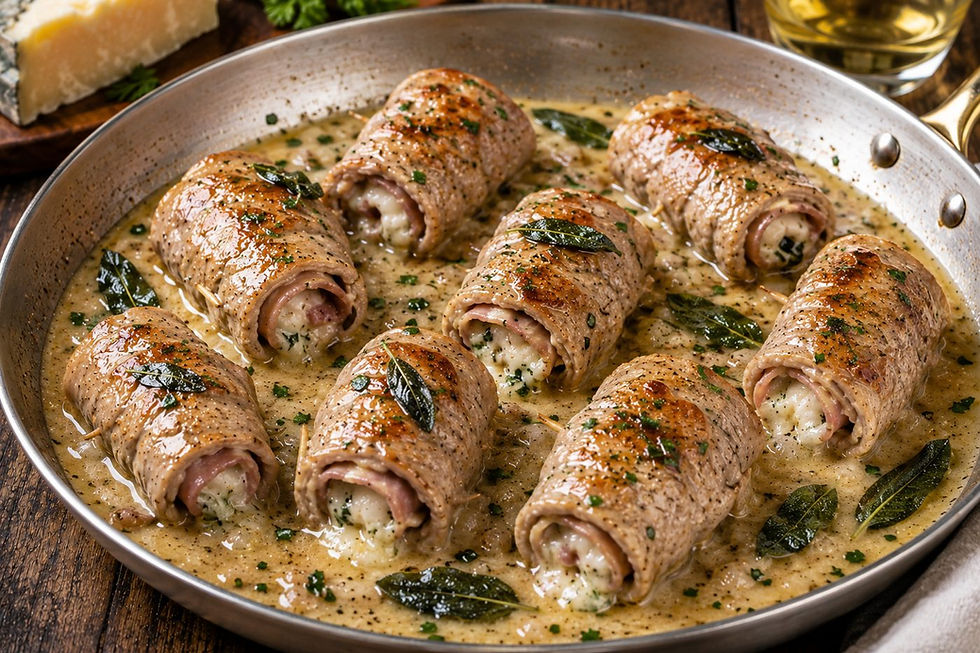
Involtini di vitello alla piemontese are thin slices of veal rolled around prosciutto cotto and Castelmagno, browned in butter and finished in white wine until the cheese inside has softened without escaping. The dish belongs to the Cuneo side of Piedmont, where the veal and the cheese come out of the same valleys.
Everything difficult about it is the cheese. Castelmagno does not behave like the cheeses usually put inside rolled meat. It will not stretch, it will not flow smoothly, and handled badly it breaks into a pool of fat and grain inside the roll. The method below is built around that single fact.
Yield: 4 servings, 8 rolls. Prep: 30 minutes. Cook: 25 minutes. Rest: 5 minutes. Total: about 1 hour. Difficulty: intermediate. Course: secondo piatto. Region: Piedmont, Valle Grana and the Cuneo plain.
The Story
Castelmagno has a paper trail almost no other Italian cheese can match. A dispute between the Marquis of Saluzzo and the mountain communities of the Valle Grana was settled in 1277 with an arbitration that set the rent for the high pastures in wheels of Castelmagno, which means the cheese was already established, already valuable and already worth paying a landlord with. Production is still confined to three small comuni of the valley, Castelmagno, Pradleves and Monterosso Grana, in the province of Cuneo. The cheese has carried DOC status since 1982 and DOP status since 1996, and the wheels made above roughly 1000 metres between the end of spring and the beginning of autumn carry the additional wording di alpeggio, which is the version worth looking for.
The veal comes from the plain below. Piedmont raises the Razza Piemontese, the breed local butchers call fassona, and its meat is famously lean, pale and fine in grain, with very little intramuscular fat. That is a gift for a tartare and a problem for anything cooked, because lean fine grained veal dries at speed and has no fat of its own to carry flavour. Piedmont answered with butter and with dairy, which is why the local kitchen browns in butter where most of Italy browns in oil, and why so many of its veal dishes arrive wrapped around something rich or under something creamy.
The involtino is that answer at its most practical. A slice of fesa pounded thin goes further than a cutlet, the ham inside seasons it, and the cheese supplies the fat the animal never had. It was also the only sensible way to serve a cheese this forceful to a whole family: a wheel of aged Castelmagno on the board defeats most palates, while an ounce of it melted into the middle of a veal roll flatters the meat and asks nothing of anybody. Rich enough for a Sunday, frugal in what it actually uses.
Ingredients
For the veal
Veal top round, fesa, cut into 8 thin slices, 1 1/2 lb (680 g)
Prosciutto cotto, thinly sliced, 4 oz (115 g)
Fresh sage leaves, 8
All purpose flour, for dusting, 3 tbsp (24 g)
Fine sea salt, 1/2 tsp (3 g)
Freshly ground black pepper, to taste
For the Castelmagno filling
Castelmagno DOP, crumbled, 5 oz (140 g)
Heavy cream, 2 tbsp (30 ml)
Unsalted butter, softened, 1 tbsp (14 g)
Fresh breadcrumbs, 2 tbsp (12 g)
Flat leaf parsley, finely chopped, 1 tbsp (4 g)
Freshly ground black pepper, to taste
For the pan and the sauce
Unsalted butter, 3 tbsp (42 g)
Shallot, finely minced, 1 small
Dry white wine, Arneis or another Piedmont white, 2/3 cup (160 ml)
Light veal or chicken stock, unsalted, 1/2 cup (120 ml)
Bay leaf, 1
For finishing
Cold unsalted butter, cubed, 1 tbsp (14 g)
Castelmagno DOP, reserved from the 5 oz above, crumbled, 2 tsp
Flat leaf parsley, chopped, 1 tsp
Flaked sea salt, a small pinch per plate
Preparation
Taste the cheese, then build the filling
Break a piece off the Castelmagno and taste it before you weigh anything. A wheel at 60 to 90 days is milky and only faintly sharp and takes the full 5 oz (140 g); a long aged wheel with visible blue threading can be twice as strong, and there you drop to about 3 1/2 oz (100 g) and let the prosciutto carry more of the filling. Crumble the cheese by hand into irregular grains the size of coarse gravel. Do not grate it and do not slice it. Work in the cream and softened butter with a fork until the grains hold as a rough paste, then fold in breadcrumbs, parsley and pepper. Reserve 2 teaspoons of dry crumbs for the plates and chill the filling.
Flatten the veal
Lay each slice between two sheets of parchment and work it to an even 1/8 inch (3 mm) with the flat side of a mallet, pushing outwards from the centre rather than hammering down. Aim for a rectangle roughly 5 by 3 1/2 inches (13 by 9 cm). Even thickness matters more than size: a slice with a thick shoulder and a thin edge tears at the thin end while the thick end is still raw. Trim ragged edges and season the inner face only: salt on the outside now draws moisture up and blocks browning.
Fill and roll
Lay half a slice of prosciutto cotto on each piece of veal, a finger's width inside the edges so it cannot act as a wick for the cheese. Spoon about 1 tablespoon of filling across the lower third and press it into a compact log. Fold the short sides inwards, then roll up from the bottom, tight but not so hard that the paste squeezes towards the ends. Press a sage leaf onto the seam and secure with a toothpick. Chill 10 minutes so the fat in the filling firms before the pan.
Brown in butter
Dust the rolls lightly with flour and knock off whatever is not clinging. Melt 3 tbsp (42 g) butter in a heavy sauté pan over medium heat, wait until the foam subsides and it smells of hazelnut, then lay the rolls in seam side down with room between them. Brown about 2 minutes a side, turning onto all four faces, roughly 7 minutes in all. Keep the heat at medium: butter past 350F (175C) turns bitter and the flour catches. The seam browning first is what glues it shut.
Deglaze and finish gently
Lower the heat, add the shallot and sweat it a minute without colour, scraping up the browned residue. Pour in the wine, reduce it by half, then add the stock and the bay leaf. Return the rolls, cover and hold the liquid at a bare simmer for 10 to 12 minutes, turning once. Do not let it boil. You are taking the veal to around 145F (63C) at the centre and bringing the cheese to temperature in steam rather than against metal.
Rest, then finish the sauce
Move the rolls to a warm plate, cover loosely and rest 5 minutes, removing the toothpicks now rather than at table. Raise the heat, discard the bay leaf and reduce the liquid until it coats a spoon, then off the heat swirl in the cold butter a cube at a time until glossy. Taste for salt last: prosciutto, stock and Castelmagno have all been contributing.
Plating
Warm the plates to around 120F (50C). The sauce is a butter emulsion and the filling is soft rather than molten, and a cold plate stiffens both within a minute. Do not overheat them either, or the cheese keeps cooking on the plate and begins to weep.
Cut one of the two rolls per person on a slight diagonal to show the spiral of ham and the pale filling in the centre, and leave the second whole beside it. Cut with a thin sharp blade in one stroke; a sawing motion drags the filling out. Spoon the sauce around the base rather than over the top, so the browned surface stays visible and dry. Finish with the reserved Castelmagno crumbs, a little parsley and a pinch of flaked salt. Polenta, soft or grilled in slices, is the Piedmont accompaniment, and braised cardoons or roasted shallots belong here too.
Professional Technique
Castelmagno is a lactic coagulation cheese, and that single fact dictates every decision here. It is not a blue cheese in the sense that Gorgonzola is. Partially skimmed cow's milk from two milkings is set with very little rennet and left to acidify slowly at low temperature, and the broken curd rests in its own acid whey for most of a day before it is drained, pressed and salted. That long acid set pulls calcium out of the casein network, and what remains is a protein matrix that is short and brittle instead of elastic. This is why the cheese is sharp on the tongue and, above all, why it is friable. A rennet set alpine cheese such as Fontina keeps an elastic network and flows into a smooth sheet when warmed. Castelmagno cannot: warm it and it crumbles further and releases its butterfat, because no cohesive network is left to hold the fat in suspension.
The handling follows directly. The cheese never goes into the roll in slices, because a slice has nothing holding it together and disintegrates and leaks. It is crumbled into grains and bound with cream and a little softened butter, which surrounds the grains with a continuous fat phase so the filling behaves as a cream while every grain stays intact. Nor does the cheese ever meet direct heat. Wrapped in veal and prosciutto inside a covered pan, it is only brought to temperature by the steam coming off the meat, which softens it without ever reaching the point where the fat separates out.
Then there is the variability. The blue threading in Castelmagno, when it appears at all, is spontaneous: moulds already in the ageing cellar find their way into the natural cracks of the wheel, and nothing is inoculated. It shows in longer aged wheels and not in young ones, and two wheels from the same dairy can differ noticeably in strength. That is why the first instruction in the preparation is to taste and adjust the weight.
Texture and Moisture Control
Veal fesa is lean, closely grained and almost free of collagen, so there is nothing to turn into gelatin and nothing to gain from long cooking. The window is narrow. Held at a gentle simmer the rolls need 10 to 12 minutes and come out at around 145F (63C), tender and faintly pink at the centre. Pushed past 160F (71C) the muscle fibres contract and expel their water, and no sauce brings that back.
The roll itself is the moisture device. Sealed at the seam by browning, it traps the water leaving the veal and turns the inside into a steam chamber that carries the filling to temperature evenly. That is also why the pan must stay covered and must not boil: a hard boil drives the liquid out, blows the seams open and takes the cheese past softening into separation.
The sauce is a butter emulsion and needs the same restraint. Swirl the cold butter in off the heat and never let the finished sauce boil: reheated hard it splits into a greasy film over watery liquid, and the plate reads as broken even when the meat is perfect.
Professional Mise en Place
The rolls can be built well ahead and everything after that takes about twenty five minutes.
Equipment and tools
Heavy sauté pan with a tight lid, wide enough to hold 8 rolls without touching
Meat mallet with a flat face and parchment sheets for pounding
Toothpicks or kitchen twine, and a small pair of scissors
Instant read thermometer
Fine sieve for the flour and a small saucepan for the stock
Prepared ahead
Castelmagno tasted, crumbled and bound with cream and butter, up to 1 day ahead, refrigerated
Veal slices pounded and layered between parchment, up to 1 day ahead
Rolls assembled and tied, up to 4 hours ahead, covered and refrigerated
Shallot minced and stock measured out, on the day
Service setup
Rolls out of the refrigerator 15 minutes before they go into the pan
Flour in a shallow dish, butter weighed, wine and stock within reach of the stove
Plates at around 120F (50C), never hotter
Cold butter cubes for the sauce kept in the refrigerator until the last moment
Chef Tips
Ask for fesa di vitello cut across the grain at about 1/4 inch (6 mm) so you can finish the flattening yourself. Machine cut slices are often thinner at one end, and a slice already at 1/8 inch tears.
Buy Castelmagno di alpeggio if you can find it, and from a counter that will let you taste. Summer mountain milk and winter dairy milk taste different in the dish: alpeggio wheels are herbaceous where the others are simply salty.
If the filling feels wet when you mix it, add breadcrumbs a teaspoon at a time rather than cutting the cream. The crumbs absorb free moisture and give the paste grip; a loose filling finds its way out at the seam.
Never substitute Gorgonzola. It is a different cheese with a different structure and it flows out of the roll entirely. If Castelmagno is unavailable, a well aged Toma Piemontese or a firm Bra duro comes closer to the right behaviour than any blue.
Common Mistakes
Slicing the cheese instead of crumbling it. A slice of Castelmagno has no elastic network holding it together, so it collapses into fat and grit and runs out of the roll. Crumble it and bind the crumbs with cream and butter.
Melting the cheese before it goes in. Taking Castelmagno to melting point in a pan separates the fat irreversibly. It must be brought to temperature only inside the roll, in steam.
Weighing the cheese without tasting it. Strength varies from wheel to wheel because the veining is spontaneous. Use the full quantity for a young milky wheel and a third less for an old, heavily threaded one.
Boiling instead of simmering. A hard boil blows the seams open, pushes the filling out and takes the veal past 160F (71C), where the lean fibres contract and dry. Keep the surface barely moving under a lid.
Finishing the sauce over the flame. Cold butter swirled into a pan still on the heat splits within seconds. Take the pan off, add the cubes one at a time, and do not reheat the sauce afterwards.
Wine Pairing
Barbera d'Asti DOCG: The most reliable match and the one poured in the region. Barbera carries very high acidity with modest tannin, exactly the right shape here: the acidity cuts the butter emulsion and the fat released by the cheese, while the low tannin leaves the lean veal alone. Its dark cherry fruit sits well beside the prosciutto.
Nebbiolo d'Alba DOC: The elegant choice, and the Nebbiolo to reach for rather than a Barolo, which overwhelms a veal roll. It gives rose and tar aromatics with fine grained tannin and firm acidity. The tannin is just enough to meet the cheese without stripping the meat, and the aromatic lift answers the sage.
Dolcetto d'Alba DOC: The everyday bottle of the Langhe and the softest red here. Low acidity, gentle tannin and plum and almond fruit make it undemanding company for a dish whose interest is textural. Serve it around 60F (16C) so the fruit stays fresh against the butter.
Roero Arneis DOCG: The white answer, from the sandy left bank of the Tanaro, and the wine that also goes into the pan. It has pear and white flower aromatics, a stony finish and enough body to stand next to the cheese, while its acidity keeps the palate clear.
Alta Langa DOCG: Piedmont's own metodo classico, from Pinot Nero and Chardonnay aged on the lees for at least thirty months. Fine persistent bubble and sharp acidity scrub fat from the palate better than any still wine, and the bready autolytic character picks up the browned butter.
Storage & Reheating
Cooked rolls keep refrigerated in an airtight container for up to 2 days, with the sauce in its own jar. Keeping them apart matters: sitting in the sauce overnight the browned surface goes soft and the butter turns waxy.
Reheat in a covered pan with 2 tbsp (30 ml) of stock over low heat for 6 to 8 minutes, turning once. Do not use a microwave, which drives the cheese straight to separation. Warm the sauce separately off the boil, whisking in a teaspoon of cold butter to bring the gloss back.
Assembled uncooked rolls hold 4 hours refrigerated and freeze for up to 1 month, wrapped individually; thaw overnight and cook from cold with 2 minutes added to the covered stage. Do not freeze them cooked, since the filling separates on thawing.
Nutrition
Per serving, based on 4 servings of 2 rolls each:
Calories: 560 kcal
Total Fat: 36 g
Saturated Fat: 20 g
Trans Fat: 1 g
Unsaturated Fat: 13 g
Cholesterol: 185 mg
Sodium: 880 mg
Total Carbohydrates: 9 g
Fiber: 0.5 g
Total Sugars: 2 g
Added Sugars: 0 g
Protein: 46 g
Lactose: 1.8 g
Principal micronutrients: calcium, phosphorus, zinc, selenium, vitamin B12, vitamin A, riboflavin
These figures are estimates. Sodium depends heavily on the prosciutto and on the age of the Castelmagno, and part of the wine and stock stays in the pan.




Comments