
Italian Family: The Squinzi Family and the Global Mapei Empire / La Famiglia Squinzi e l’Impero Globale Mapei
Updated: Aug 29
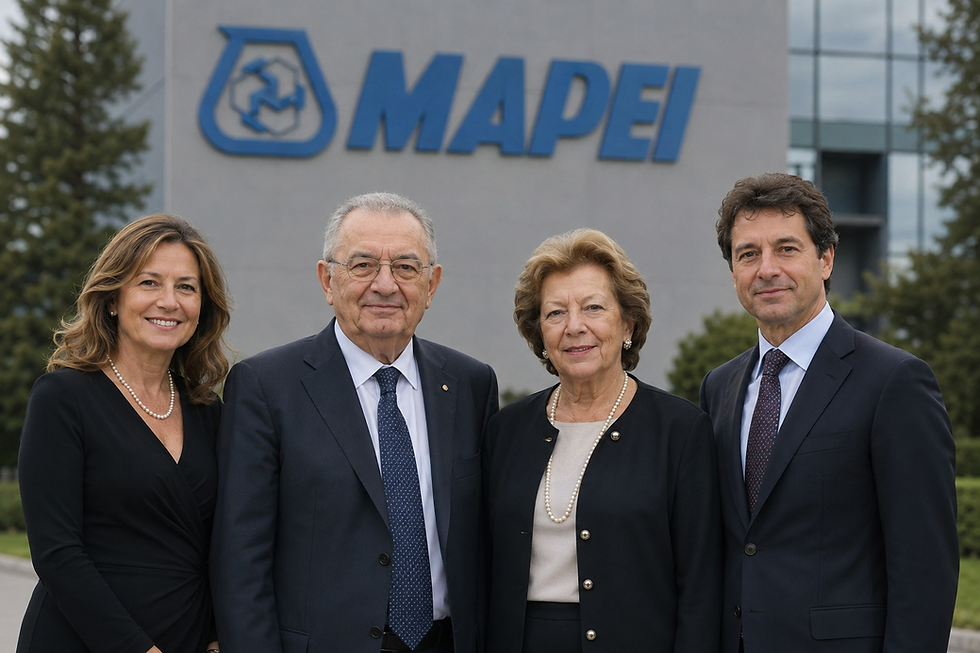
The Squinzi family built Mapei from a small Milanese materials company into one of the world’s most respected names in construction chemicals. Their history is rooted in chemistry, technical assistance, research and an unusual willingness to reinvest patiently in factories, laboratories, sport and international expansion. The dynasty demonstrates how a highly specialized industrial product can become a global family empire without becoming a consumer brand in the conventional sense.
Rodolfo Squinzi and 1937 Milan
Rodolfo Squinzi founded Mapei in Milan in 1937. The company began with materials for construction and flooring, operating in a sector where reliability matters more than glamour. The Mapei name itself emerged from the company’s original industrial purpose, and the business developed around a technical promise: products had to solve real problems for builders, architects and installers.
Chemistry as Competitive Advantage
Adhesives, mortars, waterproofing systems and concrete additives appear ordinary until they fail. Mapei built its reputation by treating them as advanced chemistry. Research laboratories, formulation expertise and field testing became the true engine of the company. This scientific culture allowed the group to compete on performance rather than merely price.
Giorgio Squinzi
Giorgio Squinzi, trained as an industrial chemist, transformed the company into an international group. His leadership combined technical knowledge with aggressive but disciplined expansion. He understood that construction chemistry is local in application but global in opportunity: buildings everywhere require adhesives, waterproofing, restoration and concrete technologies.
Adriana Spazzoli
Adriana Spazzoli became a central figure in the family enterprise, contributing to management, communication and institutional continuity. The partnership between Giorgio and Adriana reinforced the idea that the company was not simply controlled by a surname but organized as a family institution with distinct responsibilities.
International Expansion
Mapei expanded through Europe, North America, Asia and the Middle East, building factories close to markets rather than relying only on exports from Italy. Local manufacturing reduces transport costs, adapts formulations to climate and regulation, and gives customers technical support near construction sites. This geographic model created resilience and scale.
Restoration and Cultural Heritage
Mapei products have been used in restoration projects and major cultural sites, reinforcing the company’s connection with Italian architectural heritage. Restoration demands extraordinary compatibility between old materials and modern chemistry. Success in this field gave Mapei prestige while proving the seriousness of its research capabilities.
Cycling and Mapei Sport
The famous Mapei cycling team made the company visible far beyond construction. Sport sponsorship became part of corporate culture rather than a superficial marketing expense. Mapei Sport later developed scientific work around athletic performance, reflecting the family’s broader interest in measurement, research and disciplined improvement.
Sassuolo Calcio
The family’s ownership of Sassuolo Calcio extended this connection with sport and local territory. Building the club and investing in facilities demonstrated a long-term approach similar to the industrial business: develop infrastructure, professionalize systems and accept that durable results require time.
Giorgio Squinzi and Confindustria
Giorgio’s presidency of Confindustria placed him at the center of Italian industrial policy. His public role gave the family influence on questions involving manufacturing, labor, competitiveness and European industry. Unlike political dynasties, the Squinzis exercised influence through industrial credibility and institutional leadership.
Succession After 2019
The deaths of Giorgio and Adriana in 2019 created an immediate succession test. Veronica and Marco Squinzi assumed major executive responsibilities while Laura Squinzi took a leading governance role. The transition showed that succession had been prepared institutionally rather than left to improvisation.
Sustainability and the Construction Transition
Construction is under pressure to reduce emissions, improve energy efficiency and use materials more intelligently. Mapei’s future depends on lower-carbon products, circularity, digital specification and technologies compatible with modern building systems. The same research culture that built the company must now solve environmental problems.
Why the Squinzi Family Still Matters
The Squinzi family matters because Mapei proves that Italian family capitalism can create global leadership in a technical business far removed from fashion or food. Their empire was built on chemistry, factories, customer service and research. The next generation’s task is to preserve that industrial discipline while adapting to a construction sector increasingly shaped by sustainability and digital design.
The Economics Behind the Dynasty
Squinzi / Mapei should be understood not simply as a famous surname but as an ownership system operating in construction chemicals. The family’s economic power was created by accumulating capabilities that competitors cannot reproduce quickly: technical knowledge, brands, supplier relationships, distribution, institutional credibility and patient capital. Its historical base in Milanese industrial chemistry gave the enterprise a recognizable center, but scale required converting local expertise into repeatable systems. That transition is the difference between a successful founder and a durable dynasty. The family’s real asset is therefore not one product or one factory; it is the ability to organize capital and knowledge across generations while protecting the qualities that originally made the business distinctive.
Ownership, Control and Capital Allocation
The central question for every mature business family is what ownership is supposed to accomplish. In the case of Squinzi / Mapei, the model can be described as multigenerational family ownership supported by professional technical management. Family control is valuable only when it produces advantages that outside ownership would struggle to provide: longer investment horizons, consistency of identity, willingness to protect strategic assets through difficult cycles and the ability to make decisions without reacting to every short-term market signal. But concentrated ownership also creates risk. Emotional attachment can delay restructuring, relatives can disagree over dividends or strategy, and inherited voting power does not guarantee industrial competence. The family must therefore treat capital allocation as a professional discipline, not as an extension of family tradition.
Brands, Assets and Competitive Moats
adhesives, mortars, waterproofing, concrete systems, Polyglass, research laboratories and international factories form the visible part of the family’s industrial system. Their value comes from more than accounting. A respected brand lowers the cost of consumer trust; a specialized factory preserves knowledge; a distribution network creates market access; a long relationship with suppliers improves resilience. These advantages reinforce one another. Competitors may copy a product, but reproducing decades of credibility and operating knowledge is much harder. This is why the best Italian family companies often defend seemingly old-fashioned capabilities. Craft, chemistry, agriculture, engineering or local production can remain economically powerful when they are combined with modern logistics, data, finance and international management.
The Role of Professional Management
No contemporary group of this complexity can be managed successfully by relatives alone. Professional executives are necessary because international regulation, digital systems, finance, supply chains and specialized operations require expertise that cannot be inherited. The strongest family governance therefore separates ownership legitimacy from executive qualification. A descendant may be an important shareholder without being the best chief executive, scientist, winemaker, engineer or commercial director. For Squinzi / Mapei, professionalization should not be interpreted as weakening family influence. It is the mechanism that allows family influence to survive. Owners set long-term priorities and appoint capable leaders; managers execute with measurable responsibility.
Succession as an Institutional Test
Succession is frequently described as a question of identifying the next family leader, but that framing is too narrow. The real task is to build a system that remains functional even if no descendant has the personality or expertise of the previous generation. Share-transfer rules, boards, family councils, liquidity mechanisms, employment policies and conflict-resolution processes become essential as the number of heirs increases. Squinzi / Mapei will be strongest when future generations see ownership as a responsibility rather than an entitlement. The family must teach heirs how to read financial statements, understand risk, evaluate management and protect reputation before giving them meaningful influence over strategic decisions.
Internationalization Without Losing Italy
Italian family companies face a permanent tension between global scale and geographic identity. International markets provide growth, talent and diversification, yet the strongest brands often derive part of their value from a very specific Italian origin. For Squinzi / Mapei, Milanese industrial chemistry is therefore more than history. It is a source of credibility. The challenge is to internationalize management, distribution and capital without becoming culturally anonymous. When a company loses the operational substance behind Made in Italy, the phrase becomes advertising rather than competitive advantage. Maintaining an Italian center does not require keeping every activity at home, but it does require protecting the capabilities for which the group is respected.
Technology and Artificial Intelligence
Technology will change the operating model without eliminating the importance of human judgment. Artificial intelligence can improve forecasting, customer segmentation, quality control, research, predictive maintenance, inventory management and administrative efficiency. Data can reveal patterns that were previously invisible. Yet technology cannot automatically reproduce institutional trust, taste, scientific judgment or craftsmanship. The strategic question is therefore not whether Squinzi / Mapei should use AI, but where AI creates measurable advantage without damaging the knowledge that differentiates the business. Families with long time horizons can benefit because they are able to invest in systems gradually rather than treating technology as a short-lived trend.
Sustainability as Industrial Strategy
Environmental pressure increasingly affects financing, regulation, consumer expectations and operating cost. Sustainability therefore has to move from communications into capital expenditure and product design. Energy, packaging, transport, water, raw materials and supplier standards all create risks that vary by sector. The family’s long horizon can be an advantage because many environmental investments pay back over years rather than quarters. The challenge is to avoid symbolic initiatives that do not change the underlying economics. For Squinzi / Mapei, credible sustainability means measuring impact, redesigning processes and treating resource efficiency as a source of competitiveness rather than as a separate philanthropic activity.
Reputation and Public Responsibility
A major family surname becomes a public institution even when the company remains privately controlled. Employees, suppliers, communities, regulators and customers interpret corporate decisions as reflections of the family itself. This creates reputational leverage but also reputational exposure. A quality failure, governance dispute or ethical problem can move rapidly from one subsidiary to the entire family identity. The reverse is also true: decades of disciplined behavior can create trust that helps the group during crises. Squinzi / Mapei therefore has to protect reputation through systems, transparency and strong controls rather than assuming that history will automatically generate goodwill.
The Next Decade
The defining challenge for the next decade is decarbonizing construction, digital specification, global competition and succession. None of these issues can be solved through nostalgia. Historical prestige creates permission to compete, not a guarantee of future relevance. The family must continue investing in new products, people and systems while knowing which traditions are genuinely strategic and which are simply familiar. The strongest dynasties are conservative about values but flexible about methods. If Squinzi / Mapei can preserve ownership discipline, professional management and a clear sense of industrial purpose, the family will remain important not because of what previous generations built, but because the institution continues to create value under new conditions.
The Business Model Behind the Family
Squinzi is best understood not as a famous surname but as an ownership system. Its roots in Milan and Sassuolo gave the family a distinctive industrial or cultural identity, while growth in construction chemicals, materials science and industrial manufacturing required much more than heritage. The company had to convert tacit knowledge into repeatable processes, professional management and capital allocation. That distinction matters because many family firms remain excellent local businesses but never become durable international institutions. Squinzi created scale by combining recognizable identity with structures capable of operating beyond the founder. The family advantage comes from patience: owners can protect strategic assets through weak cycles, invest in capabilities whose returns take years to appear and resist financial decisions that would improve one quarter while damaging the next generation. Yet family ownership is valuable only when discipline remains stronger than sentiment. The same patience that supports long-term investment can become inertia if weak products, managers or businesses are protected simply because they are historically familiar.
How the Family Creates Economic Power
The family’s strength today rests on Mapei’s research culture, global factories, technical assistance and family continuity. Those assets reinforce one another. A respected name lowers the cost of trust. Specialized factories or laboratories protect know-how. Long supplier relationships improve resilience. Distribution gives the company access to customers competitors may struggle to reach. Financial credibility makes it easier to invest during downturns. This is the real architecture of a dynasty: not one famous object, but a network of advantages accumulated over decades. The most important assets are often invisible on a balance sheet. Reputation, technical judgment, employee experience and relationships with regulators, retailers, physicians, chefs, designers, engineers or distributors can be worth more than physical machinery. They also take far longer to rebuild after a mistake. For that reason, serious family governance must treat reputation and institutional knowledge as forms of capital that require protection just as carefully as cash, property or trademarks.
Family Ownership Versus Professional Management
As businesses internationalize, ownership and management must become separate disciplines. A descendant can be an important shareholder without automatically being the best chief executive, creative director, scientist or commercial leader. The strongest family groups understand this early. They define what the family is uniquely qualified to protect—purpose, capital structure, values, long-term risk—and allow professional executives to manage areas requiring specialized expertise. This is especially important for Squinzi, because construction chemicals, materials science and industrial manufacturing now operates through complex regulation, technology, global supply chains and institutional relationships. Family members who enter management should meet the same standards expected from outsiders. Anything less eventually damages both company performance and the credibility of the dynasty. Professionalization is therefore not a surrender of family control. It is the mechanism that allows control to remain meaningful after the founder generation disappears.
Succession Is More Than Choosing an Heir
Succession is often described too simply as deciding who becomes the next leader. Mature dynasties face a more difficult question: how can the company remain coherent when ownership spreads among cousins, grandchildren and different family branches? The solution requires formal rules for share transfers, board appointments, dividends, family employment, conflicts of interest and liquidity. Without those mechanisms, even a profitable company can be destabilized by disagreements among heirs. Squinzi will be strongest when future generations are educated as owners before they are given power. They need to understand financial statements, leverage, risk, brand equity, competitive positioning and the consequences of selling strategic assets. A surname is not an operating qualification. The family’s task is to create an institution in which a weak generation cannot easily destroy what a strong generation built.
Italy as a Strategic Asset
The connection with Milan and Sassuolo is not decorative history. It is part of the economic proposition. Italian companies often command premium prices because consumers associate specific territories with craftsmanship, design, food culture, engineering or scientific tradition. But geography creates value only when real capabilities remain behind the story. If production knowledge, technical standards and creative authority disappear, Made in Italy becomes a slogan rather than a competitive advantage. The challenge for Squinzi is therefore to internationalize without becoming culturally generic. Global executives, factories, stores and research centers may be necessary, but the company still needs a believable center of gravity. The strongest Italian dynasties use international scale to amplify their origin rather than erase it.
Technology, Data and Artificial Intelligence
Artificial intelligence will change almost every part of construction chemicals, materials science and industrial manufacturing, but it should be treated as industrial infrastructure rather than fashion. Forecasting, inventory, quality control, customer segmentation, research, predictive maintenance, logistics and administrative processes can all improve when data is used intelligently. The danger is confusing automation with judgment. Algorithms can identify patterns, but they do not automatically understand cultural identity, scientific responsibility, luxury desire or the tacit knowledge of an experienced artisan. For Squinzi, the strongest use of AI will be selective: automate repetitive analysis, improve speed and reduce waste, while keeping decisive creative, technical and ethical judgments in human hands. Family ownership can be useful here because the company does not need to chase every technological trend immediately. It can invest where the long-term economics are clear and ignore tools that create noise without competitive advantage.
Sustainability as Capital Allocation
Environmental responsibility has moved from public relations into operating strategy. Energy, water, packaging, transportation, agricultural inputs, chemicals, raw materials and supplier standards increasingly affect regulation, financing and consumer trust. The correct question is not whether Squinzi should have a sustainability program; it is where environmental constraints will alter the economics of the business. Long-lived family ownership can be an advantage because some improvements require years of investment before returns are visible. Better factories, lower-carbon materials, regenerative agriculture, circular packaging or more efficient logistics often demand capital before they create savings. The family should evaluate these investments with the same seriousness used for acquisitions or new factories. Symbolic projects are not enough. Sustainability becomes credible only when it changes product design, procurement, energy use and capital expenditure.
Reputation, Public Influence and Responsibility
Once a family controls a company of national or international importance, private decisions acquire public consequences. Employees, suppliers, communities, regulators and customers interpret corporate behavior as a reflection of the surname itself. This gives Squinzi reputational leverage but also makes mistakes more expensive. A governance scandal, product failure or labor controversy can move instantly from one subsidiary to the entire family identity. The opposite is equally true: decades of disciplined conduct can create institutional trust that helps a company during crises. The family therefore cannot rely on history alone. Reputation must be protected through internal controls, transparent decision-making, capable boards and clear accountability. The most durable dynasties understand that public credibility is an asset that can be inherited but can also be destroyed in a single generation.
The Strategic Question for the Next Decade
The central challenge ahead is decarbonizing construction, succession, digital specification and maintaining technical superiority at global scale. Historical prestige does not solve any of these problems by itself. The next decade will reward families capable of distinguishing between traditions that create value and habits that merely feel familiar. Strong dynasties are conservative about identity but flexible about methods. They preserve what competitors cannot copy—craft, technical knowledge, trust, territory, brand codes—and change everything else when economics demand it. Squinzi does not need to imitate conglomerates or technology companies, but it does need the same quality of data, management and capital discipline. If the family can maintain a long-term horizon while accepting professional challenge from outside managers and directors, ownership will remain an advantage rather than a constraint.
Zafferano & Co. Editor


Comments