
Fresh Spaghetti alla Chitarra with Pesto Genovese and Toasted Pine Nuts | Spaghetti alla Chitarra al Pesto Genovese e Pinoli Tostati
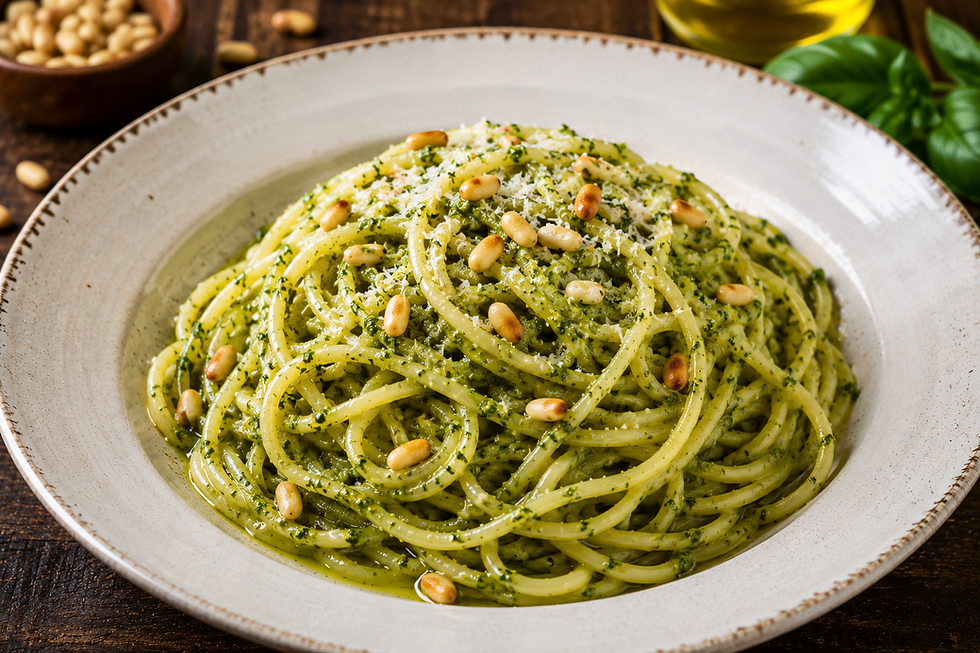
Spaghetti alla chitarra come from Abruzzo and pesto genovese comes from Liguria, so putting the two together is not tradition. It is a decision about surface. The chitarra cuts a strand with a square section and four live edges, and those edges hold a thick basil paste in a way that a round extruded spaghetto never manages.
Nothing else here is complicated: seven ingredients in the sauce, no cream, no butter, no heat on the pesto at any point, and pine nuts out of the pan in seconds rather than minutes.
Yield: 4 servings. Prep: 45 minutes. Rest: 30 minutes. Cook: 4 minutes. Total: about 1 hour 20 minutes. Difficulty: intermediate. Course: primo piatto. Regions: Abruzzo for the pasta, Liguria for the sauce.
The Story
The chitarra is a tool before it is a pasta. It is a shallow wooden box strung with parallel steel wires, and it takes its name from the guitar it looks like, close enough that the older ones were built by the same village carpenters who repaired instruments. It belongs to Abruzzo, and the Chieti and Teramo hills claim it most loudly. A sheet of egg dough is laid across the wires and pushed through with a rolling pin, and the wires cut it into strands while the frame underneath catches them. The spacing of the wires decides everything: wide for maccheroni alla chitarra, narrow for the finer spaghetti version used here.
Pesto genovese sits at the other end of the country and comes out of a completely different logic. Genoa built it from what grew on the terraces above the city: small leaved basil from Pra, garlic from Vessalico, pine nuts from the maritime pines, sheep cheese carried over from Sardinia and its own soft green olive oil. Ligurian oil is milder and far less peppery than a Tuscan or a Pugliese one, and the sauce depends on that, because a bitter oil doubles the bitterness already sitting in the basil and the garlic. Before the basil version there was agliata, a garlic and walnut paste that sailors ate because it kept. The mortar came first and the sauce was designed around it, which is why the texture of real pesto is bruised and slightly uneven rather than smooth.
In Liguria the sauce goes on trenette or on trofie, and both of those shapes exist for one reason: they carry a paste that has no liquid in it and no way to cling by itself. Chitarra does the same job by a different route. The traditional Ligurian answer is a twisted or a flat strand; the Abruzzese answer is a squared one. Neither region was thinking about the other, and the meeting is a modern one, but it is not arbitrary. The chitarra was built for egg dough and the sauce was built for a mortar, and both were built by people who owned one tool and used it for everything.
Ingredients
For the chitarra pasta
Italian 00 flour, 1 3/4 cups (220 g)
Semola rimacinata di grano duro, 3/4 cup (120 g)
Whole eggs, large, 3
Egg yolk, large, 1
Fine sea salt, 1/2 tsp (3 g)
Water, 1 to 2 tsp (5 to 10 ml), only if the dough stays dry
Semola rimacinata for dusting, about 1/4 cup (40 g)
For the pesto genovese
Genovese basil leaves, small and young, 3 oz (85 g), about 4 packed cups
Pine nuts, Mediterranean, 1/4 cup (35 g)
Garlic clove, peeled and green core removed, 1 large
Parmigiano Reggiano, grated, 2 oz (55 g)
Fiore Sardo or aged Pecorino Sardo, grated, 3/4 oz (20 g)
Ligurian extra virgin olive oil, mild, 1/2 cup (120 ml)
Coarse sea salt, 1/2 tsp (3 g)
For finishing
Pine nuts for the garnish, 2 tbsp (18 g)
Reserved pasta cooking water, about 1/2 cup (120 ml)
Coarse salt for the pasta water, 2 tbsp (36 g) for 5 quarts (4.7 l)
Parmigiano Reggiano for the table, 1 oz (30 g)
Extra virgin olive oil, a few drops per plate
Freshly ground black pepper, to taste
Preparation
Step 1
Mix the dough. Put the 00 flour and the semola in a wide bowl, make a well and add the eggs, the yolk and the salt. Work the eggs into the flour with your fingertips, then bring it together and knead for a full 10 minutes. Semola makes the dough feel harsh at the start and it needs the time. Add water a teaspoon at a time only if it refuses to come together. You want a dough that is firm, smooth and slightly springy under the thumb.
Step 2
Rest it properly. Wrap the dough tightly and leave it at room temperature for 30 minutes, longer if the kitchen is cold. The gluten relaxes and the durum flour finishes absorbing water, and a rested dough rolls out to an even thickness. A dough taken straight to the pin fights you and comes out thick in the middle and thin at the edges, which means uneven strands and uneven cooking.
Step 3
Roll the sheets. Cut the dough into four pieces and keep three covered. Roll the first out on a dusted board to about 1/12 inch (2 mm) thick, or the second thickest setting on a pasta machine. Two millimetres is the number that matters: a thinner sheet slips between the wires without cutting cleanly, a thicker one will not go through at all. Trim the sheet to the width of the frame.
Step 4
Cut on the chitarra. Dust the sheet lightly with semola, lay it across the wires and press down with the rolling pin in firm single passes from one end to the other. The strands drop into the frame below. Lift them out, toss them in semola and gather them into loose nests on a tray. Repeat with the rest, and leave the nests uncovered so the surfaces dry slightly and stop sticking.
Step 5
Toast the pine nuts. Put all the pine nuts, pesto and garnish together, in a dry pan over medium low heat and keep them moving. They need 2 to 3 minutes, no more. Take them out the moment they smell nutty and show the first blond colour, and tip them onto a cold plate. Left in the hot pan they keep cooking. Set aside the 2 tablespoons for the garnish.
Step 6
Pound the pesto. Crush the garlic with the coarse salt in a marble mortar to a paste, then add the pine nuts for the pesto and work them in. Add the basil a handful at a time, crushing with a circular movement against the wall of the mortar rather than pounding straight down. Once it is a dense green paste, work in both cheeses, then pour in the oil in a thin stream while turning the pestle. Set it aside at room temperature.
Step 7
Cook the pasta and combine. Bring 5 quarts (4.7 l) of water to a rolling boil, salt it and drop the nests in. Fresh chitarra needs 3 to 4 minutes. Reserve 1/2 cup (120 ml) of the water. Meanwhile loosen the pesto in a wide warm bowl with 3 tablespoons of that water, stirring until it turns glossy. Drain, tip the pasta into the bowl and toss hard for 30 seconds off the heat, adding water a spoonful at a time until every strand is coated. Never return the pan to the flame.
Plating
Use warm bowls, not hot ones. A bowl out of a warming drawer keeps heating the pesto from below and the basil darkens while the plate crosses the room. Warm them with hot tap water, dry them and let them stand a minute. Twist each portion into a loose mound with a carving fork and a ladle, lifting from the middle so the strands stack rather than lie flat.
Scatter the reserved pine nuts over the top at the last moment so they stay dry and audible. Add a few drops of raw olive oil, a turn of black pepper and nothing green: a basil leaf on a basil sauce adds nothing and wilts in seconds. Send the Parmigiano Reggiano to the table separately. The plate should read bright green, not olive, and reach the table inside a minute.
Professional Technique
The whole reason this pairing works is the cross section of the strand. Extruded spaghetti leaves a bronze or a teflon die as a cylinder, a continuous curved surface with no interruption along it. A dense sauce with no free liquid, which is what pesto is, has nothing to catch on and slides to the bottom of the bowl. The chitarra cuts instead of extruding, and it cuts with tensioned steel wire, so the strand comes off square, with four flat faces and four sharp edges running its whole length. Each edge is a break in the surface where a paste stops moving, and the two cut faces are torn rather than sliced, which leaves them microscopically rough. That roughness releases starch into the water and grips the basil oil in the bowl.
The second point is the pine nuts, and the margin there is smaller than almost anywhere else in Italian cooking. Pine nuts carry a high proportion of fragile unsaturated oil and little of the structure that lets an almond or a hazelnut sit in a pan. They go from raw to sweetly toasted to flatly bitter across maybe twenty seconds, and the bitterness is not a note you can bury: it compounds with the bitter edge already in the basil and the garlic, and the pesto is finished. Keep them moving in a dry pan over medium low heat, pull them at the first hint of blond colour and nutty smell, and tip them onto a cold plate at once, because the pan keeps toasting after the flame is out. Toast a few more than you need and taste one.
Texture and Moisture Control
Pesto contains no water, and that single fact governs everything that happens in the bowl. On its own it is a paste, and a paste dropped onto drained pasta coats the top strands and leaves the rest bare. The starchy cooking water is what turns it into a sauce: the dissolved starch lets the oil and the water hold together in a loose emulsion that clings. Add it in stages, three tablespoons into the pesto first and then a spoonful at a time while tossing, and stop while the sauce still looks slightly too loose. It tightens on the way to the table.
Temperature is the other control, and it runs the opposite way to most pasta dishes. Basil holds its colour and its aroma below about 140°F (60°C) and loses both above it, turning bronze and smelling of hay. The residual heat in drained pasta warms the sauce without cooking it, which is why the tossing happens off the flame and the bowl is warm rather than hot. Fresh chitarra carries more surface water than dried pasta, so drain it properly and never rinse it, and remember a 2 mm strand keeps cooking for a minute out of the pot.
Professional Mise en Place
Pasta and pesto can both be ready long before service, but the final toss lasts thirty seconds. Set up so nothing needs looking for once the pasta hits the water.
Equipment and tools
Chitarra frame with narrow wire spacing, long wooden rolling pin
Marble mortar and wooden pestle, kept cool
Pasta pot holding at least 5 quarts (4.7 l)
Trays dusted with semola, wide warm mixing bowl
Spider or tongs, carving fork and ladle
Prepared ahead
Nests cut and dusted with semola, up to 4 hours at room temperature
Pine nuts toasted and cooled on the day, garnish kept separate
Cheeses grated and mixed, 1 day ahead, covered and cold
Pesto pounded up to 4 hours ahead, sealed under oil
Salted water at a rolling boil and tasted
Service setup
Pesto out of the refrigerator 30 minutes ahead, never cold
Ladle and a jug of reserved cooking water within reach
Bowls warmed with hot water, dried, left to cool slightly
Garnish pine nuts, olive oil and pepper mill at the pass
Grated Parmigiano Reggiano in a bowl for the table
Chef Tips
Buy the smallest basil leaves you can find and use them the same day. Large mature leaves carry more bitterness and a faint mint character that shows immediately in a raw sauce. Tear out the central rib if the leaves are big.
Chill the mortar and pestle for twenty minutes first. A cool mortar keeps the friction of pounding from warming the basil, which is where that bronze colour starts. Work in short bursts and stop while the paste is still uneven.
With no chitarra, roll the sheet to 2 mm, dust it, fold it loosely and cut it by hand with a broad knife. You lose two of the four live edges but keep the rough faces and the thickness. Avoid a machine spaghetti attachment, which rounds the profile.
Taste for salt only after the cheeses go in, and again after the pasta water. Parmigiano and Fiore Sardo are both salty, the cooking water is salty, and a pesto seasoned in the mortar often needs nothing more.
Common Mistakes
Heating the pesto in a pan. The sauce is raw by definition and goes grey green over a flame within seconds. All the warmth it needs comes from the drained pasta. Toss in a bowl off the heat, never in the pot.
Rolling the sheet too thin. Below about 2 mm the dough slides between the wires instead of being cut and you get ragged half separated ribbons. Measure the first sheet against the wire spacing before rolling the rest.
Using a blender for the pesto. Steel blades cut the basil rather than bruising it and the motor heat speeds oxidation, so the sauce darkens in the jug. With no mortar, chill the bowl and pulse in very short bursts.
Skipping the rest on the dough. A semola dough taken straight to the pin springs back, tears and rolls unevenly, giving strands of three thicknesses in one pot. Thirty minutes wrapped at room temperature fixes it.
Draining the pasta dry. Pesto has no water and cannot become a sauce without the starch from the cooking water. Reserve half a cup before draining, every time, and add it gradually.
Wine Pairing
Riviera Ligure di Ponente Pigato DOC: The bottle this sauce grew up next to, from the terraces behind the same coast as the basil. Pigato has a broader body than most coastal whites and finishes on a resinous bitter almond note that runs alongside the pine nut rather than arguing with it. Its acidity cuts the olive oil and the sheep cheese.
Cinque Terre DOC: The leaner Ligurian answer, a blend led by Bosco with Albarola and Vermentino behind it. A saline, almost stony quality acts as a foil to the fat of the emulsion, with very little aromatic weight, which matters when the dish is already this fragrant. Pour it young and cold.
Gavi DOCG: Cortese from just over the Ligurian border in southern Piedmont, historically the wine that travelled down to Genoa. High acidity, low alcohol and a green apple profile give it the incisiveness a bowl coated in oil needs, and no oak leaves the basil untouched.
Offida Pecorino DOCG: From the Marche, the nearest serious white to the pasta's Abruzzese home. Pecorino is unusually structured for a central Italian white, with body, a herbal anise edge and a saline length that carries both cheeses. Choose an unoaked bottling: even a little wood turns heavy against a raw sauce.
Cerasuolo d'Abruzzo DOC: The Abruzzese rosato, from Montepulciano and much firmer than its colour suggests. A light tannic grip and sour cherry acidity stand up to the garlic and the cheeses better than a delicate white, while staying dry enough not to weigh on the basil.
Storage & Reheating
Store the components, never the finished plate. Pesto keeps refrigerated in a small jar for 3 days if the surface is sealed under a thin layer of olive oil, and it freezes for 3 months in ice cube trays without the cheeses: add those after thawing. Uncooked nests hold 24 hours refrigerated on a semola dusted tray under a cloth, or freeze solid and then bag them for 2 months, cooked from frozen with one extra minute.
Dressed pasta does not reheat. A microwave cooks the basil and a pan does it faster, and either way the emulsion breaks and the oil pools. Eat leftovers at room temperature within a few hours, or turn them into a frittata di spaghetti: bind the cold pasta with two beaten eggs and a little grated Parmigiano and cook it slowly until both faces are set and golden.
Nutrition
Per serving, based on 4 portions:
Calories: 810 kcal
Total Fat: 47 g
Saturated Fat: 10 g
Trans Fat: 0 g
Unsaturated Fat: 35 g
Cholesterol: 185 mg
Sodium: 690 mg
Total Carbohydrates: 70 g
Fiber: 4 g
Total Sugars: 3 g
Added Sugars: 0 g
Protein: 27 g
Lactose: 0.4 g
Principal micronutrients: vitamin K, vitamin E, manganese, magnesium, calcium, phosphorus, copper
These figures are estimates. Most of the salt in the cooking water is discarded, and the real sodium depends on the cheese added at the table.



Comments