
Italian Florentine Lampredotto | Lampredotto Fiorentino
Updated: Sep 13

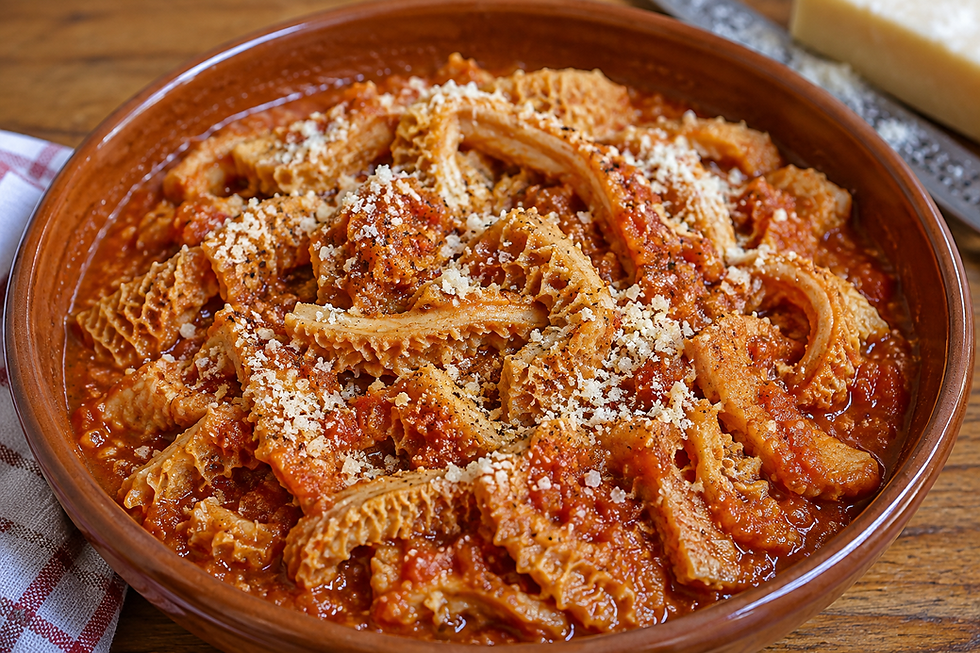
Lampredotto is the abomasum, the fourth and last stomach of the cow, and in Florence it is almost never eaten with a fork. It is eaten standing up, in a roll, bought from a trippaio at a cart parked on a corner of the Mercato Centrale or outside Sant Ambrogio. That single fact organises everything about the recipe. The meat is not braised dry in a pan and then sauced. It sits for hours in a pot of tomato broth kept just below a simmer, and it is lifted out only when someone orders, chopped hot on the board and dropped straight into bread.
What follows is written for that service, not for a dinner plate. The broth is treated as an ingredient rather than as cooking water, because it does three jobs at once: it cooks the meat, it holds the meat warm and wet for the length of a working day, and it wets the bread at the last second. Get it right and the panino works. Get it wrong and you have dry offal in a dry roll.
Serves 6. Prep: 25 minutes. Cook: 3 hours. Total: 3 hours 25 minutes.
The Story
The trippai of Florence are a licensed trade, not a recent street food fashion. Carts selling boiled offal were working the city from at least the fifteenth century, and by the nineteenth the banchi were fixed points of the working day: a hot roll for the porters at the Mercato Centrale, for the leather workers of Santa Croce, for the dyers along the Arno. The meat was cheap because the abomasum was the least valued of the four stomachs, the one the butcher wanted off his counter. The city built a whole ritual around it.
The name points at an old resemblance. The fringed, pleated edge of the abomasum was said to recall the lamprey, the lampreda that once ran up the Arno, and the word stuck long after the fish stopped being fished there. Florentines still keep two dialect names for the parts they get in the roll: the spannocchia, the fatter, softer strip, and the gala, the leaner one that holds more bite. A good trippaio will ask which you want.
What has never changed is the format. No kitchen, no plate, no table. A pot, a board, a pair of scissors, a bowl of salsa verde and a stack of rolls. The banchi still working today, at Porta Romana or in via dei Macci, use exactly those five objects, and the queue at noon is made of office workers standing next to bricklayers.
Ingredients
For the lampredotto and the broth
Cleaned beef abomasum, 3 lb (1.35 kg)
Yellow onion, halved, 1 large
Carrots, roughly chopped, 2 medium
Celery stalks with leaves, roughly chopped, 2
Ripe tomatoes, quartered, 2 (about 10 oz / 280 g)
Tomato paste, 1 tbsp (16 g)
Flat leaf parsley with stalks, 1 small bunch
Bay leaf, 1
Black peppercorns, whole, 8
Kosher salt, 1 tsp (6 g), plus more as needed
Cold water, about 4 quarts (3.8 l)
For the salsa verde
Flat leaf parsley leaves, tightly packed, 1 cup (30 g)
Garlic clove, peeled, 1
Anchovy fillets in oil, drained, 2
Capers in salt, rinsed, 1 tbsp (9 g)
Hard boiled egg yolk, 1
Stale bread crumb, soaked in vinegar and squeezed, 1 tbsp (10 g)
Red wine vinegar, 2 tbsp (30 ml)
Extra virgin olive oil, Tuscan, 1/2 cup (120 ml)
Freshly ground black pepper, to taste
For the panini
Crusty Florentine semelle or other firm crusted rolls, 6
Hot lampredotto broth for dipping, about 2 cups (480 ml)
Salsa verde, from above
Tuscan hot sauce or crushed red pepper, optional
Flaky salt and coarsely ground black pepper, for finishing
Preparation
Rinsing and trimming the abomasum
Rinse the cleaned lampredotto under cold running water and open out the folds so nothing is trapped inside them. Trim only hard, gristly edges and any lump of fat that is obviously solid. Leave the soft fatty tissue attached: it is where most of the succulence comes from, and a piece stripped completely bare will taste lean and papery no matter how long it cooks. Keep the fatter spannocchia and the leaner gala in separate pieces if your butcher has given you both, because they will finish at slightly different times and you want to lift each one when it is ready.
Building the tomato broth
Put the onion, carrots, celery, quartered tomatoes, tomato paste, parsley stalks, bay leaf, peppercorns and salt into a tall stockpot and cover with the cold water. Bring it up slowly and let it tick over for 20 minutes, until the kitchen smells of celery and tomato and the liquid has taken a faint orange colour. This is not a stock in the French sense and it should not be reduced or clarified. It wants to stay light, tomato scented and pourable, because it will later go into bread and must not set to jelly as it cools on the crumb.
The long simmer
Lower the lampredotto into the broth so it is fully covered, bring the pot back to the barest movement on the surface and leave the lid half on. Cook 2 1/2 to 3 hours. The water must never roll: a real boil drives the collagen out too fast and leaves the muscle squeaky and tight. Top up with hot water if the meat rises above the liquid. Start testing at the two hour mark by pushing a small knife into the thickest fold. It should go in with almost no resistance but the blade should still meet something, not slide through as it would in a stew.
Chopping the salsa verde by hand
Chop the parsley leaves, garlic, anchovies and capers together on a board with a heavy knife until the pile is fine but still visibly granular. Mash in the egg yolk and the vinegar soaked bread crumb, then stir in the olive oil a little at a time with a spoon. Do not use a blender: the blades bruise the parsley and drive air into the oil, and the sauce goes khaki within an hour. Chopped parsley oxidises fast, turning dark and bitter, so make the salsa verde no more than an hour before you intend to serve and keep it covered with a film of oil.
Dipping the bread and building the panino
Split a roll. Take the top half only, hold it cut side down and dip it into the hot broth for two or three seconds, no longer. Lift the meat out of the pot for one sandwich at a time, put it on the board and cut it into thin slices with scissors or a knife, working directly over the open bottom half so every drop lands in the bread. Salt and pepper the slices there and then, spoon over the salsa verde, add hot sauce if you want it, close the roll and hand it over. It is eaten immediately, in the street, wrapped in a square of paper.
Plating and Presentation
There is no plating at a banco and any attempt to invent one looks false. The panino is wrapped in a half sheet of white paper folded around the base, open at the top, so the eater holds the paper and not the bread. Cut nothing in half for display: the filling is loose and it will fall out the moment a knife goes through.
If you are serving it seated, as lampredotto al piatto, the form changes. Slice the meat a little thicker, pile it in a warm shallow bowl, ladle over three spoonfuls of hot broth so it pools around the base rather than covering the meat, and lay the salsa verde on top in one streak instead of stirring it through. A wedge of unsalted Tuscan bread goes alongside for the broth. Warm the bowl first: lampredotto loses heat faster than its richness suggests.
Professional Technique
The technique that defines this dish is the dip, and it is a matter of geometry rather than flavour. A roll that has been dunked whole has broth on all four surfaces of the crumb. Within thirty seconds the base is saturated, the crust has lost its rigidity, and the whole thing collapses in the hand as soon as the hot meat and the oily salsa verde go in on top. The trippaio dips only the cappella, the upper half, and only its cut face. That gives you a soft, savoury ceiling that presses down onto the filling, and a dry base underneath that keeps working as a structural floor for the two or three minutes it takes to eat the thing standing up.
The second half of the technique is the pot itself. A banco opens at seven in the morning and serves until the meat runs out, which means the lampredotto has to hold in serviceable condition for six hours or more. It does this because it never leaves the broth. The pot stays at around 170 to 180 F (77 to 82 C), below a simmer, and the meat is lifted out one portion at a time. Nothing is carved in advance, nothing sits in a tray, nothing is reheated. Service is a sequence of single extractions from a hot bath, and that is why the meat at five in the afternoon tastes the same as the meat at eight in the morning.
Texture and Moisture Control
Correctly cooked lampredotto is tender but it keeps a residue of bite. It should not be gelatinous. If the slices feel slippery and dissolve against the palate, the pot has been too hot or the cooking has run too long, and you have pushed past the point where the connective tissue supports the muscle into the point where it has melted away from it. Pull it at the moment a knife enters easily but still registers the meat.
Moisture is managed entirely by keeping the meat submerged. Lampredotto lifted onto a board and left there dries within minutes: the surface tightens, the cut edges go tacky, and the slices stop taking salt. That is the usual failure at home, where cooks drain the whole piece and rest it like a roast. The finished panino should read as three distinct moisture levels: a wet top crumb, hot slices carrying their own juice, and a dry base. If all three feel the same, something has gone wrong.
Professional Mise en Place
Everything except the salsa verde can and should be done ahead. The meat and its broth can be cooked the day before and brought back up slowly, which actually improves the flavour of the broth. What must happen at the last minute is the parsley, the slicing and the dip, in that order.
Day before: cook the lampredotto in its broth, cool it in the liquid, refrigerate the two together.
Two hours before service: bring the pot back to 175 F (80 C) and hold it there, meat submerged, uncovered board alongside.
One hour before service: chop the salsa verde by hand, cover the surface with oil, keep it at room temperature and never in the refrigerator.
At the pass: rolls split but not dipped, scissors and board clean and dry, salt and pepper within reach of the cutting hand.
A la minute: lift, dip the top half, slice over the bread, season, sauce, close, serve.
Chef Tips
Ask the butcher for abomasum by name and ask for a mix of spannocchia and gala. A single lean piece gives a flat sandwich.
Taste the broth for salt before the meat goes in, not after. Once the lampredotto is in the pot it will absorb salt unevenly and you will chase it for three hours.
Slice with scissors if you are nervous with a knife. The trippai use them because you can cut thin over an open roll without a board underneath.
Keep a small ladle of broth warm at the side for the dip rather than dipping into the main pot, which cools it and drops fat onto the bread.
Common Mistakes
Dipping the whole roll: the base absorbs broth, loses rigidity and tears open in the hand within a minute. Dip the cut face of the top half only, and count to three.
Making the salsa verde in a food processor, or making it in the morning: the blades bruise the parsley and chopped parsley oxidises anyway. Within a few hours the sauce is dark, muddy and bitter instead of green and sharp. Chop by hand, close to service.
Draining the cooked meat and holding it on a tray: the surface dries in minutes and the slices refuse salt. Leave every piece in the broth until the moment it is cut.
Letting the pot boil: a rolling boil tightens the muscle and clouds the broth with fat, which then coats the bread in grease rather than flavour. Hold it below a simmer for the whole three hours.
Wine Pairing
This list steps just outside Tuscany on purpose. Two of the three come from bordering regions, Emilia Romagna and Umbria, because a sandwich eaten standing in the street asks for everyday drinking weight rather than a cellar bottle, and the neighbours supply that better than the famous Florentine reds do.
Romagna Sangiovese DOC: The closest thing to the carafe red that gets poured at the banchi, from the Sangiovese hills immediately across the Apennine border. Its sour cherry acidity does the same work the tomato does in the broth, lifting the fat of the abomasum off the palate, and its tannin is light enough not to clash with the vinegar in the salsa verde.
Orvieto Classico DOC: The Umbrian white for anyone who wants the salsa verde to lead. Grechetto and Trebbiano give a dry, faintly almond bitterness that runs alongside the capers and anchovy instead of arguing with them, and the cool acidity cuts the raw olive oil in the sauce cleanly.
Brunello di Montalcino DOCG: The Tuscan bottle on the list, and the one for lampredotto served al piatto rather than in paper. Its tannin has the grip to handle three hours of rendered fat, while the long savoury finish picks up the tomato and celery left in the broth. Open it for the seated version, not for the street.
Storage and Reheating
Cool the lampredotto in its broth, then refrigerate the two together in a sealed container for up to 3 days. Never store the meat dry. It also freezes well submerged in broth, in a rigid container with an inch of headroom, for up to 2 months. Reheat from cold slowly in the same liquid over low heat until the broth is steaming and the meat is hot through, about 25 minutes, and do not let it boil. Salsa verde keeps 2 days covered with oil but loses its colour on day one, so make it fresh. Never store a built panino.
Nutrition Information
Per panino, including the roll:
Calories: 560 kcal
Total Fat: 24 g
Saturated Fat: 6 g
Trans Fat: 0 g
Unsaturated Fat: 17 g
Cholesterol: 190 mg
Sodium: 980 mg
Total Carbohydrates: 46 g
Fiber: 3 g
Total Sugars: 5 g
Added Sugars: 0 g
Protein: 40 g
Lactose: 0 g
Iron: 5 mg, Zinc: 6 mg, Vitamin B12: 2.4 mcg, Selenium: 30 mcg, Vitamin K from the parsley: 260 mcg
Allergens: wheat and gluten in the roll, fish in the anchovies of the salsa verde, egg in the yolk. Sulphites may be present in the vinegar.
These values are estimates and will move with the fat content of the abomasum and the size of the roll.


Comments