
Italian Florentine Style Tripe | Trippa alla Fiorentina

Florence is the only city in Italy where offal never became a nostalgia dish. It stayed a working lunch. The trippai still park their carts at Sant Ambrogio, at Porta Romana and at the corner of via dei Macci, and they sell tripe and lampredotto to people in suits and people in overalls with the same paper napkin. Trippa alla fiorentina is that cart food moved indoors, given a pot, two hours and a spoon of Parmigiano at the end.
This version is built on the part of the recipe most home cooks never see, because they buy tripe already bleached and pre boiled. Knowing which stomach you are holding, how it was cleaned and how long it was blanched changes the braise more than any adjustment to the tomato. Cuffia, croce and centopelle cook at different speeds and give different mouthfeel.
Yield: 6 servings. Prep: 30 minutes. Pre boil: 45 minutes. Braise: 2 hours. Rest: 10 minutes. Total: about 3 hours 25 minutes. Difficulty: intermediate. Course: secondo. Region: Tuscany, Florence.
The Story
The trippai of Florence are a guild in everything but name, licensed by the comune for well over a century, several of the carts now run by the fourth generation of the same family. The one at Sant Ambrogio market is the reference point: it opens early, it closes when the pot is empty, and it sells two things. Lampredotto, the fourth stomach, simmered in broth and served hot in a roll with salsa verde and a spoonful of the cooking liquid poured over the lid. And trippa, the other three stomachs, cold in a salad with onion and parsley or hot in tomato.
The distinction matters because the English word tripe covers four different organs. Rumine, sold as croce, is the largest and coarsest, with a smooth rubbery surface. Reticolo is cuffia, the honeycomb, and it is the best piece: fine walled, gelatinous, quick to tenderise. Omaso is centopelle, the hundred leaves, a fan of thin membranes that cooks fast and turns to mush if treated like the others. Abomaso is lampredotto and it goes into the roll, not into the pot with tomato. A Florentine butcher sells these separately and expects to be asked.
The recipe belongs to the same economy that produced ribollita and peposo. Tuscany ate what the butchers of the Mercato Centrale could not sell to anyone else and cooked it long enough to make it worth eating. The tomato arrived late and was absorbed without ceremony. What did not change was the restraint. Rome adds pecorino and mentuccia, Naples adds chilli and a great deal of garlic. Florence adds Parmigiano and stops.
Ingredients
For the tripe
Beef honeycomb tripe, cuffia, cleaned, 2 lb (900 g)
Coarse salt, 1 tbsp (18 g)
White wine vinegar, 2 tbsp (30 ml)
Lemon, halved, 1
Bay leaves, 2
For the braise
Extra virgin olive oil, 3 tbsp (45 ml)
Yellow onion, finely diced, 1 medium, 5 oz (140 g)
Carrot, finely diced, 1 medium, 3 oz (85 g)
Celery stalk, finely diced, 1, 2 oz (55 g)
Garlic clove, lightly crushed, 1
Dry white wine, 3/4 cup (180 ml)
Peeled plum tomatoes, crushed by hand, 14 oz (400 g)
Light beef or chicken stock, 1 1/4 cups (300 ml)
Bay leaf, 1
Fine sea salt, 1 tsp (6 g)
Freshly ground black pepper, 1/2 tsp (1 g)
For finishing
Parmigiano Reggiano, finely grated, 2 1/2 oz (70 g)
Flat leaf parsley, chopped, 2 tbsp (6 g)
Extra virgin olive oil, for the plate, 1 tbsp (15 ml)
Preparation
Step 1
Inspect and rinse the tripe. Even tripe sold as cleaned arrives with a faint barnyard smell and a slick film on the surface. Rub it all over with the coarse salt, rinse under cold running water, then rub it with the cut lemon and rinse again. Trim away any hard yellow fat at the edges and any grey patch that will not rinse clean. Work flat on the board, because you need to see both faces of the honeycomb. The difference between tripe that tastes clean and tripe that tastes of the abattoir is settled here.
Step 2
Pre boil it. Put the tripe in a large pot with cold water to cover by two inches, add the vinegar and the bay leaves and bring it slowly to a simmer. Skim the grey foam that rises in the first ten minutes and keep skimming until the surface is clear. Hold it at a lazy simmer for 45 minutes, then test with the point of a knife: it should go in with mild resistance, like a firm cooked carrot. Drain, discard the water and let it cool enough to handle.
Step 3
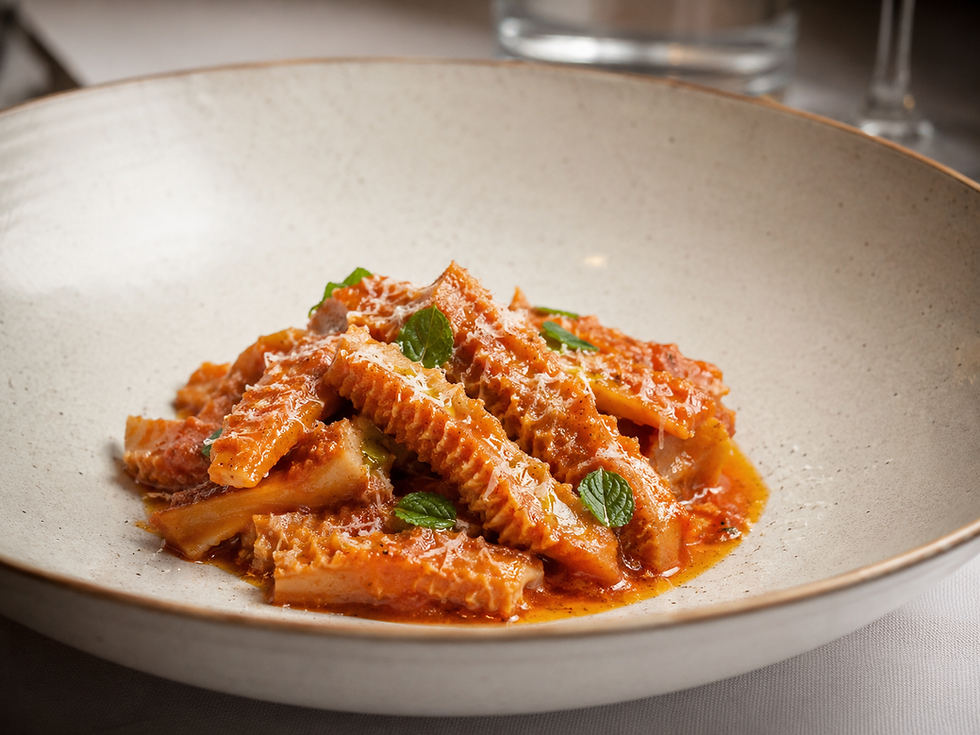
Cut it correctly. Lay each piece honeycomb side up and slice it into strips about 1/3 inch (8 mm) wide and 2 inches (5 cm) long, cutting across the piece rather than along it. Strips cut too thin disappear into the sauce, and strips cut too wide will not curl and stay leathery. If you are using croce as well as cuffia, cut the croce narrower, since it needs longer to yield.
Step 4
Build the soffritto. Warm the olive oil in a wide heavy casserole over low heat, add the onion, carrot and celery with a pinch of salt and cook for 12 to 15 minutes. The vegetables must soften and go translucent without taking any colour at all. This is where the Florentine version separates from the Neapolitan one: a browned soffritto brings a roasted sweetness that fights the tomato. Add the crushed garlic for the last 30 seconds only, just until it smells.
Step 5
Add the tripe and deglaze. Raise the heat to medium, tip in the drained strips and stir for 4 to 5 minutes so every piece is coated. Pour in the white wine and let it reduce until the pan is almost dry and the sharp alcohol smell has gone, about 4 minutes. Wine that is still raw when the tomato goes in stays raw for the whole braise and leaves a metallic edge on the sauce.
Step 6
Braise slowly. Add the crushed tomatoes, the stock, the bay leaf, the salt and the pepper. Bring it to a bare simmer, set the lid slightly ajar and cook for about 90 minutes, stirring every 20 minutes and scraping the bottom. The liquid should barely move. Take the lid off and continue for another 25 to 35 minutes, until the sauce is thick, glossy and dark red and a spoon dragged across the base leaves a channel that closes slowly.
Step 7
Finish off the heat. Remove the bay leaf and the garlic clove if it is still whole. Turn the heat off, wait a full minute, then fold in half the Parmigiano and half the parsley. The pot must not be bubbling: cheese added to a boiling sauce breaks into strings and leaves a greasy film, while cheese folded in below a simmer emulsifies and rounds the acidity of the tomato. Taste for salt now and not before. Rest for 10 minutes before serving.
Plating
This is a hot dish that cools fast, because the sauce is rich in gelatin and tightens the moment it drops below serving temperature. Use deep bowls rather than flat plates and warm them to around 140°F (60°C). A cold bowl sets the sauce into a skin within a minute.
Spoon the tripe into the centre of each bowl with enough sauce to pool around it but not to swim, roughly two thirds tripe to one third sauce. Keep the mound low and loose. Scatter the remaining Parmigiano over the top, add the rest of the parsley and finish with a thin thread of raw olive oil poured in a single pass.
Serve with unsalted Tuscan bread, plain and untoasted, cut thick. The bread is not a garnish, it is the tool for the sauce left in the bowl, and its lack of salt is what makes it work beside a seasoned braise. The dish takes no side and is diminished by one.
Professional Technique
The technical heart of this dish is the conversion of a very tough connective tissue into a sauce body. Tripe is almost pure smooth muscle wrapped in collagen, with very little intramuscular fat and no marbling. At a steady 185°F (85°C) that collagen hydrolyses into gelatin over roughly two hours, and it is the gelatin, not the tomato, that gives the sauce its gloss. Push the pot to a rolling boil and the muscle fibres contract before the collagen has converted, which produces the classic failure: a watery sauce around rubbery strips.
The two stage cooking exists for a second reason beyond cleaning. The pre boil is done in acidulated water that is then thrown away, taking the volatile sulphur compounds with it. Braise from raw instead and those compounds stay in the pot and end up in the sauce. It is why every Florentine trippaio keeps a separate bleaching pot.
Choosing the stomach is the third decision and the least discussed. Cuffia has fine walls and the highest surface area, so it takes on the braise fastest and gives the most tender result. Croce needs about 30 minutes longer and repays it with more chew. Centopelle is best kept out of a long braise entirely. A mixture is traditional at the carts but only works when each type is cut to a different width.
Texture and Moisture Control
Two textures move in opposite directions. The tripe is losing rigidity for the whole cook, while the sauce gains viscosity as water evaporates and gelatin accumulates. The lid controls the balance: ajar for the first 90 minutes keeps enough liquid for the tripe to stay submerged, off for the last half hour lets the sauce concentrate. If the tripe reaches perfect tenderness before the sauce has thickened, lift it out with a slotted spoon, reduce the sauce hard on its own and return the tripe at the end.
The reverse problem is a sauce that tightens while the tripe is still tough, which usually means the simmer was too strong. Add hot stock a quarter cup at a time, never cold water, and lower the heat. Cold liquid drops the pot below the collagen conversion range and stalls the process.
The gelatin that makes the sauce also makes it set. Judge the consistency in the pot knowing it will be thicker in the bowl and thicker again the next day. Leave it a shade looser than looks right on the stove, and if it sets too firm on reheating, a splash of stock brings it straight back.
Professional Mise en Place
Almost everything here can be done ahead, and the dish is better on the second day.
Equipment and tools
Wide heavy casserole or Dutch oven, at least 5 quarts (4.7 litres)
Large pot for the pre boil, plus a skimmer
Sharp chef knife and a board kept only for the tripe
Slotted spoon for lifting the tripe out during reduction
Fine grater for the Parmigiano
Prepared ahead
Tripe cleaned, pre boiled and cut into strips, up to 2 days ahead, refrigerated
Soffritto vegetables diced and kept covered, on the day
Braise completed to the end of step 6, up to 3 days ahead, refrigerated in its sauce
Parmigiano grated at the last minute, never in advance
Service setup
Bowls warming at 140°F (60°C)
Hot stock on hand to loosen the sauce if it has tightened
Parsley chopped no more than 20 minutes before service
Good finishing olive oil and bread ready at the pass
Chef Tips
Ask the butcher which stomach you are being sold and buy cuffia if you can get it. If the shop cannot answer, the tripe came in frozen and pre bleached, which means it needs less pre boiling, closer to 25 minutes than 45. Test with a knife rather than trusting the clock.
Use a tomato with low acidity and real flesh. Peeled plum tomatoes crushed by hand give texture that passata cannot. Keep the quantity modest: tomato is a seasoning here, not the base, and a pot that turns bright red has gone wrong.
Cook it the day before you serve it. The gelatin sets overnight, the tomato loses its edge, and the Parmigiano integrates completely instead of sitting on the surface. Reheat gently with a little stock and fold in fresh cheese and parsley at the table.
Keep a dedicated board and knife for the raw tripe and wash them in very hot water immediately. Tripe leaves a persistent film that transfers into whatever you cut next. A wooden board scrubbed with coarse salt and lemon is the traditional answer.
Common Mistakes
Skipping the pre boil. Braising tripe straight from the packet leaves the sulphur compounds in the pot and they end up in the sauce. Forty five minutes in acidulated water you throw away is the whole difference between clean and barnyard.
Browning the soffritto. Colour on the vegetables brings a roasted sweetness that fights the restraint of the Florentine version. Keep the heat low and pull the pan off if the onion starts to take on any gold.
Boiling instead of simmering. A rolling boil contracts the muscle fibres faster than the collagen can convert, so the tripe stays rubbery while the sauce goes thin. The surface should barely move for the entire braise.
Too much tomato. Fourteen ounces is the ceiling for two pounds of tripe. Beyond that it becomes tomato stew with tripe in it and the gelatin is diluted into nothing.
Adding the Parmigiano over heat. Cheese stirred into a bubbling pot splits, strings and leaves an oily slick. Turn the heat off, wait a minute, then fold it in.
Salting at the start. Between the stock and the Parmigiano a lot of salt arrives late. Season lightly at the beginning and correct only after the cheese has gone in.
Wine Pairing
Chianti Rufina DOCG: The Rufina hills sit higher and cooler than the rest of Chianti, so the wines keep a sharper acidity and a more nervous structure. That acidity is what this pairing needs: it cuts through the gelatin coating the palate and resets it between mouthfuls. The sour cherry and iron note underneath sits beside the tomato without adding sweetness to a dish that has none.
Carmignano DOCG: A Sangiovese blend with a required portion of Cabernet, grown just west of Florence in the city's own hill country. The Cabernet fraction gives a firmer tannin and a faint herbal edge that latches onto the celery and bay in the soffritto. It has more flesh than a standard Chianti, which stands up to a braise cooked down this far.
Rosso di Montalcino DOC: Younger and brighter than its Brunello sibling, with softer tannin and fresher red fruit. That lighter grip is an advantage here, because tripe carries no fat to speak of and a heavily tannic wine would find nothing to bind to and turn astringent. The dried herb finish runs parallel to the Parmigiano.
Vino Nobile di Montepulciano DOCG: Prugnolo Gentile, the local Sangiovese clone, gives a rounder and darker wine than the Florentine bottles, with a violet and tobacco character that comes forward with a few years of age. Its softened tannin and persistent acidity handle the glossy reduced sauce, and that earthiness is a genuine match for offal.
Vernaccia di San Gimignano DOCG: The white option, and a serious one rather than a concession. Vernaccia has more structure than most Italian whites and finishes on a bitter almond note that cuts the richness of the Parmigiano. Its salinity works with the savoury depth of the braise, and served cool it makes the dish taste lighter.
Storage & Reheating
This braise improves with a night in the refrigerator. Cool it to room temperature within two hours, transfer it to an airtight container with the sauce covering the tripe, and keep it for up to 4 days. Add the final Parmigiano and parsley only at service, because the cheese dulls and the parsley blackens.
Reheat on the stove over low heat in a covered pan, stirring occasionally, with 2 to 3 tablespoons of hot stock added at the start. The sauce sets firm when cold because of the gelatin and needs that liquid to come back. Give it 10 to 12 minutes and do not let it boil. Avoid the microwave: it heats the sauce faster than the tripe and the strips come out tough in a loose sauce.
It freezes well. Portion it with the sauce, leaving half an inch of headroom, and freeze for up to 3 months. Thaw overnight in the refrigerator, then reheat as above. Do not freeze it after the cheese has been added, since the emulsion breaks on thawing.
Nutrition
Per serving, based on 6 servings:
Calories: 310 kcal
Total Fat: 17 g
Saturated Fat: 5 g
Trans Fat: 0 g
Unsaturated Fat: 11 g
Cholesterol: 135 mg
Sodium: 780 mg
Total Carbohydrates: 9 g
Fiber: 2 g
Total Sugars: 5 g
Added Sugars: 0 g
Protein: 27 g
Lactose: 0.2 g
Principal micronutrients: vitamin B12, selenium, zinc, calcium, phosphorus, iron
These figures are estimates. Tripe is very lean and high in protein, and most of the fat comes from the olive oil and the Parmigiano rather than the meat. The sodium depends heavily on the stock used.




Comments