
Italian Neapolitan Style Tripe | Trippa alla Napoletana

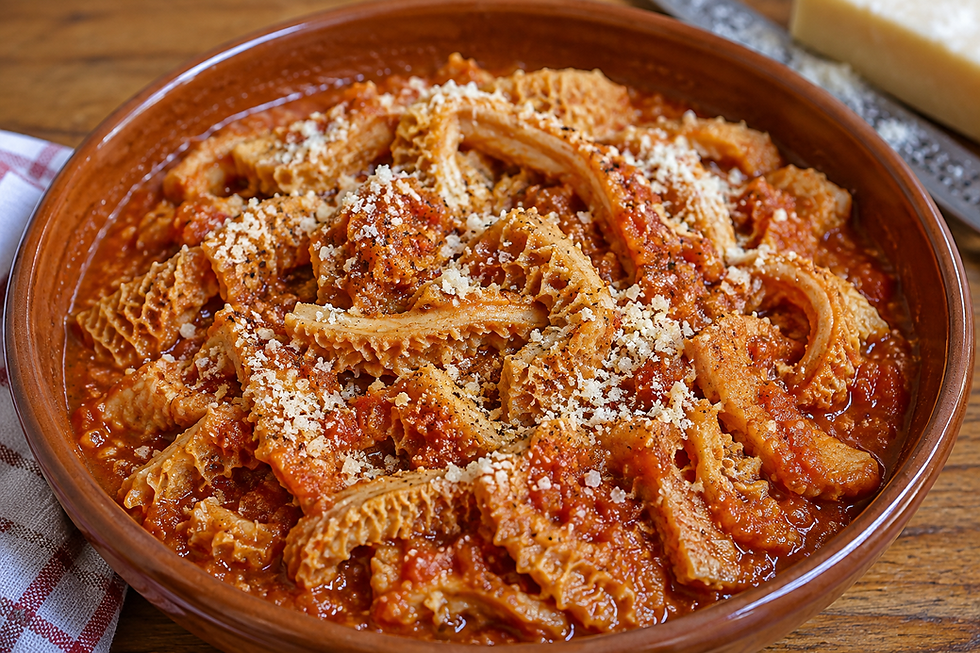
Trippa alla Napoletana is the tomato and chilli version of tripe, and the chilli is not a garnish on it. Naples works peperoncino into the oil at the very start, which separates this dish from every other Italian tripe: the heat is built into the base of the sauce rather than sprinkled over the finished plate. Tomato, garlic, basil, a long unhurried simmer and a heavy hand of grated Pecorino complete it.
What makes it worth cooking properly is that tripe is not one material. A cow has four stomach chambers and three reach the butcher, each with its own thickness and cooking time. Treated as interchangeable, some strips finish tender while others stay rubbery in the same pot. Cut to different widths, they arrive together.
Yield: 6 servings. Prep: 30 minutes. Pre boil: 1 hour 30 minutes. Cook: 1 hour 45 minutes. Rest: 15 minutes. Total: about 4 hours. Difficulty: intermediate. Course: secondo. Region: Campania, Naples.
The Story
Tripe in Naples belongs to the quinto quarto, the fifth quarter, the butcher's term for everything left once the animal has been divided into its four commercial quarters. Heart, lung, spleen, stomach, snout, trotters and tail all fell into it, and in a city this densely populated they fed a great many people who would never see a cut of steak. It was not a cuisine of choice, it was what was affordable, and Neapolitan cooking turned it into something people came back for on purpose.
The street trade made it famous. For well over a century Naples had its own specialists in cooked offal, the trippari, selling from marble topped stalls and carts in the Pignasecca, around Porta Capuana and through the Quartieri Spagnoli. The best known survivor of that trade is zuppa e o' pere e o' musso, trotter and snout, boiled and sliced cold onto a paper cone, dressed with coarse salt and lemon, eaten standing up. Tripe was sold warm from the pot at the same counters.
That origin explains the recipe. The long boil happened at the stall, where a cauldron ran all day, so the cook at home began with tripe already softened and only built the sauce. It explains the chilli, cheap, grown everywhere in Campania and able to keep its punch through long cooking as black pepper cannot. And it explains the bread instead of a side dish.
Ingredients
For the tripe and the pre boil
Cleaned beef tripe, mixed cuffia, croce and centopelli, 2 1/2 lb (1.15 kg)
Water, 4 quarts (3.8 liters)
Coarse sea salt, 1 tbsp (18 g)
White wine vinegar, 1/4 cup (60 ml)
Yellow onion, halved, 1
Carrot, 1
Celery stalk, 1
Bay leaves, 2
Lemon, halved, 1
For the sauce
Extra virgin olive oil, 1/3 cup (80 ml)
Garlic cloves, thinly sliced, 4
Dried Calabrian peperoncino, crumbled, 2 whole pods, about 1 tsp (2 g)
Fresh red chilli, finely chopped, 1 small
Yellow onion, finely diced, 1 medium
Dry white wine, 1/2 cup (120 ml)
Canned San Marzano tomatoes, crushed by hand, 28 oz (795 g)
Tomato paste, 1 tbsp (16 g)
Fine sea salt, 1 1/2 tsp (9 g), plus more to taste
Freshly ground black pepper, to taste
Basil sprigs, 2
For finishing
Pecorino Romano, finely grated, 3 oz (85 g)
Flat leaf parsley, chopped, 2 tbsp (8 g)
Basil leaves, torn, 8 to 10
Extra virgin olive oil, 2 tbsp (30 ml)
Country bread, thick sliced and grilled, 6 slices
Preparation
Step 1
Sort the tripe by type before cutting. Cuffia, the honeycomb, has the deep cell structure and is thinnest and most tender. Croce, the flat rumen, is thick, smooth and toughest. Centopelli, the bible tripe, is layered, thin but dense. Rinse everything under cold water, rub each piece with the cut lemon and rinse again: even tripe sold as cleaned carries a faint mineral smell.
Step 2
Cut each type to a different width. This is the step that decides the dish. Croce into strips about 1/4 inch (6 mm) wide, centopelli about 3/8 inch (10 mm), cuffia a generous 1/2 inch (12 mm), all across the grain in lengths of about 2 1/2 inches (6 cm).
Step 3
Pre boil with aromatics. Put the tripe in a large pot with the cold water, coarse salt, vinegar, halved onion, carrot, celery and bay leaves. Bring to the boil, skim the grey foam of the first ten minutes, lower to a gentle simmer and cook for 1 hour 30 minutes. The croce should bend easily and yield under a fingernail but keep some body. Drain, and do not rinse in cold water, which tightens it.
Step 4
Extract the chilli in the oil. Pour the olive oil into a wide heavy pot over low heat, add the sliced garlic with both the crumbled dried peperoncino and the fresh chopped chilli, and infuse for 3 to 4 minutes without letting the garlic colour. The oil should smell sharply of chilli and turn faintly orange.
Step 5
Sweat the onion and deglaze. Add the diced onion with a pinch of salt and cook over medium low heat for 8 to 10 minutes until soft and translucent, never browned. Pour in the white wine, raise the heat and let it bubble hard for 2 minutes until the sharp alcohol smell has gone, then stir in the tomato paste and cook it out.
Step 6
Build the tomato base. Add the hand crushed San Marzano tomatoes, the fine salt, a grind of black pepper and the basil sprigs, and simmer uncovered for 15 minutes so the watery liquid goes. Crush by hand rather than blending: you want soft irregular pulp that clings to the tripe, not a smooth passata that slides off.
Step 7
Simmer the tripe in the sauce. Add the drained tripe, stir until every strip is coated, and add just enough hot water to keep it barely covered, about 1 cup (240 ml). Return to a bare simmer, cover partially and cook for 1 hour 30 minutes to 1 hour 45 minutes, stirring every 20 minutes. The strips should be completely tender and slightly gelatinous at the edges, the sauce thick enough to hold the mark of a spoon. Uncover for the last 15 minutes if it stays loose.
Step 8
Finish off the heat and rest. Remove the basil, taste for salt and take the pot off the heat. Wait 2 minutes, then scatter in the Pecorino Romano in three additions, stirring after each until it disappears. Off the heat is deliberate: Pecorino added to a boiling sauce separates into strings. Stir in the parsley, cover and stand for 15 minutes.
Plating
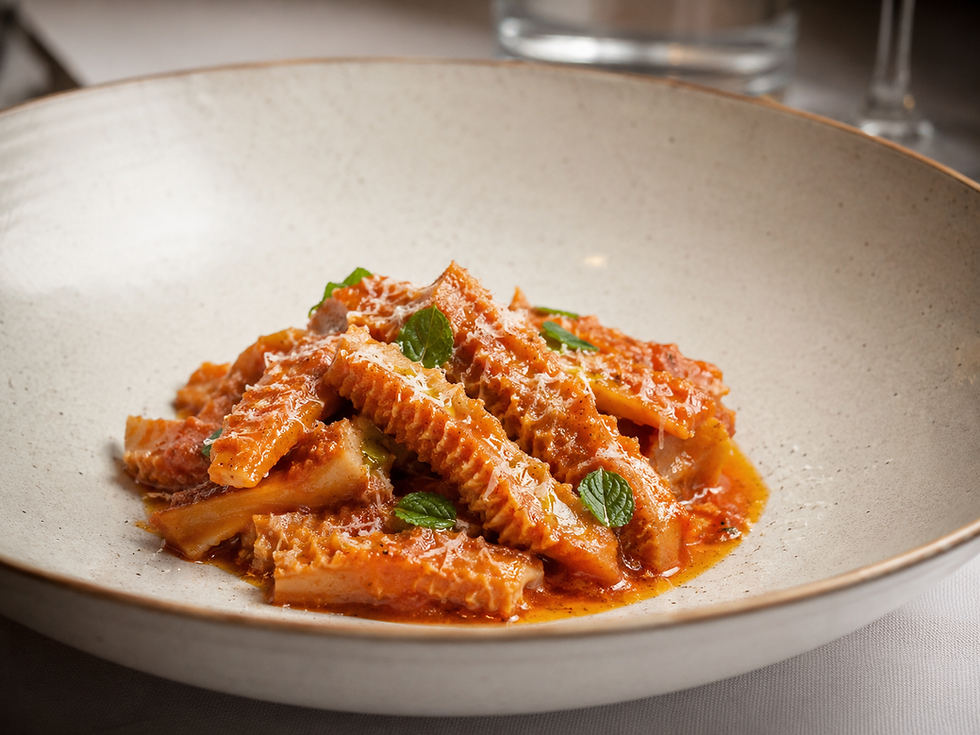
This is a bowl dish and it should look like one. Use deep bowls, genuinely warmed, because the sauce is rich in gelatin and sets on a cold surface. Ladle in about 1 1/4 cups per person and make sure each serving gets a mix of all three types of tripe.
Finish with torn basil, a further light snow of Pecorino Romano and a thread of raw olive oil. The raw oil matters more than it sounds: it carries the chilli aroma back up to the nose, which two hours of simmering has largely driven off. Serve grilled country bread alongside and nothing else, since a green side is not traditional here and only dilutes a dish that is already complete.
Professional Technique
The first technique here is cutting the tripe to three different widths, and it exists because tripe is not a single tissue. Cattle have a four chambered stomach and three of those chambers are sold. The rumen, croce, has a thick dense muscular wall. The reticulum, cuffia, is the honeycomb and is markedly thinner. The omasum, centopelli, is built of many thin dense leaves. All three in one pot at the same width cannot finish evenly: after two hours the cuffia has gone soft and woolly while the croce is still resilient. Cutting the thickest cut narrowest and the thinnest cut widest equalises the distance heat and water must travel into each strip. That is why a plate of tripe in a good Neapolitan trattoria has strips of visibly different sizes.
The second is where the chilli goes in. Capsaicin, the compound responsible for the heat of peperoncino, is fat soluble and almost insoluble in water, so it will not travel through a watery tomato sauce on its own. Put the crumbled chilli into hot olive oil at the start and the capsaicin dissolves into that oil, which then emulsifies through the sauce during the simmer and distributes the heat evenly. Add the same quantity at the end and much of it stays locked in the dry flakes, giving hot spots and a thinner overall warmth. That is the mechanical reason behind a habit Neapolitan cooks describe simply as putting the chilli in first.
The third point runs in two directions. Heat drives off the volatile aromatics of the chilli, and the fat and sugars released by two hours of tomato reduction coat the mouth and shield the receptors capsaicin binds to, so perceived pungency falls the longer the pot runs. Salt does the opposite: sodium sharpens pungency, and 3 oz of Pecorino is a substantial addition. Judge the chilli before the long simmer and the salt after the cheese, because there is no practical way to add convincing heat to a finished pot.
Texture and Moisture Control
Tripe is dense collagen with very little intramuscular fat, and its whole texture story is the conversion of that collagen into gelatin. That needs sustained moist heat between about 180F (82C) and 195F (91C) and it needs time, which is why the cooking runs past three hours across two stages. Below that range the collagen never converts and the tripe stays rubbery. At a rolling boil the muscle fibres contract and force moisture out, so the strips turn stringy while the collagen is still converting.
The gelatin released into the sauce gives the pot its body. It thickens on cooling and thins again on reheating, so what looks correct in a hot pot will be firmer in the bowl: stop while it still falls easily from the spoon. It also means the sauce cannot be corrected by reduction at the end without concentrating the salt from the Pecorino, so control the liquid during the simmer instead.
During the pre boil the tripe must stay submerged, since any strip breaking the surface hardens and never recovers. During the second simmer the level should sit just at the top of the tripe so the sauce concentrates while the tripe stays wet. Always add hot water, never cold, which stalls the conversion.
Professional Mise en Place
The work here is front loaded and almost all of it can be done the day before. Separating the pre boil from the sauce is the better way to cook this dish.
Equipment and tools
Large stockpot, at least 8 quarts, for the pre boil
Wide heavy pot with a lid for the sauce
Long bladed knife and a board kept for the tripe
Skimmer and colander
Instant read thermometer to hold the simmer under 195F (91C)
Prepared ahead
Tripe sorted, rinsed with lemon and cut to the three widths, 1 day ahead
Pre boiled tripe, drained and covered, up to 2 days ahead
Tomato base through step 6, up to 2 days ahead, kept apart
Chilli oil with garlic, made fresh on the day
Pecorino grated on the day and kept covered
Service setup
Pot at a bare simmer, partially covered, hot water at hand
Bowls warming, since the gelatin sets fast on a cold surface
Pecorino, torn basil, parsley and finishing oil in reach
Bread going onto the grill as the bowls are filled
Salt corrected once more after the cheese
Chef Tips
Ask the butcher for a mix of all three cuts and say so explicitly. Most shops default to whatever they have most of, usually croce, and a pot made from one cut alone loses the variety of texture. If you can only get one, choose cuffia, cut to a single 1/2 inch width.
Cook it a day ahead if you can. Tripe in tomato is better on the second day by a wide margin: the strips finish absorbing the sauce and the chilli heat integrates instead of sitting on top. Stop 15 minutes short, refrigerate, and finish it the next day.
Taste the chilli before you commit it. Dried peperoncino varies enormously between batches, and two pods from a hot lot can be three times the heat of two from a mild one. You can always add more in the oil, but nothing takes heat back out of a finished pot.
Use Pecorino Romano and grate it yourself. Pre grated cheese carries anticaking starch that turns a glossy sauce chalky, and a mild Pecorino or a Parmigiano will not deliver the sharp salty note the dish is built around.
Common Mistakes
Cutting all the tripe to the same width. The three cuts have different thicknesses and cooking times, so uniform strips guarantee that something in the pot is tough or overcooked. Croce narrowest, cuffia widest, centopelli in between.
Adding the chilli at the end. Capsaicin is fat soluble and needs the hot oil at the start to release into the sauce. Chilli stirred in late leaves isolated hot spots and a flat overall warmth.
Boiling instead of simmering. A rolling boil contracts the muscle fibres and forces moisture out while the collagen is still converting, so the tripe ends up stringy. Keep the surface barely moving in both stages.
Adding the Pecorino to a boiling pot. Above about 180F (82C) the cheese proteins tighten and separate from their fat, so the sauce turns stringy and oily on top. Off the heat, wait two minutes, then add it in three stages.
Salting to taste before the cheese goes in. Pecorino Romano is heavily salted and 3 oz of it shifts the seasoning of the whole pot. Judge the salt only after the cheese has melted in.
Wine Pairing
Aglianico del Taburno DOCG: The most complete match, from the hills just inland of Naples. Aglianico has firm grippy tannin and unusually high acidity for a southern red, and both do specific work: the tannin binds the gelatin the tripe releases and clears it from the palate, while the acidity runs level with the tomato instead of being flattened by it. Its smoky volcanic depth sits beside the chilli without amplifying it.
Lacryma Christi del Vesuvio DOC: The bottle this dish grew up with, from the volcanic slopes above the bay. In its red form, built on Piedirosso, it is lighter and lower in alcohol than the Aglianico, and moderate alcohol is a real advantage with peperoncino, since ethanol dissolves capsaicin and spreads the burn. Its brisk red cherry fruit refreshes between mouthfuls of a sauce heavy with Pecorino.
Taurasi DOCG: Aglianico taken to its serious conclusion in the hills of Avellino, for a Sunday pot rather than a weeknight one. Choose a bottle with some age, where the young tannin has resolved into leather and dried cherry: that softened structure still cuts the gelatin but no longer competes with the chilli. Young Taurasi is too austere and makes the heat feel sharper.
Falanghina del Sannio DOC: The white option, and a better one than people expect with tripe in tomato. Cutting citrus acidity, modest alcohol and a faintly bitter almond finish handle the two hardest things here: the salt of the Pecorino, balanced directly by acidity, and the chilli, left alone by a low alcohol wine. Serve it cold, around 50F (10C).
Etna Rosso DOC: A Sicilian alternative built on Nerello Mascalese, pale in colour and more structured than it looks. High acidity, fine grained tannin and a saline mineral edge from the volcanic soil that answers the salt in the cheese rather than fighting it. Serve it a little cool, around 59F (15C).
Storage & Reheating
This dish improves in the refrigerator, so cook it for the day after. Cooled quickly in an airtight container it holds for 4 days, and the second and third days are the best of them. The sauce sets almost solid from the gelatin, which is the sign of a tripe cooked correctly rather than a fault.
Reheat in a covered pot over low heat, never in a microwave, which heats unevenly and toughens the strips at the edges. Add 2 or 3 tablespoons of hot water to give the set gelatin something to loosen into, and stir until the sauce is pourable again. A night in the cold mutes both chilli and salt, so a little extra Pecorino and a fresh grind of pepper usually put it back.
It freezes well, which not every tomato braise does, and the gelatin is the reason. Freeze it in portions, without the cheese if you are planning ahead, for up to 3 months, and thaw overnight in the refrigerator. Reheat as above, then add the Pecorino off the heat.
Nutrition
Per serving, based on 6 servings, bread excluded:
Calories: 390 kcal
Total Fat: 24 g
Saturated Fat: 8 g
Trans Fat: 0 g
Unsaturated Fat: 15 g
Cholesterol: 175 mg
Sodium: 890 mg
Total Carbohydrates: 13 g
Fiber: 3 g
Total Sugars: 7 g
Added Sugars: 0 g
Protein: 31 g
Lactose: 0.3 g
Principal micronutrients: vitamin B12, selenium, zinc, calcium, iron, phosphorus, potassium, lycopene
These figures are estimates. Tripe is high in protein and vitamin B12 and much lower in fat than most beef cuts, so most of the fat above comes from the olive oil and the Pecorino rather than the meat.


Comments