Vegan Milanese King Oyster Mushroom Ossobuco, Reinterpreted | Ossobuco Vegano di Cardoncelli alla Milanese Rivisitato

Ossobuco alla milanese is the great braise of Milan: thick rounds cut across the shank, browned, simmered in white wine and broth, finished with a sharp gremolata of lemon, garlic and parsley and served on a golden saffron risotto. The original is a slice of veal shank with its marrow, so this vegan recipe is a reinterpretation, not the classic dish: it keeps the shape, the sauce and the ritual of the original and builds the rounds from the thick stems of king oyster mushrooms, the cardoncelli of southern Italy, standing upright like the classic cut, with a soft center of roasted garlic and white miso in place of the marrow. Browned hard and braised briefly in the white Milanese style, they turn tender and meaty, glossed with a reduced sauce that the risotto absorbs. It is a complete Lombard plate, precise in every step and entirely plant based.
Yield: 4 servings. Prep: 40 minutes. Cook: 1 hour 10 minutes. Rest: 5 minutes. Course: secondo piatto. Region: Lombardy.
The Story
Ossobuco means bone with a hole, and the name describes the classic cut: a thick slice across a veal shank, with the round bone and its marrow at the center. In Milan it has been braised for centuries in the same way: dusted with flour, browned, cooked slowly with onion, white wine and broth until the meat is soft enough to cut with a fork. The marrow, eaten with a small spoon, is considered the best part. Pellegrino Artusi includes ossobuchi in his book of 1891, La scienza in cucina e l'arte di mangiar bene, and leaves the dish to the Milanese as a specialty of Lombard cooking.
The oldest Milanese version is called in bianco, white: no tomato, only wine, broth, onion and a final gremolata of grated lemon zest, garlic and parsley that brightens the rich sauce at the last moment. The version with tomato and carrots came later and spread far beyond Milan. Purists in Lombardy still prefer the white one, and this recipe follows it, because its clean flavors suit the delicate, savory taste of mushrooms.
Ossobuco is inseparable from risotto alla milanese, the golden rice colored and perfumed with saffron. A famous legend dates that risotto to 1574, when an apprentice working on the stained glass windows of the Duomo, nicknamed for his habit of adding saffron to his colors, had it added to the rice at his master's daughter's wedding. Whatever its truth, saffron rice and ossobuco form the most celebrated pairing of Lombard cooking, one of the rare cases in Italy where a risotto is served on the same plate as a main course.
This recipe replaces the shank with king oyster mushrooms, Pleurotus eryngii, called cardoncelli in Apulia and Basilicata, where they grow wild on the roots of field eryngo in the Murgia. Their thick, white stems are firm and fibrous, and when cut into tall cylinders and browned they take on a dense, meaty texture and a deep savory taste. The marrow is replaced by a small center of roasted garlic, white miso and olive oil that melts into the sauce, and the butter of the original by olive oil and a plant butter. The wine, the broth, the gremolata and the saffron risotto remain exactly Milanese.
Ingredients
Choose king oyster mushrooms with thick, straight, very firm stems, at least 1 1/2 inches (4 cm) across, white and dry, without soft or yellow patches: only the thick stems make convincing rounds. The caps are used in the soffritto, so nothing is wasted. For the risotto, use Carnaroli or Vialone Nano rice and saffron in threads, never powdered, from a reliable source. Use an unwaxed organic lemon for the gremolata, because the zest is eaten raw. A dry, neutral white wine from Lombardy, such as a Lugana or an Oltrepò Pavese white, is ideal for the braise.
For the mushroom ossobuco
King oyster mushrooms, large, 2 lb (900 g), about 8 thick stems
Roasted garlic, 6 cloves, mashed
White miso, 1 tbsp (18 g)
Extra virgin olive oil, 1 tsp (5 ml), for the filling
All-purpose flour, for dusting, 1/3 cup (40 g)
Extra virgin olive oil, 3 tbsp (45 ml)
Plant butter, 2 tbsp (28 g)
Fine sea salt and freshly ground black pepper
For the braise
Yellow onion, 1 medium, finely chopped
Carrot, 1 small, finely chopped
Celery, 1 stalk, finely chopped
King oyster mushroom caps and trimmings, finely chopped
Garlic, 1 clove, finely chopped
Dry white wine, 3/4 cup (180 ml)
Vegetable broth, hot, 2 cups (475 ml)
Lemon peel, 1 wide strip
Bay leaf, 1
For the gremolata
Lemon zest, finely grated, from 1 unwaxed lemon
Garlic, 1 small clove, very finely chopped
Flat-leaf parsley leaves, finely chopped, 3 tbsp (10 g)
For the risotto alla milanese
Carnaroli rice, 1 1/2 cups (300 g)
Saffron threads, 1/2 tsp (0.3 g)
Vegetable broth, hot, 5 cups (1.2 l)
Shallot, 1, very finely chopped
Extra virgin olive oil, 2 tbsp (30 ml)
Dry white wine, 1/3 cup (80 ml)
Plant butter, cold, cubed, 3 tbsp (42 g)
Fine sea salt, to taste
Preparation
Step 1

Cut and fill the rounds. Cut the caps from the king oyster mushrooms and set them aside for the braise. Trim the base of each stem and cut it into cylinders 2 inches (5 cm) tall, so they stand upright. With a small melon baller or the tip of a paring knife, hollow a cavity 1/2 inch (1.2 cm) wide and deep in the top of each round. Mix the mashed roasted garlic, miso and 1 tsp (5 ml) olive oil and fill the cavities. Score the sides of each round lightly with a few shallow vertical cuts. The scoring helps the mushroom release water and take color, and the filling becomes a soft, savory center that recalls the marrow of the original.
Step 2

Steep the saffron. Crush the saffron threads lightly between your fingers into a small cup and pour over 1/4 cup (60 ml) of the hot risotto broth. Leave to steep for at least 30 minutes. Saffron releases its color and aroma slowly in warm liquid; steeping ahead gives a deeper gold and a stronger perfume than adding the threads directly to the rice, and the long infusion avoids the bitter taste of overheated saffron.
Step 3

Brown the rounds. Season the rounds with salt and pepper and dust the sides and base with flour, keeping the filled top clean. Heat the olive oil and plant butter in a wide, heavy pan over medium high heat until the butter foams. Lay the rounds on their sides and brown them, turning, for 8 to 10 minutes, until the sides are deep golden, then stand them upright and brown the base for 2 minutes. Lift them onto a plate. The flour coating browns quickly and later thickens the sauce, exactly as in the classic method, while hard browning drives off the water of the mushrooms and concentrates their flavor.
Step 4

Make the soffritto and deglaze. Lower the heat to medium, add the onion, carrot, celery and chopped mushroom caps to the same pan and cook for 8 to 10 minutes, stirring, until soft and lightly golden. Add the garlic for the last minute. Pour in the wine, scraping the browned residue from the bottom with a wooden spoon, and reduce by half. The chopped caps melt into the soffritto and give the sauce body and depth; the wine dissolves the browned flour and juices stuck to the pan, which hold much of the flavor of the dish.
Step 5

Braise the ossobuco. Stand the rounds upright in the pan in a single layer, add the hot broth until it comes halfway up their sides, then the lemon peel and bay leaf. Bring to a gentle simmer, cover and braise over low heat for 25 to 30 minutes, until a skewer passes through the rounds easily. Uncover for the last 5 minutes to reduce the sauce until it coats a spoon. Baste the tops twice. Mushrooms do not need hours like the original cut, but a slow, covered braise lets them absorb the sauce and turn tender and juicy throughout.
Step 6

Cook the risotto. In a heavy saucepan warm the olive oil and cook the shallot over low heat for 4 minutes, until soft and translucent. Add the rice and toast it for 2 to 3 minutes, stirring, until the grains are hot and slightly translucent at the edges. Pour in the wine and let it evaporate. Add hot broth a ladle at a time, stirring often, keeping the rice just covered. After 10 minutes add the saffron with its liquid. Cook for 16 to 18 minutes in all, until the rice is tender with a slight bite at the center and still fluid. Toasting seals the surface of the grains so they release starch gradually and stay separate inside a creamy base.
Step 7

Finish the risotto and the gremolata. Take the risotto off the heat, add the cold plant butter and beat vigorously with a wooden spoon for 1 minute, the mantecatura, until creamy and glossy. Season with salt, cover and rest for 2 minutes. Meanwhile, mix the lemon zest, garlic and parsley for the gremolata. Sprinkle half over the ossobuco in the pan and keep the rest for the plate. The cold fat emulsifies with the starch to give the risotto its flowing, wave-like texture, all'onda; the gremolata goes on at the last moment, because heat dulls the lemon and turns the garlic sharp.
Plating
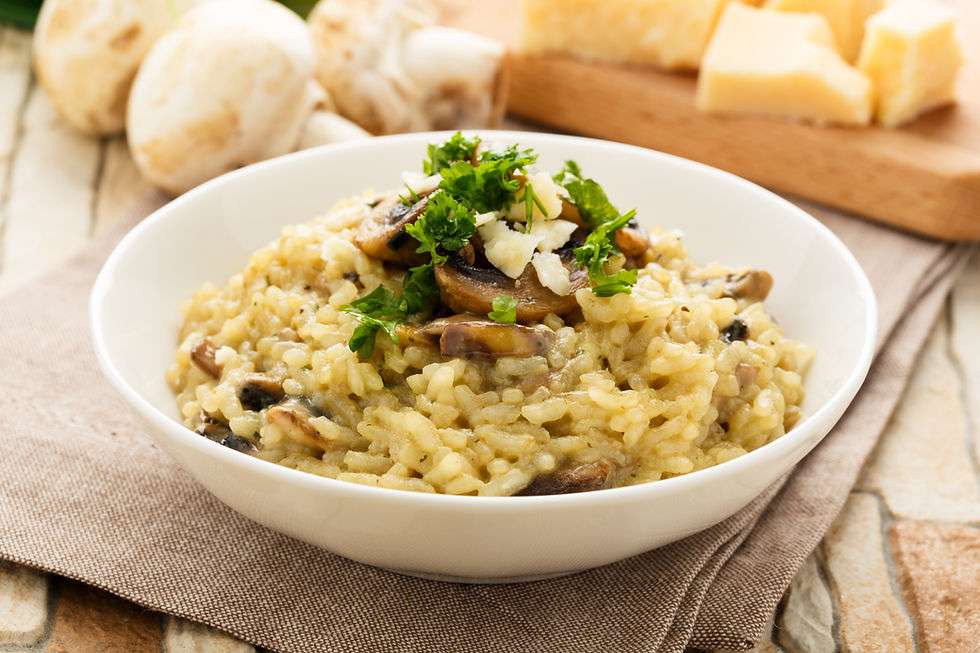
Warm wide, shallow plates to about 140°F (60°C). Spoon the risotto onto each plate and tap the base gently on a folded towel so it spreads into an even, golden disk that flows slowly to the edges. Stand two mushroom rounds on the risotto, slightly off center, with the soft filled tops facing up.
Spoon the reduced sauce over and around the rounds, letting some of it run into the risotto, and finish with a pinch of the remaining gremolata on each round. Serve with a small spoon for the soft center, as the marrow is eaten in Milan. The guest should taste in each forkful the golden rice, the meaty mushroom, the wine sauce and the fresh burst of lemon and parsley.
Professional Technique
The key number is the height of the rounds: 2 inches (5 cm), from stems at least 1 1/2 inches (4 cm) wide. At this size the rounds stand upright, brown evenly on the sides and stay juicy at the center after the braise. Shorter rounds fall over and dry out; thinner stems shrink too much during cooking and lose the look of the classic cut.
The hidden variable is water. King oyster mushrooms are about 90 percent water, and any water left in them when the braise begins dilutes the sauce and keeps them pale. Browning in a hot pan, with the rounds not crowded and not moved too often, drives off the surface water and starts the browning. Brown in two batches if the pan is not wide enough.
The doneness test is the skewer and the sauce. The rounds are ready when a skewer passes through with almost no resistance and the mushroom feels dense but tender, never rubbery. The sauce is ready when a spoon drawn through it leaves a clean trail on the bottom of the pan for a moment, and when it lightly coats the back of a spoon.
Sauce and Texture Control
The sauce of an ossobuco is thickened by two things: the flour on the browned pieces and the reduction. Here the chopped mushroom caps and the soffritto add a third, giving body as they break down. Keep the flour coating light, a dusting rather than a crust, or the sauce turns pasty. If the sauce is too thin at the end, reduce it uncovered over medium heat; if it is too thick, add a spoonful of hot broth.
The texture of the mushrooms changes with time. In the first 15 minutes of the braise they release more liquid and soften; between 20 and 30 minutes they reabsorb part of the sauce and become dense and juicy. Beyond 40 minutes they begin to turn soft and stringy. Watch them, not the clock, and stop as soon as the skewer slides in easily.
The risotto has its own control point: the consistency all'onda. A spoonful dropped on the plate should spread into a wave and settle flat, never stand in a mound. Always leave it a little more fluid than you want on the plate, because the starch keeps thickening in the minutes between the pan and the table.
Professional Mise en Place
In service the ossobuco can be braised ahead and kept warm in its sauce, while the risotto is cooked to order in 18 minutes. Organize the station so the broth is hot, the saffron steeped and the gremolata chopped before the rice goes in.
Equipment and tools
Paring knife, small melon baller, cutting board
Wide, heavy sauté pan with a lid, slotted spatula, wooden spoon
Heavy saucepan for the risotto, ladle, small cup for the saffron
Microplane for the zest, thin skewer, instant-read thermometer
Prepared ahead
Garlic roasted and mashed with miso, up to 2 days ahead
Mushroom rounds cut, filled and refrigerated, up to 1 day ahead
Ossobuco braised, cooled in its sauce, up to 2 days ahead
Saffron steeping in warm broth at least 30 minutes before the risotto
Service setup
Vegetable broth hot on the stove, ladle in it
Ossobuco warm in its covered pan over the lowest heat
Plates warmed to about 140°F (60°C), small spoons for the soft center
Gremolata chopped within 30 minutes of service, cold plant butter cubed
Chef Tips
Roast a whole head of garlic for the filling the day before: wrap it in foil with a drop of olive oil and roast it at 400°F (200°C) for 40 to 45 minutes, until soft and golden. Roasted garlic is sweet and mellow, and with the miso it gives the center of each round a rich, savory taste.
The braised ossobuco is even better the next day. The mushrooms absorb more of the sauce overnight and the flavors settle. Reheat it gently, covered, with a spoonful of broth, and add fresh gremolata only at service.
If you cannot find thick king oyster stems, use smaller ones whole and lay them on their sides: the dish loses the look of the classic cut but keeps its flavor and texture. Never substitute button mushrooms, which collapse in the braise.
Save the saffron for the risotto. Saffron in the ossobuco sauce, sometimes suggested, competes with the gremolata. The classic Milanese plate keeps the gold in the rice and the lemon on the braise, and the contrast between them is the point of the dish.
Common Mistakes
Using thin stems. Thin mushrooms shrink, topple and lose the shape of the round. Choose stems at least 1 1/2 inches (4 cm) across.
Crowding the pan. Too many rounds in the pan steam instead of browning. Brown them in batches with space between them.
A heavy flour coat. Too much flour turns the sauce pasty and dull. Dust the rounds lightly and shake off the excess.
Braising too long. After 40 minutes the mushrooms become soft and stringy. Stop when the skewer passes through easily.
Boiling the saffron. Saffron added to very hot fat or boiled for long loses its aroma. Steep it in warm broth and add it halfway through the risotto.
Gremolata cooked too long. Heat dulls the lemon and makes the garlic sharp. Add the gremolata only at the end and on the plate.
A stiff risotto. Risotto served thick and compact misses the classic texture. Keep it fluid and serve at once all'onda.
Wine Pairing
Valtellina Superiore DOCG: Nebbiolo from the steep terraces of the Valtellina, in the Alps of northern Lombardy, with red berries, dried herbs and fine, firm tannins. Its mountain freshness and earthy notes suit the savory mushrooms and cut through the plant butter of the risotto. Serve it at about 61-64°F (16-18°C).
Franciacorta DOCG: The bottle-fermented sparkling wine of the hills near Brescia, with fine bubbles, notes of bread crust and citrus. Its acidity and bubbles refresh the palate between forkfuls of creamy saffron risotto and echo the lemon of the gremolata. Serve it at about 46-50°F (8-10°C).
Lugana DOC: The white of the southern shore of Lake Garda, from the Turbiana grape, with almond, white peach and a mineral, saline finish. The natural choice for the braise itself, its body and freshness match the white Milanese sauce. Serve it at about 50-54°F (10-12°C).
Pinot Nero dell'Oltrepò Pavese DOC: The red of the hills south of Pavia, light in body, with cherry, forest floor and soft tannins. Its earthy notes meet the mushrooms, and its delicacy does not cover the saffron. Serve it at about 57-61°F (14-16°C).
Storage & Reheating
Refrigerator: keep the braised ossobuco in its sauce in an airtight container for up to 3 days. The risotto is best eaten at once; leftovers keep for 2 days, but they set firm and are better used for risotto al salto, the crisp saffron rice cake of Milan, pan fried in a little olive oil. Freezer: the braised mushrooms freeze acceptably for up to 2 months in their sauce, though they soften slightly on thawing; the risotto does not freeze well.
Reheat the ossobuco in a covered pan over low heat with 2 tbsp (30 ml) of broth for 8 to 10 minutes, basting, until hot to the center. In the microwave, cover and heat at 50 percent power for 2 to 3 minutes. Reheat leftover risotto in a pan with a little hot broth, stirring until creamy, and finish both with fresh gremolata.
Nutrition
Per serving, based on 4 servings:
Calories: 640 kcal
Total Fat: 24 g
Saturated Fat: 7 g
Trans Fat: 0 g
Unsaturated Fat: 17 g
Cholesterol: 0 mg
Sodium: 1,080 mg
Total Carbohydrates: 84 g
Fiber: 7 g
Total Sugars: 7 g
Added Sugars: 0 g
Protein: 14 g
Principal micronutrients: niacin, riboflavin, pantothenic acid, potassium, copper, selenium, vitamin C
These figures are estimates, calculated on the quantities listed and rounded to the nearest whole number. They vary with the brand of plant butter and vegetable broth, the size of the mushrooms and the amount of broth absorbed by the rice.




Comments