
Italian Ricotta, Fig and Chestnut Honey Panettone | Panettone Ricotta, Fichi e Miele di Castagno
Updated: Sep 14
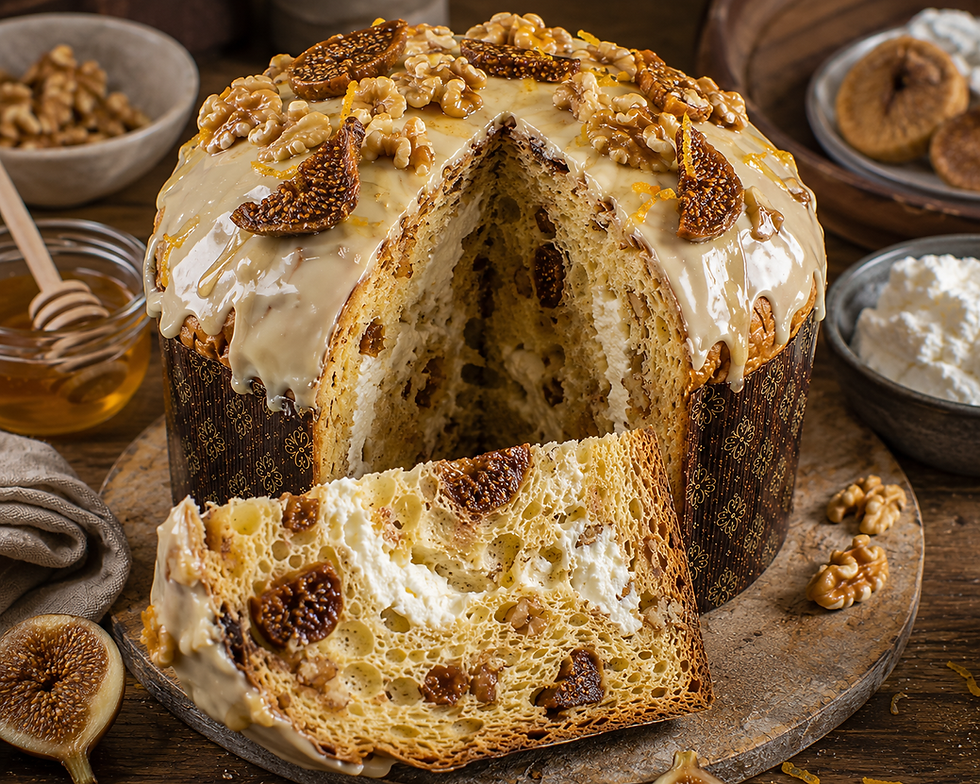
Panettone is a Milanese loaf, but this one answers to the south. The dough is leavened the orthodox way, entirely on lievito madre across two mixes and about thirty hours, because nothing else gives that shredding, silken crumb or the keeping quality that goes with it. What changes is everything that goes into it.
Dried figs and toasted walnuts replace the candied peel and raisins. The glaze is white chocolate cut with chestnut honey rather than the usual almond and sugar crust. And the loaf is piped full of sweetened sheep's milk ricotta only after it has cooled completely, so the cheese stays fresh, cool and faintly grainy against the resinous bitterness of the honey.
It is a long recipe and there is no shortening it. Two of the three days are waiting, and the waiting is the recipe: a first rise that must triple rather than double, a bake judged only by core temperature, and a night hanging upside down. Skip any of the three and you have a sweet bread.
Yield: 1 loaf of about 2.2 lb (1 kg), roughly 16 portions. Active work: about 3 hours. Fermentation: about 30 hours. Total: 3 days. Difficulty: advanced. Course: dessert, festive baking. Region: Milan by descent, central and southern Apennines by flavour.
The Story
Panettone as we know it is barely a century old. Milan had sweet Christmas breads long before, low dense things closer to a pan dolce, but the tall domed loaf in a paper case is an industrial invention: Angelo Motta reshaped it in the 1920s, raising the dough in a paper collar so it climbed instead of spreading, and the format now defines the word. What survived from the older baking is the method, a natural leaven refreshed obsessively and a dough enriched in stages until it can barely hold itself together.
The filling comes from a different Italy altogether. Chestnut honey is made where the chestnut forests are, along the Apennine spine through Molise, Campania, Calabria and inland Tuscany, and it is the least sweet honey in the Italian repertoire: dark, resinous, tannic, genuinely bitter at the finish. Dried figs belong to the same geography, above all the pale ones of the Cilento, which carry a DOP and are still dried in the sun on cane racks. Sheep's milk ricotta is the cheese of the transhumance country between them. Those three have shared a table for centuries, and putting them inside a Milanese loaf is less a fusion than a relocation.
Ingredients
For the first dough
Strong bread flour, W380 to W400, 1 3/4 cups (220 g)
Active lievito madre, 2 1/2 oz (75 g)
Granulated sugar, 1/3 cup (70 g)
Water, 1/4 cup (60 ml)
Unsalted butter, 5 1/2 tbsp (80 g), at 64°F (18°C)
Egg yolks, 1/4 cup (65 g), about 4 large yolks
For the second dough
All of the risen first dough
Strong bread flour, 2/3 cup (80 g)
Granulated sugar, 1/3 cup (70 g)
Egg yolks, 1/3 cup (80 g), about 5 large yolks
Unsalted butter, 5 tbsp (70 g), at 64°F (18°C)
Fine sea salt, 1 1/2 tsp (8 g)
Vanilla bean, seeds of 1
Finely grated orange zest, from 1 orange
Soft dried figs, 1 1/4 cups (180 g), diced
Toasted walnuts, 3/4 cup (80 g), roughly chopped
For the ricotta filling
Fresh sheep's milk ricotta, 1 1/4 cups (300 g)
Chestnut honey, 2 1/2 tbsp (50 g)
Confectioners sugar, 1/3 cup (40 g)
Vanilla bean, seeds of 1/2
Finely grated orange zest, from 1/2 orange
For the chestnut honey glaze
White chocolate, 5 oz (150 g), finely chopped
Chestnut honey, 1 1/2 tbsp (25 g)
Heavy cream, 2 tbsp (30 ml)
For finishing
Dried figs, 4, quartered
Toasted walnut halves, 8
Chestnut honey, for drizzling
Finely grated orange zest, a little
Edible gold leaf, optional
Preparation
Refreshing the lievito madre
The day before you mix, refresh the starter three times at four hour intervals. It is ready when it triples within four hours at 82°F (28°C) and smells of yogurt rather than vinegar. A sluggish or sour starter is the commonest reason a home panettone fails, and extra proofing will not rescue it: acetic acid weakens gluten rather than raising dough. If the third refresh does not triple on schedule, rebuild the starter over several days rather than pressing on.
Mixing the first dough
Dissolve the sugar in the water, add the leaven and the flour, and mix on low until the gluten comes together and the dough cleans the bowl. Add the yolks in three additions, waiting for full absorption each time, then the butter in small pieces at 64°F (18°C). Keep a probe in the bowl: the dough must never pass 78°F (26°C), and if it climbs, stop and rest it rather than pushing through. It is finished when it is glossy, elastic and stretches into a translucent windowpane.
The first rise to a triple
Cover and leave at 78°F (26°C) for 10 to 12 hours, until the dough has tripled. Tripled, not doubled: that volume proves the leaven can carry the far heavier second dough. Mark the starting level so you are measuring rather than guessing. A dough that has only doubled after twelve hours will not recover, and one taken past a triple collapses in the tin.
Mixing the second dough and adding the fruit
Work the remaining flour into the risen first dough until the gluten rebuilds and the mass is elastic again, which takes longer than you expect. Add the sugar, the yolks, the salt, the vanilla and the zest, then the butter, one element at a time and always waiting for full incorporation. Fold in the figs and walnuts by hand, or on the slowest speed for under a minute, so the fruit does not tear the gluten you spent two days building.
Shaping, proofing and scoring
Rest the dough covered 45 minutes, then round it into a taut ball with a scraper in the rolling movement bakers call pirlatura. Rest 20 minutes, round again, and drop it into a 2.2 lb (1 kg) paper mould. Proof 5 to 7 hours at 82°F (28°C), until the dome is about half an inch (1 cm) below the rim. Leave it uncovered the last 15 minutes so a skin forms, then score a cross with a razor, lift the four flaps, set a knob of butter in the centre and fold them back.
Baking and hanging the loaf
Bake at 300°F (150°C) for 50 to 55 minutes in a static oven, rack low so the dome does not scorch. Judge it by core temperature and nothing else: the centre must reach 199°F (93°C). Below that the crumb sets into a damp seam, far above it the loaf dries. Tent the dome with foil if it colours early. The moment it comes out, skewer the paper through the base with two long rods and hang the loaf upside down across two deep pots, then leave it inverted at least 8 hours. Left upright it slumps under its own weight within twenty minutes.
Making the ricotta filling
Drain the ricotta in a cheesecloth lined sieve at least 4 hours in the refrigerator, or overnight. This decides whether the filling holds or weeps into the crumb. Pass the drained curd through a drum sieve, or push it through a fine mesh strainer with a spatula; a processor makes it slack and glossy in the wrong way. Fold in the honey, the confectioners sugar, the vanilla and the zest until just homogeneous, then taste. Chestnut honey is aggressively bitter behind its sweetness and batches vary, so you may want more sugar. Chill an hour, then load a piping bag with a long filling nozzle.
Making the chestnut honey glaze
Melt the white chocolate over a bain marie to 113°F (45°C), stirring so no part runs hotter, since white chocolate seizes into a granular paste above about 120°F (49°C). Warm the cream with the honey until it just steams, then pour it over the chocolate in three additions, stirring from the centre outward until each emulsifies and turns glossy before the next goes in. If it splits, a few drops of warm cream and a stick blender bring it back. Cool the glaze to 88°F (31°C), where it sits on the dome and drips a little down the sides without sliding off.
Filling and glazing
Once the loaf is completely cold, stand it upright and withdraw the skewers. Push the nozzle up through the base at four or five points, two thirds of the way to the dome, and pipe slowly while drawing it back out so the cream lays a channel rather than a pocket. You are distributing about 10 1/2 oz (300 g) evenly: the loaf feels heavier and the base begins to resist. Pour the glaze over the dome, coax it to the edges with an offset spatula, and set the figs, walnut halves and zest into it while it is tacky. Gold leaf goes on last, with dry tweezers.
Plating
Serve at 64 to 68°F (18 to 20°C) and never straight from the refrigerator, where the butter in the crumb goes waxy and the fig aroma disappears completely. If the loaf has been chilled, give it a full hour on the counter before it is cut.
Cut it as the Milanese do, down through the dome into wedges rather than across into slices, so every portion carries glaze, crumb and a section of the ricotta channel. Use a serrated knife with a long sawing motion and no downward pressure, wiping the blade between cuts. On the plate a spoonful of reserved ricotta cream, one quartered fig and a thread of chestnut honey are enough: the loaf is already decorated and the plate should not compete.
Professional Technique
Everything difficult about panettone comes from one conflict: the dough carries more fat and sugar than gluten normally tolerates, and it still has to hold gas for thirty hours. Fat coats the protein strands and blocks them from linking, sugar competes for water, and both slow fermentation. The answer is sequence. Build a full gluten network on flour, water and leaven alone, then introduce yolk and butter in small additions, each fully absorbed before the next, so the network is extended rather than interrupted. Butter added in one go gives a batter that never recovers.
Temperature is the second half of the same problem. The butter has to stay plastic, near 64°F (18°C), soft enough to disperse but not melted, and the dough itself under 78°F (26°C) throughout mixing. Friction alone pushes a long mix past that, which is why professionals stop, rest and resume rather than run the mixer harder. Past 80°F (27°C) the butter breaks out of suspension, the gluten relaxes and the loaf bakes squat and greasy at the base.
The inverted cooling is the technique nobody expects and nobody can skip. Straight from the oven the crumb is extremely open and its starch has not set, so the structure is weakest exactly when the loaf is tallest. Hanging it upside down puts the dome in tension rather than compression while the starch firms over several hours.
Texture and Moisture Control
Three systems have to stay in balance. The crumb depends on a dough that never breaks 78°F (26°C) and on a genuine triple in the first rise; over warm butter or a shortened rise gives a tight, cakey texture that no baking will open up afterwards. The figs must be soft but not wet: if yours are dry, hydrate them briefly in warm water or Marsala and blot them thoroughly, because free liquid entering the second dough at that stage weakens the gluten and leaves tunnels around the fruit.
The ricotta governs how long the finished loaf lasts. Undrained, it releases whey into the crumb within hours and the channels turn grey and sodden; drained hard, the same cream holds two days. Fill within an hour of service in a warm room. The glaze has its own window at 88°F (31°C): warmer and it runs off the dome, cooler and it sets in a thick lid that cracks when the loaf is cut.
Professional Mise en Place
Work backwards from the day of service. Three days out, refresh the leaven and mix the first dough that evening. On day two mix the second dough in the morning, proof through the afternoon, bake late and hang overnight. On day three drain the ricotta, make the filling and glaze, and finish an hour before the table.
Equipment and tools
Stand mixer with a dough hook and a probe thermometer
Paper panettone mould for 2.2 lb (1 kg) and two long metal skewers
Proofing box or oven with the light on, at 78 to 82°F (26 to 28°C)
Fine mesh or drum sieve, piping bag with a long filling nozzle
Bain marie setup and an offset spatula for the glaze
Prepared ahead
Leaven refreshed three times and tripling on schedule
Butter cubed and held at 64°F (18°C), yolks weighed and covered
Figs diced, walnuts toasted and cooled before the mixer starts
Ricotta drained overnight, filling made and chilled on the day
Glaze made ahead, rewarmed gently to 88°F (31°C)
Service setup
Space cleared for hanging the loaf before it goes in, not after
Loaf filled no more than 1 hour before the table in a warm room
Figs, walnut halves, zest and gold leaf lined up before glazing
Serrated knife and a cloth for wiping the blade
Reserved ricotta cream and honey held cool for the plate
Chef Tips
Buy the strongest flour you can find, W380 to W400. Ordinary bread flour will not carry this much butter, sugar and fruit through a thirty hour fermentation, and the loaf bakes short and dense however well you mix it. If the bag gives no W value, look for 14 percent protein or more.
Use sheep's milk ricotta if you can. Its higher fat and faint lanolin sweetness are what make this version worth doing, and cow's milk ricotta reads flat against chestnut honey. If only cow's milk is available, drain it longer and add a tablespoon of mascarpone.
If chestnut honey is too bitter for your table, cut it half and half with acacia rather than reducing the quantity, which only thins the glaze and unbalances the filling.
Weigh everything, including the yolks and the water. Panettone is the one Italian recipe where volume measurement genuinely fails: a few grams of hydration either way changes how the gluten develops, and there is no correcting it once the first dough is mixed.
Common Mistakes
Letting the dough overheat in the mixer. The commonest failure. Past 80°F (27°C) the butter breaks out of suspension, the gluten relaxes and the loaf bakes squat and greasy. Keep a probe in the bowl and rest the dough rather than mixing harder.
Adding butter or yolk before the previous addition has absorbed. Fat sitting on the surface coats the protein strands and stops them linking, so the dough never builds strength. Wait each time, even when it feels slow.
Settling for a double on the first rise. A dough that has only doubled has not proved the leaven can carry the second dough. Mark the container and measure, and rebuild the starter if it will not triple.
Judging the bake by colour. The dome browns long before the centre sets. The only reliable measure is 199°F (93°C) at the core; a loaf pulled at 190°F (88°C) collapses into a damp seam as it cools.
Standing the loaf upright out of the oven. The crumb is weakest while hot and the dome sinks within half an hour. Skewer and hang it inverted immediately, for at least 8 hours.
Filling with ricotta that has not been drained. Free whey migrates into the crumb and the channels turn grey within hours. Four hours draining is the minimum, overnight better.
Wine Pairing
Vin Santo del Chianti Classico DOC: The closest thing to a mirror of this loaf. Trebbiano and Malvasia dried on racks and aged for years in small caratelli give dried fig, walnut skin and honey, the three flavours the recipe is built on, with an oxidative edge that keeps it from being merely sweet.
Ramandolo DOCG: Verduzzo Friulano from the steep slopes above Nimis, and the one Italian sweet white with real tannin, drawn from its thick skins. That grip answers the bitterness of the chestnut honey directly rather than covering it, and its bitter almond note sits naturally beside the walnuts.
Colli Orientali del Friuli Picolit DOCG: The delicate choice, for anyone who finds the other two heavy. Picolit is low in acidity and gently sweet, with apricot, dried flowers and a faint bitter finish, and it flatters the fresh ricotta rather than the honey. Serve it cool and pour small.
Moscato d'Asti DOCG: The everyday Italian answer to festive baking, and it earns its place. Low in alcohol, lightly frizzante and full of grape, sage and orange blossom, it refreshes between mouthfuls of a rich filling instead of adding weight, and the bubble lifts the butter off the palate.
Storage & Reheating
An unfilled panettone keeps remarkably well. Once cold, seal it in a food safe bag with a light spritz of neutral alcohol inside the bag and hold it at room temperature up to three weeks; the natural leaven and the butter do the preserving. Never refrigerate an unfilled loaf, which stales it within a day.
Filled and glazed it becomes a fresh pastry. Refrigerate it covered, eat it within 48 hours, and bring each portion back to room temperature for 30 minutes first. The baked unfilled loaf freezes 3 months well wrapped; thaw it overnight still sealed, then fill and glaze.
There is no reheating in the usual sense, since warming a filled loaf melts the ricotta out of its channels. A dry unfilled panettone revives with 4 to 5 minutes at 300°F (150°C), or cut it thick, toast it briefly and eat it with more chestnut honey.
Nutrition
Per portion, based on 16 portions cut from one filled loaf:
Calories: 355 kcal
Total Fat: 17 g
Saturated Fat: 8 g
Trans Fat: 0 g
Unsaturated Fat: 8 g
Cholesterol: 95 mg
Sodium: 145 mg
Total Carbohydrates: 42 g
Fiber: 2 g
Total Sugars: 22 g
Added Sugars: 15 g
Protein: 8 g
Lactose: 1.8 g
Principal micronutrients: calcium, phosphorus, potassium, iron, magnesium, selenium, vitamin A, vitamin B12, folate
These figures are estimates. The walnuts contribute alpha linolenic acid, the dried figs most of the fibre, potassium and iron, and chestnut honey carries more minerals and polyphenols than pale honeys, which is why it tastes so much darker. Totals move with the fat content of the ricotta and how generously the loaf is filled.


Comments