
Italian Caramel Panna Cotta | Panna Cotta al Caramello

Panna cotta al caramello is the Piedmontese cream set that carries its own sauce. The caramel goes into the mold first and sets hard against cold metal, then turns back to syrup while the cream chills above it. Unmould it the next day and the sauce arrives on the plate by itself.
The whole dessert rests on one decision made at the stove, in the seconds when you judge the sugar dark enough.
Yield: 6 servings. Prep: 25 minutes. Cook: 20 minutes. Chill: at least 8 hours. Total: about 9 hours. Difficulty: intermediate. Course: dolce. Region: Piedmont, the Langhe.
The Story
Panna cotta belongs to the Langhe, the hills south of Alba where Piedmont keeps its vineyards, its hazelnuts and, historically, its dairy. The name says everything the dish is: cooked cream, nothing more. It appears in Piedmontese kitchens in the nineteenth century, in a region that had abundant heavy cream from cattle grazing the alpine foothills and very little sugar to spare, and it was built to use the first generously and the second sparingly. Early versions were set with isinglass drawn from fish, which is why the dessert stayed a domestic and occasional thing until commercial leaf gelatine made it reliable. It has no single author and no protected recipe, and Piedmont has never asked for one. What it has instead is an agreed shape: cream, sugar, gelatine, a mold and patience overnight.
The caramel version is the oldest of the flavoured ones and it is not a modern addition. Turin became one of the great confectionery cities of Europe in the same century, working sugar and chocolate on an industrial scale, and cooked sugar entered Piedmontese domestic cooking through that trade. Caramel lining a mold was also practical: it released the set cream cleanly, it kept for weeks in its dry state, and it turned a very small quantity of sugar into a sauce. A jar of cooked caramel sat in a good many Piedmontese pantries for exactly this purpose, ready whenever there was cream. The region pairs cream with three things above all others, caramel, hazelnut and coffee, and caramel came first.
It is worth separating this dessert from the one it is constantly confused with. Creme caramel is a baked custard: eggs set it, a water bath cooks it, and it comes out of the oven firm and faintly eggy. Panna cotta has no eggs at all. It is never baked, it is never stirred over heat into a custard, and its texture comes from gelatine holding cream in suspension. The two share a caramel and a mold and nothing else. The panna cotta is the lighter of the two on the palate and the more fragile of the two on the plate, and that fragility is the point: it should barely stand. One that holds a sharp edge has too much gelatine in it and has stopped being Piedmontese.
Ingredients
Use the heaviest cream you can find, at 35 percent fat or above. Lower fat cream sets rubbery, because you need more gelatine to compensate for the missing body. The sugar quantity looks generous, but a third of it stays in the pan as sauce and never reaches the molds. Buy leaf gelatine rather than powder: it dissolves without lumps and leaves nothing on the palate.
For the caramel
Granulated sugar, 1 cup (200 g)
Water, 3 tbsp (45 ml)
Fresh lemon juice, 1/4 tsp (1 ml)
Heavy cream, warm, for stopping the caramel, 1/3 cup (80 ml)
Fine sea salt, 1 small pinch
For the cream base
Heavy cream, 35 percent fat or above, 2 1/2 cups (600 ml)
Whole milk, 1/2 cup (120 ml)
Granulated sugar, 1/4 cup (50 g)
Fine sea salt, 1/8 tsp (0.5 g)
For the gelatine
Leaf gelatine, gold strength, 3 sheets, 6 g total
Cold water, for softening the sheets, 2 cups (475 ml)
For the molds
Metal dariole molds or ramekins, 4 fl oz (120 ml) each, 6
Neutral oil, a few drops per mold
For finishing
Flaky sea salt, a very small pinch per plate
Toasted hazelnuts, roughly crushed, 2 tbsp (18 g), optional
Unsweetened whipped cream, 1/2 cup (120 ml), optional
Preparation
Soften the gelatine before anything heats
Put the sheets in a bowl of cold water for 8 to 10 minutes, until completely limp. Gelatine added to hot liquid while still stiff dissolves unevenly and leaves threads. Lift them out, squeeze firmly in your fist to shed the carried water, and set them on a plate beside the stove.
Oil the molds and chill them
Wipe the inside of each mold with a few drops of neutral oil on a paper towel, leaving a barely visible film. Line the molds up on a metal tray and refrigerate it. Cold metal makes the caramel set fast and flat in the base instead of creeping up the walls.
Warm the cream and milk together
Combine the cream, milk, sugar and pinch of salt in a heavy saucepan and bring to about 175°F (80°C) over medium heat, stirring until the sugar has gone. Do not boil. Pull the pan off the heat and cover it. This liquid has to be hot when the caramel is ready.
Cook the sugar to one shade lighter than you want
Put the sugar, water and lemon juice in a wide heavy pan over medium heat. Once it boils, do not stir: swirl the pan instead. The syrup goes clear, then pale straw, then gold. Take it off at light amber, around 338°F (170°C), before the colour you want. It darkens on the counter.
Line the molds while the caramel is fluid
Pour about 2 teaspoons of caramel into each chilled mold and tilt it once so the base is covered. Work quickly and in order. Caramel thickens within 30 seconds of leaving the pan, so an uneven pour cannot be corrected. Return the tray to the refrigerator.
Stop the rest of the caramel with warm cream
Set the pan of remaining caramel over the lowest heat and pour in the warm 1/3 cup (80 ml) of cream in a thin stream, whisking continuously. It will foam up hard and hiss. Keep whisking to a smooth dark sauce, add the pinch of salt, and pour it into the warm cream and milk.
Dissolve the gelatine off the heat
Check that the combined liquid sits between 140°F and 160°F (60°C and 70°C), then drop in the squeezed gelatine and stir slowly until no trace of it remains, about a minute. Gelatine held above 175°F (80°C) loses setting power, so never return the pan to the flame once the sheets are in.
Strain, rest and skim
Pass the mixture through a fine mesh sieve into a jug, catching undissolved sugar or gelatine. Let it stand 5 minutes and skim the foam off with a spoon. Skipping this leaves a pale porous crust on what becomes the top of the unmoulded dessert.
Fill the molds and chill undisturbed
Bring out the molds and pour the cream gently down the inside wall of each rather than onto the caramel, filling to about 1/8 inch (3 mm) below the rim. Cover the tray loosely and refrigerate at least 8 hours, ideally overnight. Do not move the tray during the first hour.
Test the set without unmoulding
Tilt one mold slightly. The surface should move as a single mass with a clear wobble and no liquid running at the edge. If the centre looks loose, give it another 2 hours. The caramel will have drawn moisture from the cream and become a thin syrup.
Plating
Chill the plates. A warm plate softens the base within a minute and it begins to slump. Run the outside of each mold under hot tap water for 3 or 4 seconds, then slide the tip of a thin knife around the very top edge only. Put the cold plate face down over the mold, invert the pair together, and wait. It drops with an audible sound.
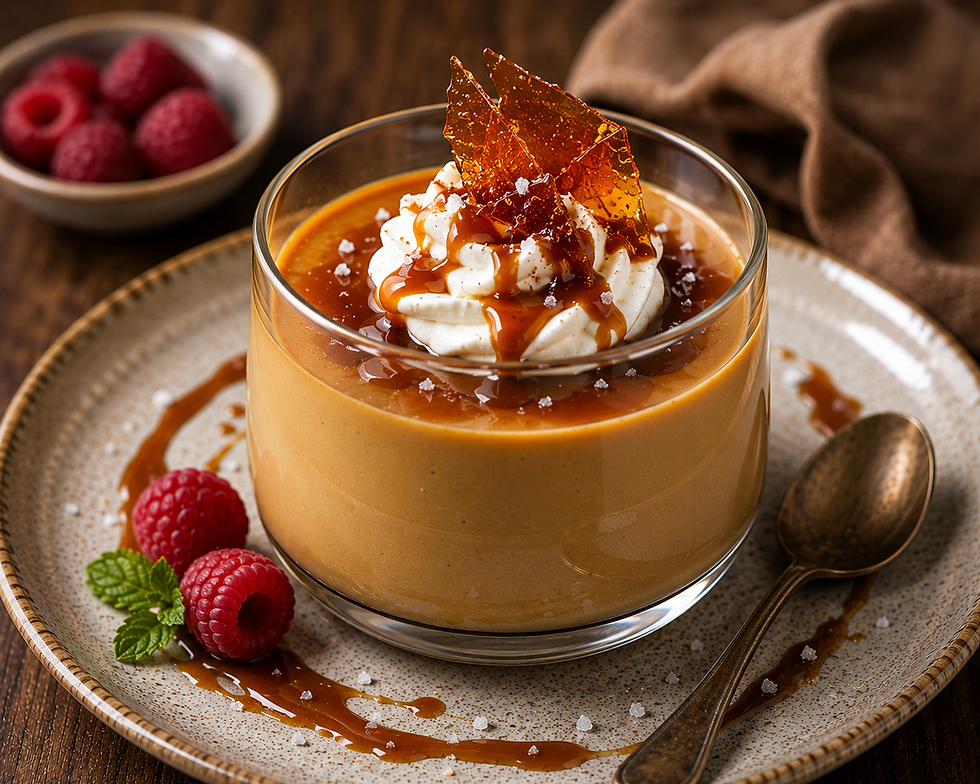
The caramel comes with it and pools around the base on its own, so add nothing else unless you want it there. A pinch of flaky salt on the caramel, never on the cream, sharpens the whole dessert. Crushed toasted hazelnuts on one side give the crack it otherwise lacks. Serve immediately: this dessert looks its best in its first two minutes.
Professional Technique
The technique that decides this dessert is that sugar does not stop cooking when the heat stops. Molten sugar at 338°F (170°C) holds great energy in a small mass with almost no water left to absorb any, and the heavy pan base keeps feeding it more. Lift it off at exactly the colour you wanted and it darkens for another 20 to 30 seconds, running through amber into acrid. So you take it off early, one shade lighter than the target, and stop the reaction by decuocere, adding liquid to drop the temperature fast.
That liquid has to be warm. Cream from the refrigerator is more than 300 degrees Fahrenheit colder than the sugar it meets. Its water flashes to steam and throws molten sugar out of the pan, and the sugar at the contact point is chilled so violently that it seizes into hard lumps that will not redissolve without long heating. Warm cream in a thin stream, with the whisk moving, cools the sugar steadily instead of shocking it.
Learn to read the caramel by nose, because the smell runs ahead of the colour. Sugar passes through stages with distinct aromas: plain sweetness, then butterscotch, then a roasted note with a thin bitter edge that arrives while the pan still looks safely gold. That edge is the signal to move. The base is cream at 35 percent fat set soft, and fat coats the palate and dulls it, so sweet caramel on top turns cloying by the third spoonful. The bitter fraction of a dark caramel cuts that film and resets the palate, which is why a pale caramel makes a worse dessert than a slightly too dark one.
Texture and Moisture Control
Two textures have to arrive together: a cream that barely holds its shape and a caramel that has become liquid again. They are connected. Caramel is hygroscopic, and over 8 hours in the refrigerator it pulls water out of the cream sitting on it and dissolves into a thin syrup. That transfer is why the dessert has to rest overnight rather than 3 hours, and why the layer of cream against the caramel is always slightly firmer than the rest. That gradient is correct, not a fault.
Temperature governs service. Between 39°F and 43°F (4°C and 6°C) the set is firm enough to stand and soft enough to yield to a spoon. Above 50°F (10°C) it collapses at the base and the caramel thins and runs off the plate. Below freezing the gelatine network is destroyed and the thawed dessert weeps water.
Moisture moves the wrong way if the molds sit uncovered. Cold cream in an open mold loses water and forms a tough skin, which becomes the base once inverted and reads on the tongue as a rubbery disc. Cover the tray loosely, not tightly: a sealed cover traps condensation that drips back and pits the surface.
Professional Mise en Place
Caramel gives you no pause once it is poured, so the molds, the warm cream and the softened gelatine must all be ready before the sugar goes on the heat.
Equipment and tools
Wide heavy saucepan for the sugar, pale inside so the shade stays readable
Second heavy saucepan for the cream and milk
Instant read thermometer, fine mesh sieve, pouring jug, balloon whisk
Six metal molds of 4 fl oz (120 ml) and a metal tray that fits the refrigerator
Prepared ahead
Molds oiled and chilling on the tray, before anything is heated
Gelatine softening in cold water, squeezed and waiting on a plate
Cream and milk warmed to 175°F (80°C) and covered off the heat
The whole dessert made up to 2 days ahead and left in the molds
Service setup
Plates in the refrigerator for at least 20 minutes before service
A jug of hot tap water beside the plates, not boiling water
Thin paring knife, dry cloth, flaky salt and hazelnuts within reach
Unmould to order, one plate at a time, never in advance
Chef Tips
Cook the caramel in a pan with a pale interior. In a dark pan you cannot see the colour until it is past the point you wanted, and the nose alone will not save a first attempt.
Weigh the gelatine rather than counting sheets. Leaf gelatine is sold at different strengths and sheet sizes, and 3 sheets can mean anything from 4 g to 10 g. What this recipe needs is 6 g of gold strength leaf for 3 1/4 cups (780 ml) of liquid.
The quarter teaspoon of lemon juice keeps the syrup from crystallising in the pan and is spent before it can do anything else, leaving no trace of flavour or acidity in the finished dessert.
If the caramel seizes into lumps when the cream goes in, do not force it with high heat. Put the pan over the lowest flame, add 2 tablespoons of hot water, and leave it alone for several minutes, swirling occasionally. It usually comes back.
Common Mistakes
Adding cold cream to the hot caramel. It erupts, throws molten sugar, and seizes the caramel into lumps that may never recover. Warm the cream first and pour it in a thin stream with the whisk moving.
Taking the caramel off at the colour you want. By the time it reaches the molds it is two shades darker and bitter in the wrong way. Stop the pan one shade early and let the carry over heat finish it.
Boiling the cream after the gelatine is in. Gelatine loses setting strength above 175°F (80°C) and the dessert will not hold its shape. Add the sheets off the heat, between 140°F and 160°F (60°C and 70°C).
Rushing the chill in the freezer. Ice crystals wreck the gelatine network and the thawed panna cotta weeps onto the plate. It also stops the caramel dissolving, so the base stays a hard glassy disc.
Pouring the cream straight onto the set caramel. A jet of warm liquid landing in the centre punches through the caramel layer, which ends up uneven and partly floating. Pour gently down the inside wall instead.
Wine Pairing
Moscato d'Asti DOCG: The Piedmontese answer, made in the hills next to where this dessert was born. It carries about 5 percent alcohol and a light sparkle, and both matter: the bubbles lift the film of butterfat off the palate, and the low alcohol never sharpens the bitter edge of the caramel the way a stronger wine would. Grapey peach and orange blossom sit above the caramel rather than competing with it. Serve at 46°F (8°C).
Recioto di Soave DOCG: Garganega dried on racks until the sugars concentrate, and the acidity concentrates with them. That retained acidity is why it works on a dessert this rich: it scours the cream between mouthfuls instead of layering sweetness onto sweetness. Dried apricot and honeyed almond echo the cooked sugar directly, with enough weight to stand beside a 35 percent fat cream.
Vin Santo del Chianti Classico DOC: Aged oxidatively for years in small casks, which builds the toasted walnut, dried fig and caramelised note the sugar in the mold already has. This mirrors the dessert rather than contrasting with it, and it goes deep. Pour small quantities: the alcohol runs high and the wine is more concentrated than the cream.
Malvasia delle Lipari DOC: From the Aeolian islands, with candied orange peel, dried apricot and a faint salty note off the volcanic soil. That saline thread does to the caramel what the pinch of flaky salt on the plate does, pushing the sugar into relief. Moderate alcohol and firm acidity keep it from turning syrupy alongside the cream.
Storage & Reheating
Panna cotta is a dessert to make ahead, which is most of its appeal. Leave it in the molds, cover the tray loosely and keep it at 39°F (4°C) for up to 3 days. It is best between 12 and 24 hours after it is made, once the caramel has turned to syrup but before the cream tightens. From day three the surface dries and the set becomes noticeably firmer.
Once unmoulded it will not wait: serve within a few minutes or it slumps and the caramel spreads into a film across the plate. Never freeze it: ice crystals destroy the gelatine network and the thawed dessert leaks water. Nothing here is reheated. The only thing that can be warmed is reserved caramel sauce, kept in a jar for up to 2 weeks and loosened over the lowest heat with a spoonful of cream.
Nutrition
Per serving, based on 6 portions and excluding the optional hazelnuts and whipped cream:
Calories: 460 kcal
Total Fat: 34 g
Saturated Fat: 21 g
Trans Fat: 0.8 g
Unsaturated Fat: 11 g
Cholesterol: 105 mg
Sodium: 95 mg
Total Carbohydrates: 37 g
Fiber: 0 g
Total Sugars: 36 g
Added Sugars: 32 g
Protein: 4 g
Lactose: 4 g
Principal micronutrients: calcium, vitamin A, vitamin D, riboflavin, phosphorus
These figures are estimates and move with the fat content of the cream you use.


Comments