
Italian Caramel Budino | Budino al Caramello
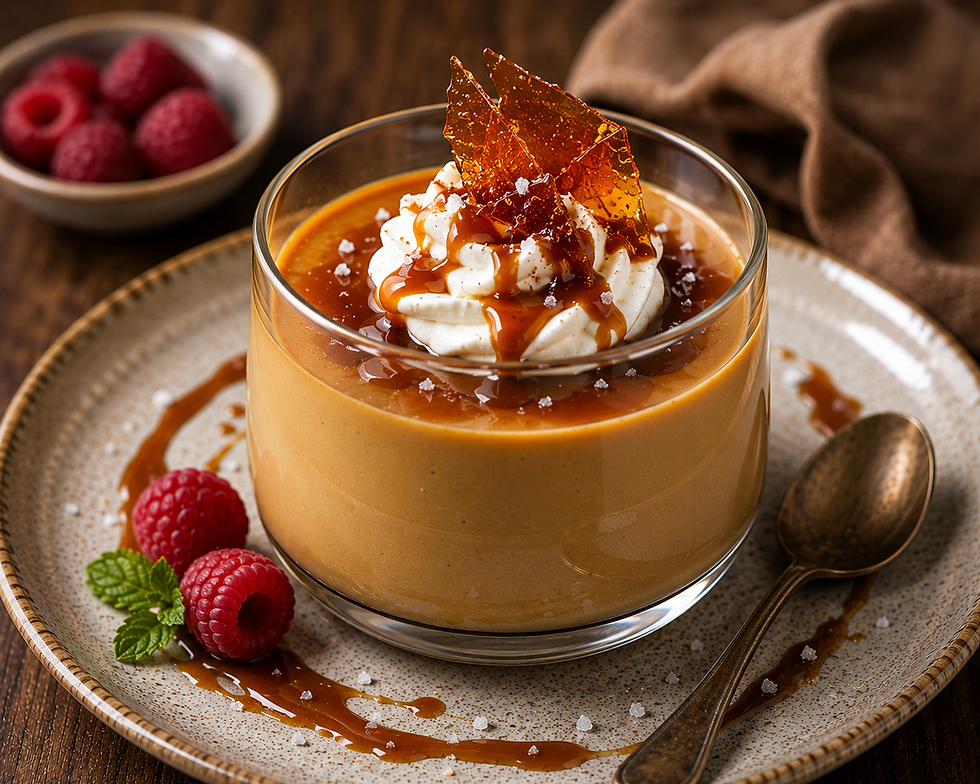
Caramel budino decides its own character in the first three minutes, while the sugar is still alone in the pan. Everything afterwards, the dairy, the yolks, the starch, the hours in the refrigerator, only carries whatever that sugar became. Stop it pale and the dessert tastes of sweetened milk. Take it to deep amber and it tastes of caramel, with the faint bitter edge that keeps a sweet spoon dessert from turning tiring by the third mouthful.
Yield: 6 servings in 5 oz (150 ml) glasses. Prep: 20 minutes. Cook: 25 minutes. Chill: at least 4 hours. Total: about 5 hours. Difficulty: intermediate. Course: dessert.
The Story
Budino, in Italian pastry, is the whole family of spoon desserts set firm enough to hold an edge and soft enough to eat with a teaspoon. The name came in from the French boudin and shares a root with the English pudding, and by the eighteenth century Italian kitchens were using it for almost anything set or baked in a mould, savoury versions included. Pellegrino Artusi, writing La scienza in cucina in 1891, lists budini of almonds, of ricotta, of semolina, of rice, of chocolate, and nearly all of them are baked or steamed in a mould and turned out. The stovetop budino, thickened over the heat and left to set in the glass it will be eaten from, is the modern branch of that family.
Caramel entered Italian sweets through the sugar refineries of the south and the French trained pastry cooks of the northern courts, and Piedmont is where the two met. Turin under the Savoy had a pastry culture that spoke French and worked with Italian ingredients, and it produced bonet and latte alla portoghese, both custards baked over a layer of caramel poured into the mould. That caramel sits under the dessert and glazes it when it is unmoulded. In a caramel budino the caramel goes the other way, straight into the dairy, so it is not a sauce on a custard but a flavour dissolved through it. Every spoonful carries the same amount, which is what the unmoulded versions cannot do.
The stovetop version survived in Italian homes for the plainest of reasons: it needs no oven, no water bath and no mould. From the 1960s the Italian food industry sold budino as a powder in a sachet, vanilla and chocolate above all, and trained two generations to expect a glossy set cream with no work at all. Caramel is the one flavour that never translated into a packet, because real caramel is a cooked sugar and a powder can only imitate it. That single failure is the best argument for making this dessert by hand.
Ingredients
The sugar is split into two quantities that behave differently. The first is cooked to a deep caramel and becomes the flavour of the budino. The second stays uncooked, goes in with the yolks and the starch, and is there for sweetness and to protect the yolks. Weigh both before you light the burner, because once caramel is moving there is no time to measure anything.
For the budino
Granulated sugar, for the caramel, 1/2 cup (100 g)
Water, for the wet method only, 2 tbsp (30 ml)
Whole milk, 2 cups (480 ml)
Heavy cream, 1 cup (240 ml)
Egg yolks, large, 4
Granulated sugar, for the custard, 3 tbsp (38 g)
Cornstarch, 3 tbsp (24 g)
Fine sea salt, 1/2 tsp (3 g)
Unsalted butter, cold, cut in cubes, 2 tbsp (28 g)
Vanilla extract, 1 tsp (5 ml)
For the salted caramel finish
Granulated sugar, 1/3 cup (67 g)
Water, 1 tbsp (15 ml)
Heavy cream, warm, 1/4 cup (60 ml)
Unsalted butter, 1 tbsp (14 g)
Flaky sea salt, 1/4 tsp (1.5 g)
For finishing
Lightly whipped unsweetened cream, 1/2 cup (120 ml)
Flaky sea salt, a few crystals per glass
Thin plain butter biscuits, 6, one per glass
Preparation
Step 1

Choose your method and cook the sugar. For the dry method put the 1/2 cup of sugar alone in a heavy pan over medium heat and leave it until the edges liquefy, then swirl the pan, never stir. For the wet method add the 2 tablespoons of water first, stir once to wet the sugar, and from then on touch nothing. Either way take it to a deep amber the colour of an old copper coin, about 340°F (170°C). Pull it while it still smells sweet and toasted rather than sharp.
Step 2

Add the dairy in stages. Warm the milk and cream together to about 150°F (65°C) in a separate pan while the sugar cooks, so the two are not far apart. Pour a third of the warm dairy into the caramel at arm's length: it will boil up hard and hiss, and the caramel will seize into threads. Return the pan to low heat and whisk until every thread has dissolved, then add the rest. Do not move on while there is still hard caramel on the bottom of the pan.
Step 3

Mix the yolks, sugar and starch. In a bowl whisk the yolks with the 3 tablespoons of sugar and the salt until slightly paler, then sift in the cornstarch and whisk again until the mixture is completely smooth and has no dry lumps in it. Work the starch in properly here, on a cold mixture, because a lump that survives this bowl will survive the cooking and end up on somebody's spoon. The mixture should fall thickly from the whisk and look glossy rather than grainy.
Step 4

Temper and cook the custard. Ladle about a cup of the hot caramel dairy into the yolk mixture in a thin stream, whisking without stopping, then return the loosened mixture to the pan with the rest. Cook over medium low heat, whisking constantly and getting into the corners of the pan, until the custard thickens and the first large slow bubbles break the surface. Keep whisking through that moment and give it a further 60 seconds, never longer, then take the pan off the burner.
Step 5

Finish, strain and fill. Drop in the cold butter cubes and the vanilla and whisk until the butter has disappeared completely and the surface has gone glossy. Pour the custard through a fine mesh sieve into a jug, pressing any residue with a ladle and discarding what will not pass. Fill the six glasses at once, while everything is fluid, and tap each one gently on the worktop to settle it. Press a disc of plastic film onto each surface and refrigerate for at least 4 hours.
Step 6

Make the salted caramel finish. Cook the 1/3 cup of sugar with the tablespoon of water to a slightly lighter amber than the first caramel, since this one is tasted on its own and not through dairy. Off the heat whisk in the warm cream, then the butter, then the flaky salt, and let it cool to room temperature. It should pour in a thick unbroken ribbon. If it sets too firm, loosen it with a teaspoon of warm cream, never water.
Plating
Serve the budino in the glass it set in. It was never meant to be turned out, and a wide low glass of about 5 oz (150 ml) shows the colour better than anything you could unmould. Take the glasses out of the refrigerator 15 minutes before service: at 45°F (7°C) the caramel aroma is closed and the texture reads heavy, while at about 54°F (12°C) both open up.
Peel the film off cleanly and spoon a thin layer of the cooled caramel over each surface, about 2 teaspoons, enough to pool and not enough to become a second dessert. Add a small spoon of barely whipped unsweetened cream to one side, since its job is to cut the sugar. Put the flaky salt on at the last second so the crystals are still crystals when the spoon reaches them, lean a thin biscuit against the rim and send the glasses out inside 10 minutes.
Professional Technique
There are two ways to make a caramel and they are not interchangeable. The dry method puts sugar in the pan with nothing else. It is fast, it reaches colour in four or five minutes, and it gives the deepest flavour because nothing dilutes the sugar. It also cooks in patches: the crystals over the hot spots melt and brown while those a finger away are still white. That is why it demands a genuinely thick base, which spreads the heat, and why you swirl the pan instead of stirring it. A spoon dragged through melting sugar carries unmelted crystals with it and builds a lump that will not melt again.
The wet method dissolves the sugar in a little water first. The syrup boils at one even temperature throughout, so every part of the sugar arrives at caramel together and the colour comes up gradually and readably. You pay for that control with time, since the water has to boil off before any browning starts, and with one risk: crystallization. Water climbs the walls of the pan, evaporates there and leaves sugar crystals behind, and if one falls back into the syrup it seeds the whole pan, which goes grainy and opaque in seconds.
The remedy is a pastry brush dipped in water and run once around the inside wall just above the syrup line, early, while the sugar is still dissolving: it washes the stray crystals down into the liquid where they dissolve harmlessly. A tight lid for the first two minutes does the same job with the steam. For this budino, where the caramel is read through a cup of dairy and needs depth more than precision, the dry method wins if your pan is heavy enough. Use the wet method on a thin pan, on a larger batch, or when you need to see a lighter colour arriving.
Texture and Moisture Control
What you want on the spoon is a clean soft set that holds a shape for a second and then relaxes, with no elastic pull and no water underneath. The set happens while the custard cooks, not in the refrigerator, which only fixes what the pan produced. That is why the 60 seconds after the first slow bubbles matter in both directions: stop short and the glasses stay loose, run long and the texture turns pasty.
Once the budino has set, leave it alone. Stirring a set starch custard tears the structure and it will not rebuild, so the mixture goes into the glasses fluid and is never touched again. Water leaving the set is the second failure, visible as a pale liquid ring at the edge of the glass, and it comes from cooking too hard or from leaving the surface open to the air. A disc of plastic film pressed onto the surface stops both the skin and the weeping.
The butter goes in last and off the heat. Cold butter beaten into a custard below boiling point emulsifies and gives the gloss a finished budino should have. Added earlier, over the flame, it separates and floats as a film of fat.
Professional Mise en Place
Caramel gives you no pauses, so everything is within reach before the sugar goes on the heat.
Equipment and tools
Heavy based saucepan for the caramel, light coloured inside if possible
Second saucepan for warming the milk and cream
Balloon whisk, silicone spatula, pastry brush and a small bowl of water
Fine mesh sieve and a pouring jug
Six glasses of 5 oz (150 ml), plastic film cut into discs
Prepared ahead
Both sugar quantities weighed into separate bowls
Milk and cream measured together, ready to warm
Yolks, sugar, starch and salt whisked smooth and kept cold
Salted caramel finish made up to 2 weeks ahead and refrigerated
Glasses washed, dried and lined up in a tray
Service setup
Glasses out of the refrigerator 15 minutes before service
Caramel finish at room temperature in a jug or squeeze bottle
Cream whipped to a barely holding stage, kept cold
Flaky salt in an open dish, added at the last second
Biscuits held dry and away from any steam
Chef Tips
Cook the caramel in a pan with a pale interior, stainless steel rather than black nonstick. Caramel is judged entirely by colour and a dark pan hides two shades of it, which is the commonest reason a first attempt comes out weak or burnt.
Have the dairy warm and standing next to the caramel pan before you start. Cold dairy makes the seizing worse and the recovery much longer.
Taste the caramel dairy before the yolks go anywhere near it. This is the only point where you can still correct the flavour. If it tastes flat there is nothing to be done later, so it is cheaper to cook a second caramel now than to serve six glasses of sweet milk.
Fill the glasses slightly under the rim rather than to the top. The caramel finish needs somewhere to pool, and a budino filled flush sends it over the outside of the glass the moment a spoon goes in.
Common Mistakes
Stirring a dry caramel with a spoon. The spoon carries unmelted crystals into the melted sugar and they clump into a mass that will not dissolve again. Swirl the pan by the handle instead.
Ignoring the walls of the pan on a wet caramel. One crystal falling back into the syrup turns the whole pan grainy and cloudy. Brush the inside wall with water while the sugar dissolves, or cover the pan for the first two minutes.
Stopping the caramel at golden. Light caramel disappears entirely behind three cups of milk and cream, and the budino tastes of sweetened dairy. Deep amber is not a stylistic choice here, it is the minimum for the flavour to survive dilution.
Adding the starch to a hot mixture. Starch shaken into anything warm sets on the outside of each lump and seals the dry centre in. It goes sifted into the cold yolks and sugar, and is whisked smooth before any heat touches it.
Skipping the sieve. Every custard leaves a little cooked egg on the bottom of the pan and a few starch specks in suspension, and both are obvious on a spoon.
Wine Pairing
A caramel dessert needs a wine at least as sweet as it is, or the wine arrives tasting thin and sour. It also needs acidity, because there is cream, butter and egg yolk to clear. Pour small, about 2 oz (60 ml), at 54°F (12°C).
Vin Santo del Chianti Classico DOC: The closest thing in Italy to caramel in a glass. Trebbiano and Malvasia dried on racks, then aged for years in small caratelli under controlled oxidation, build dried fig, walnut skin and a genuine toffee note that meets the cooked sugar on its own ground. The acidity underneath stays high enough to cut the cream, and the dry nutty finish stops the pairing becoming one long sweet note.
Marsala DOC: Fortified, oxidative and built on the same flavours as the dessert. Choose a Superiore Dolce, where the sweetness sits alongside burnt sugar, dried apricot and a bitter almond edge. That bitterness echoes the deep amber of the caramel rather than the sugar, and the higher alcohol scours butterfat as no unfortified wine can.
Recioto di Soave DOCG: The lighter and more aromatic option, from Garganega withered on racks through the winter. Its sweetness is moderate rather than heavy, and it brings acacia honey, dried yellow peach and a faint saffron note that lifts the dessert instead of matching its weight. High acidity keeps the palate moving between spoonfuls.
Ramandolo DOCG: The unexpected one, and the best choice when the salt on top is generous. Verduzzo Friulano is unusual among sweet whites for carrying real tannin, and that tannin over a firm acidity gives it a grip that cuts the yolks and the butter effortlessly. Dried apricot, quince and a resinous herbal edge keep it from tasting syrupy.
Storage & Reheating
The budino keeps refrigerated for 3 days, covered with film pressed onto the surface of each glass, and it is at its best on the second day when the caramel has spread through the dairy. After the third day the starch begins to release water and a ring of liquid appears at the edge. There is no way to whisk that back in.
Nothing here is reheated. A set starch custard warmed up breaks down and turns to liquid, and it does not set again on cooling. Do not freeze the filled glasses either: the water in the set freezes into crystals that tear the structure and the budino thaws grainy.
The salted caramel finish is the one part that stores well. Refrigerated in a sealed jar it keeps for 2 weeks and reheats over the lowest heat, loosened with warm cream if needed.
Nutrition
Per serving, based on 6 glasses with the caramel finish and the cream:
Calories: 415 kcal
Total Fat: 24 g
Saturated Fat: 14 g
Trans Fat: 0 g
Unsaturated Fat: 8 g
Cholesterol: 195 mg
Sodium: 240 mg
Total Carbohydrates: 44 g
Fiber: 0 g
Total Sugars: 38 g
Added Sugars: 31 g
Protein: 6 g
Lactose: 7 g
Principal micronutrients: calcium, vitamin A, vitamin D, riboflavin, phosphorus, selenium
These figures are estimates and will move with the size of the glass and how heavily the caramel is spooned on.


Comments