
Italian Revisited Pasta alla Norma | Pasta alla Norma Rivisitata

Pasta alla Norma is four ingredients and a great deal of discipline: tomato, fried eggplant, basil and ricotta salata over short pasta. Catania has made it in that form for well over a century and the city is protective about it, because the dish has nothing to hide behind. No stock, no cream, no wine, no long braise. Anything done badly stays visible on the plate.
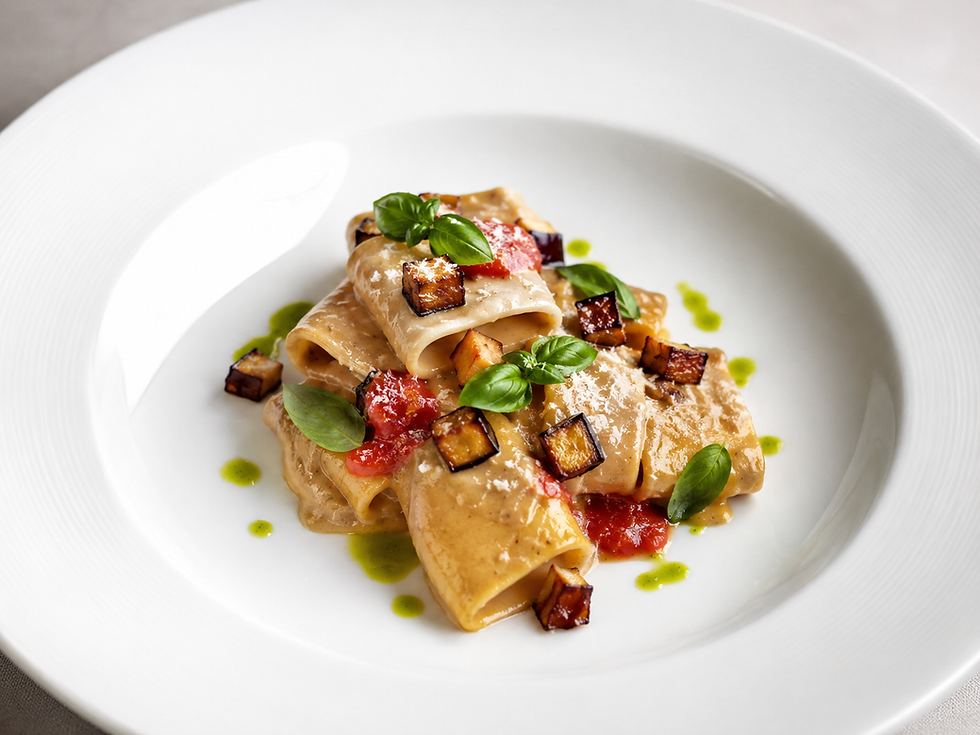
This revisited version changes method rather than ingredients. The eggplant is split into a slow roasted smoky puree underneath and cubes fried to order on top. The tomato is split as well, a long cooked datterino confit for depth and a cold pressed tomato water for lift. Ricotta salata arrives frozen and grated to a snow, so it never turns pasty against the heat.
Yield: 4 servings. Prep: 40 minutes. Roasting: 45 minutes. Cook: 30 minutes. Total: about 2 hours. Difficulty: intermediate. Course: primo piatto. Region: Sicily, Catania and the eastern slopes of Etna.
The Story
Pasta alla Norma belongs to Catania, and the city ties it to its most famous son. Vincenzo Bellini was born there in 1801, and his opera Norma opened at La Scala on 26 December 1831. The story Catanesi tell is that the playwright Nino Martoglio, served this pasta at a friend's table, pushed his plate back and called it a real Norma, meaning a masterpiece of its kind. Whether he ever said the words, the dialect use of norma for a benchmark is genuine, and the name fixed itself to this dish and to no other.
The ingredients are older than the name. Eggplant reached Sicily through Arab agriculture in the early Middle Ages and settled into the island's cooking centuries before the rest of Italy would accept it. Tomato arrived much later and became ordinary in Sicilian kitchens only in the nineteenth century. Ricotta salata is the pressed and salted sheep milk ricotta of the Sicilian interior, aged until it grates rather than spreads, and it is what makes the plate unmistakably Sicilian rather than merely southern.
Catania cooks it with short pasta, usually maccheroni or rigatoni, and grates the ricotta salata at the table so it never melts. The eggplant is fried, not roasted and not grilled, and in the city that is not open to discussion. Around Etna the tomatoes and the eggplant both come off volcanic soil, which is why the dish tastes the way it does on that side of the island.
Ingredients
For the roasted eggplant base
Globe eggplant, large, 1, about 1 lb (450 g)
Extra virgin olive oil, 2 tbsp (30 ml)
Garlic clove, 1
Fine sea salt, 1/2 tsp (3 g)
For the fried eggplant
Globe eggplant, firm, 2, about 1 3/4 lb (800 g)
Coarse sea salt, 2 tbsp (30 g), for purging
Sunflower or peanut oil, 4 cups (950 ml), for frying
For the tomato confit
Datterino or cherry tomatoes, ripe, 1 1/4 lb (570 g)
Canned San Marzano tomatoes, crushed by hand, 1 cup (240 g)
Extra virgin olive oil, 3 tbsp (45 ml)
Garlic cloves, lightly crushed, 2
Fine sea salt, 1 tsp (6 g)
Granulated sugar, 1 pinch, only if the tomatoes are sharp
For the tomato water
Very ripe tomatoes, 14 oz (400 g)
Fine sea salt, 1/4 tsp (1.5 g)
For the pasta
Bronze die rigatoni, 14 oz (400 g)
Water, 5 quarts (4.7 liters)
Coarse sea salt, 3 tbsp (45 g)
For finishing
Ricotta salata, well aged, 3 1/2 oz (100 g), frozen
Fresh basil leaves, small, 20
Extra virgin olive oil, 2 tbsp (30 ml)
Freshly ground black pepper, to taste
Preparation
Roast the eggplant for the base
Heat the oven to 425°F (220°C). Prick the large eggplant all over, rub it with 1 tablespoon of the olive oil and roast it whole for 40 to 45 minutes, turning once, until the skin blisters and the fruit collapses under a spoon. Split it open, let the free liquid run off for 5 minutes, then scoop out the flesh and discard the skin. Blend the flesh with the raw garlic clove, the remaining oil and the fine salt until smooth, and keep it warm.
Purge and dry the eggplant cubes
Cut the two firm eggplants into cubes of about 3/4 in (2 cm), skin on for structure. Toss them with the coarse salt in a colander and leave them 30 minutes over a bowl to draw out the brown bitter water. Rinse quickly under cold water, then dry the cubes hard between two clean cloths, pressing rather than rubbing. They must be dry to the touch before they meet oil, or the frying turns into steaming and they come out grey.
Build the datterino confit
Warm the olive oil with the crushed garlic in a wide pan over low heat until fragrant but pale, about 3 minutes, then lift the garlic out. Add the halved datterino tomatoes and the crushed San Marzano, season with the fine salt and let the pan barely simmer for 25 to 30 minutes. The surface should move slowly and never boil. Add the pinch of sugar at the end only if the acidity is sharp rather than bright.
Press the raw tomato water
Grate the very ripe tomatoes on the coarse side of a box grater, discarding the skins, and season the pulp with the fine salt. Tip it into a fine mesh sieve over a bowl and leave it to drip for 20 minutes without pressing. Do not heat the clear fragrant liquid that collects underneath at any point. Hold it at room temperature and use it raw at the very end, where its freshness is the whole reason it exists.
Freeze and grate the ricotta salata
Wrap the ricotta salata and put it in the freezer for 40 minutes. It should be firm and cold through, not frozen solid. Grate it on the coarse side of a grater over a chilled plate and return it to the freezer until service. Cold cheese breaks into dry separate threads, while cheese grated warm clumps and smears into a dull paste on hot pasta.
Cook the rigatoni and save the water
Bring the water to a rolling boil and add the coarse salt, roughly 9 grams per litre. Add the rigatoni and cook them 2 minutes short of the time on the packet. Before draining, reserve 2 cups (475 ml) of the cloudy cooking water. Drain but never rinse: the starch clinging to the surface is what binds the sauce in the next step.
Fry the cubes and finish the pasta
While the pasta cooks, heat the frying oil to 340°F (170°C) and fry the dried cubes in two batches for 3 to 4 minutes each, until deep gold and crisp at the corners. Drain them on a rack, not on paper, and salt them at once. Tip the drained rigatoni into the pan of confit with a ladle of pasta water and toss hard over medium heat for 90 seconds, adding more water in splashes, until the sauce turns glossy and clings. Off the heat, fold in half the cubes and the basil.
Plating
Use wide shallow bowls warmed to about 140°F (60°C), warm enough to hold the pasta but not so hot that the ricotta salata softens on contact. Spoon 2 tablespoons of the warm eggplant puree into the base of each bowl and spread it with the back of the spoon into a broad disc reaching almost to the rim.
Lift the rigatoni with tongs and stack them upright over the puree so the tubes stand rather than lie flat, which keeps the sauce inside them. Scatter the remaining fried cubes over and around, spoon a tablespoon of cold tomato water around the edge of the bowl where it will not be heated through, and finish with the frozen ricotta salata, small basil leaves, a thread of raw olive oil and black pepper. Send it immediately.
Professional Technique
The controlling technique is doubling each main ingredient into a cooked form and a fresh form. Roasted eggplant flesh, blended, gives a smoky low note with no texture at all, while cubes fried at 340°F (170°C) give a caramelised crust and a creamy centre with no smoke. Neither alone is the whole flavour of eggplant. Together they cover the full range, and the diner reads one ingredient with unusual depth.
The same logic runs through the tomato. Thirty minutes at a bare simmer concentrates sugars and builds body through slow pectin release, but it also drives off the volatile compounds that make a raw tomato smell like a tomato. Cold pressed tomato water carries exactly those compounds and nothing else, which is why it goes onto the plate unheated at the last second. Warm it even slightly and it becomes indistinguishable from the sauce.
The third element is the frying. Eggplant is a sponge of air pockets, and oil below about 320°F (160°C) fills them before the surface sets. At 340°F (170°C) the exterior seals within seconds, the trapped water turns to steam and pushes outward against the oil, and the cube fries rather than soaks. The salt purge collapses part of that air structure beforehand and makes the seal happen faster still.
Texture and Moisture Control
Three textures have to arrive intact: rigatoni firm at the centre, fried cubes crisp at the corners, ricotta salata dry and separate. The pasta is pulled 2 minutes early because it keeps cooking during the mantecatura, and rigatoni carried to full doneness in the water end up soft and split once they meet the sauce. Cook them to a genuine al dente in the pan, not in the pot.
The binding is done with starch, not with fat or cream. Cloudy pasta water is a suspension of gelatinised starch, and beaten into the tomato and the olive oil over heat it builds a light emulsion that coats every tube and holds. Add it in small splashes and keep the pan moving, because poured in all at once it simply dilutes the sauce.
Moisture is the enemy of the fried cubes from the moment they leave the oil. Draining them on paper traps steam underneath and softens the base within a minute, so use a rack. Only half go into the pan to soften. The other half stay dry until they hit the bowl, which is the only way one serving offers both crisp and yielding eggplant at once.
Professional Mise en Place
Everything except the frying and the final toss can be done in advance, and the service window is roughly 4 minutes long. Set the pasta pot and the frying oil to come up to temperature together, because the cubes must reach the bowl within two minutes of leaving the oil.
Equipment and tools
Wide low sided pan for the confit and the final mantecatura
Deep heavy pot for frying with a probe thermometer
Cooling rack set over a tray for the fried cubes
Fine mesh sieve and a blender for the puree and the tomato water
Coarse box grater and a chilled plate for the ricotta salata
Prepared ahead
Roasted eggplant puree, up to 2 days, refrigerated and gently rewarmed
Tomato confit, up to 3 days, refrigerated in a sealed container
Tomato water, on the day only, kept covered at room temperature
Eggplant cubes purged, rinsed and dried, up to 4 hours, kept uncovered
Ricotta salata grated from frozen and held in the freezer
Service setup
Frying oil steady at 340°F (170°C) with the thermometer left in
Confit warm in the wide pan, loosened with a splash of pasta water
Pasta water at a rolling boil, reserved cups drawn before draining
Basil picked into small leaves, olive oil and pepper mill within reach
Bowls warmed to 140°F (60°C), never hotter
Chef Tips
Buy eggplant heavy for its size, with taut glossy skin and a green calyx. Light dull fruit is old, full of developed seeds and genuinely bitter, and no amount of salting will correct it.
Use two different oils. Sunflower or peanut oil for the frying, because it holds 340°F (170°C) without breaking down, and good extra virgin olive oil raw at the finish, where you can actually taste what you paid for.
Grate the ricotta salata straight from the freezer onto a cold plate. It shatters into dry threads instead of smearing, and it lands on hot pasta without melting into the film that ruins most versions of this dish.
Taste the tomato water on its own before you use it. If it seems thin, do not reduce it: add a pinch of salt. Any heat at all destroys the fresh aroma that is the entire reason for making it.
Common Mistakes
Skipping the salt purge. Unpurged cubes carry water that turns the frying oil into a steam bath, and what comes out is grey, limp and oily rather than crisp. Thirty minutes under coarse salt, a quick rinse and a hard dry is the whole difference.
Frying the eggplant too early. Cubes fried an hour ahead go soft as their own residual heat works through the crust, and reheating never brings it back. Fry them while the pasta is in the water and get them into the bowl within two minutes.
Letting the ricotta salata cook. Grated into a hot pan it turns to paste and coats the rigatoni in a dull salty film. It belongs on the plate at the last second, grated from frozen, where it stays dry and separate.
Boiling the tomato confit hard. High heat splits the fruit and drives off the perfume, leaving a flat sauce with a faintly metallic edge. Hold it at a bare simmer and let time rather than temperature do the concentrating.
Draining the pasta dry. Without two ladles of starchy cooking water the sauce cannot emulsify, and the rigatoni sit in oil with tomato around them instead of wearing a glossy coat. Reserve the water before you drain, every time.
Wine Pairing
Etna Rosso DOC: Nerello Mascalese grown on the volcano above Catania, which makes it the local answer in the most literal sense. Its tannin is fine and dusty rather than gripping, so it meets the fried eggplant without drying the palate, and the high altitude acidity keeps pace with the tomato. The smoky mineral note underneath picks up the roasted eggplant puree directly.
Faro DOC: A tiny appellation on the hills above Messina, built on the same Nerello grapes with Nocera alongside. It is leaner and more savoury than Etna Rosso, with dried herb and blood orange notes that sit well against basil and salted sheep ricotta. Serve it at around 61°F (16°C), because any warmer and the alcohol starts competing with the frying oil.
Cerasuolo di Vittoria DOCG: From the far southeast of the island, Nero d'Avola for flesh and Frappato for perfume. The Frappato half brings sour cherry and a light floral lift that answers the sweetness of the confit tomatoes, while the low tannin means nothing clashes with the ricotta salata. It is the easiest bottle here to drink through a second helping.
Etna Bianco DOC: Carricante, for anyone who wants a white with this plate, and a serious choice rather than a compromise. The acidity is high and the finish distinctly saline, which cuts the oil left on the fried cubes better than any red manages. Its faintly bitter citrus pith character also runs alongside the eggplant skin instead of fighting it.
Cesanese del Piglio DOCG: A mainland alternative from Lazio when the Sicilian bottles are out of reach. Cesanese gives dark fruit with a peppery edge and soft tannin, and that pepper works with the basil and the black pepper over the finished bowl. Choose a young unoaked bottling and serve it cool, since oak would flatten the raw tomato water completely.
Storage & Reheating
Store the components, never the assembled bowl. The eggplant puree keeps refrigerated in an airtight container for 2 days. The tomato confit keeps for 3 days and improves on the second. Grated ricotta salata keeps in the freezer for 2 weeks in a sealed bag. The tomato water is a same day preparation and loses its aroma overnight.
Dressed pasta does not really keep. If you have leftovers, refrigerate them up to 2 days in a shallow airtight container so the tubes cool quickly and stop softening. Never freeze finished pasta alla Norma: the eggplant cubes collapse into mush on thawing and the tomato weeps.
To reheat, put the pasta in a wide pan with 3 tablespoons of water, cover and warm it over medium low heat for 3 to 4 minutes, shaking the pan rather than stirring. The water turns to steam and rehydrates the sauce without cooking the pasta further. Never use a microwave, which overcooks the outside of every tube. Fry fresh cubes and grate fresh cheese over the top: that is what the reheated bowl is missing.
Nutrition
Per serving, based on 4 servings:
Calories: 690 kcal
Total Fat: 31 g
Saturated Fat: 8 g
Trans Fat: 0 g
Unsaturated Fat: 21 g
Cholesterol: 25 mg
Sodium: 980 mg
Total Carbohydrates: 84 g
Fiber: 9 g
Total Sugars: 14 g
Added Sugars: 0 g
Protein: 21 g
Lactose: 0.6 g
Principal micronutrients: vitamin C, vitamin K, potassium, folate, calcium, phosphorus, manganese
These figures are estimates. The fat total depends almost entirely on how well the cubes were fried and drained, and most of the salt in the pasta water is poured away rather than eaten.


Comments