
Italian Duchess Potatoes | Patate Duchessa al Parmigiano
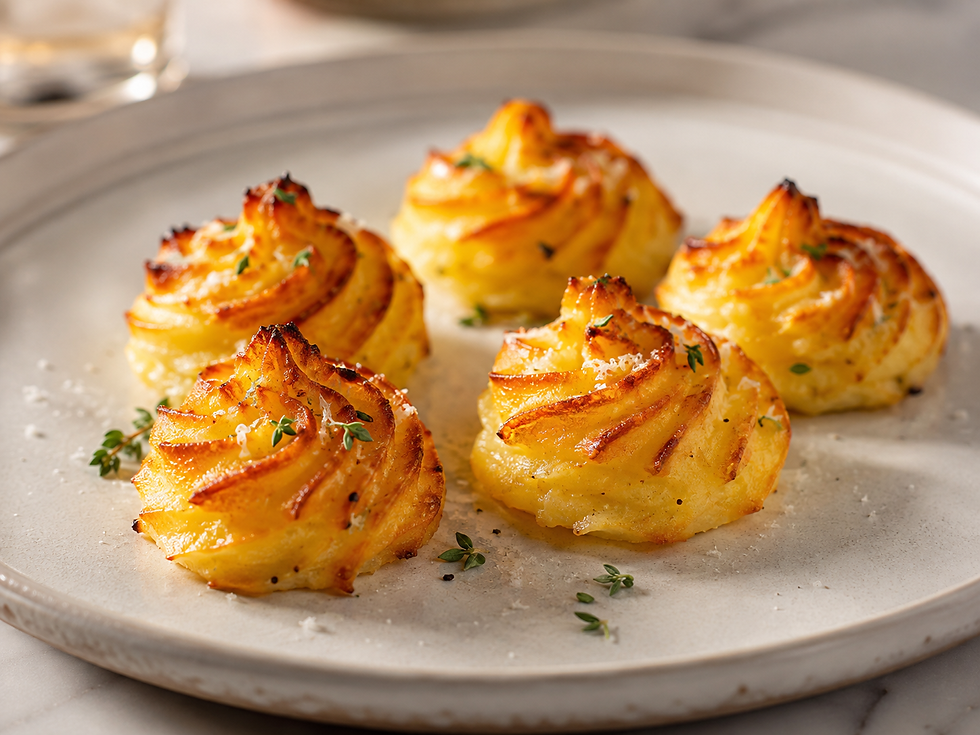
Patate duchessa are piped potato rosettes, baked until the ridges colour and the inside stays light. They are one of the few Italian side dishes that entered the kitchen from the dining rooms of the aristocracy rather than from the fields. The mixture is nothing more than dry floury potato, egg yolk, butter and Parmigiano Reggiano, which is exactly why every one of those four has to be right.
Everything that can go wrong goes wrong before the piping bag. Potato that carries water turns the mixture slack and the rosettes spread into puddles in the oven. Too much yolk makes them taste of custard. Cheese grated coarsely catches in the star tip and tears the ridge. The method below deals with each of those in order, and none of it is difficult once the sequence is clear.
They are also the most useful make ahead side dish there is, since the piped rosettes freeze raw and bake from frozen without losing anything at all.
Yield: 6 servings, about 18 rosettes. Prep: 30 minutes. Cook: 1 hour 25 minutes. Chill: 30 minutes. Total: about 2 hours 25 minutes. Difficulty: intermediate. Course: contorno. Region: adopted across Italy, with roots in the French trained court kitchens of Turin and Naples.
The Story
The dish is French by birth. Pommes duchesse belong to the grande cuisine of the 19th century and reach their fixed form in the Guide Culinaire of Escoffier in 1903, where the potato is bound with yolk, piped through a star tube and gilded with egg wash before it goes into the oven. Nothing in that description mentions cheese, because the French original does not carry any.
It arrived in Italy the way most of the classical repertoire did, through kitchens that employed French trained cooks. In Turin the Savoy court ate essentially French food for the better part of two centuries. In Naples and in Sicily the aristocratic households kept the monsu, a local rendering of monsieur, a chef trained in the French manner who ran the kitchen of a single family. Those cooks brought the potato into Italian cooking as something other than famine food, and the same households gave us gattò di patate and the fried crocchè of the Neapolitan street stalls.
The Parmigiano Reggiano is the Italian edit, and it is not decoration. It replaces part of the salt, it adds a savoury depth the French version draws from butter alone, and its protein helps the piped ridge hold its shape as the rosette heats. By the middle of the 20th century the rosettes had moved out of aristocratic dining rooms into the windows of gastronomie and rosticcerie, and onto the Christmas and Easter table of ordinary families, which is where most Italians meet them now.
Ingredients
For the potato base
Starchy yellow potatoes, Yukon Gold or bintje type, 2 1/4 lb (1 kg)
Coarse sea salt for the baking bed, 2 cups (500 g)
For the enriched mixture
Unsalted butter, softened, 4 tbsp (57 g)
Egg yolks, large, 4, about 2 1/2 oz (70 g)
Parmigiano Reggiano, grated to a powder, 2 1/2 oz (70 g)
Whole milk, warm, 2 tbsp (30 ml), only if needed
Fine sea salt, 1 tsp (6 g)
Freshly ground white pepper, 1/4 tsp (0.5 g)
Freshly grated nutmeg, 1/8 tsp (0.3 g)
For finishing
Egg yolk, 1, beaten with whole milk, 1 tsp (5 ml)
Unsalted butter, melted, 1 tbsp (14 g)
Parmigiano Reggiano, grated to a powder, 1/2 oz (15 g)
Flaky sea salt, a few grains per plate
Preparation
Bake the potatoes whole on a bed of salt
Heat the oven to 400°F (200°C). Scrub the potatoes, dry them, prick each one twice with a fork and sit them directly on a bed of coarse salt in a roasting tray. Bake for 55 to 70 minutes depending on size, until a skewer slides through the centre with no resistance at all.
Rice them hot and dry the purée
Split each potato as soon as you can handle it and scoop the flesh straight into a ricer or a food mill fitted with the fine disc. Work fast. Potato riced while it is steaming stays fluffy, while potato that has cooled turns gluey under pressure because the starch granules have set. Return the riced flesh to the empty pan and stir it over low heat for 2 to 3 minutes, until it stops steaming and the surface starts to look matte rather than wet.
Enrich off the heat
Take the pan off the burner and beat in the softened butter in two additions, until it disappears completely. Let the purée fall to about 140°F (60°C), warm but no longer hot, then beat in the egg yolks one at a time. Yolks added to a scorching purée set on contact and leave cooked threads that will block the piping tip later. Add the warm milk last, a spoonful at a time, and only if the mixture feels too stiff to pipe.
Season and fold in the Parmigiano
Stir in the grated Parmigiano Reggiano, the salt, the white pepper and the nutmeg. Use white pepper rather than black, because black specks read as burnt on a pale gilded rosette. Grate the cheese as finely as the grater allows, on the smallest holes or in a rotary grater, since any shred longer than a couple of millimetres will catch in the star tip and break the ridge. Taste and correct the salt now, while you still can.
Pipe the rosettes
Fit a piping bag with a large open star tip, about 1/2 inch (12 mm) across, and fill it no more than two thirds full. Pipe rosettes about 2 inches (5 cm) wide onto a tray lined with baking parchment, starting at the outside and spiralling in, finishing with a clean upward lift. Leave 1 inch (2.5 cm) between them.
Chill until the ridges set
Refrigerate the piped rosettes uncovered for at least 30 minutes, or freeze them for 15. The butter has to firm up inside the ridges before any heat reaches them, otherwise the pattern slumps in the first two minutes of baking and what comes out is a smooth mound.
Gild and bake
Raise the oven to 425°F (220°C). Brush each rosette very lightly with the yolk and milk wash, using a soft brush and touching only the top of the ridges, then bake for 12 to 15 minutes until the peaks are deep gold and the valleys are still pale. Spoon the melted butter over them and scatter the remaining Parmigiano in the last 2 minutes, so the cheese toasts without burning.
Plating
Serve them hot, within about ten minutes of leaving the oven, on a warmed plate. They are one of the few side dishes that genuinely suffer from waiting: the outside softens as steam moves back out of the centre, and the contrast between the crisp gilded ridge and the light interior is the whole point of the dish.
Arrange three rosettes per person, spaced rather than crowded, so the ridges stay visible. They belong beside anything with a sauce, roast veal, brasato or guinea fowl, because the sauce collects in the grooves. Do not sauce them yourself. A grind of white pepper and a few grains of flaky salt is the only finish they need.
Professional Technique
The technique that separates a standing rosette from a flat one is moisture management, and it is decided before any enrichment happens. A potato is roughly four fifths water. Boiling adds more, and the only route out for that water is the oven, where it turns to steam inside a piped shape and forces it open. Baking whole on salt drives moisture out instead, and the salt bed lifts the tray surface away from direct contact so the underside cooks in dry heat rather than sitting in its own condensation.
The ricer is not a convenience either. A food processor shears potato cells open and releases free starch, which turns the purée into glue, while a ricer pushes the cooked flesh through in intact fragments. The egg yolk then does two jobs at once. Its lecithin emulsifies the butter into the potato so the fat does not weep out under heat, and its proteins set between 149°F and 158°F (65°C and 70°C), building a structure inside the ridge that holds the piped shape while the rosette expands.
The gilding is chemistry rather than appearance. A thin wash of yolk and milk supplies protein and a trace of lactose exactly at the surface, which is where the Maillard reaction gives the ridges their colour and their roasted flavour in twelve minutes.
Texture and Moisture Control
Three things have to arrive together: a crisp ridge, a light interior and a clean edge that has not spread. Each fails for its own reason. The ridge softens if the rosettes sit after baking or if they are covered while hot. The interior turns dense if the purée was overworked or riced cold. The edge spreads if the mixture was too wet, or if it went into the oven at room temperature instead of straight from the cold.
Judge the purée by how it behaves on the spoon rather than by the quantities, because potato varies from one week to the next. The finished mixture should hold a soft peak and fall from a spoon reluctantly, in one piece. If it ribbons off, it is too wet, and the correction is two more minutes of drying over low heat before the yolks go in, never extra cheese or flour.
Heat is the other lever. A hot oven for a short time is right: at 425°F (220°C) the surface sets and colours before the inside has time to release its steam, and that is the balance that keeps the shape. A moderate oven over a longer time dries the rosette all the way through and it comes out pale and chalky.
Professional Mise en Place
Almost everything here can be done in advance, and the piped rosettes are the point at which the work stops. Service is nothing more than a wash and twelve minutes of oven.
Equipment and tools
Potato ricer or food mill fitted with the fine disc
Roasting tray and enough coarse salt for a shallow bed
Piping bag with a large open star tip, about 1/2 inch (12 mm)
Rotary grater, or the smallest holes of a box grater
Soft pastry brush and a sheet tray lined with baking parchment
Prepared ahead
Potatoes baked, riced, dried and enriched, up to 1 day ahead, refrigerated covered
Rosettes piped and chilled on their tray, up to 1 day ahead
Rosettes piped and frozen solid, then bagged, up to 1 month
Parmigiano grated to a powder and kept in a sealed container
Egg wash whisked and strained, up to 4 hours ahead
Service setup
Oven at 425°F (220°C), shelf in the upper third
Rosettes straight from the refrigerator or the freezer, never at room temperature
Melted butter warm and the finishing cheese within reach
Plates warmed, because the rosettes go out immediately
Add 3 to 4 minutes to the bake when they come from frozen
Chef Tips
Choose the potato for dryness rather than for colour. Starchy varieties rice light and fluffy, and any bintje type or a good Yukon Gold will do it. Waxy new potatoes hold water and will never give you a rosette that stands up.
Weigh the yolks if you can. Four large yolks come to about 2 1/2 oz (70 g), and going much above that is the commonest way to ruin the flavour, which drifts towards sweet custard and away from potato. The yolk is there to bind and to enrich, not to take over the dish.
Pipe one test rosette and bake it alone for twelve minutes before you commit the batch. It costs a single rosette and it tells you everything: whether the mixture spreads, whether the ridges hold and whether the salt is right. Correct the rest of the tray on what you see.
Keep a bowl of warm water beside you while piping and wipe the tip every eight or ten rosettes. Potato dries fast on metal, and a crust on the star tip is what produces the torn ragged ridges that never colour evenly.
Common Mistakes
Boiling the potatoes. Peeled potatoes in water absorb it right through, and the mixture that results is slack no matter how much cheese goes in to compensate. Bake them whole in their skins, or at the very least steam them whole and dry the purée hard afterwards.
Using a food processor or a blender. The blade tears the potato cells and releases free starch, and thirty seconds is enough to turn a purée into a sticky paste that cannot be rescued. Use a ricer or a food mill, and stir by hand from there on.
Adding the yolks to a scorching purée. Above about 158°F (70°C) the yolk sets on contact and leaves cooked threads through the mixture, which block the star tip and show as pale specks after baking. Let the purée drop to hand hot first.
Baking the rosettes immediately after piping. The butter has to be firm inside the ridges when the heat arrives, otherwise the pattern melts before the surface sets and you get a smooth mound. Thirty minutes in the refrigerator is the minimum, and freezing for fifteen works too.
Flooding them with egg wash. Wash that pools in the grooves bakes into a shiny yellow film that tastes of cooked egg and hides the pattern entirely. Brush the tops of the ridges only, with a nearly dry brush.
Wine Pairing
Franciacorta DOCG: The cleanest answer to butter and egg yolk. The mousse of a metodo classico scrubs the fat off the palate between mouthfuls, and the autolytic bread and hazelnut character that comes from long lees ageing sits naturally alongside the toasted cheese crust on the ridges. A Brut rather than an Extra Brut, since the small amount of sugar carries the sweetness the potato itself brings.
Verdicchio dei Castelli di Jesi Classico Riserva DOCG: A white with enough body to meet a rich purée without needing oak to get there. The Riserva spends longer on its lees and gains a waxy texture that mirrors the butter, while the bitter almond finish characteristic of Verdicchio cuts straight through the Parmigiano and keeps the last bite as clean as the first.
Soave Superiore DOCG: Garganega grown on volcanic soil gives a white of quiet weight, with white flowers, pear and a faintly saline finish. It is the pairing for when the rosettes sit beside roast poultry rather than red meat, because it has the acidity to handle the yolk without ever competing with the main plate for attention.
Collio Friulano DOC: Friulano brings a green almond bitterness and a firm dry finish that reads as a palate cleanser against the softness of the potato. There is more texture here than the alcohol would suggest, which is what allows it to stand up to the cheese, and the herbal edge keeps the nutmeg in the mixture from turning sweet.
Alto Adige DOC Pinot Nero: The red for anyone serving these with a braise. Alpine Pinot Nero stays light in tannin and high in acidity, with red cherry and a dried leaf note, so it works with the roasted surface of the rosettes rather than flattening them. Serve it at around 57°F (14°C), cooler than a full red, to keep the alcohol from magnifying the butter.
Storage & Reheating
Raw is the state to store them in. Piped rosettes keep on their tray, uncovered until firm and then loosely covered, for 24 hours in the refrigerator, and they bake from cold exactly as written. Frozen solid on the tray and then transferred to a bag, they keep for 1 month and go into the oven straight from the freezer with 3 to 4 minutes added. Do not thaw them first, which gives you a puddle.
The finished mixture, before piping, holds for 1 day covered in the refrigerator. It comes out stiff, so leave it at room temperature for twenty minutes and beat in a tablespoon of warm milk before it will pass through a tip.
Baked rosettes keep for 2 days refrigerated, in a single layer in a rigid container, although they are much better on the first day. Reheat them in a 400°F (200°C) oven for 6 to 8 minutes, directly on a tray, never covered and never in a microwave, which steams the crust off. Once baked they are not worth freezing.
Nutrition
Per serving, based on 6 servings of about 3 rosettes each:
Calories: 285 kcal
Total Fat: 14 g
Saturated Fat: 8 g
Trans Fat: 0.4 g
Unsaturated Fat: 5 g
Cholesterol: 185 mg
Sodium: 480 mg
Total Carbohydrates: 29 g
Fiber: 3 g
Total Sugars: 2 g
Added Sugars: 0 g
Protein: 10 g
Lactose: 0.6 g
Principal micronutrients: potassium, vitamin C, vitamin A, calcium, phosphorus, vitamin B6
These figures are estimates. The salt bed under the potatoes contributes almost nothing to the final sodium, since the skins are discarded, and the real variable is how generously the finishing butter and cheese are applied.


Comments