
Vegan Italian Tomato Pizzette | Pizzette Rosse Vegane

Pizzette are the small round pizzas of the Italian bakery and the coffee bar, the ones lined up on trays for a mid-morning snack, a children's party or the buffet of a family celebration. The red version, pizzetta rossa, is topped only with tomato, olive oil and oregano, which makes it plant-based by nature and the ideal starting point for a vegan recipe. This version takes the bakery classic seriously: a dough with extra virgin olive oil fermented slowly in the refrigerator for a light, digestible crumb, a raw tomato topping seasoned with garlic, oregano and capers, and a baking method that gives a crisp base and a soft, airy edge. Each pizzetta is about 3 inches (7.5 cm) wide, two bites of pure Italian flavor.
Yield: 6 servings (24 pizzette). Prep: 40 minutes, plus 24 hours cold fermentation. Cook: 12 minutes per tray. Rest: 2 hours at room temperature. Course: antipasto. Region: all of Italy.
The Story
Pizzette are not the pizza of the pizzeria. The round pizza baked in a wood-fired oven belongs to Naples and to its pizzaioli, while pizzette belong to the bakeries, pastry shops and bars of the whole country. They are usually made from a soft dough enriched with olive oil, rolled out, cut into small rounds with a cutter and baked in trays in an ordinary oven, then sold by weight or by the piece. In many Italian cities, a paper bag of warm pizzette from the bakery is still the most common snack of the late morning, and no birthday or communion buffet is complete without a tray of them next to the small savory pastries.
The topping is simple. The bakery classic is a spoonful of seasoned tomato, a little mozzarella and sometimes a caper or an olive. The red version leaves out the cheese and relies on the tomato, the oil and dried oregano, exactly as the Neapolitan pizza marinara does with its tomato, garlic, oregano and olive oil. The marinara, one of the oldest pizzas of Naples, shows that the Italian tradition has always had pizzas without any animal ingredient, and the pizzetta rossa belongs to that same family.
The tomato is the heart of the dish. Southern Italy grows the plum tomatoes that the world associates with pizza, and the San Marzano dell'Agro Sarnese-Nocerino DOP, grown on the volcanic soils between Naples and Salerno, is the most famous of them. Its long shape, thin skin, few seeds and balanced sweetness and acidity make it perfect for a raw topping that cooks only in the oven. Any good canned Italian plum tomato, whole and peeled, crushed by hand rather than blended, gives a fresher and less watery topping than a thick passata.
This recipe keeps the bakery format, the size and the rustic generosity of the pizzette, and adds the precision of modern pizza making: a moderately hydrated dough, a long cold fermentation that develops flavor and digestibility, a topping drained of excess water so it does not soak the base, and a hot baking surface that sets the bottom crisp before the edge dries out.
Ingredients
Use a soft wheat flour with medium strength, such as Italian type 00 for pizza or a good all-purpose flour with about 11 to 12 percent protein: it gives a dough that stretches easily and bakes tender. Choose whole peeled Italian plum tomatoes in tins, ideally San Marzano DOP, and dried oregano from Sicily or Calabria, sold on the branch, which is far more aromatic than the dusty ground kind. Salt-packed capers from Pantelleria or Salina keep their floral aroma better than capers in vinegar; rinse them well.
For the dough
Type 00 pizza flour or all-purpose flour, 4 cups (500 g)
Cold water, 1 1/4 cups (300 ml)
Instant dry yeast, 1/2 tsp (2 g)
Extra virgin olive oil, 2 tbsp (25 ml), plus extra for the trays
Fine sea salt, 1 3/4 tsp (10 g)
Granulated sugar, 1/2 tsp (2 g)
For the tomato topping
Whole peeled Italian plum tomatoes, canned, 1 can of 28 oz (800 g)
Extra virgin olive oil, 3 tbsp (45 ml)
Garlic, 1 clove, finely grated
Dried oregano, 1 1/2 tsp (2 g)
Fine sea salt, 3/4 tsp (4 g), to taste
Salt-packed capers, rinsed, soaked and drained, 2 tbsp (20 g)
For finishing
Extra virgin olive oil, peppery, 2 tbsp (30 ml)
Dried oregano, a pinch
Fresh basil leaves, small, 24
Optional: pitted Gaeta or Taggiasca olives, halved, 12
Preparation
Step 1

Mix the dough. In a large bowl, dissolve the yeast and the sugar in the cold water. Add the flour all at once and mix with a spoon or a dough hook on low speed for 2 minutes, until no dry flour remains. Rest the dough for 15 minutes, then add the salt and the olive oil and knead for 8 to 10 minutes by hand, or 5 to 6 minutes in a mixer on medium-low speed, until it is smooth, soft and slightly tacky. The short rest before the salt lets the flour absorb water and the gluten begin to form on its own, so less kneading is needed. Cold water keeps the dough temperature at about 75°F (24°C) at the end of kneading, the ideal point for a slow fermentation.
Step 2

Ferment the dough cold. Shape the dough into a smooth ball, put it in a lightly oiled container with a lid and leave it at room temperature for 1 hour. Then refrigerate it at about 39°F (4°C) for 24 hours, and up to 48 hours. In the cold the yeast works very slowly while the enzymes of the flour break part of the starch into sugars and part of the proteins into flavorful compounds. The dough gains aroma, a slight pleasant acidity and better digestibility, and it browns better in the oven thanks to the sugars released.
Step 3

Prepare the tomato topping. Drain the tomatoes in a sieve set over a bowl for 15 minutes and keep the juice for another use. Crush the drained tomatoes by hand into small pieces, removing any hard core or piece of skin, then season them with the olive oil, the grated garlic, the oregano and the salt. Chop the capers coarsely and stir them in. Leave the topping to rest in the sieve for another 15 minutes. Draining is essential for small pizzas: their thin base has no time to evaporate the water of a wet topping, and a watery tomato makes a soggy, pale pizzetta. Crushing by hand keeps a fresh texture; a blender aerates the tomato and turns it pink and dull.
Step 4

Shape the pizzette. Take the dough out of the refrigerator 2 hours before baking and leave it covered at room temperature. On a lightly floured surface, roll it out to a sheet about 1/4 inch (6 mm) thick. Cut out rounds with a fluted or plain cutter 3 inches (7.5 cm) wide, pressing straight down without twisting, and place them on two oiled baking trays, 1 inch (2.5 cm) apart. Gather the scraps, rest them for 10 minutes and roll them out once more. Cover the trays loosely with plastic wrap and let the pizzette rise for 45 minutes, until slightly puffy. Twisting the cutter seals the edges and stops them from rising evenly.
Step 5
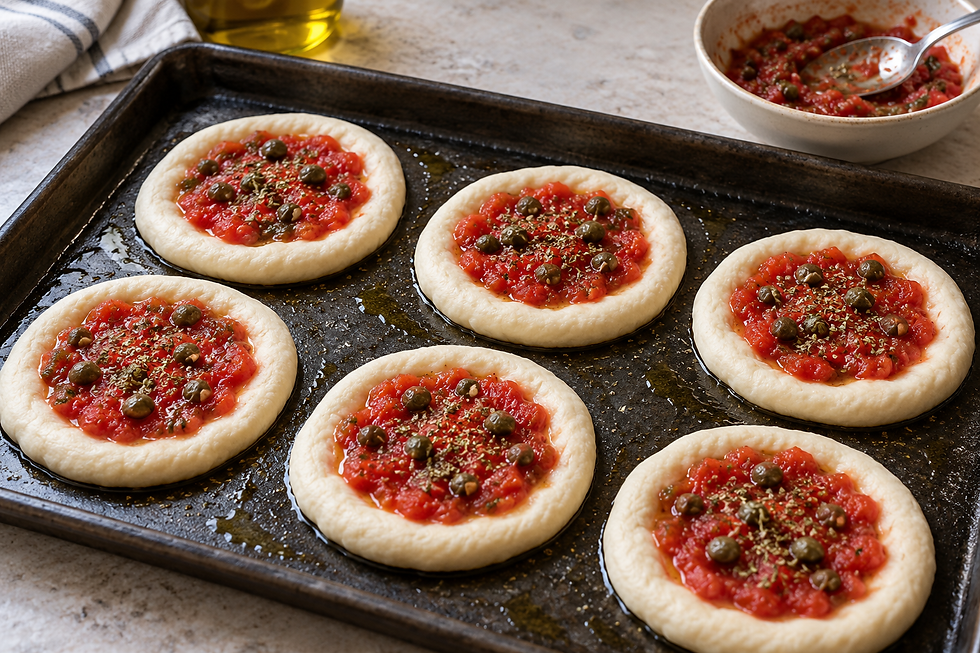
Top the pizzette. Preheat the oven to 475°F (245°C) with a rack in the lowest position, or with a baking steel or stone in it, for at least 30 minutes. With your fingertips, press a small hollow in the center of each pizzetta, leaving a rim of about 1/4 inch (6 mm). Spoon about 2 teaspoons of the tomato topping into the hollow, spreading it to the rim but not over it. Add half an olive if you like. The hollow keeps the topping in place and gives the pizzetta its typical shape, with a soft, raised edge around a crisp, saucy center.
Step 6

Bake hot and low. Bake one tray at a time on the lowest rack, or slide the tray directly onto the steel or stone, for 10 to 12 minutes, until the edges are golden and the bottom is browned and firm when lifted with a spatula. Strong heat from below is what makes a pizzetta crisp: the base must set before the moisture of the tomato can soak into it. If the tops brown before the bottoms, move the tray lower; if the bottoms darken first, add a second tray underneath as insulation.
Step 7

Finish and rest. Transfer the pizzette to a wire rack. While they are hot, drizzle each one with a few drops of peppery olive oil, sprinkle a pinch of oregano over the tray and place a small basil leaf in the center of each. Leave them to rest for 3 minutes before serving. The raw oil, added at the end, keeps its fresh, green aroma, which would be lost in the oven, and the heat of the tomato releases the perfume of the basil. The short rest on the rack lets steam escape from the base, so it stays crisp.
Plating
Serve the pizzette warm, at about 120 to 140°F (50 to 60°C), when the base is crisp and the tomato is fragrant. For an antipasto, arrange them in a single layer on a large wooden board or a warm platter, close together but not overlapping, with a few extra basil leaves scattered among them. Never stack them, because the steam from the lower ones softens the bases above.
For a plated starter, place four pizzette on a warm plate in a small arc, with a few dressed salad leaves or a spoonful of marinated olives at the side. The guest eats them with the fingers, in two bites, and should taste the crunch of the base, the soft edge, the bright tomato and the aromatic oil together.
Professional Technique
The key ratio is the hydration of the dough. At 60 percent water on the weight of flour, plus 5 percent olive oil, the dough is soft enough to rise into a tender edge but firm enough to roll and cut cleanly without shrinking. A wetter dough, typical of pizza in a tray, would spread when cut into small rounds; a drier one would bake hard and biscuit-like.
The hidden variable is the temperature of the dough when it goes into the oven. Pizzette baked straight from the refrigerator rise poorly, stay dense and take longer to cook, so the edges dry out. The 2-hour rest at room temperature and the final rise bring the dough to about 70°F (21°C), so the yeast and the steam can push the edge up in the first minutes of baking.
The doneness test is in the base. Lift a pizzetta with a spatula: the underside should be evenly browned and the pizzetta should feel light and rigid, not floppy. The edge should be golden and spring back when pressed, and the tomato should look concentrated, with slightly darkened edges.
Moisture and Crust Control
Water is the enemy of a small pizza. A large pizza in a very hot oven evaporates the water of its topping in a minute; a pizzetta in a domestic oven bakes for 10 minutes at a lower temperature, so any extra liquid soaks into the dough instead of evaporating. Draining the tomatoes, discarding the juice and resting the seasoned topping in the sieve remove the water that would otherwise make a pale, gummy center.
The amount of topping is just as important. Two teaspoons on a 3-inch (7.5 cm) base is enough to taste the tomato in every bite without weighing the dough down. More topping lowers the temperature at the center of the pizzetta and keeps it from rising, while the edges bake normally, so the result is uneven.
Heat from below sets the crust. A heavy dark tray, a baking steel or a stone stores heat and transfers it quickly to the base. Light, thin trays reflect heat and give pale bottoms. If your oven is weak from below, preheat an empty tray on the lowest rack and slide the tray of pizzette onto it, so the base receives an immediate burst of heat.
Professional Mise en Place
The dough is made one or two days ahead, so on the day of service the work is only rolling, topping and baking. Organize the trays so that one is in the oven while the next one rises, and the pizzette come out in a steady flow.
Equipment and tools
Kitchen scale, large bowl or stand mixer with dough hook
Lidded container for the cold fermentation
Rolling pin, round cutter 3 inches (7.5 cm), bench scraper
Two heavy baking trays, baking steel or stone, wire rack
Fine sieve and bowl for draining the tomatoes
Prepared ahead
Dough mixed and fermented in the refrigerator for 24 to 48 hours
Tomatoes drained, crushed and seasoned, up to 4 hours ahead, refrigerated
Capers soaked, rinsed and chopped, olives pitted and halved
Basil leaves picked and kept between damp paper towels
Service setup
Oven at 475°F (245°C) with the steel or stone preheated for 30 minutes
Trays of shaped pizzette rising in rotation
Peppery olive oil in a small jug, oregano and basil on the pass
Warm boards or platters for serving
Chef Tips
Rub the dried oregano between your palms before adding it to the tomato. The friction breaks the leaves and releases their aromatic oils, so the same quantity gives much more perfume. Sicilian oregano on the branch is the best choice; strip it over a sheet of paper and keep it in a jar.
Use the drained tomato juice. It is full of flavor and can be added to a soup, a pasta sauce or a risotto the same day. In the bakery tradition nothing is thrown away, and the juice is the most aromatic part of the tin.
For a more golden, crisper base, replace 10 percent of the flour with fine semolina of durum wheat, the semola rimacinata used for southern Italian bread. It adds a pale golden color, a slightly sweet taste and a finer crunch underneath.
Pizzette can be partly baked ahead for a party. Bake them for 7 minutes, until set but still pale, cool them on a rack and keep them covered at room temperature for up to 4 hours. Finish them at 475°F (245°C) for 4 to 5 minutes just before serving, then add the raw oil and the basil.
Common Mistakes
Using the dough straight from the refrigerator. Cold dough rises poorly and bakes dense, with dry edges. Let it rest for 2 hours at room temperature before rolling and shaping.
Adding too much topping. An overloaded pizzetta stays raw at the center and soggy underneath. Two teaspoons of drained tomato is enough for each one.
Skipping the draining. Wet tomato soaks into the thin base during baking. Drain the tomatoes and rest the seasoned topping in a sieve.
Baking on the middle rack. Without strong heat from below, the base stays pale and soft while the edge dries out. Bake on the lowest rack or on a preheated steel or stone.
Twisting the cutter. Twisting seals the edges and the pizzette rise lopsided. Press the cutter straight down and lift it straight up.
Adding the oil before baking only. Olive oil in the oven loses its fresh aroma and can taste flat. Season the topping with oil, then finish with a few drops of raw peppery oil after baking.
Stacking the pizzette. Steam from the lower layer softens the bases above. Serve them in a single layer on a board or a platter.
Wine Pairing
Lacryma Christi del Vesuvio DOC: The red version, based mainly on Piedirosso from the slopes of Vesuvius, has red fruit, a light smoky note and soft tannins. It grows on the same volcanic soils as the great Campanian tomatoes and meets the acidity of the topping without hardening. Serve it slightly cool, at about 60°F (16°C).
Cerasuolo d'Abruzzo DOC: A deep rosé from the Montepulciano grape, with cherry fruit and fresh acidity. It has the body to accompany tomato and oregano and the freshness to cleanse the palate after the olive oil. Serve it at about 54°F (12°C).
Lambrusco di Sorbara DOC: The palest and most acidic of the Lambruschi of Emilia, dry and sparkling, with notes of strawberry and violet. The bubbles and the bright acidity are a classic partner for baked dough and tomato at an informal table. Serve it at about 50°F (10°C).
Etna Rosso DOC: From the volcanic slopes of Mount Etna in Sicily, based on Nerello Mascalese, with red fruit, herbs and a savory mineral finish. Its fine tannins and its herbal note echo the oregano and the capers. Serve it at about 60 to 62°F (16 to 17°C).
Storage & Reheating
Room temperature: baked pizzette keep for 1 day, covered with a clean towel, though the base softens. Refrigerator: up to 3 days in an airtight container; the dough becomes firmer and the topping loses some aroma. Freezer: baked and cooled pizzette freeze well for up to 2 months in a single layer, then in a bag, because the low moisture of the topping prevents ice crystals from damaging the dough. The raw dough can also be frozen after the cold fermentation, for up to 1 month; thaw it overnight in the refrigerator.
Reheat pizzette in the oven at 425°F (220°C) on a preheated tray for 4 to 5 minutes, or 7 to 8 minutes from frozen, until the base is crisp again. An air fryer at 375°F (190°C) for 3 to 4 minutes also works well. Avoid the microwave, which makes the dough chewy. Finish with a drop of fresh olive oil and a basil leaf.
Nutrition
Per serving, based on 6 servings (4 pizzette each, without olives):
Calories: 410 kcal
Total Fat: 14 g
Saturated Fat: 2 g
Trans Fat: 0 g
Unsaturated Fat: 12 g
Cholesterol: 0 mg
Sodium: 820 mg
Total Carbohydrates: 61 g
Fiber: 4 g
Total Sugars: 5 g
Added Sugars: 0.5 g
Protein: 11 g
Principal micronutrients: lycopene, vitamin C, potassium, vitamin E, iron, B vitamins
These figures are estimates, calculated on the quantities listed and rounded to the nearest whole number. They vary with the flour, the amount of topping on each pizzetta and the oil used to finish.


Comments