
Italian Smoked Eggplant Meatballs with Mozzarella | Polpette di Melanzane Affumicate con Cuore di Mozzarella

These polpette contain no meat at all, and that single fact decides everything about how they are made. The eggplants are charred whole until the skin blisters and the flesh turns soft and faintly smoky, then drained hard, chopped and worked with hydrated bread, Parmigiano Reggiano and egg. A cube of mozzarella goes into the centre of each one. They are breaded, fried, and served while the cheese is still soft.
The difficulty is not flavour, which arrives almost by itself once the eggplant has been properly smoked. It is that a vegetable polpetta has nothing in it that behaves like meat protein, so it holds together for one reason only: the starch of the bread, and the hours the mixture spends cold. Skip that rest and the same mixture opens in the oil and leaves you a pan of fried crumbs.
Everything below is organised around that constraint. The eggplant is dried harder than most recipes suggest, the bread is hydrated rather than added dry, and the mixture is chilled two hours minimum before a single polpetta is shaped.
Yield: 4 servings, about 12 polpette. Prep: 40 minutes. Rest: 2 to 3 hours. Cook: 35 minutes. Total: about 3 hours 45 minutes. Difficulty: intermediate. Course: secondo or substantial antipasto. Region: Sicily and the southern mainland.
The Story
Eggplant reached Sicily with Arab agriculture, and the island had been growing it for centuries before the rest of Italy would touch it. Northern herbalists spent the late Middle Ages warning against it, and the old name melanzana was read as mela insana, the unhealthy apple. The south ignored all of that, and by the time the vegetable was accepted elsewhere, Sicilian, Calabrian and Campanian cooks had built an entire repertoire on it. Polpette di melanzane are among its most practical inventions.
They are a dish of the meatless days, and of the many months of the year when meat was simply not on the table. Friday, Lent, the vigil of a feast: the shape of the meal stayed the same, a plate of polpette with sauce, and the filling changed. Eggplant was abundant from July into October, stale bread was in every kitchen, and a piece of hard cheese and an egg were enough to turn both into something that arrived looking like the real thing. Nobody was pretending. The point was that the form was familiar and the cost was nothing.
The smoke is not a modern restaurant idea either. In rural kitchens the eggplants went straight onto the embers of the wood fire that was already lit, skin blackening while the flesh steamed inside, because that was simply where the heat was. Cooks in Sicily still do it on a gas flame or over charcoal, and the charred skin is thrown out once the flesh has taken the smoke. The mozzarella centre is the one genuinely recent addition, borrowed from the filled polpette of Campania, and it earns its place.
Ingredients
For the eggplant
Large globe eggplants, 3, about 2 1/4 lb (1 kg) total
Fine sea salt, 1/2 tsp (3 g)
For the polpette mixture
Stale country bread, crust removed, 3 1/2 oz (100 g)
Whole milk, 1/3 cup (80 ml)
Parmigiano Reggiano, finely grated, 2 1/2 oz (70 g)
Large eggs, 2
Garlic clove, minced, 1
Flat leaf parsley, chopped, 3 tbsp (10 g)
Basil leaves, torn, 10
Fine sea salt, 1 tsp (6 g)
Freshly ground black pepper, 1/2 tsp (1 g)
Dry breadcrumbs, 2 to 4 tbsp (15 to 30 g), only if needed
For the mozzarella heart
Firm low moisture mozzarella or drained fior di latte, 5 oz (140 g)
For the breading
All purpose flour, 1/2 cup (60 g)
Large eggs, beaten, 2
Fine dry breadcrumbs, 1 1/2 cups (150 g)
For the tomato sauce
Canned San Marzano tomatoes, crushed by hand, 2 cups (480 g)
Extra virgin olive oil, 2 tbsp (30 ml)
Garlic clove, lightly crushed, 1
Basil sprig, 1
Fine sea salt, 1/2 tsp (3 g)
For frying and finishing
Sunflower or peanut oil for frying, about 4 cups (950 ml)
Flaky sea salt, for the fried polpette
Small basil leaves, 12
Parmigiano Reggiano, for grating at the table
Preparation
Charring and smoking the eggplants
Set the whole eggplants over a gas flame at medium high, or on a charcoal grill, turning them every few minutes with tongs. The skin has to blacken and split everywhere, 15 to 20 minutes, while the flesh steams inside. They are ready when a skewer meets no resistance. Cool them 10 minutes, covered.
Draining the flesh properly
Split each eggplant, scoop the flesh out and discard every piece of blackened skin. Chop it roughly, salt it and leave it in a fine mesh sieve over a bowl for 30 minutes, pressing down twice with a ladle. Aim to lose 1/2 cup (120 ml) of dark liquid. Squeeze it in a cloth, then chop it finer.
Making the tomato sauce
Warm the olive oil with the crushed garlic until fragrant but not coloured, then remove the garlic. Add the tomatoes and the salt, bring to a simmer and cook 20 to 25 minutes over low heat, until thickened and no longer raw tasting. Add the basil sprig at the end and remove it before serving.
Hydrating the bread
Tear the crustless bread small, pour the milk over it and leave it 10 minutes, turning once. It should be uniformly heavy, with no dry white centres and no free milk in the bowl. Squeeze it lightly and break it up with your fingers. Dry bread stirred straight in leaves hard specks.
Mixing the impasto
Combine the drained eggplant, the hydrated bread, the Parmigiano, eggs, garlic, parsley, basil, salt and pepper in a wide bowl and work them with a spatula for one minute, no longer. The mixture should hold a rough shape when pressed while still feeling soft. If it slumps, add dry breadcrumbs a tablespoon at a time, four at most.
Resting the mixture cold
Cover the bowl with film pressed against the surface of the mixture and refrigerate it at least 2 hours, up to 3. This is not a pause, it is the step that makes the polpette possible, for the reason the technique section explains. The mixture comes out firmer, drier to the touch and easy to handle.
Shaping around the mozzarella
Cut the mozzarella into 12 cubes of about 1/2 inch (1.5 cm) and blot them dry. Divide the cold mixture into 12 portions of about 2 oz (55 g). Flatten one in your palm, set a cube in the middle, close the mixture over it and roll until smooth and sealed, with no cracks. Keep them cold on a tray.
Breading
Set out three shallow dishes with the flour, the beaten eggs and the fine breadcrumbs. Roll each polpetta in flour and tap off the excess, turn it in egg until entirely coated, then press it into the breadcrumbs, rotating it so every part is covered including the closing point. Chill 15 minutes. A gap is where the cheese escapes.
Frying
Heat the oil in a deep saucepan to 350°F (175°C) and check it with a thermometer rather than by eye. Fry four polpette at a time, never more, for 3 to 4 minutes, turning once, until the crust is a deep even gold. Let the oil recover between batches. Lift them onto a rack, salt at once and serve within minutes.
Plating
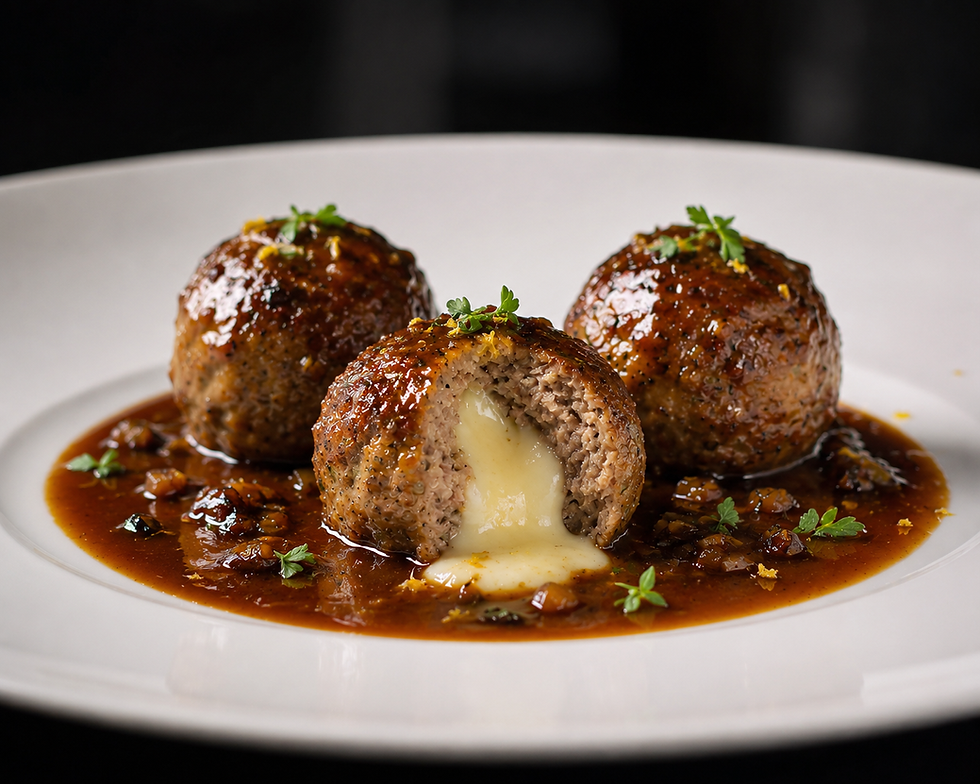
Serve them hot, on warm plates, and serve them fast. Spoon a shallow pool of the tomato sauce onto each plate and set three polpette on it, spaced apart rather than piled, so the crust stays dry on top where it is not touching sauce. Grate a little Parmigiano over them at the table and finish with three or four small basil leaves.
Do not bury them under sauce and do not hold them in the oven. Both are the same mistake in different forms: the crust you spent nine steps building goes soft in under two minutes. If one has cracked and leaked, plate it face down and grate extra cheese over it. Cut one open in front of whoever is eating, because the interior is the point of the dish and it does not wait.
Professional Technique
A meat polpetta binds itself. Working ground meat with salt extracts myosin, the salt soluble muscle protein, which dissolves into a sticky film at the surface of the mince and sets into a solid gel the moment it meets heat. That gel holds a meatball together in the pan. A polpetta of eggplant has no myosin at all, and kneading produces no substitute. Its structure comes from one place only: the starch of the bread, and what it does while the mixture is cold.
When the torn bread takes up the milk, and again when it meets the wet eggplant, its starch granules swell and gelatinize. They absorb water, burst, and release long amylose and amylopectin chains into the mixture as a loose viscous paste. That paste is sticky, which is why a freshly mixed impasto feels as though it might work, but it has no rigidity: the chains are dispersed, and in hot oil the whole thing flows apart.
During the hours in the refrigerator those dispersed chains slowly realign. Sections of amylose pair up into ordered crystalline regions, trapping water between them and turning the paste into a continuous network running through the whole mixture. This is retrogradation, the same process that stales a loaf on the counter, and here it is entirely an advantage: the mixture firms, stops slumping and gains a structure that survives the fryer. A polpetta mixed and fried immediately falls apart. The identical mixture after three hours cold holds.
Two hours is the minimum, and the bowl must be covered with film against the surface, because an uncovered mixture dries unevenly and that dry skin shapes badly and splits in the oil while the inside is still slack. Adding a third egg does not replace the rest. Egg coagulates only once the polpetta is already frying, seconds after it needed support, and until then it only makes the raw mixture wetter and the fried result rubbery. It masks the problem.
Texture and Moisture Control
Everything here is a fight against water. A charred eggplant is roughly 90 percent water, most of it still in the flesh when you scoop it out. Salting, draining 30 minutes and squeezing in a cloth is the difference between a mixture that firms in the refrigerator and one that stays a purée however long you leave it. Half a cup pressed out is a good result, and more is better.
The crust and the centre want opposite things from the oil. At 350°F (175°C) the breadcrumbs dehydrate and brown in about three minutes while the inside reaches only 150 to 160°F (65 to 70°C), enough to soften the mozzarella without driving it out. Cooler oil leaves the crust pale and greasy, hotter browns it before the centre has warmed at all. Four at a time keeps the temperature up.
After the oil, the rack. Paper traps the steam still leaving the polpette and softens the underside within a minute, the commonest way a good fried polpetta is ruined between pan and plate.
Professional Mise en Place
The chilling is long and the frying is short, so everything except the frying can be finished hours ahead.
Equipment and tools
Gas burner, charcoal grill or broiler for charring the eggplants
Fine mesh sieve, clean kitchen cloth, wide mixing bowl
Deep heavy saucepan and a probe thermometer
Three shallow dishes for the breading, spider or slotted spoon, wire rack
Small saucepan for the tomato sauce
Prepared ahead
Eggplants charred, drained and chopped, up to 1 day ahead, kept covered and cold
Tomato sauce, up to 3 days ahead, refrigerated
Mixture made and resting, at least 2 hours and up to 3
Polpette shaped and breaded, up to 4 hours ahead on a tray in the refrigerator
Mozzarella cut into cubes and blotted dry, held cold
Service setup
Oil at 350°F (175°C), thermometer in the pan, checked between batches
Breaded polpette cold and spaced on their tray, ready beside the pan
Rack set over a tray, flaky salt and basil within reach
Tomato sauce warm, plates warm, cheese and grater on the table
Chef Tips
Char one eggplant more than you think you need. Three large ones give the 1 lb 5 oz (600 g) of drained flesh this recipe is built on, but they vary enormously in how much water they give up, and arriving short means a mixture that is mostly bread.
Use firm low moisture mozzarella, not the kind sold in water. Fresh fior di latte works only if you cut it, salt it lightly and leave it on a rack in the refrigerator for an hour first.
Fry one polpetta alone before the first real batch. In three minutes it tells you whether the mixture is firm enough, the coating complete and the oil right, and if it opens you still have eleven cold and time to add breadcrumbs and chill again.
Keep the parsley and basil coarse rather than minced to paste. Chopped too finely they bleed, turn the mixture grey and slightly bitter, and lose the fresh note they are there for.
Common Mistakes
Frying the mixture the same day you mixed it. Without the hours cold the starch has not retrograded, nothing holds the mixture together, and the polpette collapse in the oil. This accounts for most failures.
Leaving the eggplant wet. Flesh that goes into the bowl straight from the skin keeps the mixture loose however long it chills. The sieve and the cloth are not optional.
Correcting a soft mixture with more egg. Egg makes it wetter now and rubbery later, and does nothing in the first seconds of frying when support is needed. Use dry breadcrumb, or chill it longer.
Roasting the eggplants instead of charring them. You get cooked eggplant and no smoke, and the smoke is half the flavour. With no flame, use the broiler at its highest setting and blacken the skin properly.
Crowding the pan. Eight at once drop the oil below 300°F (150°C), the crust turns pale and greasy and the coating softens before it sets. Four at a time, and let the oil recover.
Draining them on paper towels. Trapped steam softens the underside within a minute. A wire rack keeps the crust crisp on all sides.
Wine Pairing
Etna Bianco DOC: The best match on the list, and a Sicilian one. Carricante grown at altitude on volcanic soil has severe acidity and a flinty, faintly smoky edge that meets the charred eggplant on its own ground instead of contrasting with it. That acidity is also what a fried crust needs.
Grillo Sicilia DOC: A rounder Sicilian white with real body and a savoury citrus core. It has the weight to sit beside the Parmigiano and the soft mozzarella without being erased, and its herbal finish picks up the basil and parsley.
Cerasuolo d'Abruzzo DOC: A serious rosato rather than a pale one, with Montepulciano fruit behind it and a touch of tannin. It handles the tomato sauce best of all: acidity to match it, red fruit to echo it, and a slight bitterness on the finish that works with the smoke.
Franciacorta DOCG: For anyone who wants sparkling wine with fried food, which is a sound instinct. Bottle fermentation gives fine persistent bubbles and a bready depth, and pressure plus high acidity scours oil from the palate better than any still wine. Serve the non vintage brut, cold.
Etna Rosso DOC: The red option, and it has to be a light one. Nerello Mascalese is pale, high in acidity and fine in tannin, closer to a mountain Pinot Nero than a southern red, so it never overwhelms a dish with no meat in it. Serve it at 59°F (15°C).
Storage & Reheating
The mixture keeps better than the fried polpette. Refrigerate it covered up to 2 days and it only improves, since the starch network goes on setting. Breaded polpette hold 4 hours on a tray, or freeze raw and bag them for up to 2 months, frying from frozen at 340°F (170°C) for 5 to 6 minutes. The sauce keeps 3 days refrigerated, 3 months frozen.
Fried polpette keep 2 days in an airtight container, but the crust will never be what it was. Reheat on a rack in a 375°F (190°C) oven for 8 to 10 minutes, or in an air fryer at the same temperature for 6, which recrisps the surface and softens the cheese again. The microwave turns them into a wet sponge. Never freeze them once fried.
Nutrition
Per serving, based on 4 servings of 3 polpette each, with sauce:
Calories: 520 kcal
Total Fat: 31 g
Saturated Fat: 10 g
Trans Fat: 0 g
Unsaturated Fat: 19 g
Cholesterol: 145 mg
Sodium: 890 mg
Total Carbohydrates: 39 g
Fiber: 6 g
Total Sugars: 9 g
Added Sugars: 0 g
Protein: 22 g
Lactose: 2 g
Principal micronutrients: calcium, phosphorus, potassium, manganese, vitamin K, folate, vitamin B12
These figures are estimates. The fat depends almost entirely on how much oil the coating takes up, which the oil temperature governs: polpette fried at 350°F (175°C) absorb considerably less than those fried cool.



Comments