
Italian Charred Radicchio with Amarone, Gorgonzola and Walnuts | Radicchio Tardivo alla Brace, Amarone, Gorgonzola e Noci
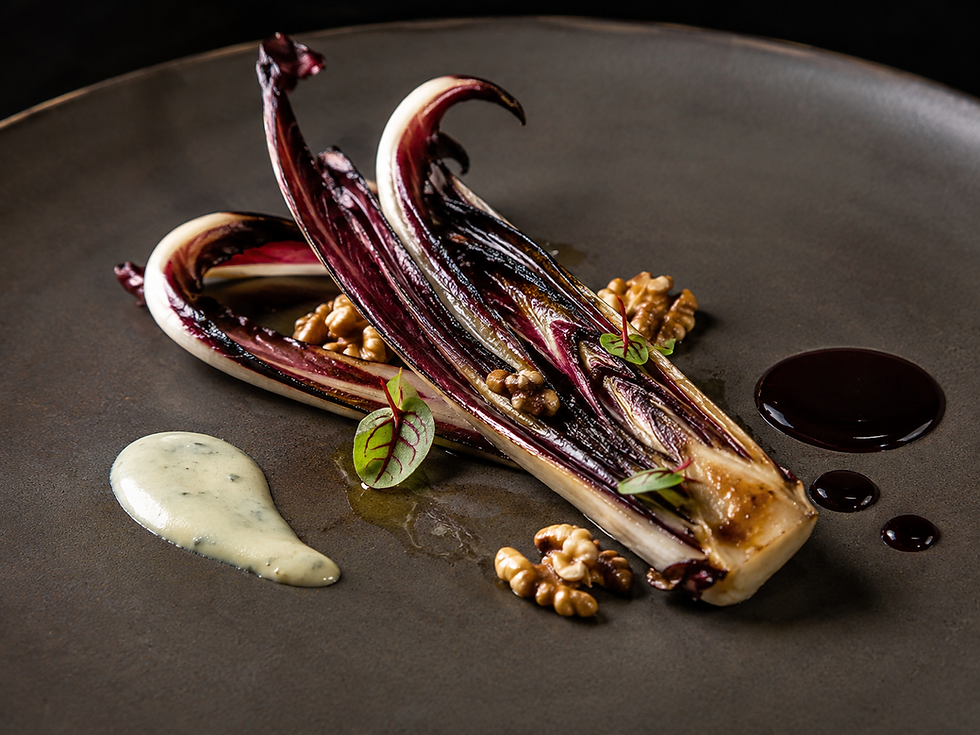
Radicchio tardivo is the winter vegetable that improves when you set fire to it. The long curled heads are bitter in a way no cooking removes, and the Veneto never tried to remove it. It pushed the leaves onto live embers instead, until the ribs blistered and the tips went black, because fire does not cancel bitterness, it gives it something to argue with.
This version keeps the fire at the centre and builds three answers around it. An Amarone reduction supplies dark concentrated sweetness with acidity still inside it. A warm gorgonzola cream supplies the fat that bitter chicory has always been eaten with here. Toasted walnuts supply a drier bitterness and the only crunch. The radicchio arrives still recognisable as four charred quarters.
The discipline is restraint. The reduction stops while still fluid, the cream stays loose, the walnuts get one teaspoon of honey rather than a caramel coating, and the radicchio is salted only after it leaves the grill. Done properly the plate reads bitter, then smoky, then sweet, then salty, and the sequence is the dish.
Yield: 4 side servings. Prep: 30 minutes. Fire: 25 minutes to build the ember bed. Cook: 20 minutes. Total: about 1 hour 15 minutes. Difficulty: intermediate. Course: contorno. Region: Veneto, the Treviso plain and the Valpolicella hills.
The Story
In the Veneto countryside the winter kitchen was the hearth, and the grill sat over vine prunings rather than charcoal. Growers burned what they had cut from the rows, and in December the thing most often thrown across the bars was a head of bitter chicory. Radicchio alla griglia was osteria food along the Piave and behind Treviso, cooked to order beside grilled polenta and a slice of sopressa, dressed with oil, salt and pepper and nothing else.
Tardivo is the late crop, cut after the first hard frosts have gone through the field, and the cold is what turns a coarse leaf into something slender and sweet at the rib. That rib is why the variety belongs on fire rather than in a pan: thick, full of water, able to take direct heat long enough to caramelize while the leaf above it collapses.
The accompaniments are historical rather than invented. Bitter leaves were always eaten with fat in the Po valley, first lardo and strutto, later cheese, as gorgonzola moved east from the Lombard dairy towns. The Amarone reduction is the one modern element, a Veronese restaurant habit from the 1970s and 1980s, when cooks around Valpolicella began reducing the local dried grape red into a glaze. Amarone is made from Corvina and Rondinella dried for roughly four months in the fruttai before pressing, and it finishes dry, which is why its reduction tastes concentrated instead of sugary.
Ingredients
For the radicchio
Radicchio Rosso di Treviso Tardivo heads, 4, about 1 3/4 lb (800 g)
Extra virgin olive oil, 3 tbsp (45 ml)
Fine sea salt, 1 tsp (6 g)
Freshly ground black pepper, to taste
For the Amarone reduction
Amarone della Valpolicella, 1 1/2 cups (360 ml)
Shallot, finely sliced, 1
Honey, 2 tsp (14 g)
Bay leaf, 1
Black peppercorns, 6
Unsalted butter, cold, 1 tbsp (14 g)
For the gorgonzola cream
Gorgonzola Dolce DOP, rind removed, 5 oz (140 g)
Heavy cream, 1/3 cup (80 ml)
Whole milk, 2 tbsp (30 ml)
Freshly ground white pepper, to taste
For the walnuts
Shelled walnut halves, 3 oz (85 g)
Honey, 1 tsp (7 g)
Fine sea salt, 1 small pinch
For finishing
Gorgonzola Piccante DOP, crumbled, 1 oz (30 g)
Extra virgin olive oil, a few drops per plate
Flaky sea salt, to taste
Freshly ground black pepper, to taste
Preparation
Build a two zone ember bed
Light hardwood charcoal or dry vine prunings and let them burn down completely. You want grey covered embers with no visible flame, banked deep on one half of the grill and thin on the other. This takes about 25 minutes. Test the hot side with the back of your hand four inches above the bars: three seconds of tolerance is right.
Trim, wash and quarter the heads
Cut away bruised outer leaves and shorten the root, leaving the core attached, because it is the only thing holding the quarters together over the fire. Split each head lengthwise into quarters through that core. Wash them in cold water, working between the ribs where grit collects, then dry them thoroughly on cloth. Wet radicchio steams and never colours.
Reduce the Amarone with shallot and honey
Put the wine, shallot, bay leaf and peppercorns in a small heavy saucepan and bring them to a bare simmer. Reduce slowly, uncovered, to roughly one quarter of the original volume. Amarone carries 15 to 16 percent alcohol and needs the first minutes to drive that off, so keep the heat low. Strain out the solids, stir in the honey and reduce one minute more.
Finish the reduction with cold butter
Take the pan off the heat, wait until the bubbling stops, then whisk in the cold butter in one piece until it disappears. This gives gloss and stops the reduction tasting sharp. Judge thickness while it is warm, since it tightens as it cools: it should coat the back of a spoon and still run off. If it sets hard, loosen it with a teaspoon of warm water over the lowest heat.
Melt the gorgonzola into a warm cream
Cut the gorgonzola dolce into rough cubes and warm it with the cream and milk in a small saucepan over very low heat, stirring with a spatula. Stop the moment the cheese has gone and the mixture is smooth and pourable. It must never approach a simmer: blue cheese proteins tighten and weep fat above 160°F (70°C) and a split cream cannot be brought back. Season with white pepper only, since the cheese carries the salt.
Toast the walnuts with honey and salt
Toast the walnut halves in a dry pan over medium heat for 4 to 5 minutes, moving them constantly, until they smell sweet and the skins darken. Off the heat, add the honey and the pinch of salt and toss until every piece is barely lacquered. Tip them onto parchment and separate them while warm. Walnut oil turns bitter fast, so work by smell.
Char the cut faces over the embers
Brush the quarters with olive oil and lay them cut side down over the hot side of the fire. Leave them for 2 to 3 minutes. You want defined black lines on the ribs and blistered leaf tips, not an evenly grey surface. Turn them onto the second cut face for 2 minutes more. Every lift breaks the contact that builds char.
Move the quarters to the cooler side and rest
Slide the radicchio onto the thin ember side, close the lid if the grill has one, and give it 4 to 6 minutes so the rib softens through to the core while the outside stops cooking. They are ready when a knife tip meets no resistance at the base of the rib. Season now with fine sea salt and black pepper and let them sit 3 minutes. Salt applied before the grill draws water to the surface and prevents the char.
Plating
Serve this hot from the fire. The gorgonzola cream stiffens on a cold plate and the reduction sets into a lacquer, so warm the plates to hand temperature but no further.
Spoon two tablespoons of gorgonzola cream slightly off centre and spread it into a shallow oval with the back of the spoon. Lay two charred quarters across it, cut side up so the grill lines stay visible, leaning against each other rather than flat.
Draw the Amarone reduction around the radicchio in a broken line or a few deliberate drops, never over the char, where it would soften the surface you spent twenty minutes building. Scatter the honeyed walnuts and the crumbled piccante across the quarters, finish with flaky salt, pepper and a few drops of olive oil, and send it immediately.
Professional Technique
The technique that defines this dish is two stage fire management, and it exists because radicchio has two structures cooking at once. The leaf is thin and burns in seconds, the rib is thick and mostly water. Direct embers handle the leaf and start the caramelization, then indirect heat drives the rib to tenderness by conduction rather than radiation. All direct heat gives a black outside and a raw base; all indirect gives a soft quarter with no char.
The second technique is reducing a dry high alcohol red without turning it sour. Amarone finishes dry, so little residual sugar protects the acids as water leaves the pan. Reduced fast it turns thin and sharp. Reduced slowly the alcohol goes first, the glycerol stays, and the honey at the end fills the gap the missing sugar leaves. Cold butter off the heat emulsifies fat into the syrup and rounds the finish.
The third is temperature control on the blue cheese. Gorgonzola dolce has a loose moist curd, which makes it melt readily but also makes it fragile. Held below a simmer it forms a stable emulsion of milk fat in cream; past that point the casein network contracts, squeezes the fat out and leaves a grainy mass in a pool of oil. Low heat and an early stop are the whole method.
Texture and Moisture Control
Water is the enemy from start to finish. A washed head of tardivo holds a great deal of it between the ribs, and every drop on the surface must evaporate before the leaf reaches browning temperature. Drying the quarters on cloth is not tidiness, it is the difference between char and steam. Salt goes on afterwards for the same reason: on raw radicchio it pulls moisture to the cut face.
The rib and the leaf need different endings. The rib should give under a knife tip while holding its shape, silky rather than fibrous, which is what the indirect stage delivers. The leaf should be part crisp and part collapsed, the blackened tips brittle enough to shatter. If the quarter is uniformly soft it spent too long on the cool side; if the rib squeaks it never got there.
The three garnishes hold different moisture levels and should stay that way. The cream is the wet element and goes down first, under the radicchio. The reduction is viscous and sits on the plate, not on the vegetable. The walnuts are dry and go on last, because a walnut sitting in warm cream for two minutes is simply a soft nut. This is not a dish that waits in a pass.
Professional Mise en Place
Everything except the grilling is done ahead, which is what makes a live fire dish manageable at service.
Equipment and tools
Charcoal grill with a lid, and a chimney starter for the coals
Long tongs, a bench scraper for banking the embers, a grill brush
Small heavy saucepan for the reduction, second small pan for the cheese
Fine mesh strainer, silicone spatula, cloth for drying the heads
Warm plates held at hand temperature, never hot
Prepared ahead
Amarone reduction, up to 5 days ahead, refrigerated and rewarmed gently
Honeyed walnuts, up to 3 days ahead, in an airtight jar at room temperature
Radicchio trimmed, quartered, washed and dried, up to 4 hours ahead, kept cold
Gorgonzola cream, up to 1 day ahead, refrigerated and rewarmed over the lowest heat
Service setup
Ember bed banked deep on one side and thin on the other, lid within reach
Gorgonzola cream warm in a bain marie, spatula in the pan
Reduction in a squeeze bottle or small jug, fluid, not set
Oil, flaky salt, pepper mill and walnuts at the pass
Chef Tips
Buy tardivo with the root attached and the tips curled and glossy. A head gone limp at the tips has been out of cold storage too long and will collapse on the grill instead of holding four defined quarters. The season runs from late November through February and there is no point attempting this outside it.
Use a drinkable Amarone, not the bottle nobody would open. A reduction concentrates whatever is in the wine fourfold, including any oxidised note. If Amarone is out of reach, a Valpolicella Ripasso reduced to one third is an honest substitute at a fraction of the cost.
Taste the gorgonzola before deciding how much piccante goes on top. Dolce and piccante vary enormously between producers, and a sharp piccante can take over the plate. Start with half the listed quantity, taste with cream and reduction together, and add the rest only if it still feels flat.
With no grill, a cast iron ridged pan taken to smoking point produces a genuine char, and 6 minutes in a 400°F (200°C) oven replaces the indirect stage. It will not taste of wood smoke, so add nothing to compensate. Smoked salt and liquid smoke both announce themselves and cheapen the plate.
Common Mistakes
Grilling over flame instead of embers. Open fire burns the leaf tips to ash while the rib stays raw, and the quarter tastes of soot rather than smoke. Wait for grey covered coals.
Salting the radicchio before it goes on the fire. Salt draws water to the cut surface and the quarter steams in its own moisture and refuses to colour. Oil before, salt after, in that order.
Reducing the Amarone over high heat. A hard boil strips the aromatics and concentrates the acids faster than the body, leaving something closer to vinegar than a glaze. Reduce slowly and add the honey at the end.
Letting the gorgonzola cream reach a simmer. Above roughly 160°F (70°C) the cheese splits, the fat separates and the texture turns grainy beyond repair. Keep it under a simmer and stop the moment it is smooth.
Cutting the core out of the heads. The core is the hinge that keeps each quarter intact on the bars. Remove it and you are grilling loose leaves that fall through. Shorten the root, do not cut it out.
Pouring the reduction over the radicchio. It soaks into the blistered leaves, softens the char and turns the plate into one sweet note. Draw it around the vegetable and let the diner bring the two together.
Wine Pairing
Amarone della Valpolicella DOCG: The wine already in the dish, and the most coherent glass on the list. Its dried fruit concentration and high glycerol meet the gorgonzola on equal terms, and the firm tannin cuts the fat of the cream. The bitter almond edge under that ripeness runs parallel to the charred radicchio. Serve at 61°F (16°C).
Valpolicella Ripasso DOC: A lighter route to the same flavours. Refermented on the drained Amarone skins, it keeps the fresher acidity of a straight Valpolicella, which handles the honeyed walnuts and the sweetness in the reduction, while its soft tannin never overwhelms a vegetable.
Teroldego Rotaliano DOC: From the gravel plain north of Trento, dark, dry and unusually savoury. Its cool blueberry and violet character contrasts with the smoke rather than echoing it, and the bitter finish is a natural partner for chicory. Enough acidity to reset the palate between mouthfuls of cheese.
Alto Adige DOC Lagrein: Lagrein is built on dark fruit, iron and a bitter twist at the end, which makes it one of the few Italian reds that actively likes charred vegetables. Its tannin is chalky rather than drying, so it sits under the gorgonzola without hardening against the salt. Choose a lightly oaked bottling, since new barrel collides with wood smoke.
Refosco dal Peduncolo Rosso Friuli DOC: The most bracing option, for anyone who wants the bitterness pushed rather than soothed. Refosco is high in acid, herbal and frankly astringent, and it turns the plate sharper. Use the piccante gorgonzola generously with it: the salt softens the tannin while the wine keeps the fat in check.
Storage & Reheating
Grilled radicchio does not keep as a finished plate, so store the components separately and grill to order. Charred quarters keep refrigerated in a covered container for up to 2 days and are good chopped into a warm salad. Do not freeze them: the rib turns to water on thawing.
The Amarone reduction keeps refrigerated in a sealed jar for up to 5 days and thickens when cold. Warm it over the lowest heat, loosening it with a teaspoon of warm water if it has set. The honeyed walnuts hold 3 days in an airtight jar at room temperature, never in the refrigerator, where they soften.
The gorgonzola cream keeps 1 day refrigerated. Warm it over a bain marie and stop as soon as it flows again; direct heat will split it. To reheat whole quarters use a 350°F (175°C) oven for 6 to 8 minutes on a rack. A microwave collapses the leaf structure. Served at room temperature is often the better answer for leftovers.
Nutrition
Per serving, based on 4 side portions:
Calories: 430 kcal
Total Fat: 33 g
Saturated Fat: 13 g
Trans Fat: 0 g
Unsaturated Fat: 18 g
Cholesterol: 48 mg
Sodium: 640 mg
Total Carbohydrates: 14 g
Fiber: 3 g
Total Sugars: 8 g
Added Sugars: 4 g
Protein: 11 g
Lactose: 1.2 g
Principal micronutrients: calcium, phosphorus, potassium, folate, vitamin K, copper, magnesium
These figures are estimates. The final sodium depends almost entirely on how much gorgonzola piccante goes on at the end.


Comments