
Italian Charred Celeriac | Sedano Rapa alla Brace, Burro Nocciola, Parmigiano e Tartufo Nero
Updated: Sep 22

Celeriac is one of the most underrated vegetables in professional kitchens. Cooked slowly first and then hit with intense direct heat, it develops an almost meat like texture, a deep sweetness and a roasted complexity that stands up to brown butter, aged Parmigiano Reggiano and black truffle without disappearing underneath them.
This version is built as a serious restaurant side dish. The interior stays soft and almost creamy while the exterior goes properly black at the edges. A concentrated vegetable jus gives the plate structure, brown butter adds nuttiness, Parmigiano brings umami and salt, and fresh black truffle finishes it without taking it over.
Yield: 4 to 6 servings. Prep: 20 minutes. Cook: 1 hour 30 minutes. Rest: 10 minutes. Total: about 1 hour 50 minutes. Difficulty: intermediate.
The Story
Sedano rapa is not a glamorous vegetable in Italy. It grows well in the cold, damp winters of Piedmont, Lombardy and the Veneto, it keeps for months in a cellar, and for most of its history it went into broth, into a winter salad shredded raw with lemon, or into the pot alongside a bollito misto. It was cheap, ugly and abundant, which is precisely the profile of vegetables that end up being rediscovered.
The rediscovery came through the vegetable forward cooking of the last two decades, where chefs started treating dense roots the way they had always treated meat: seasoned hard, cooked slowly to tenderness, then finished over fierce heat for colour. Celeriac takes to that treatment better than almost any other vegetable because its flesh is unusually low in sugar and high in dry matter, so it browns deeply without going sweet or collapsing.
The finishing trio is straight Italian, and specifically Piedmontese. Burro nocciola, butter cooked to the colour of a hazelnut, is a northern Italian pantry technique older than any restaurant. Parmigiano Reggiano supplies the glutamate that makes a vegetable dish taste complete. And the black truffle belongs to the same Langhe hills that produce the famous white one, appearing from late autumn through winter, exactly when celeriac is at its best. Put together, they turn a cellar vegetable into a plate you can put in front of anyone.
Ingredients
For the celeriac
1 large celeriac, about 2 lb (900 g)
2 tbsp (30 ml) extra virgin olive oil
1 tsp (6 g) kosher salt
1/2 tsp (1 g) freshly ground black pepper
3 garlic cloves, lightly crushed
2 sprigs thyme
1 sprig rosemary
1/4 cup (60 ml) water
For the brown butter
6 tbsp (85 g) unsalted butter
4 fresh sage leaves
1 tsp (5 ml) fresh lemon juice
For the vegetable jus
1 cup (240 ml) strong vegetable stock
1/2 cup (75 g) celeriac trimmings, from peeling above
1 small shallot, sliced
1 tsp (5 g) tomato paste
1/4 cup (60 ml) dry white wine
1 tsp (5 g) cold unsalted butter
For the Parmigiano emulsion
2 oz (55 g) Parmigiano Reggiano, finely grated
2 tbsp (30 ml) heavy cream
2 tbsp (30 ml) hot vegetable stock
For finishing
0.5 to 0.7 oz (15 to 20 g) fresh black truffle
1 tsp (5 ml) extra virgin olive oil
Freshly ground black pepper, as needed
Choose a celeriac that feels heavy for its size, with a firm, dry surface and no soft spots around the root base. Fresh black truffle should be firm and intensely aromatic through the paper it is wrapped in; if it smells of nothing in the shop, it will smell of nothing on the plate.
Preparation
Trimming and cutting the celeriac
Peel the celeriac, cutting away the tangled root base and any damaged skin, and reserve the trimmings for the jus. Do not over peel: the outer layer just under the skin protects the interior during the slow cook. Cut the celeriac into thick rounds or wedges about 1 1/2 in (4 cm) across, keeping them even so they cook at the same rate. Toss with the olive oil, salt, pepper, crushed garlic, thyme and rosemary, coating the cut faces evenly so the char reads as deliberate rather than patchy.
Slow cooking to tenderness
Arrange the seasoned pieces in a single layer in a roasting dish with the aromatics, add the water, cover tightly with foil and cook at 325°F (160°C) for about 1 hour, until a skewer enters the centre with gentle resistance. This stage is about tenderness, not colour, the foil keeps the environment humid so the dense flesh cooks through evenly. Let the pieces rest 10 minutes before searing so the internal steam redistributes; cut or seared immediately, they lose moisture fast and go dry at the surface.
Building the vegetable jus
While the celeriac cooks, put the reserved trimmings, the sliced shallot and the tomato paste into a saucepan with a splash of oil and cook over medium heat for 3 to 4 minutes, until the shallot softens and the paste darkens slightly. Add the white wine and let it reduce by half, then add the stock and simmer 15 to 20 minutes, until it has reduced to a light sauce consistency. Strain, discard the solids, and whisk in the cold butter off the heat so the jus takes on a gloss.
Making the Parmigiano emulsion
Warm the cream and the hot stock together in a small pan, then add the grated Parmigiano gradually, whisking constantly, until it melts into a smooth, light emulsion. Keep it below a simmer, boiling makes the cheese proteins tighten and the emulsion break into grains and oil. If it thickens too much before service, loosen it with a spoonful of hot stock rather than more cream, which would dull the flavour.
Browning the butter
Melt the butter in a light coloured skillet over medium heat and add the sage leaves as it starts to foam. Cook, swirling occasionally, for 4 to 5 minutes, watching the milk solids rather than the clock: the moment they turn hazelnut brown and the pan smells nutty, take it off the heat and stir in the lemon juice to arrest the cooking. A few seconds too long and the solids blacken and turn acrid, which fights the controlled bitterness of the char instead of complementing it.
Charring the celeriac
Heat a heavy skillet or a grill pan until it is genuinely hot. Sear the tender celeriac pieces on their flat cut faces, without moving them, for 4 to 5 minutes per side, until deeply charred, you want real blackening at the edges, not golden colour. Because the interior is already cooked, you can commit to the heat. If any piece still feels firm at the centre, add a splash of water to the pan, cover and steam over medium low heat for a few more minutes before finishing the char.
Shaving the truffle
Brush the truffle clean with a dry brush, never under water. Shave it thinly with a truffle slicer or the flattest part of a very sharp blade, and do it at the last possible moment: the aromatic compounds are volatile and start dissipating within minutes of the truffle being cut. Shave it over the warm plate, never into the pan.
Plating
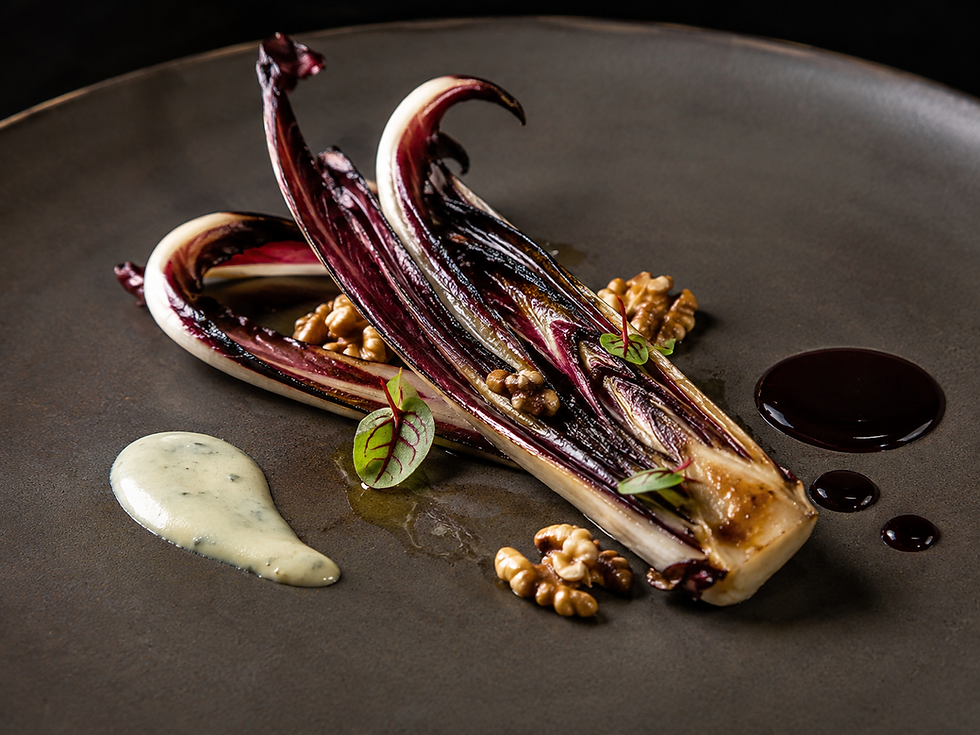
Warm the plates. Spoon the Parmigiano emulsion in a shallow pool slightly off centre and set the charred celeriac pieces on and around it, charred faces up so the black surface is what the guest sees.
Spoon the brown butter over the cut surfaces at the last moment, letting a crisp sage leaf fall onto each plate, then drop the vegetable jus around the edge of the emulsion rather than over the celeriac, you want the crispest edges to stay dry. A thread of raw olive oil and a turn of black pepper finish the base.
Shave the truffle over the top only when the plate is otherwise complete and about to leave the pass. Generous, overlapping slices, laid flat rather than piled; the warmth rising from the plate is what opens the aroma. Nothing further belongs here, the black, the ivory and the brown are the whole composition.
Professional Technique
This dish depends on doing two incompatible things to the same vegetable in the right order. Celeriac cell walls are held together by pectin, which only breaks down with prolonged moist heat above about 185°F (85°C); that is why the covered stage at 325°F (160°C) is non negotiable and why an hour of it is not excessive. Deep charring, on the other hand, needs a dry surface and a pan well above 400°F (205°C). Attempt them simultaneously and you get a burnt exterior over a fibrous centre, the classic failure with this vegetable.
Browning the butter is a separate piece of chemistry with an unforgivingly narrow window. Butter is roughly 16% water and 2% milk solids; the water boils off first, and only once the pan is dry does the temperature climb past 250°F (120°C) and the proteins and lactose in the solids start to brown. From the first nutty smell to burnt is often under 30 seconds, which is why the lemon juice matters: adding a cold, acidic liquid drops the pan temperature instantly and stops the reaction where you want it.
The Parmigiano emulsion works because casein acts as an emulsifier when it is warm but not hot. Above about 175°F (80°C) the proteins coagulate, squeeze out the fat and the sauce goes grainy. Adding the cheese gradually into warm liquid, off a direct flame, is what keeps that from happening, the same principle behind a cacio e pepe made off the heat.
Texture and Moisture Control
The finished celeriac should be almost creamy at the centre and unmistakably crusted at the edges, with a clean contrast between the two rather than a gradient. Test with a skewer before you sear: it should enter with gentle resistance, like a properly cooked potato. If there is a firm core, more slow heat is the answer, never more searing.
Moisture management goes in two directions at once. During the covered stage you want to trap steam, the quarter cup of water plus the vegetable's own juices keeps the environment humid enough to break down pectin. Before the sear you want the opposite: pat the pieces dry with a towel, because any surface water has to evaporate before browning can begin, and while it evaporates the piece is steaming rather than charring.
On the plate, keep the sauces separate from the char. Brown butter goes over the cut face where it will be tasted, jus goes around the outside, and the emulsion sits underneath. Flood the whole plate and the crust you spent ten minutes building softens within a minute of reaching the table.
Professional Mise en Place
Up to 4 days ahead: make the vegetable jus and refrigerate it. It reheats gently without losing anything, and the finishing knob of cold butter can be whisked in fresh at service instead.
Earlier the same day: peel and cut the celeriac, season it, and run the covered slow cook stage completely. Cool the pieces on a tray, uncovered, so the surfaces dry out, this actually improves the sear later. Grate the Parmigiano and keep it in a sealed container. Buy the truffle the same day if you can.
À la minute: bring the jus back to a simmer and hold it warm. Build the Parmigiano emulsion and keep it just warm, whisking now and then. Char the celeriac. Brown the butter last, in the final minute, because it does not hold, it separates and continues cooking in a hot pan. Then plate, sauce, and shave the truffle at the pass.
Chef Tips
Use a light coloured stainless skillet for the brown butter. In a dark or nonstick pan you cannot see the milk solids change colour, and you will overshoot.
Do not throw away the celeriac peel. The trimmings are what give the jus a flavour that connects it to the vegetable on the plate; stock alone tastes generic beside it.
Cut all the pieces the same thickness. Uneven wedges mean some are still fibrous when others are collapsing, and there is no fixing that later.
Dry the pieces thoroughly before searing. Ten seconds with a towel is the difference between charring and steaming.
Cook the sage leaves in the browning butter until they go translucent and crisp, then use them on the plate, they are a free garnish that actually belongs to the dish.
Brush truffles, never wash them. Water gets into the fissures, dulls the aroma and shortens their life by days.
If good black truffle is out of season or out of budget, leave it out entirely rather than substituting truffle oil, which is a synthetic aroma and will overwhelm everything else on the plate.
Common Mistakes
Burning the brown butter. A few seconds past amber and it turns bitter and acrid. Have the lemon juice measured out and within reach before you start.
Charring before the interior is cooked. High heat cannot penetrate dense celeriac; you get a black crust over a raw core. Slow first, char second, always.
Skipping the rest after the slow cook. Searing straight out of the oven drives moisture out of the flesh and the pieces go dry.
Boiling the Parmigiano emulsion. The proteins tighten, the fat separates and the sauce turns grainy. Warm, whisked, never bubbling.
Over peeling the celeriac. You lose both yield and the protective layer that keeps the interior moist during the long cook.
Cooking the truffle. Direct heat destroys precisely the volatile aromatics you paid for. Shave it over the finished plate, off the heat.
Flooding the plate with sauce. The char goes soft, the contrast collapses and the dish reads as a puréed vegetable in butter.
Under seasoning the celeriac at the start. It is a dense root and it absorbs a lot of salt; season the raw pieces properly and taste the jus and the emulsion separately before they meet on the plate.
Wine Pairing
Roero Arneis DOCG: The Piedmontese white that grows in the same country as the truffle. Arneis gives pear, white flowers and a gently herbal, almond bitter finish, with enough body to sit beside brown butter and Parmigiano without being flattened. Its moderate acidity refreshes between bites while leaving the earthy notes of the celeriac and truffle intact.
Erbaluce di Caluso DOCG: Sharper and more mineral than Arneis, from northern Piedmont, with green apple, citrus and a distinctly stony spine. The higher acidity is the point: it cuts through a plate carrying butter, cream and cheese, and keeps the palate clean so each successive mouthful of truffle registers as strongly as the first.
Nebbiolo d'Alba DOC: The lightest way into red with this dish. Rose, tar and red cherry aromatics run naturally alongside black truffle, and the tannins are present but fine enough not to clash with the sweetness of the roasted root. Serve it a degree or two below room temperature to keep it lifted.
Barbaresco DOCG: More structured and more perfumed, and the classic Langhe answer to anything with truffle on it. Its savoury, dried rose and forest floor character mirrors the earthiness of the celeriac char, while the acidity handles the fat of the brown butter and the emulsion. Choose a bottle with some age; young Barbaresco is too tannic for a vegetable.
Barolo DOCG: The most ambitious pairing here, and it works only when the truffle is generous and the dish is the centre of the meal. A mature Barolo brings tar, dried cherry, leather and tertiary earthiness that meets the truffle on equal terms, and its firm acidity keeps the Parmigiano emulsion from feeling heavy. A young, tannic vintage will simply overrun the plate.
Storage & Reheating
Refrigerator: the vegetable jus and the Parmigiano emulsion keep separately in airtight containers for up to 4 days. Cooked and charred celeriac keeps up to 2 days, though the crust softens overnight. Brown butter keeps a week refrigerated and sets solid; it will need remelting gently.
Freezer: the jus freezes cleanly for up to 3 months. The Parmigiano emulsion does not, it breaks irreversibly on thawing. Cooked celeriac can be frozen but loses its texture and is really only worth keeping for soup or purée afterwards.
Reheating: warm the celeriac in a 350°F (175°C) oven for 8 to 10 minutes, then give it 60 seconds in a hot dry pan to bring the crust back. Reheat the jus in a small pan and whisk in a fresh knob of cold butter. Bring the emulsion back over the gentlest heat, whisking constantly with a splash of hot stock, and never let it boil. Add fresh truffle only at serving time; the aroma does not survive storage in any form.
Nutrition
Per serving, based on 4 servings:
Calories: 430 kcal
Total Fat: 35 g
Saturated Fat: 19 g
Trans Fat: 0 g
Unsaturated Fat: 15 g
Cholesterol: 70 mg
Sodium: 690 mg
Total Carbohydrates: 24 g
Fiber: 5 g
Total Sugars: 6 g
Added Sugars: 0 g
Protein: 9 g
Lactose: approximately 1 g
Key micronutrients: calcium 260 mg, potassium 820 mg, phosphorus 220 mg, vitamin K 55 mcg, vitamin C and vitamin A
These figures are estimates. They vary with the size of the celeriac, how much peel is lost in trimming, how much brown butter and emulsion actually reach each plate, and whether the dish is served as four portions or six.



Comments