Venetian Lagoon Seafood Risotto | Risotto alla Pescatora Veneziana
Updated: Oct 24

Risotto alla pescatora is cooked all along the Italian coast, but the lagoon between Venice and Chioggia is where it makes the most sense. This is the one stretch of Italy where a serious rice culture and a serious fishing culture sit on top of each other: the Vialone Nano paddies of the Veronese plain are two hours from the Chioggia fish market.
The Venetian version is quieter than the one served in Rimini or Naples. Tomato appears in a spoonful or not at all, never as a sauce. There is no cream, no butter and no cheese, because Venetian cooks decided generations ago that dairy and shellfish do not belong in the same pan. What carries the dish instead is a light fumetto built from the shells and heads, and the starch the rice releases while absorbing it.
The method below follows the Venetian order exactly: shells become stock, the shellfish open separately in their own liquor, the rice is toasted dry, and the seafood returns only in the last ninety seconds.
Yield: 4 servings. Prep: 40 minutes. Cook: 35 minutes. Total: about 1 hour 15 minutes. Difficulty: intermediate to advanced. Course: primo piatto. Region: Veneto, the Venetian lagoon and Chioggia.
The Story
Rice reached the Veneto in the fifteenth century, when the Venetian Republic drained mainland marshland and planted the flooded fields that still run between Verona and Mantua. Isola della Scala became the centre of it, and Vialone Nano, the short grain variety bred there and granted IGP status in 1996, is still the rice a Venetian cook reaches for. It absorbs more liquid than Carnaroli and cooks faster, producing the loose, spreading risotto the Veneto calls all onda, the wave.
The seafood half comes from the lagoon and from Chioggia, the fishing town at its southern end, which has supplied Venice since the Middle Ages and still runs one of the largest fish markets on the Adriatic. The catch it handles, small cuttlefish, mantis shrimp, clams, mussels and the tiny shrimp Venetians call schie, is exactly what a risotto alla pescatora was built around: many small creatures, none of them expensive, cooked together because that is what came off the boat.
The rule against cheese in a seafood risotto is Venetian and genuinely old. Sixteenth century household accounts already separate the pesce dishes from the latte dishes, and the separation survived into twentieth century restaurant cooking as a point of pride. It is not superstition: grated cheese contributes glutamate and fat that flatten the delicate iodine notes of clams and raw shrimp.
Ingredients
For the shellfish and the fumetto
Live clams, vongole veraci, 1 lb (450 g)
Live mussels, scrubbed and debearded, 1 lb (450 g)
Raw shrimp, shell on, 10 oz (285 g)
Small cuttlefish or squid, cleaned, 7 oz (200 g)
Extra virgin olive oil, 2 tbsp (30 ml)
Garlic cloves, lightly crushed, 2
Dry white wine, 1/2 cup (120 ml)
Yellow onion, quartered, 1/2
Celery stalk, 1
Parsley stems, 6
Bay leaf, 1
Water, 5 cups (1.2 L)
For the risotto
Vialone Nano rice, 1 1/2 cups (300 g)
Extra virgin olive oil, 3 tbsp (45 ml)
Shallot, very finely chopped, 1 medium
Garlic clove, whole, 1
Dry white wine, 1/2 cup (120 ml)
Cherry tomatoes, halved, 1/3 cup (50 g)
Dried red chilli, small, 1
Fine sea salt, to taste
For finishing
Extra virgin olive oil, 2 tbsp (30 ml), chilled
Flat leaf parsley, finely chopped, 2 tbsp
Finely grated lemon zest, from 1/2 lemon
Freshly ground black pepper, to taste
No butter and no cheese, by design
Preparation
Step 1
Purge the clams and check the mussels. Put the clams in cold water salted to about 35 g per litre, roughly the salinity of the sea, and leave them somewhere cool for 1 hour. Tap water alone makes them close and keep their sand. Lift them out rather than draining. Discard any clam or mussel that stays open when tapped, or that has a cracked shell.
Step 2
Build the fumetto from the shells. Peel the shrimp and keep the shells and heads. Warm 1 tablespoon of oil in a saucepan, add them and press hard with a wooden spoon for 3 minutes until deep orange. Add the onion, celery, parsley stems and bay leaf, cover with the 5 cups (1.2 L) of water and bring to a bare simmer. Cook 25 minutes without letting it boil, strain through a fine mesh sieve and hold at about 190°F (88°C).
Step 3
Open the clams and mussels separately. Heat the remaining oil with the crushed garlic in a wide pan over high heat, add the clams and mussels, pour in the 1/2 cup (120 ml) of wine and cover at once. Shake the pan and cook 3 to 4 minutes, lifting each shell out the moment it opens. Strain the liquor through a sieve lined with damp paper and keep it. Shell most of the molluscs, leaving eight of each in the shell for the plate.
Step 4
Cut the cuttlefish and season the fumetto. Slice the bodies into rings about 1/3 inch (8 mm) wide and halve the tentacle clusters. Add the strained shellfish liquor to the hot fumetto, taste, and only now decide about salt. Clam liquor is aggressively saline, and a stock that tasted flat alone can be fully seasoned once it goes in.
Step 5
Toast the rice. Warm the 3 tablespoons of oil with the whole garlic clove and the chilli in a wide heavy pan, add the shallot and sweat it over low heat for 4 minutes until translucent with no colour. Remove the garlic and chilli. Raise the heat, add the rice dry and stir constantly for 2 to 3 minutes until the grains are hot to the touch and the outer starch is opaque white around a translucent core.
Step 6
Deglaze and start the absorption. Pour in the 1/2 cup (120 ml) of wine and stir until the pan is almost dry. Add the cherry tomatoes, then begin adding the hot fumetto one ladle at a time, just enough to cover the rice, stirring often and waiting until each addition is nearly absorbed before the next. Keep a steady lively simmer. Cooked too gently the rice steams and goes gluey, cooked too hard it sets a hard core.
Step 7
Cook to the correct point and add the seafood. Vialone Nano needs about 14 minutes from the first ladle. At minute 11 stir in the cuttlefish, which needs three minutes and no more or it turns to rubber. At minute 13 add the shelled clams, mussels and the raw peeled shrimp and stir once. Ninety seconds in hot rice is all they can take. Start tasting grains from minute 12.
Step 8
Mantecatura without butter. Pull the pan off the heat while the rice still has a fine firm point at the centre and looks slightly looser than you want to serve it. Add the chilled olive oil, parsley and lemon zest and beat vigorously with a wooden spoon for 30 seconds, then tip and shake the pan so the mass slides forward and back. Cold oil into hot rice emulsifies with the released starch and gives the gloss butter would normally provide. Rest 1 minute, covered, and serve.
Plating
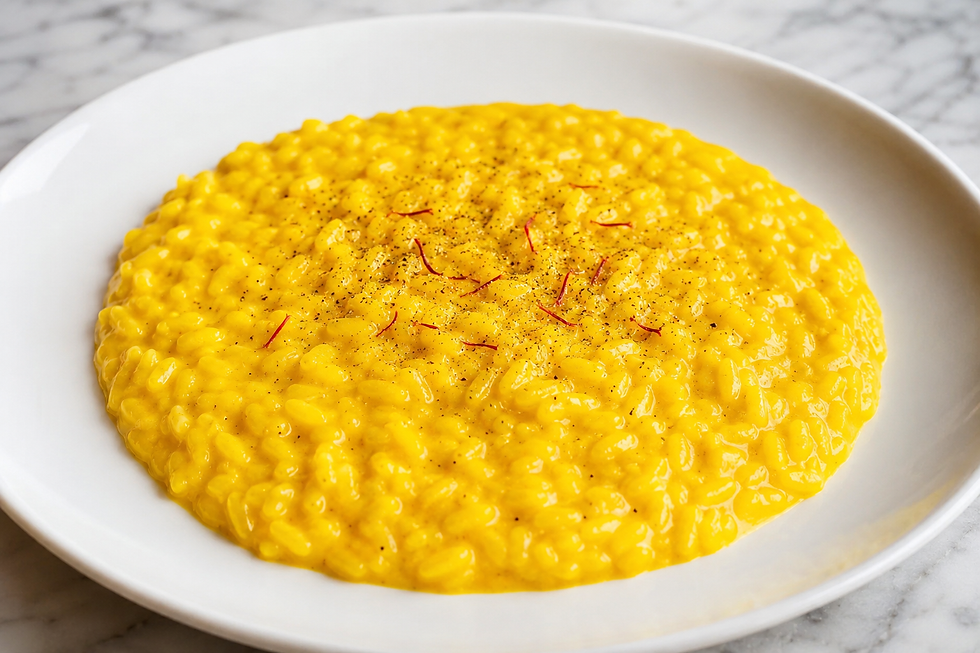
Serve on warm flat plates, never in a bowl and never on porcelain straight from a hot cupboard. Around 120°F (50°C) is right: a cold plate sets the starch in seconds and turns a wave into a mound, while a genuinely hot one keeps cooking the rice in front of the guest. Spoon the risotto into the centre and tap the underside of the plate once with the flat of your hand. Correctly finished, it spreads into an even layer about half an inch deep with a faintly rippled edge. That is the Venetian test of all onda.
Arrange the reserved clams and mussels around the outside, hinge down so each shell sits flat, and set two or three shrimp and a few cuttlefish rings where they can be seen. Finish with a thread of raw olive oil, a turn of black pepper and nothing else. No parsley crown, no lemon wedge, no shaved cheese: the dish is built to be eaten immediately.
Professional Technique
Everything here depends on separating the cooking times of four seafoods that have nothing in common. Clams and mussels are done in three minutes and rubber at five. Cuttlefish is tender at three minutes, tough from four to forty, and tender again only after an hour of braising. Shrimp need ninety seconds. Rice needs fourteen. The only workable answer is to cook each in the window that suits it and reunite them at the end.
The second technique is the double extraction behind the stock. Pressing shrimp shells and heads in hot oil is a Maillard step, not a simmering step, and those three minutes produce the roasted sweetness that separates a real fumetto from shrimp water. The clam and mussel liquor, added afterwards and never boiled, supplies the raw saline note heat destroys. The third is mantecatura with cold olive oil in place of butter: Vialone Nano sheds amylopectin freely, and that starch in suspension is an emulsifier waiting for fat. Oil at refrigerator temperature beaten into rice at around 175°F (80°C) disperses into droplets fine enough to scatter light, and the result is glossy and creamy with no dairy in it at all.
Texture and Moisture Control
The target is all onda: loose enough to spread slowly across a flat plate, with every grain separate and each carrying a firm, distinct point at its centre. That firmness is not undercooking. It is the intact heart of a grain whose outer layers have gelatinised and released their starch into the liquid around them, and it comes from the dry toasting at the start, which sets the surface proteins and slows water entry into the core.
Moisture is managed by adding stock in measured amounts rather than flooding the pan. Each ladle should just cover the rice and be almost gone before the next arrives, because grains sitting in deep liquid boil instead of absorbing. Stir often enough to keep the grains rubbing against each other, which is the mechanical action that frees the starch, but not constantly, which breaks them open. Finish the rice looser than it should look on the plate, because it keeps absorbing during the mantecatura and the rest. If it tightens too far, loosen it with hot fumetto rather than water.
Professional Mise en Place
Once the rice is in the pan there are eighteen minutes of continuous work with no gaps, so the whole seafood side must be finished and within reach before the tostatura begins.
Equipment and tools
Wide heavy pan with a thick base, about 11 inches (28 cm), for the rice
Separate wide pan with a tight lid for opening the shellfish
Saucepan for the fumetto, held hot beside the rice pan
Fine mesh sieve and damp paper for straining the shellfish liquor
Wooden spoon, ladle, and warm flat plates standing ready
Prepared ahead
Fumetto made and strained, up to 1 day ahead and refrigerated
Clams purged and mussels cleaned, on the day, kept cold and covered with a damp cloth
Cuttlefish cut, shrimp peeled, shallot and parsley chopped, all within 3 hours of service
Shellfish opened and their liquor strained, up to 2 hours ahead
Service setup
Fumetto and shellfish liquor combined, tasted for salt and held at about 190°F (88°C)
Shelled molluscs covered with a spoonful of their own liquor so they do not dry
Reserved clams and mussels left in their shells, kept apart for the plate
Olive oil for the mantecatura chilled until the moment it is used
Plates warmed early and allowed to stand before plating
Chef Tips
Buy the clams and mussels live and cook them the same day. A clam dead for hours gives a dull, slightly metallic liquor that runs through the whole stock, and since that liquor does most of the seasoning here there is no correcting it later. If a batch smells of anything but clean seawater, use fish stock alone.
Do not skip the shrimp heads. They hold the enzymes and orange fat that give a fumetto its depth, and a stock built on shells alone is noticeably thinner. If your shrimp came headless, press the shells harder in the oil and add a tablespoon of tomato paste for two minutes to compensate.
Keep the stock hot and taste it as you work. Cold stock hitting hot rice arrests the cooking and forces you to add more liquid overall, the commonest cause of a soupy risotto. Hot stock also reduces in its own pan, so a fumetto correctly seasoned at the start can be too salty twenty minutes later.
If you cannot find Vialone Nano, use Carnaroli and add two minutes, but adjust your expectations. Carnaroli holds its shape better and releases less starch, so the risotto will be tighter and less creamy. Arborio is the weakest option: it blows out at the tips before the centre is done and gives exactly the gluey texture this dish avoids.
Common Mistakes
Adding the seafood too early. Clams, mussels and shrimp put in at the start of the rice are rubber by the time the grain is ready. They go in during the last ninety seconds and nothing changes that.
Boiling the fumetto. A hard boil emulsifies shell fats into the liquid, clouds the stock and turns a sweet shellfish flavour bitter. Keep a bare simmer for the full 25 minutes and strain without pressing the solids.
Salting before tasting the combined stock. Clam and mussel liquor is close to seawater. Season the rice or the fumetto in advance and the finished dish will be inedibly salty once the liquor goes in. Combine, taste, then decide.
Finishing with butter or cheese. Both flatten the iodine and mineral notes the shellfish liquor contributed, which is why the lagoon tradition leaves them out. Cold olive oil beaten into the starch supplies the same gloss and body.
Flooding the pan with stock. Rice submerged in deep liquid boils instead of absorbing, and the starch it releases ends up in the surplus liquid rather than coating the grains. One ladle at a time, just enough to cover, then wait.
Wine Pairing
Soave Superiore DOCG: The classic Veneto answer and the one poured with this dish in Verona and Venice. Garganega from the volcanic hills above Soave gives white peach and a distinctly bitter almond finish, and that almond note runs alongside the toasted shrimp shell in the fumetto rather than competing with it. Its acidity is medium rather than sharp, which suits a dish seasoned mainly by saline clam liquor.
Lugana DOC: Turbiana from the southern shore of Lake Garda, the most textural white in this part of Italy. It has a waxy, almost saline weight that matches the starch and olive oil emulsion of the mantecatura, so it never feels thin against a creamy risotto. Its citrus is lime rather than lemon and the finish is long and mineral.
Bianco di Custoza DOC: A blend from the moraine hills just south of Garda, and the least assertive choice here, which is its value. Light, floral and gently herbal, it stays behind the cuttlefish and the raw olive oil instead of pushing past them, and its soft acidity does not sharpen the chilli.
Conegliano Valdobbiadene Prosecco Superiore DOCG: Choose the brut rather than the extra dry, since residual sugar sits badly against clams. The fine bead scrubs olive oil and starch from the palate between mouthfuls, which no still wine does as efficiently, and its green apple and white flower aromatics lift the lemon zest. Serve it at about 45°F (7°C).
Ribolla Gialla Collio DOC: From Friuli, just east of the lagoon, and the most interesting bottle on the list. Ribolla has high natural acidity, a faint grip on the finish and almost no tropical fruit, which makes it unusually good with the mineral edge of mussel liquor. Its bitter citrus peel character also handles the dried chilli cleanly, where a rounder white would turn sweet against it.
Storage & Reheating
This is a dish to finish and eat, not to store, and the seafood is the reason. Cooked clams, mussels and shrimp deteriorate faster than almost anything else in the kitchen and will be chewy and faintly metallic by the next day. Refrigerate leftovers within one hour in a shallow airtight container so the mass cools quickly, and eat them within 24 hours.
To reheat, put the cold risotto in a wide pan with two or three tablespoons of hot fish stock per portion, cover, and warm over low heat for about 4 minutes, stirring gently, until it loosens and steams. Never use a microwave, which heats unevenly and toughens the seafood in seconds, and never bring it back to a simmer.
Do not freeze the finished risotto: rice and shellfish both come back watery and the starch emulsion breaks irreversibly. The fumetto freezes very well for up to 3 months in measured portions, which turns this into a dish you can start at short notice. The better use for leftovers is arancini: chill the risotto overnight, roll it into balls, crumb them and deep fry at 350°F (175°C) until golden.
Nutrition
Per serving, based on 4 servings:
Calories: 570 kcal
Total Fat: 18 g
Saturated Fat: 2.6 g
Trans Fat: 0 g
Unsaturated Fat: 14 g
Cholesterol: 195 mg
Sodium: 890 mg
Total Carbohydrates: 63 g
Fiber: 2 g
Total Sugars: 3 g
Added Sugars: 0 g
Protein: 36 g
Lactose: 0 g
Principal micronutrients: iodine, selenium, zinc, iron, vitamin B12, phosphorus, copper
These figures are estimates. Sodium is the least predictable value, since almost all of it comes from the clam and mussel liquor rather than added salt.




Comments