
Italian Genoese Layered Sponge Cake | Sacripantina Genovese
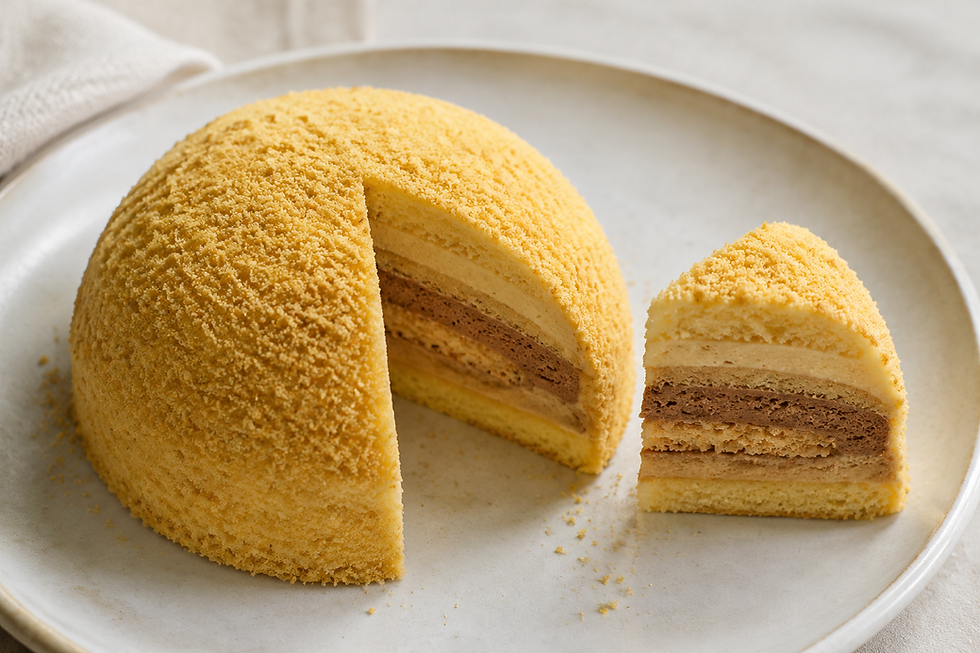
Sacripantina is a dome of pale sponge soaked in marsala, filled with two butter creams, one of zabaione and one of cocoa, and rolled in its own crumbs. Nothing is glazed or piped. It is cut at the table so the bands inside show, and that reveal is the whole point of the cake.
It is a two day recipe, and every hour of waiting earns its place.
Yield: 10 servings. Prep: 1 hour 15 minutes. Sponge rest: 12 hours. Setting: 6 hours. Difficulty: advanced. Region: Liguria.
The Story
The cake was created in Genoa in 1851 at the Preti pastry shop, and unlike most Italian sweets it has a named birthplace and a date rather than a fog of village tradition. It arrived in one of the busiest ports of the Mediterranean, where sugar, cocoa, vanilla and fortified wine came off ships from Sicily and the Atlantic trade, and where a merchant class had the money to buy a pastry made entirely of expensive things. Yolks, butter and marsala in one object were a statement about the shop that made it.
The name is a literary joke. Sacripante is the Saracen king of Circassia in Boiardo's Orlando Innamorato and Ariosto's Orlando Furioso, a figure of enormous boasting and rather less achievement. By the nineteenth century the word had passed into ordinary Italian to mean a swaggerer, a man who makes a great deal of noise. Sacripantina is the diminutive, affectionate rather than cruel, and the cake has always carried an air of theatrical excess that suits it.
What keeps it Genoese rather than generic is the finish. Ligurian pastry has a long habit of understatement that sits oddly with the richness of its ingredients, and Sacripantina takes that to its conclusion: a cake of yolks and butter that refuses to be decorated. No glaze, no piping, no chocolate shell, only its own crumbs and a veil of sugar. It is still made and sold in Genoa today, and still cut in wedges from a dome instead of slices from a round, which is the only way the layers inside can be seen.
Marsala is the other quiet witness to the port. English merchants had built the wine into an export trade from western Sicily in the late eighteenth century, and it moved through the Mediterranean by the same sea routes as the sugar. Pastry cooks used it in place of costlier liqueurs, which is why a Sicilian wine sits at the heart of a Ligurian cake.
Genoa was also a serious pastry city by then. Confectioners, several of them Swiss, had settled around the port and opened shops that competed on refinement, and a cake that could be admired in a window and then cut open to reveal its bands was exactly the kind of object that sold. That theatre, the closed dome that gives away nothing until the knife goes in, is still the reason to make it.
Ingredients
For the pan di Spagna
Large eggs, 4, about 7 oz (200 g) without shells
Granulated sugar, 1/2 cup plus 2 tbsp (125 g)
All purpose flour, sifted, 3/4 cup (95 g)
Potato starch, sifted, 1/4 cup (35 g)
Zest of 1 unwaxed lemon
Vanilla extract, 1 tsp (5 ml)
Fine sea salt, 1 pinch
Butter and flour, for the pan
For the marsala soak
Water, 1/2 cup (120 ml)
Granulated sugar, 1/4 cup (50 g)
Dry Marsala Superiore, 1/3 cup (80 ml)
Lemon peel, 1 strip, no pith
For the zabaione cream
Egg yolks, 6
Granulated sugar, 2/3 cup (130 g)
Dry Marsala Superiore, 2/3 cup (160 ml)
Unsalted butter, softened to 68°F (20°C), 12 tbsp (170 g)
Heavy cream, cold, 1/2 cup (120 ml)
Fine sea salt, 1 pinch
For the cocoa cream
Unsalted butter, softened to 68°F (20°C), 9 tbsp (130 g)
Confectioners sugar, sifted, 1 cup (120 g)
Unsweetened cocoa powder, sifted, 1/4 cup (24 g)
Whole milk, 3 tbsp (45 ml)
Reserved zabaione cream, 3/4 cup (180 g)
For the mould
Hemispherical bowl, 7 inch (18 cm) across, about 1 1/2 quarts (1.4 L)
Cling film, 3 sheets, each 20 inches (50 cm) long
For finishing
Sponge trimmings, dried and crushed, about 1 cup (60 g)
Confectioners sugar, 2 tbsp (16 g), for dusting
Preparation
Step 1. Whip the eggs to a full ribbon

Butter and flour an 8 inch (20 cm) pan and heat the oven to 340°F (170°C). Whisk the eggs, sugar, zest and salt in a bowl over barely simmering water until warm to the finger, then beat on high for 8 to 10 minutes until tripled and a ribbon of batter holds on the surface for 10 seconds. Add the vanilla in the last minute.
Step 2. Fold in the flour and starch

Sift the flour and starch together three times. Add them in three parts, folding with a wide spatula from the bottom of the bowl with as few strokes as possible. Every extra turn knocks out air and the sponge loses height.
Step 3. Bake and rest the sponge overnight

Pour the batter into the pan, bake 30 minutes until the top springs back, cool on a rack and leave it uncovered for 12 hours. Sponge baked the same day is too tender to slice and turns to paste under the brush.
Step 4. Make the marsala soak

Simmer the water, sugar and lemon peel until the sugar dissolves, then cool completely and remove the peel. Stir in the Marsala cold. Heat drives off the aroma that justifies the wine.
Step 5. Cook the zabaione over a water bath

Whisk the yolks, sugar and Marsala in a bowl over barely simmering water, never touching it, for about 8 minutes until the foam thickens and reaches 175°F (80°C). Do not go past 180°F (82°C) or the yolks scramble. Keep whisking the whole time so the heat reaches every part of the bowl evenly.
Step 6. Build the zabaione cream

Whisk the zabaione over cold water to 68°F (20°C). Beat the butter with the salt for 4 minutes, add the zabaione in four additions, then fold in the cream whipped to soft peaks. Set aside 3/4 cup (180 g) for the cocoa cream.
Step 7. Make the cocoa cream

Beat the butter with the confectioners sugar and cocoa until pale, add the milk, then fold in the reserved zabaione cream. The two creams must be the same temperature and texture or the bands will smear.
Step 8. Cut the sponge and line the bowl

Line a 7 inch (18 cm) hemispherical bowl with overlapping cling film. Slice the sponge into three layers. Cut a 6 1/2 inch (16 cm) disc from one, cut the rest into tapered strips and brush them with the cold soak. Press the strips against the film, overlapping slightly, up to the rim, with no gaps showing between them.
Step 9. Fill in alternating layers

Spoon in zabaione cream about 1 inch (2.5 cm) deep and level it. Chill 10 minutes, then add cocoa cream, level, and chill again. Repeat, ending with zabaione, and close with the brushed sponge disc. Fold the film over the base and press a plate on top.
Step 10. Chill, unmould and finish

Refrigerate at 39°F (4°C) for at least 6 hours. Invert onto a board, peel off the film and roll the dome in the dried crumbs. Dust with confectioners sugar and rest 25 minutes at room temperature before cutting. Press the crumbs on gently with the flat of your hand.
Plating
The dome goes to the table whole and is cut in front of the guests. Use a thin knife dipped in hot water and wiped dry between cuts, and slice wedges from the apex down to the plate so each one shows every band, the pale gold, the brown and the sponge wall.
Serve on a small chilled white plate at 54°F (12°C), with nothing beside it but a spoon and perhaps a thin glass of Marsala. No sauce, no fruit, no cream. The cake is complete, and anything added only competes with the layers.
Cut the first wedge slightly thicker than the rest, since it tends to crumble at the edge. Lay each wedge on its side so the bands face the guest, and keep the knife clean for every cut. Leftover wedges go back into the refrigerator at once.
Professional Technique
The technique that defines this cake is the upside down assembly. The bowl lined with cling film and sponge is the mould, and it gives the shape, but it is built in reverse: the bottom of the bowl becomes the crown of the cake, so the first cream that goes in is the last one anyone sees, and the sponge disc that closes the top of the bowl becomes the flat base.
The filling goes in strictly in layers, starting from the point of the dome. Each layer is spooned in at the centre, pushed to the walls with a small offset spatula and levelled flat, pressing the cream firmly against the sponge lining. This is where the cake is won or lost. Any air pocket left at the wall or under a layer is invisible until the knife goes through, and then it shows as a hollow in the cut face. Tap the bowl on a folded towel between layers, chill each one 10 minutes so the surface firms, and the next cream sits on it instead of blending into it.
The last decision is when to unmould, and the answer is by set point, not by the clock. The butter in both creams must have crystallised right through the centre, which in a 39°F (4°C) refrigerator takes at least 6 hours. Press the sponge disc lightly: it should feel firm all the way down with no give. Unmould early and the walls slump and the bands run into each other. Unmould at the right point and the dome slides out clean, with sharp bands, a smooth crown and no hollows.
Texture and Moisture Control
A Sacripantina is held up by butterfat, and butterfat is a temperature problem. Cold butter and warm zabaione produce a curdled, greasy cream, while butter above 72°F (22°C) produces a cream that will never firm. Butter at 68°F (20°C) meeting zabaione at 68°F (20°C) gives a smooth emulsion that sets fully in the cold.
Moisture inside the dome redistributes during setting, which is why the sponge is baked a day ahead and left uncovered. Slightly dry sponge takes the cold soak evenly, brushed on in a measured amount, and the wall stays tender and structural. Sponge that is too fresh turns to paste, while sponge left too dry stays pale in the middle of the wall and tastes of flour.
The crumb coat is a moisture barrier as much as a finish. Dried sponge crumbs absorb any sweat from the cold surface, so the dome stays matte instead of glossy. Take the cake out 25 minutes before cutting: colder and the butter is waxy on the tongue, warmer and the zabaione cream starts to lose its shape. The first bite should be cool, soft and just barely yielding.
Professional Mise en Place
This is a two day cake with a strict temperature window in the middle, so organise it in stages and keep each stage on its own tray.
Equipment and tools
Stand mixer, hand whisk, and a heatproof bowl for the water bath
Probe thermometer, offset spatula, pastry brush
7 inch (18 cm) hemispherical bowl, cling film, serving plate
Sifter, fine mesh sieve for the confectioners sugar and cocoa
Two small bowls of cold water and ice for cooling the zabaione
Prepared ahead
Pan di Spagna baked and rested uncovered, 12 to 24 hours
Marsala soak made and chilled, up to 3 days ahead
Butter measured and softened to 68°F (20°C) before starting the zabaione
Sponge sliced into three layers and the disc cut the evening before, wrapped loosely
Trimmings dried in a 200°F (95°C) oven for 20 minutes and crushed to fine crumbs
Service setup
Dome held at 39°F (4°C) until 25 minutes before service
Thin knife, hot water jug and clean towel at the table
Chilled plates and spoons
Finished dome on its board, crumbed and dusted, ready to carry to the table
Chef Tips
Use a real Marsala Superiore labelled secco or at most semisecco. Sweet cooking Marsala makes the cake cloying and hides the yolk. Taste the Marsala on its own first: it should smell of dried fruit, not of syrup.
Take the butter out of the refrigerator before you start the zabaione, not after. Butter that has to be rushed into softness never emulsifies properly. A press of the finger should leave a clean dent without the butter feeling oily.
Line the bowl with overlapping sheets of cling film rather than one piece, leaving a generous overhang, so you can pull the dome out cleanly and fold the film over the base. Smooth every wrinkle, because film creases print onto the sponge.
If the zabaione cream splits, warm the bowl briefly over the water bath and whisk it back together. It is almost always recoverable, but only if you do it at once, before the fat firms up again.
Common Mistakes
Using a sponge baked the same day. It has too much moisture and collapses into paste when soaked. Bake a day ahead and let it rest.
Adding marsala to hot syrup. The heat drives off the aroma, and only sweet liquid is left. Let the syrup cool completely first.
Taking the zabaione above 180°F (82°C). The yolks coagulate and the cream turns grainy, with no way back. Use a thermometer and pull the bowl off early.
Mixing butter and zabaione at different temperatures. Warm zabaione melts the butter and cold zabaione makes it seize, and either way the cream splits. Check both with a probe.
Pouring the syrup on instead of brushing. The sponge floods, the walls go soft, and the dome cannot stand once unmoulded. About 1 teaspoon per strip is enough.
Unmoulding before 6 hours. The creams have not set through the centre, so the walls slump and the bands run together. Plan the setting time the day before.
Glazing the finished cake. Sacripantina is finished with crumbs and sugar alone, and a glaze ruins the matte surface and hides the crumb coat that defines the cake.
Wine Pairing
Cinque Terre DOC: The Sciacchetrà of this denomination is the local answer, made from dried Ligurian grapes. Its honeyed, apricot sweetness matches the zabaione, and its bright acidity keeps the butter from coating the palate. It is scarce and expensive, so pour it in small glasses, and it keeps the table firmly Ligurian.
Moscato d'Asti DOCG: A light, lightly sparkling wine with low alcohol and peach and orange blossom aromas. The bubbles lift the butter creams, and its gentle sweetness never overpowers the marsala. It is also the easiest bottle to find and the gentlest with the cocoa layer.
Recioto di Soave DOCG: Made from dried Garganega, it brings almond, candied citrus and a long acid finish. That acidity cuts the richness of the yolks, and the nutty note picks up the toasted edge of the sponge. Serve it cool but not cold, in small glasses.
Marsala DOC: A small glass of aged Marsala echoes the wine already inside the cake. Its dried fruit, caramel and walnut notes deepen the zabaione and the cocoa, so choose a Superiore with some age. It is the most traditional finish to the meal and the boldest match on the list.
Alta Langa DOCG: The pick for guests who dislike sweet wines. A brut metodo classico has fine bubbles and crisp acidity that scrub the palate clean between bites of a very rich cake. Serve it well chilled, and it clears each mouthful of butter before the next.
Storage & Reheating
This cake lives in the refrigerator. Keep the finished dome loosely covered at 39°F (4°C) for up to 4 days. The flavour improves after the first day as the soak settles, though the crumb coat softens a little. Use a container tall enough that the lid does not touch the dome, or an inverted large bowl.
Freezing works. Wrap the whole unfinished dome tightly and freeze for up to 1 month, then thaw overnight in the refrigerator and crumb it after thawing. Slices can also be frozen individually, wrapped one by one, and are good for two weeks. Never refreeze a thawed dome.
Nothing here is reheated. Warming a slice destroys the butter structure, so simply let it stand 25 minutes at room temperature. If the dome has been in the freezer, thaw it fully in the refrigerator first, never on the counter, so condensation does not soak the crumb coat.
Nutrition
Per wedge, with the dome cut into 10:
Calories: 570 kcal
Total Fat: 33 g
Saturated Fat: 19 g
Trans Fat: 1 g
Unsaturated Fat: 13 g
Cholesterol: 260 mg
Sodium: 100 mg
Total Carbohydrates: 58 g
Fiber: 1 g
Total Sugars: 42 g
Added Sugars: 41 g
Protein: 6 g
Lactose: 0.8 g
Alcohol: about 3 g, most of it retained
Principal micronutrients: vitamin A, vitamin B12, choline, selenium, riboflavin
These are estimates. Because of the alcohol, do not serve this cake to children or to anyone avoiding it.


Comments