
Vegan Umbrian Black Truffle Spaghetti | Spaghetti al Tartufo Nero all'Umbra Vegani

Spaghetti al tartufo nero is the great winter pasta of Umbria, and one of the purest dishes in Italian cooking: dry spaghetti, fresh black truffle, Umbrian extra virgin olive oil, a clove of garlic and salt. The truffle is used twice, grated into warm oil to make a fragrant base that coats every strand, and shaved over the plate at the end. In its simplest form the dish is naturally plant based, and this version keeps it that way, relying only on the quality of the truffle, the oil and the pasta. What it adds is precision: the exact temperature of the oil, the right moment to grate and the emulsion that turns three ingredients into a glossy, perfumed sauce.
Yield: 4 servings. Prep: 15 minutes. Cook: 15 minutes. Rest: 30 minutes for the truffle to reach room temperature. Course: primo piatto. Region: Umbria.
The Story
Umbria, the green heart of Italy, is the country's great land of the black truffle. The valleys and wooded hills around Norcia and Spoleto, in the Valnerina and the mountains of the southeast, produce the prized black winter truffle, Tuber melanosporum, called tartufo nero pregiato in Italy. Truffle hunters, the tartufai, go out with their dogs from late autumn to early spring and search the soil at the roots of oaks, hornbeams and hazelnut trees, where the fungus lives in symbiosis with the tree. Norcia celebrates it every year in late winter with a large fair dedicated to the black truffle and the products of the Valnerina.
The black winter truffle is the noblest of the black truffles. It has a dark, warty skin and a deep purple-black flesh streaked with fine white veins, and an aroma that is intense, earthy and long, with notes of undergrowth, cocoa and dried fruit. Unlike the white truffle of Alba, which is almost always eaten raw, the black truffle can take gentle warmth: a few minutes in warm oil release its perfume instead of destroying it. That is the principle on which the Umbrian way of dressing pasta is built.
In Umbrian homes, the truffle was never a luxury reserved for restaurants. In the mountain villages it was a product of the land, gathered by the family or a neighbor, and it was grated generously over the simplest foods: on bread with olive oil, on potatoes, on pasta. The classic preparation for spaghetti and for strangozzi, the hand-rolled Umbrian noodles, consists of grating the truffle into olive oil warmed with garlic and tossing the pasta in it. Some family versions add other savory elements to the oil; the essential recipe uses only oil, garlic, truffle and salt.
That essential recipe is already fully vegan, and it reflects the deep connection between Umbria's truffle and its olive oil. Umbria is a region of olive groves, from the hills of Assisi and Spoleto to Trevi and Lake Trasimeno, and its extra virgin olive oil is protected by the Umbria DOP. A green, fruity, gently peppery Umbrian oil is the natural partner of the black truffle: its fat carries the truffle's aromatic compounds, and its fruit frames them. This recipe keeps the Umbrian tradition intact and controls only what decides the result.
Ingredients
Everything depends on the truffle. Buy fresh Tuber melanosporum in season, roughly December to March, from a trusted truffle merchant. It must be firm to the touch, heavy, with an intense, clean aroma; avoid soft truffles or those that smell of ammonia. Choose dry spaghetti made from durum wheat semolina, bronze extruded and slowly dried, so its rough surface holds the oil. Use an Umbrian extra virgin olive oil from the most recent harvest, green and fruity, with a moderate pepperiness: a very aggressive oil hides the truffle.
For the truffle oil base
Fresh black winter truffle, 2 to 3 oz (60 to 80 g), brushed clean
Extra virgin olive oil, Umbria DOP, 1/3 cup (80 ml)
Garlic, 1 clove, peeled and halved, green germ removed
Fine sea salt, 1 pinch
For the pasta
Dry spaghetti, bronze extruded, 12 oz (340 g)
Water, 4 quarts (3.8 l)
Coarse sea salt, 1 1/2 tbsp (25 g), for the water
For the finish
Extra virgin olive oil, Umbria DOP, 1 tbsp (15 ml)
Flat-leaf parsley, very finely chopped, 1 tsp (1 g), optional
Flaky sea salt, 1 pinch
Freshly ground black pepper, a light turn
Preparation
Step 1

Clean and temper the truffle. Take the truffle out of the refrigerator 30 minutes before cooking, still wrapped, so it reaches room temperature. Brush it under a thin stream of cold water with a soft, small brush, removing the soil from every crevice of the warty skin, then pat it completely dry with a paper towel. Never soak it. A cold truffle is closed and gives little aroma; at room temperature its volatile compounds evaporate more freely and the perfume opens. Divide it: about two thirds for grating into the oil, one third for shaving at the end.
Step 2
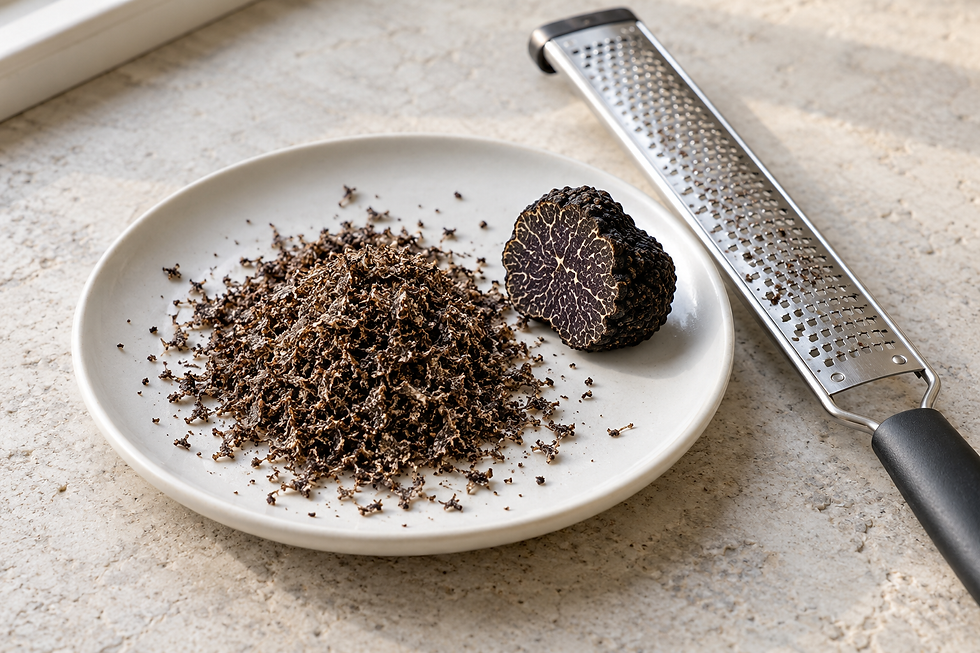
Grate the truffle. Using the fine side of a box grater or a microplane, grate two thirds of the truffle onto a plate. Work quickly and grate it only now, just before cooking, because grated truffle loses its aroma within minutes. Keep the remaining piece whole for the final shavings. Grating multiplies the surface of the truffle in contact with the oil, so the oil can absorb as much aroma as possible in a short time, while the shavings at the end give the visual impact and a fresh, direct perfume.
Step 3

Bring the water to a boil. Bring 4 quarts (3.8 l) of water to a rolling boil in a large pot and add the coarse salt only when it boils. The water should taste pleasantly salted, about 1 percent. The sauce of this dish has very little salt of its own, so the seasoning of the pasta comes mostly from the water. Do not add oil to the water: it does nothing to prevent sticking and leaves a film on the pasta that stops the sauce from clinging.
Step 4

Warm the oil with garlic. Pour 1/3 cup (80 ml) of olive oil into a wide, cold pan large enough to hold the spaghetti, and add the halved garlic. Warm it over the lowest heat for 4 to 5 minutes, until small bubbles form around the garlic and the oil reaches about 160°F (70°C). The garlic must stay pale and soft, perfuming the oil without frying. Take out the garlic and discard it. In the Umbrian tradition the garlic is a background note: browned garlic would turn bitter and fight with the truffle, while gentle warmth releases only its sweetest aroma.
Step 5

Infuse the grated truffle. Take the pan off the heat and wait 1 minute, so the oil drops to about 140°F (60°C). Add the grated truffle and a pinch of fine salt, stir with a wooden spoon and leave it to infuse for 3 to 4 minutes, pressing the truffle gently against the pan. The oil will darken slightly and become intensely fragrant. Warm, never hot: above about 175°F (80°C) the truffle starts to fry, its delicate compounds evaporate and the aroma becomes flat. This is the moment that decides the dish, so keep the pan off the heat.
Step 6

Cook the spaghetti. Drop the spaghetti into the boiling water, stir during the first minute so the strands do not stick, and cook them for 2 minutes less than the time on the package. They should still be firm at the center, because they will finish cooking in the pan. Just before draining, take 1 cup (240 ml) of the cooking water and keep it aside. The starch released by bronze-extruded spaghetti into the water is what will bind the oil and the water into a sauce.
Step 7

Emulsify and finish. Put the truffle pan back over low heat and add 1/4 cup (60 ml) of the cooking water. Lift the spaghetti with tongs straight into the pan and toss vigorously for 1 1/2 to 2 minutes, moving the pan and lifting the pasta, adding more cooking water a spoonful at a time, until the spaghetti are al dente and coated in a glossy, creamy film. Take the pan off the heat, add 1 tbsp (15 ml) of fresh olive oil and the parsley if using, and toss again. Taste and adjust the salt. The sauce should be fluid, never oily: if it separates, a splash of cooking water and a few seconds of tossing bring it back.
Plating
Warm shallow bowls to about 140°F (60°C), so the pasta stays hot and the truffle's perfume keeps rising. With a long fork, twist each portion into a tight nest against the side of the pan, then lift it into the center of the bowl and pour over the oil and the grated truffle left in the pan, so none of it is wasted.
At the table, shave the remaining truffle over each plate with a truffle slicer, in thin, wide slices, about 1/4 oz (7 g) per person. Finish with a few flakes of salt and a very light turn of pepper. The guest twirls the spaghetti with a fork, and each bite should bring the warm, deep perfume of the infused oil and the fresher, sharper aroma of the raw shavings, two faces of the same truffle.
Professional Technique
The key ratio is truffle to pasta. For a dish where the truffle is the only flavoring, count at least 1/2 oz (15 g) of fresh truffle per person, of which about two thirds goes into the oil and one third on the plate. Less, and the oil is not perfumed enough to carry the dish; the pasta then tastes simply of oil and garlic. More is always welcome. The oil quantity, 1/3 cup (80 ml) for 12 oz (340 g) of pasta, is enough to coat every strand once emulsified, without leaving a pool at the bottom of the bowl.
The hidden variable is oil temperature. The aromatic compounds of the black truffle dissolve readily in fat, and warmth speeds their transfer into the oil, but too much heat drives them off into the air. Between 130°F and 150°F (55°C and 65°C), the oil absorbs the most aroma. An instant-read thermometer makes this precise; without one, the oil is right when you can hold a finger in it for a second.
The doneness test concerns both pasta and sauce. The spaghetti are ready when they are just al dente, with a fine, firm thread at the center. The sauce is ready when the strands look glossy and slightly creamy, with no free oil sliding to the bottom of the pan. If you see drops of oil, the emulsion needs more water and more movement.
Aroma and Temperature Control
Aroma is the whole point of this dish, and every step protects it. The truffle is tempered to room temperature, grated at the last minute, infused in warm oil off the heat and shaved raw at the end. Each of these choices reduces the loss of volatile compounds, the molecules that we perceive as the truffle's perfume. Grated too early, left in hot oil or cooked with the pasta, the truffle loses most of its value in a few minutes.
The emulsion carries the aroma to the palate. Oil alone would slide off the spaghetti and pool in the bowl; the starch of the cooking water allows oil and water to combine into a stable, creamy sauce that clings to each strand. The emulsion forms only with movement and moderate heat: vigorous tossing breaks the oil into tiny droplets, and the starch keeps them suspended.
Serving temperature completes the work. Aroma rises from warm food, so cold bowls or a slow walk from the stove to the table cost a large part of the perfume. Warm the bowls, plate quickly and shave the truffle at the table, so the guest receives the dish at its aromatic peak.
Professional Mise en Place
This dish takes less than 15 minutes from the moment the water boils, and every second counts. Prepare everything before the pasta goes in, and cook no more than 4 portions in one pan.
Equipment and tools
Large pot of at least 6 quarts (5.7 l)
Wide pan of about 12 inches (30 cm), large enough to toss the spaghetti
Microplane or fine grater, truffle slicer, small soft brush
Tongs, wooden spoon, instant-read thermometer, ladle or heatproof cup
Prepared ahead
Truffle brushed, dried and tempered at room temperature for 30 minutes
Garlic peeled, halved, germ removed
Parsley chopped, if using, within 30 minutes of service
Bowls warming in a low oven at about 140°F (60°C)
Service setup
Pasta water at a rolling boil, salted
Truffle grated into the warm oil just before the pasta goes in
Cup for the cooking water next to the pot
Truffle slicer, the reserved truffle, flaky salt and pepper mill on the pass
Chef Tips
Store the fresh truffle in the refrigerator, wrapped in a paper towel inside a closed glass jar, and change the paper every day, because the truffle releases moisture and can mold. Use it within a week: it loses aroma every day. Do not store it in rice, which dries it out, but you can keep a few raw almonds in the jar for a day to perfume them and use them in another dish.
If the truffle is small or less fragrant than you hoped, add half of the grated truffle to the oil and the other half to the pasta in the pan at the end, off the heat. This layering gives more perfume from the same quantity.
Use the trimmings. The small pieces left after slicing can be grated into the oil next time, or mixed with olive oil and a pinch of salt and kept refrigerated for 2 days as a quick truffle oil for bread or roasted potatoes. Never buy commercial truffle oil to boost the dish: most are flavored with a synthetic compound.
Strangozzi, the Umbrian hand-rolled noodles of flour and water, are the other classic pasta for this dressing. If you have them, use them in place of spaghetti, cooking them for 4 to 5 minutes, and keep the same method for the oil and the emulsion.
Common Mistakes
Frying the truffle. Hot oil cooks the truffle and destroys its perfume. Add it to warm oil off the heat, never to a sizzling pan.
Browning the garlic. Browned garlic is bitter and covers the truffle. Warm it gently, keep it pale and remove it before adding the truffle.
Grating too early. Grated truffle loses its aroma within minutes. Grate it just before it goes into the oil.
Using a cold truffle. Straight from the refrigerator, the truffle releases little aroma. Let it reach room temperature for 30 minutes.
Overcooking the pasta. Spaghetti cooked fully in the water turn soft in the pan. Drain them 2 minutes early and finish them in the sauce.
Skipping the emulsion. Without cooking water and vigorous tossing, the oil stays separate and the pasta is greasy. Add starchy water and toss until glossy.
Using truffle oil. Synthetic truffle flavoring is harsh and unbalances the dish. Use only fresh truffle and a good Umbrian olive oil.
Wine Pairing
Torgiano Rosso Riserva DOCG: From the hills of Torgiano, near Perugia, an Umbrian red based on Sangiovese with notes of cherry, violet, leather and spice from its long aging. Its earthy maturity mirrors the truffle, and its fresh acidity cleans the olive oil from the palate. Serve it at about 63°F (17°C).
Montefalco Sagrantino DOCG: The great red of Umbria, from the Sagrantino grape around Montefalco, with dark fruit, spice and firm tannins. Choose a bottle with some years of age, when the tannins have softened and tertiary notes of earth and undergrowth echo the black truffle. Open it an hour ahead and serve it at about 64°F (18°C).
Orvieto Classico DOC: The historic white of southwestern Umbria, based on Grechetto and Trebbiano, with notes of white flowers, pear and a bitter almond finish. Light and fresh, it lets the truffle lead and balances the richness of the oil. Serve it at about 50°F (10°C).
Verdicchio di Matelica DOC: From the inland valley of Matelica, just across the Apennines from Umbria in the Marche, a white with citrus, almond and herbal notes and a firm, mineral acidity. It has the structure to accompany an intensely aromatic pasta and the freshness to keep each bite clean. Serve it at about 50°F (10°C).
Storage & Reheating
Refrigerator: this dish is meant to be eaten at once, because the truffle's perfume fades quickly and the emulsion breaks as the pasta cools. Leftovers keep in an airtight container for 1 day, but expect much less aroma. The fresh truffle, as described in the Chef Tips, keeps up to a week. Freezer: not recommended for the finished pasta. A fresh black truffle can be frozen whole, wrapped tightly, for up to 3 months, and grated from frozen straight into the warm oil, with some loss of aroma.
To reheat leftovers, warm them in a wide pan over low heat with 2 tbsp (30 ml) of water and a little fresh olive oil, tossing gently for 2 to 3 minutes until hot and glossy again. Avoid the microwave, which dries the spaghetti and separates the oil. Finish with a few fresh shavings of truffle if you have any left, to bring the dish back to life.
Nutrition
Per serving, based on 4 servings:
Calories: 530 kcal
Total Fat: 23 g
Saturated Fat: 3 g
Trans Fat: 0 g
Unsaturated Fat: 20 g
Cholesterol: 0 mg
Sodium: 440 mg
Total Carbohydrates: 68 g
Fiber: 4 g
Total Sugars: 2 g
Added Sugars: 0 g
Protein: 12 g
Principal micronutrients: vitamin E, vitamin K, thiamin, folate, selenium, manganese, iron
These figures are estimates, calculated on the quantities listed and rounded to the nearest whole number, assuming that only part of the pasta cooking salt is absorbed. They vary with the brand of pasta and the amount of oil left in the pan.


Comments