Italian Benevento Nougat | Torrone di Benevento
Updated: Oct 24

Torrone di Benevento is a honey confection before it is a sugar one, and the honey is what makes it hard to imitate. The mass sits over water in slow cooking for most of a day, and it comes off the heat amber, dense and faintly toasted rather than pale and sweet. There is no shortcut in it. Everything worth knowing about this bar is in how long the honey is allowed to cook and who stirs it.
Yield: about 2 1/4 lb (1 kg), roughly 24 bars. Prep: 45 minutes. Cook: 5 to 6 hours over a bain marie. Set: 12 hours. Difficulty: advanced. Course: dolci. Region: Campania, Benevento and the Sannio.
The Story
Benevento made its name in nougat for a reason that has nothing to do with sugar. The province sits inland in Campania, ringed by the hills of the Sannio and the Taburno massif, and it has been honey country for as long as anyone has recorded anything about it. Roman writers already mention beekeeping in the valleys of the Calore and the Sabato, and the Samnite towns of the interior traded honey long before cane sugar reached the peninsula. When a confection built on honey, egg white and nuts arrived in southern Italy through Arab Sicily and the Angevin and Aragonese courts, Benevento had the one ingredient the recipe cannot fake.
The other half of the story is monastic and papal. Benevento was a papal enclave for more than eight centuries, cut off administratively from the kingdom around it, and its convents kept confectionery alive with the patience that institutional kitchens allow. A nougat that needs six hours of attention is a convent product, not a domestic one: somebody has to be in the room. By the eighteenth century the torrone of Benevento was being sent as a gift to Naples and Rome, and by the nineteenth a small industry had formed around San Marco dei Cavoti and the city itself, with family houses that still work to the same timings.
What the town produces is a family of bars rather than one recipe. There is the pale almond bar, the hazelnut version that leans on the nuts of the Campanian hinterland, the spiced torrone that carries clove and cinnamon, and the celebrated croccantino coated in dark chocolate. They share a base: local honey, egg white, and nuts toasted that morning. The bar in this recipe is the plain honey and nut version, the one the other variations are built on, and the one that shows immediately whether the honey was cooked properly or hurried.
It is Christmas food across the whole country now, sold in paper wrapped batons on every stall from December onward. In Benevento it is also a year round trade, and the local houses will tell you the same thing if you ask what makes theirs different. It is not the nuts and it is not the sugar. It is the hours.
Ingredients
For the nougat mass
Acacia or millefiori honey, 1 1/2 cups (500 g)
Granulated sugar, 1 1/4 cups (250 g)
Water, 1/3 cup (80 ml)
Egg whites, at room temperature, 3 large (100 g)
Fine sea salt, 1/8 tsp (0.5 g)
For the nuts
Whole blanched almonds, 10 1/2 oz (300 g)
Whole hazelnuts, skin on, 7 oz (200 g)
For the aromatics
Vanilla bean, split and scraped, 1
Ground cinnamon, 1/4 tsp (0.5 g)
Orange blossom water, 1 tsp (5 ml), optional
For the frame and finishing
Edible wafer sheets, ostie, 4 sheets to fit your frame
Neutral oil, for the frame and the spatulas
Confectioners sugar, 1 tbsp (8 g), for dusting the blade
Preparation
Toast the almonds and the hazelnuts separately
Heat the oven to 320°F (160°C). Spread the almonds on one tray and the hazelnuts on another, because they do not finish together. The almonds need about 12 minutes and should smell sweet with the faintest colour at the tip. The hazelnuts need 15 to 18 minutes, until the skins crack and lift. Two trays, two timers, no compromise between them.
Rub the hazelnuts and hold both nuts hot
Tip the hazelnuts into a coarse cloth, fold it over and rub firmly until most of the skins come away, then pick the nuts out and discard the papery debris. Return both nuts to the switched off oven with the door ajar and keep them at about 150°F (65°C) until the moment they go in. Cold nuts dropped into hot nougat chill the mass and it stops folding.
Set up the bain marie and start the honey
Choose a heavy copper or thick stainless bowl that sits inside a wider pan of water without touching the bottom. Put the honey in the bowl, bring the water to a bare simmer, and leave it. For the first hour the honey simply loosens and steams. Stir it every ten minutes with a wooden spatula, always in the same direction, scraping the sides back into the middle.
Cook the honey down for four to five hours
This is the whole recipe and it cannot be hurried. Keep the water simmering, never boiling hard, and stir every ten minutes for four to five hours. The honey darkens through gold into a deep amber, the volume drops by roughly a third, and the smell changes from floral to something closer to caramel and toasted bread. Never move the bowl onto direct heat to speed it up.
Whip the whites and fold them in
When the honey has reached that amber stage, whip the whites with the salt to a firm glossy meringue in a stand mixer. Add the meringue to the honey in three additions, folding each one in completely before the next. The mass will look slack and grainy at first. Keep it over the simmering water and keep stirring, and within twenty minutes it becomes smooth, pale gold and glossy again.
Boil the sugar syrup and add it
Combine the sugar and water in a small heavy saucepan and cook without stirring until the syrup is clear, heavy and slow to fall from the spatula, and a thread drawn from it holds in the air rather than sagging. Pour it into the honey and egg mass in a thin steady stream while a second pair of hands keeps stirring. It must never be tipped in at once.
Work the mass until it tests brittle
Continue over the bain marie, stirring constantly, for another hour to ninety minutes. Test by dropping a little into iced water: while the mass is still young the drop stays soft and chewy, and it is ready only when the cooled drop snaps cleanly between the teeth with no stickiness at all. Stir in the vanilla seeds, the cinnamon and the orange blossom water, then fold in the hot nuts.
Press the slab and leave it overnight
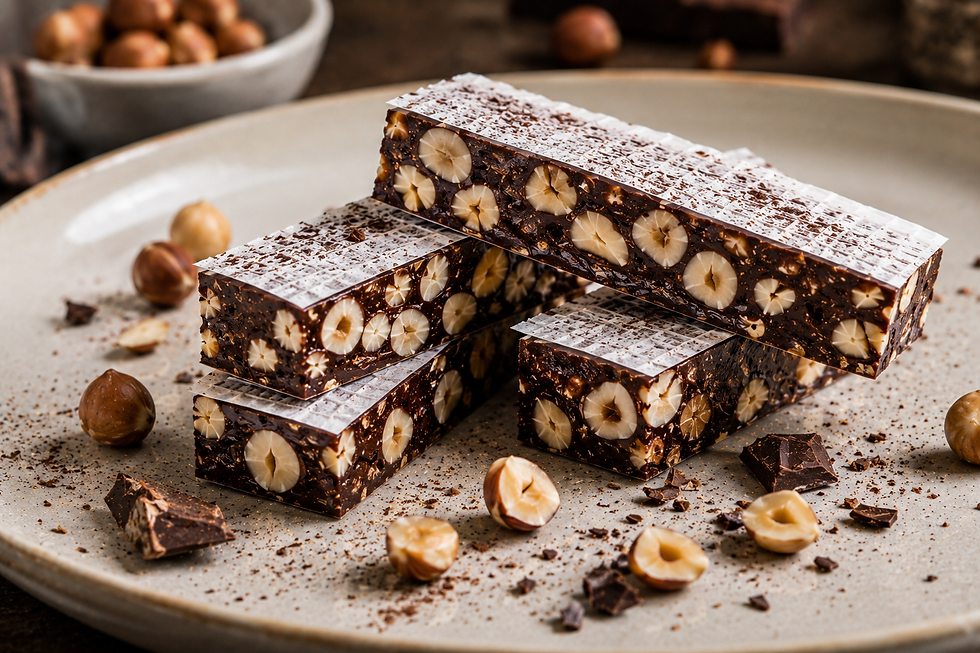
Oil a rectangular frame, line the base with wafer sheets and scrape the mass in. Cover with more wafer, lay a board on top and press hard, evenly, with weights. Leave it at cool room temperature for 12 hours, never in the refrigerator. Warm a long knife, dust the blade, and cut bars with one decisive stroke each, then wrap every bar.
Plating
Torrone is served at room temperature and nothing else is true of it. Straight from a cool larder the bar is glassy and hard on the teeth; left twenty minutes in the room it softens just enough to break cleanly and the honey aroma comes forward. Never serve it chilled.
For the table, cut the bars into batons about 3 in (8 cm) long and stack two or three on a small wooden board or a marble slab, wafer edges showing. A single sprig of rosemary or a few toasted almonds beside them is enough. For a restaurant dessert, break a bar into irregular shards rather than slicing it, stand two shards upright against a spoon of thick sheep milk ricotta, and add nothing sweet alongside. The bar is already at the limit of what a plate can carry.
Professional Technique
The technique that defines Beneventan torrone is a long low transformation of honey, and it is chemistry rather than patience for its own sake. Raw honey is mostly fructose and glucose in a saturated solution with about eighteen percent water, plus a set of volatile aromatic compounds that give each variety its floral signature. Five hours over simmering water does three separate things to that mixture. It drives off most of the water, which is what eventually allows the mass to set hard. It breaks down the most fragile of those volatiles, and the sharp high floral note that makes raw honey taste perfumed simply disappears. And it starts slow Maillard reactions between the sugars and the small amount of protein and amino acids present in honey, which is where the amber colour and the toasted, rounded flavour come from.
None of that can be forced with a higher flame. Honey scorches on a directly heated surface long before the interior reaches the same temperature, because its sugars caramelise at well under the boiling point of the water inside it, and a scorched layer on the bottom of the pan taints the entire batch with bitterness that no amount of further cooking removes. The bain marie caps the temperature of the vessel at just under 212°F (100°C) and holds it there for hours, which is exactly the window these reactions need.
The other reason this is professional work is that it takes two people. The mass must be stirred continuously through the final stage, and the sugar syrup must be streamed in slowly at the same time. One pair of hands cannot do both, and stopping the stir to pour lets the base set against the bowl.
Texture and Moisture Control
Water content decides everything about the finished bar. The mass leaves the bain marie with very little of it left, and the thread test and the iced water test are both ways of reading the same thing without a thermometer: a drop that stays soft still holds water, a drop that snaps clean does not. Stop too early and the bar stays tacky for weeks and sags under its own weight. Take it too far and the sugars begin to caramelise on their own, the colour goes brown rather than amber, and the bar turns brittle enough to shatter into powder under the knife.
After setting, the enemy is the air. Torrone attracts moisture from a humid kitchen, and a surface that has taken it up turns first slightly sticky and then soft all the way through. Wrap each bar the day it is cut, work on a dry day if you have the choice, and never set the slab in a refrigerator, where condensation forms on the surface as it comes back to the room. The wafer sheets are structural in this respect as well as traditional: they give the honey mass a dry face to sit against and make the bars handleable.
Professional Mise en Place
This is a two person preparation with a fixed six hour spine, so everything that can be weighed or positioned in advance should be.
Equipment and tools
Heavy copper or thick stainless bowl and a wider pan for the bain marie
Two wooden spatulas, a stand mixer, a small heavy saucepan for the syrup
Rectangular wooden or steel frame, a flat board and 10 lb (4.5 kg) of weights
Bowl of iced water for testing, long thin knife, wafer sheets cut to size
Prepared ahead
Nuts toasted, skinned and held warm, the same day only
Sugar and water weighed into the syrup pan, ready to light
Frame oiled and lined with wafer before the mass is ready
Egg whites separated and brought to room temperature
Service setup
Second person briefed for the syrup stage, which cannot be done alone
Timer set for a ten minute stir through the long cook
Cut bars wrapped individually and held in a dry sealed tin
Chef Tips
Buy the honey as if it were the only ingredient, because in flavour terms it nearly is. A mild acacia gives a clean bar that lets the nuts speak; a millefiori from the Sannio hills gives more character and a darker finish. Avoid chestnut honey here: its bitterness concentrates over five hours into something harsh.
Use a copper bowl if you have one. Copper conducts evenly enough that the honey never develops a hot ring where it meets the side of the vessel, which is the commonest source of a faint burnt note in a home batch.
Taste the honey at the four hour mark and again at five. You are looking for the moment the perfumed floral edge has gone and a toasted note has arrived. That is a judgement of flavour, not of clock time, and it moves with the honey you bought.
Cut the bars the morning after pressing, not later. Torrone hardens progressively for several days, and a slab left three days fights the knife and cracks rather than cutting.
Common Mistakes
Cooking the honey on direct heat. It scorches against the pan base while the bulk is barely warm, and that bitterness runs through the whole batch. The bain marie is the only way to hold honey at this temperature for hours.
Stopping the long cook at two or three hours. The bar sets, but it stays perfumed and one dimensional and turns tacky within days because too much water is still in it. Four to five hours is the minimum.
Adding cold nuts. Nuts straight from a cupboard drop the temperature of the mass sharply, the nougat stiffens around them and the last folding turns into a fight. Hold them at 150°F (65°C) until the moment they go in.
Tipping the sugar syrup in all at once. The mass seizes into lumps that never fully smooth out and the meringue structure collapses. Stream it in thinly while a second person keeps the spatula moving, which is why this is not a solo job.
Setting the slab in the refrigerator. Cold slows the set rather than helping it, and condensation on the way back to room temperature leaves the surface sticky. Press it at cool room temperature and give it the full 12 hours.
Wine Pairing
Vin Santo del Chianti Classico DOC: The closest match here, because oxidative ageing in small casks builds exactly the toasted almond and dried apricot register that five hours of honey cooking builds in the bar. Its acidity stays high under the sweetness, which keeps the nuts from turning heavy. Serve it cool, around 55°F (13°C).
Greco di Bianco DOC: A sun dried Calabrian sweet white with orange blossom, bergamot and honey of its own. It echoes the floral origin that the long cook drove out of the bar, so the pairing reconstructs on the palate what the pan removed, with a saline finish that stops the match becoming cloying.
Malvasia delle Lipari DOC: Dried fig, raisin and candied citrus peel from grapes part dried on the islands, with moderate alcohol and a lift of acidity. The candied fruit sits beside the toasted nut rather than over it, and the sweetness matches the bar without exceeding it, which matters because a wine sweeter than the dessert tastes flat.
Recioto di Soave DOCG: Garganega dried on the vine gives white peach, marzipan and a distinctly bitter almond finish. That almond note runs straight into the almonds in the nougat, and the wine is lighter in body than most sweet whites, which suits a confection this dense.
Moscato di Noto DOC: Grapey, muscat aromatic and lower in alcohol, the freshest choice here. Its sweetness is direct rather than layered, and its acidity and light perfume clean the palate between mouthfuls of a very rich bar at the end of a long Christmas table.
Storage & Reheating
Wrapped individually in parchment or cellophane and kept in a sealed tin at cool room temperature, the bars hold for 2 months and are arguably better after the first week, once the honey flavour has settled. Keep the tin away from the stove and away from any source of steam. Never refrigerate torrone: the humidity of a refrigerator softens the surface and the bar loses its snap for good.
Freezing is possible but pointless, since the bar keeps so long at room temperature, and thawing brings condensation onto the surface. If a bar has gone slightly tacky in a humid kitchen, spread the pieces on a tray in a 250°F (120°C) oven for 5 minutes, let them cool completely in a dry room and rewrap at once. That drives off surface moisture only and will not rescue a bar that was undercooked in the first place.
Nutrition
Per bar, based on 24 bars:
Calories: 215 kcal
Total Fat: 9 g
Saturated Fat: 0.8 g
Trans Fat: 0 g
Unsaturated Fat: 8 g
Cholesterol: 0 mg
Sodium: 15 mg
Total Carbohydrates: 31 g
Fiber: 1.5 g
Total Sugars: 29 g
Added Sugars: 10 g
Protein: 4 g
Lactose: 0 g
Principal micronutrients: vitamin E, magnesium, manganese, copper, phosphorus, riboflavin
These figures are estimates and shift with the size of the cut bar and with the honey used.


Comments