
Italian Cremona Nougat | Torrone di Cremona
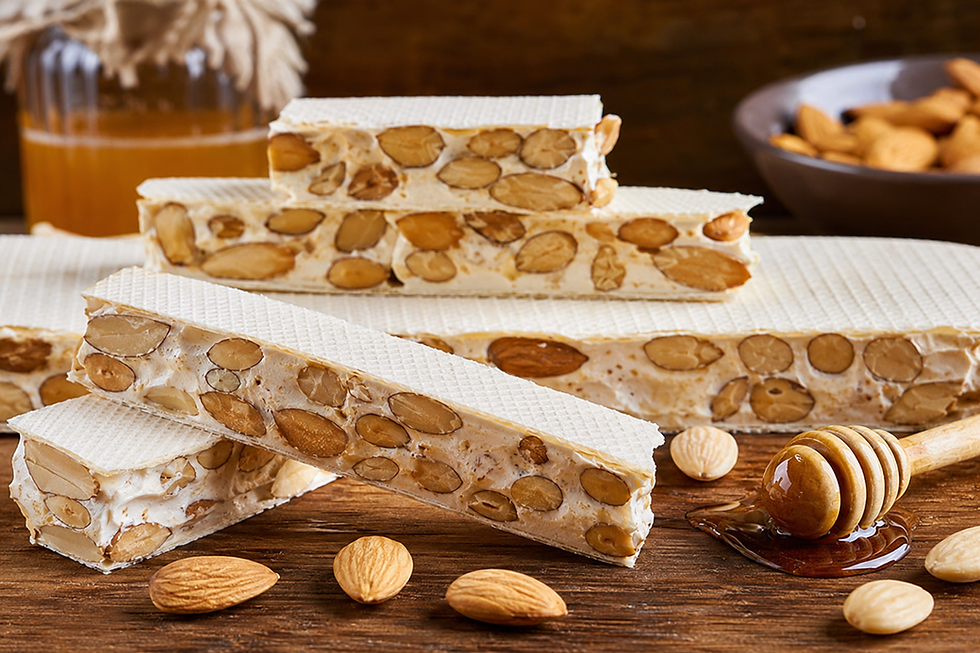
Torrone di Cremona is the hard nougat, the one that snaps rather than yields, and the one that measures a confectioner by a single decision: how much almond the slab can carry. Everything else in the recipe serves that ratio. Get it right and the bar cuts clean and breaks with a dry crack. Get it wrong in either direction and you have either gravel or candy.
Yield: about 2 1/2 lb (1.15 kg), roughly 24 bars. Prep: 30 minutes. Cook: 1 hour 15 minutes. Rest: 12 hours. Total: about 14 hours. Difficulty: advanced. Course: dolce. Region: Lombardy, Cremona.
The Story
Cremona dates its nougat to a wedding. On 25 October 1441 Francesco Sforza married Bianca Maria Visconti in the city, and the banquet is said to have closed with a sweet of honey, egg white and almonds moulded into the shape of the Torrazzo, the enormous brick bell tower that still dominates the square. Whether the story is documentary fact or civic myth hardly matters any more. Cremona has repeated it for nearly six centuries, and the city organises a Festa del Torrone every November around it.
The sweet itself arrived in Italy long before that banquet, carried by Arab confectioners into Sicily and Spain, where the same three ingredients produce cubbaita and turron. What Cremona added was industry. The city sat on the Po with a bridge, a river port and the roads north from the ports of the south, which meant almonds from Puglia and Sicily, sugar from the Venetian trade, and honey from the plain and the foothills all met in one market town. Confectioners settled there because the raw material did. Sperlari opened in 1836 and Vergani later in the century, and both are still working.
Cremona torrone is the hard school. Sienese panforte is a different sweet altogether, Benevento makes a softer torrone, Abruzzo works in chocolate, and Sardinia leans on its own honeys. Cremona keeps the mass lean, drives the water out, and loads it heavily with whole toasted almonds so the bar finishes brittle and pale. The wafer sheets that face it top and bottom are a Cremonese habit as much as a practical one. Bought by weight at Christmas, broken with the flat of a knife at the table, it is one of the few Italian sweets that is still eaten more or less exactly as it was.
Ingredients
For the almonds
Whole blanched almonds, 1 lb 5 oz (600 g)
Whole blanched hazelnuts, optional, 3 1/2 oz (100 g), in place of the same weight of almonds
For the nougat mass
Mild acacia or wildflower honey, 9 oz (250 g)
Granulated sugar, 9 oz (250 g)
Glucose syrup, 1 3/4 oz (50 g)
Water, 3 tbsp (45 ml)
Egg whites, 2 large, 2 1/2 oz (70 g), at room temperature
Fine sea salt, 1 small pinch
Vanilla bean, split and scraped, 1
Finely grated zest of 1 unwaxed lemon
For finishing
Edible wafer sheets, ostie, 2 large, cut to the frame
Neutral oil, for the frame and the knife
Preparation
Step 1
Set up the frame and the wafers. Line a shallow tray with a square metal frame or four wooden battens about 3/4 in (2 cm) high, enclosing roughly 8 by 10 in (20 by 25 cm). Brush the inner faces with a film of neutral oil, lay one wafer sheet on the base and cut a second to size for the top. Have both ready before you start cooking.
Step 2
Toast the almonds and keep them hot. Spread the almonds on a tray and toast at 325F (165C) for 12 to 15 minutes, until they smell sweet and the cut face of a split one is pale gold through to the centre. Then drop the oven to 200F (95C) and leave them inside. They must go into the mass hot, and the whole plan depends on you not forgetting them.
Step 3
Warm the honey. Put the honey in a heavy saucepan with the scraped vanilla bean and bring it to a steady bubble over medium low heat, stirring with a spatula. It foams, then the foam becomes finer and paler as water leaves. You want it thick, fragrant and reduced, which takes around 25 minutes over gentle heat. Lift out the bean.
Step 4
Whip the whites. When the honey is close, whip the egg whites with the pinch of salt to firm peaks in a stand mixer. They need to be ready and waiting, not started late, because they lose volume standing much more slowly than hot sugar waits.
Step 5
Cook the syrup. In a second pan combine the sugar, glucose and water and cook without stirring to 300F (150C) on a digital thermometer. Brush the inner walls down once with a wet brush at the start to stop crystals forming.
Step 6
Build the mass. With the mixer on medium, pour the hot honey down the side of the bowl in a thin steady thread, then the syrup the same way. Keep the stream clear of the whisk or it throws hot sugar up the sides. The mixture will slacken, then tighten and pale as it takes the air.
Step 7
Dry the mass over heat. Transfer the bowl to a wide pan of barely simmering water, or use a mixer bowl you can sit over it, and keep beating on low for 20 to 30 minutes. This is the stage that turns a pale foam into torrone. It is ready when a spoonful dropped on marble cools to something you can snap between your fingers rather than bend. Add the lemon zest at the very end.
Step 8
Fold in the almonds. Take the almonds straight from the oven and tip them in all at once, off the heat, and fold with a strong spatula in wide turns until every nut is coated and no dry pockets remain. Work fast and firmly. Do not stir gently and do not stop halfway to look at it.
Step 9
Press and rest. Scrape the mass into the frame, level it roughly, lay the second wafer on top and press it down hard and evenly with an oiled board until the slab is uniform and the wafer is bonded. Leave it at cool room temperature, uncovered, for 12 hours.
Step 10
Cut the bars. Lift the slab out, set it wafer side down on a board and cut with a heavy knife, wiped and lightly oiled, using one decisive push per cut rather than sawing. Cut bars about 1 1/4 in (3 cm) wide.
Plating
Torrone is served at cool room temperature, never chilled and never warm. A bar out of the refrigerator is harder than it should be and tastes of nothing until it warms in the mouth; a bar left near a stove goes slack and smears the knife. Around 64F (18C) is where the snap and the honey aroma both arrive at once.
Present it as a short stack of bars on a wooden board or a marble slab, with one bar broken across so the cut face shows the almonds packed edge to edge. That cross section is the whole argument of the recipe and it deserves to be visible. Add nothing to the board except perhaps a small knife. No sauce, no dusting, no fruit.
At the end of a meal it goes with coffee and a glass of something sweet. At Christmas in Cremona it sits out all afternoon alongside dried fruit for people to break pieces off as they pass.
Professional Technique
Think of the finished slab as a composite material rather than a sweet. The cooked mass of egg white and sugar is the binder, and the almond is the load it carries. Every almond has to be wrapped in a film of that binder, and each almond also has to be glued to its neighbours through whatever binder is left over between them. Both jobs draw on the same limited supply.
Push the almond fraction past roughly sixty percent of the finished weight and the supply runs out. There is still enough binder to coat the nuts individually, but not enough left in the gaps between them to hold the block together, so the slab has no continuous path through it. It looks perfect in the frame and then disintegrates under the knife, shedding whole almonds and dust. No extra drying, pressing or resting recovers it: the failure is structural, not a matter of set.
Go below about forty percent and the opposite happens. The binder becomes the majority phase and the almonds are scattered raisins in it, so what the teeth meet is a thick sweet chew with no resistance and no fracture. It tastes of sugar rather than of almond. The window in between is where Cremona works. The quantities here put 600 g of almonds into a mass that finishes near 1150 g once the water has gone, about fifty two percent, with room on both sides for the scale error of a home kitchen.
The other half of the technique is thermal. Cold almonds act as a heat sink, several hundred grams of dense material pulling the binder temperature down within seconds. The mass stiffens on contact, stops flowing around the nuts, and traps air pockets that become the fracture lines the slab later splits along. Almonds taken straight from a low oven at around 200F (95C) keep the binder fluid long enough to be folded properly and to reach every surface, which is what a composite with this much load needs.
Texture and Moisture Control
The drying stage over simmering water is where the texture is fixed. What leaves the bowl in those twenty to thirty minutes is water, and what stays is a sugar phase concentrated enough to be brittle at room temperature. Test it by dropping a small spoonful on cold marble and letting it cool for a minute: it should break cleanly between finger and thumb. If it bends, the mass needs longer, and stopping early is the most common reason a home made slab never sets properly.
Pressing controls the other half. The fold leaves air between the almonds, and air is empty space that the binder should be occupying. Pressing the slab hard with an oiled board collapses those voids, brings nut and binder into contact and raises the density of the block, which is what gives the clean dry snap instead of a crumbly one. Press evenly across the whole surface rather than heavily in the middle, and press once, firmly, while the mass is still warm.
The twelve hour rest is not idle time. The slab cools slowly and the sugar phase finishes hardening throughout its depth, not just at the surfaces. Cut it after an hour and the interior is still plastic and drags on the blade. Cut it cold from the refrigerator and it shatters. Twelve hours at room temperature gives a slab which cuts rather than breaks.
Professional Mise en Place
There is a window of about ninety seconds between a finished mass and a mass that no longer folds, so nothing can be improvised after the syrup goes in. Everything below is in place before the honey goes on the heat.
Equipment and tools
Stand mixer with a whisk, and a bowl that can sit over a pan of simmering water
Two heavy saucepans, one for the honey and one for the syrup
Digital probe thermometer, checked in boiling water before you start
Square frame or four wooden battens, a lined tray and a flat board for pressing
Stiff silicone spatula, heavy chef knife, cold marble or steel slab for testing
Prepared ahead
Frame oiled, tray lined and both wafer sheets cut to size
Almonds toasted and holding in the oven at 200F (95C)
Sugar, glucose and water weighed into the second pan
Egg whites weighed and at room temperature, lemon zested, vanilla split
Service setup
Slab cut into bars and held in a single layer between sheets of parchment
Board, small knife and one bar broken to show the cut face
Bars brought to around 64F (18C) at least an hour before serving
Chef Tips
Weigh the almonds after any sorting and discarding, not before. Broken halves and shrivelled nuts should come out, and if you lose 50 g to them you have quietly moved the ratio without knowing it. Weigh what actually goes into the bowl.
Choose a mild honey. Acacia and wildflower both let the toasted almond lead, while chestnut and strawberry tree honey are strong enough to take the sweet over completely and taste bitter against the sugar. Save those for a torrone built deliberately around them.
Check the thermometer in boiling water before you start. A probe reading four degrees low will have you cook the syrup past where you want it, and the whole decision about when to stop rests on that one number being true.
Cut the bars in the direction the almonds lie. Fold and press leave most nuts loosely aligned with the long axis of the slab, and a blade travelling along that axis passes between them, while a blade crossing it has to cut through whole almonds and tears the surrounding binder. Look at the slab, find the grain, and cut with it.
Common Mistakes
Adding more almonds than the mass can bind. It feels generous and it destroys the slab: past about sixty percent of the finished weight there is no binder left between the nuts and the block falls apart at the first cut. Respect the weights, and if you want more almond flavour, toast the same quantity darker.
Folding in cold almonds. Several hundred grams of cold nuts chill the binder on contact, the mass seizes before it is evenly distributed, and the dry pockets left behind become the cracks the finished slab splits along. Keep them in a low oven and add them hot.
Stopping the drying stage early. A mass that still bends when a test spoonful is cooled on marble will never harden in the frame, whatever the recipe timing says. Keep beating over the water and test again in five minutes.
Sawing the slab instead of cutting it. Back and forth movement drags whole almonds out of the binder and leaves a ragged crumbling edge. One decisive push with a heavy wiped blade, ideally along the direction the almonds lie, gives a clean face.
Wine Pairing
Moscato di Scanzo DOCG: The Lombard answer, from a few hectares of hillside near Bergamo, and the most interesting bottle on the list. Dried on racks and aged, it is a sweet red with real tannin, and that tannin is the point: it grips the fat of six hundred grams of almond in a way no white can, while its rose and dried cherry aromatics sit above the honey rather than competing with it.
Moscato d'Asti DOCG: The everyday pairing across northern Italy and the one most Cremonese tables actually pour. Low alcohol, gentle sparkle and grapey sweetness that stays lighter than the torrone, so it lifts rather than layers. The carbon dioxide scrubs the palate between bites of a dense brittle sweet, which is exactly what a bar this rich needs.
Vin Santo del Chianti Classico DOC: A nut against nut match, and the classic choice for hard Tuscan almond sweets. Oxidative ageing in small barrels gives dried apricot, walnut skin and a faintly bitter almond finish that runs directly alongside the toasted nuts. Its acidity and its higher alcohol cut the honey, and the dryness of the finish keeps the whole pairing from turning cloying.
Recioto di Soave DOCG: The elegant option when the torrone is served alone rather than after a heavy meal. Dried Garganega gives candied citrus, almond blossom and yellow fruit with a firm acid spine, and that acidity is the tool here: it resets the palate after the sugar without adding weight, and the wine finishes long and clean where a richer sweet wine would sit on top.
Storage & Reheating
Torrone keeps better than almost anything else in the pastry repertoire, and it keeps best whole. Wrap the uncut slab tightly in parchment and then in foil and store it in a sealed tin at cool room temperature, where it holds its snap for up to two months. Cut bars have far more exposed surface and are best eaten within three weeks, wrapped individually or laid in a single layer between sheets of parchment in an airtight tin.
Do not refrigerate it. Cold makes it over hard to bite and dulls the honey aroma, and the swing back to room temperature leaves the surface tacky. Freezing is worse and gains nothing, since the shelf life at room temperature is already long. There is no reheating: a torrone that has gone soft has taken up moisture from the air and cannot be dried back, which is why the tin matters more than anything you can do afterwards.
Nutrition
Per bar, based on 24 bars from the full slab:
Calories: 205 kcal
Total Fat: 11 g
Saturated Fat: 0.9 g
Trans Fat: 0 g
Unsaturated Fat: 10 g
Cholesterol: 0 mg
Sodium: 10 mg
Total Carbohydrates: 23 g
Fiber: 1.6 g
Total Sugars: 21 g
Added Sugars: 20 g
Protein: 4 g
Lactose: 0 g
Principal micronutrients: vitamin E, magnesium, manganese, copper, riboflavin, phosphorus
These figures are estimates and vary with the size of the bar you cut.




Comments