
Italian Extra Soft Milk Cake with Pistachio Cream | Torta al Latte con Crema al Pistacchio

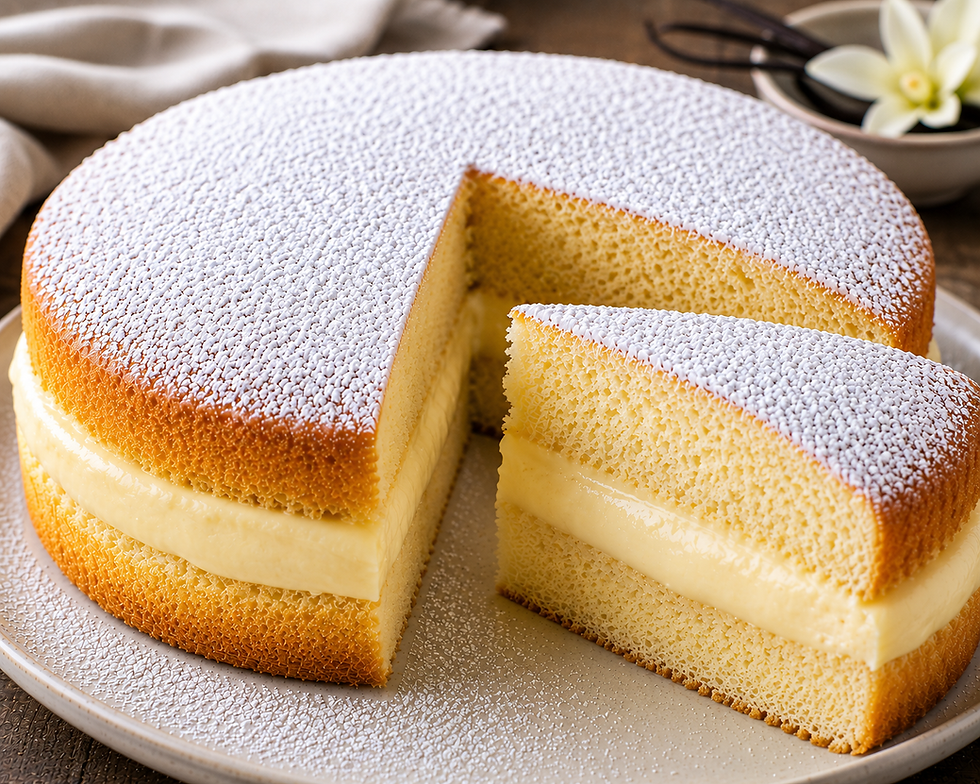
Torta al latte is the plainest cake in the Italian domestic repertoire and the pistachio cream is what turns it into something people ask about. The batter is built on whipped whole eggs, flour lightened with starch and hot milk stirred in at the very end, which is where the extreme softness comes from.
The decoration happens afterwards, on a completely cooled surface, and it is done with a piping bag rather than a spoon. That single choice is the difference between a clean cake and a torn one.
Yield: 10 slices, one 9 inch cake. Prep: 35 minutes. Bake: 35 minutes. Cooling: 2 hours. Total: about 3 hours 10 minutes. Difficulty: intermediate. Course: dolce. Region: Italian home baking with Sicilian pistachio.
The Story
Milk cakes belong to the Italian breakfast table rather than to the pastry shop. They come from the long tradition of torte da colazione, cakes mixed in a single bowl on a weekday morning with whatever the pantry held, and milk was the cheapest way to make a batter rich when butter was measured out by the ounce and eggs came in twos. No region owns torta al latte. It surfaces in Piedmont, the Veneto, Campania and Sicily under different names and proportions, always as the cake a family eats plain with coffee. Its only constant is that milk, not cream and not much butter, carries the fat.
The hot milk step is older than it looks and it is the reason this cake is soft rather than merely light. Eggs and sugar are whipped to the ribbon, the flour is folded in, and then milk heated to just below a simmer goes in with a little oil. Warm liquid keeps the batter fluid for the few seconds the folding takes, so the foam is not beaten flat while the cook fights a stiff mixture, and it wets the starch granules evenly before the pan goes in the oven. The result is a fine even crumb with no tunnels and no dense band at the base. Bakers in the English speaking world call the same method hot milk sponge.
The pistachio comes from the other end of the country. Pistacchio Verde di Bronte earned its DOP in 2009 and grows on the black lava rock of the western slopes of Etna, around Bronte, Adrano and Biancavilla, where the trees push their roots into fissures in the stone. Growers crop them in alternate years, stripping the flowers in the off season so the plant gives everything to the following autumn, so a real harvest arrives only every second year, picked by hand in late August. The kernel is long, narrow and deeply green, and Sicilians call it oro verde. The spreadable crema al pistacchio sold in jars all over the island is a modern product built on that nut, and it is what this cake borrows.
Ingredients
For the milk cake
Whole eggs, at room temperature, 4 large
Granulated sugar, 3/4 cup (150 g)
All purpose flour, 1 1/4 cups (155 g)
Potato starch, 1/3 cup (50 g)
Baking powder, 2 tsp (8 g)
Fine sea salt, 1/4 tsp (1.5 g)
Whole milk, 3/4 cup (180 ml)
Sunflower oil, 1/4 cup (60 ml)
Vanilla extract, 1 tsp (5 ml)
Finely grated lemon zest, from 1 lemon
For the pistachio cream
Shelled raw pistachios, Bronte if possible, 7 oz (200 g)
White chocolate, chopped, 3 1/2 oz (100 g)
Whole milk, 1/2 cup (120 ml)
Powdered sugar, 1/3 cup (40 g)
Sunflower oil, 2 tbsp (30 ml)
Fine sea salt, 1 small pinch
For finishing
Pistachios, coarsely chopped, 2 tbsp
Powdered sugar, for dusting
Preparation
Blanching and grinding the pistachios
Drop the shelled pistachios into boiling water for 60 seconds, drain and rub them between two kitchen towels while warm so the papery skins come away. Dry them on a tray in a 300°F (150°C) oven for 8 minutes without letting them colour. Grind them in a food processor in short pulses, scraping the bowl every 30 seconds, until you have a thick paste. Pulses matter: run the machine continuously and the paste climbs past 105°F (40°C), the oil breaks out and the texture turns greasy.
Building the pistachio cream
Warm the milk to about 150°F (65°C) and pour it over the chopped white chocolate, waiting a minute before stirring from the centre outwards until smooth. Add the pistachio paste, the powdered sugar, the oil and the salt, and blend until glossy and uniform. Do not whip it, because every bubble beaten in now becomes a void in the piped layer later. Press the cream through a fine mesh sieve, cover the surface directly with film and leave it at room temperature.
Whipping the eggs to the ribbon
Put the eggs and sugar in a stand mixer with the whisk and run it on medium high for 8 to 10 minutes. The mixture has to triple, turn almost white and fall from the lifted whisk in a thick unbroken ribbon that sits on the surface for three seconds. This foam is the only structure the cake has beyond the baking powder. Add the vanilla and the lemon zest in the last 30 seconds.
Folding in the dry ingredients
Sift the flour, the potato starch, the baking powder and the salt together twice. Add them to the foam in three additions, folding with a large spatula from the bottom of the bowl up over the top and turning the bowl a quarter turn between strokes. Stop the moment the last streak of flour disappears. The starch dilutes the gluten so the crumb stays tender, and every extra stroke works against it.
Adding the hot milk
Heat the milk with the oil until it steams and reads about 160°F (70°C), no hotter. Pour it down the side of the bowl in a thin stream while folding steadily. The batter will slacken visibly and this is correct: it should pour like heavy cream. Work quickly, no more than 20 seconds, then scrape it into a 9 inch round pan lined with parchment and tap the pan once on the counter.
Baking and cooling
Bake at 350°F (175°C) for 33 to 38 minutes on the middle shelf without opening the door for the first 25 minutes. The cake is done when the centre reads 205°F (96°C) and the surface springs back under a fingertip. Leave it in the pan for 10 minutes, then turn it onto a rack and let it cool completely, at least 2 hours. The top must be at room temperature and dry to the touch before any cream goes near it.
Piping the cream
Stir the cream smooth with a spatula, never a whisk, and check that it holds a soft shape. Fit a piping bag with the nozzle you have chosen, drop it into a tall glass and fold the top over the rim so you can fill it with both hands clean. Twist the top shut, then hold the bag upright and tap it firmly on the counter until no bubbles rise. Pipe onto the cooled cake, finish with the chopped pistachios and a dusting of powdered sugar.
Plating
Serve the cake whole on a flat white stand so the piped surface is read before anything is cut. A footed stand raises it to eye level and the relief of the rings or the rosettes is the whole point of the presentation.
Portion into ten wedges with a thin blade wiped clean between each one, and lift each wedge onto a room temperature plate rather than a chilled one. Set it with the point towards the diner so the layered edge faces up.
Nothing else is needed on the plate. A small spoonful of the reserved cream beside the wedge is the only addition worth making, and a few chopped pistachios scattered on the plate keep the green reading bright.
Professional Technique
The piping bag is not a flourish on this cake, it is the only tool that can put cream on it without damage. The crumb of a hot milk sponge is open, fragile and slightly tacky on top, and a spoon or a palette knife has to press down and drag sideways to move cream across it. That lifts the surface, tears the crust and pulls crumbs into the cream, and because the hand cannot hold a constant pressure over a wide arc the layer ends up thick in the middle of each stroke and almost bare where the stroke began and ended. A slice cut through that has a heavy sweet zone and then a gap of dry cake.
A bag solves it by never touching the surface. The nozzle sits a fraction above the cake, the cream is laid down under the pressure of the hand rather than pushed across the crumb, and the thickness is decided by how fast you move, not by how hard you press. Work from the outside in, either as concentric rings that meet without overlapping or as rosettes piped side by side around the rim and then inside it.
Two things make or break it. The cream has to be free of air, which is why it is stirred rather than whipped and why the filled bag is tapped upright until nothing rises: a bubble reaching the nozzle interrupts the flow and leaves a hole in the layer. And the nozzle diameter has to match the thickness you want, because the two are directly linked. A 1/4 inch plain round tip lays a thin restrained line. A 1/2 inch tip gives a layer around a third of an inch deep. A 5/8 inch star tip builds tall rosettes. Choose before you fill the bag, since there is no way back once the cream is in.
Texture and Moisture Control
Softness here is a matter of ratio and of mixing, not of fat. The liquid is high for the weight of flour, the potato starch replaces a quarter of that flour with something that has no gluten at all, and the fat is a neutral oil that stays liquid at room temperature instead of setting firm the way butter does. Those three choices give a crumb that yields under the side of a fork the day after baking. What undoes them is stirring: every stroke after the flour has disappeared develops gluten, and an overfolded batter bakes springy and slightly rubbery rather than tender.
The internal temperature is the honest test of doneness. At 205°F (96°C) the starch has gelatinised fully and the crumb holds together while still carrying most of its water. Two or three minutes further and the centre climbs past 210°F (99°C), water leaves as steam and the cake loses the quality it was built for. Trust a thermometer, not the colour of the top.
The cream needs its own consistency window. Correct means it falls from the spatula in a thick lazy ribbon and holds a soft peak for a second. Too stiff and it will not pass the nozzle cleanly. Too slack and the rings spread and lose definition. Adjust with milk a teaspoon at a time.
Professional Mise en Place
This cake has two independent preparations and an assembly that cannot start until the sponge is cold, so the order below keeps the day short.
Equipment and tools
Stand mixer with the whisk attachment, and a large flexible spatula
Food processor with a sharp blade, plus a fine mesh sieve
9 inch round pan, parchment, and a cooling rack
Piping bags and plain round and star nozzles in several diameters
Instant read thermometer, essential for both the milk and the crumb
Prepared ahead
Pistachio paste, up to 1 week ahead, refrigerated in a sealed jar
Pistachio cream, up to 3 days ahead, covered on the surface with film
The cake itself, baked the day before and kept wrapped at room temperature
Pistachios for the garnish, chopped and kept dry in a small bowl
Service setup
Cream brought back to room temperature and stirred smooth, never whipped
Nozzle chosen and the bag filled and tapped free of air just before piping
Cake fully cold, dry on top, sitting on the stand it will be served from
Thin knife and a cloth for wiping it between cuts
Chef Tips
Taste the pistachios raw before you commit them. Nuts that have sat warm in a shop for a year are already faintly rancid and no amount of sugar or chocolate hides it in a cream this pale. Buy from somewhere with turnover and use them the same week.
Sift the flour and the starch together twice rather than once. Potato starch clumps far more than flour does, and an unbroken lump will not disperse during a fold that has to be finished in thirty strokes.
Pipe one test rosette onto a cold plate before you touch the cake. It tells you in five seconds whether the cream is too stiff, too slack or holding, and the cake gives you no second chance.
Use a light coloured aluminium pan. Dark nonstick pans absorb more radiant heat and set the outside of a high liquid batter long before the centre, which leaves a pale sunken middle under a browned rim.
Common Mistakes
Stopping the egg whip too early. Five minutes gives a pale foam that looks ready and is not. It has to triple in volume and hold a ribbon for three seconds, otherwise the crumb comes out coarse and heavy at the base.
Adding the milk cold, or boiling. Cold milk stiffens the batter and forces extra folding that flattens the foam. Milk above 175°F (80°C) sets the egg protein on contact and leaves cooked specks. Aim for 160°F (70°C).
Grinding the pistachios without stopping. A processor run continuously drives the paste past 105°F (40°C), the oil separates and the cream is greasy rather than smooth. Pulse, scrape, and rest the machine.
Spreading the cream with a spoon or a palette knife. Pressing and dragging on an open crumb tears the surface and leaves a layer that is thick in some places and bare in others. A bag lays cream down without contact, at constant pressure.
Filling the piping bag and using it straight away. Air trapped during filling reaches the nozzle as a bubble, breaks the flow and leaves a hole in the layer. Tap the upright bag hard on the counter until nothing rises.
Wine Pairing
Moscato d'Asti DOCG: The lightest possible answer and often the right one. At around 5.5 percent alcohol with a soft frothy sparkle, it lifts the fat of the white chocolate and the ground nut off the palate instead of piling more weight onto it. The grape and orange blossom aromatics sit beside the lemon zest in the crumb, and the sweetness is moderate enough that the cake still tastes like the sweeter of the two.
Malvasia delle Lipari DOC: Sicilian like the pistachio, and the most interesting match here. The grapes dry partly on the vine and partly on mats, giving apricot, candied citrus peel and honey, but the islands leave a saline thread through the finish that keeps the pairing from turning cloying. That salinity is what stops a rich nut cream from tasting flat halfway down the glass.
Vin Santo del Chianti Classico DOC: Trebbiano and Malvasia dried on racks through the winter, then aged for years in small caratelli with a deliberately oxidative character. The result smells of almond, dried fig and caramel, and that nut note runs alongside the toasted pistachio rather than arguing with it. The acidity underneath is firm enough to cut the milk fat in the crumb.
Moscato di Noto DOC: From the limestone corner of southeastern Sicily, Moscato Bianco made lighter and more floral than the Aeolian wines. Orange blossom, white peach and a clean citrus finish, with moderate residual sugar that matches the cake instead of overtaking it. Serve it at 46°F (8°C) in a small glass: warmer, the alcohol shows and the pistachio loses definition.
Storage & Reheating
The undecorated cake keeps best. Wrapped closely in film at room temperature it stays soft for 3 days, and the oil in the batter is the reason: unlike a butter cake it does not firm up overnight. Do not refrigerate a bare sponge.
Once the cream is piped, keep the cake under a dome at cool room temperature and eat it the same day or the next. If the kitchen is warm, refrigerate it and take it out 40 minutes before serving.
The cake freezes well undecorated: wrap it in film and then foil and it holds for 2 months, thawing in its wrapping at room temperature in about 3 hours. The pistachio cream keeps refrigerated for 5 days in a sealed jar with film on the surface, and it does not freeze, since the cocoa butter in the white chocolate turns grainy on thawing. There is nothing to reheat.
Nutrition
Per slice, based on 10 slices:
Calories: 420 kcal
Total Fat: 24 g
Saturated Fat: 5 g
Trans Fat: 0 g
Unsaturated Fat: 18 g
Cholesterol: 78 mg
Sodium: 155 mg
Total Carbohydrates: 43 g
Fiber: 2 g
Total Sugars: 26 g
Added Sugars: 22 g
Protein: 9 g
Lactose: 2.2 g
Principal micronutrients: vitamin B6, vitamin E, thiamine, potassium, phosphorus, copper, manganese
These figures are estimates and shift with the size of the wedge and with how much cream is piped on.



Comments