
Italian Extra Soft Milk Cake with Mascarpone Cream | Torta al Latte con Crema al Mascarpone
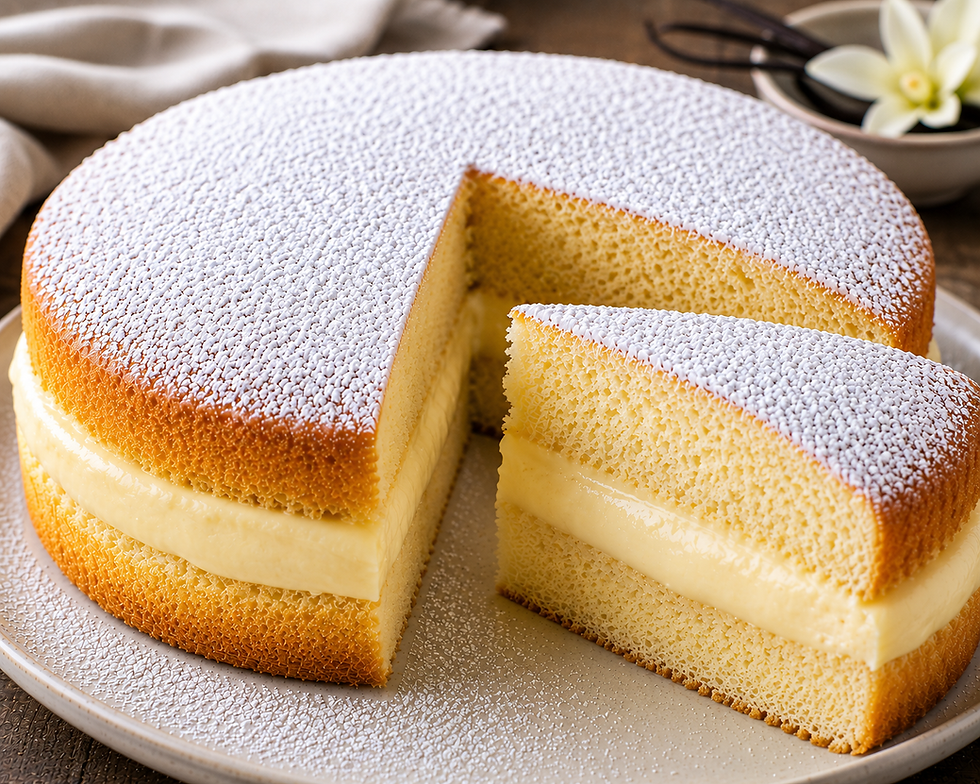
Torta al latte is the plainest cake in the Italian home repertoire and the one that punishes carelessness most. There is no butter in it. Milk carries the flavour, the moisture and most of the tenderness, and the crumb it gives is so soft that it behaves almost like a set custard. Filled with mascarpone cream it becomes a dessert, and the whole success of that filling comes down to one number nobody writes on the recipe: the temperature of the cake when the cream first touches it.
Yield: 8 servings, one 9 inch (23 cm) cake. Prep: 25 minutes. Bake: 35 minutes. Cooling: 2 hours 30 minutes. Chilling after filling: 1 hour. Total: about 4 hours 30 minutes. Difficulty: intermediate. Course: dolce. Region: Lombardy and the Po valley.
The Story
Torta al latte belongs to the part of Italian baking that never had a chef attached to it. It is a cake of the casa, written down in school notebooks and on the backs of envelopes, and its defining choice is economic rather than culinary: milk instead of butter. In the decades when butter was bought in small amounts for feast days, milk was the one fat bearing liquid that any household with a connection to the countryside had every single morning. A cake built on it cost almost nothing, and because milk is mostly water, it produced a crumb that stayed soft for days without any of the corrections a butter cake needs.
The dairy geography matters. The Po valley, and Lombardy in particular, is where Italian milk culture is densest: the plain between Lodi, Cremona and Pavia has supported herds and cheese making for centuries, and it is also the home of mascarpone, which was being produced around Lodi and Abbiategrasso long before it became the international face of tiramisu. Mascarpone is not a cheese in the way pecorino is a cheese. It is cream, heated, set with an acid, drained, and nothing else, which makes it the richest thing a dairy in that region could build out of what it already had standing in the pail.
Putting the two together was never a restaurant invention. A plain milk cake and a bowl of sweetened mascarpone were two things the same kitchen already owned, and splitting the cake to put one inside the other is the kind of step that happens without a recipe. What the pairing does is set a lean, milky, almost neutral crumb against a filling that is close to pure butterfat, and that contrast is the whole dessert. It also sets a trap, because the two halves want completely different temperatures, and generations of Italian home cooks learned by ruining a few cakes exactly what happens when that is ignored.
Ingredients
For the milk cake
Whole milk, 1 cup (240 ml)
Sunflower oil, 1/3 cup (80 ml)
Large eggs, at room temperature, 4
Granulated sugar, 1 cup (200 g)
All purpose flour, 1 3/4 cups (220 g)
Cornstarch, 1/4 cup (30 g)
Baking powder, 2 1/2 tsp (10 g)
Fine sea salt, 1/4 tsp (1.5 g)
Vanilla extract, 2 tsp (10 ml)
Finely grated lemon zest, from 1 lemon
For the mascarpone cream
Mascarpone, very cold, 1 lb (450 g)
Heavy cream, very cold, 3/4 cup (180 ml)
Powdered sugar, sifted, 2/3 cup (80 g)
Vanilla extract, 1 tsp (5 ml)
Fine sea salt, 1 small pinch
For the milk syrup
Whole milk, 1/2 cup (120 ml)
Granulated sugar, 2 tbsp (25 g)
Vanilla extract, 1/2 tsp (2.5 ml)
For finishing
Powdered sugar for dusting, 1 tbsp (8 g)
Softened butter and flour for the pan
Preparation
Preparing the pan and the oven
Heat the oven to 350°F (175°C) with a rack in the lower middle position. Butter a 9 inch (23 cm) round pan, line the base with parchment and dust the sides with flour. The pan needs to be at least 2 3/4 inches (7 cm) deep, since the cake climbs high before it settles.
Warming the milk with the oil
Warm the milk and the sunflower oil together in a small saucepan to about 130°F (55°C), hot to the finger and nowhere near a simmer. Warm liquid disperses into a whipped egg foam far more readily than cold, and it swells the starch slightly on contact, which is part of why this crumb finishes so tender. Add the vanilla off the heat and keep the pan warm.
Whipping the eggs and sugar to the ribbon
Whip the eggs, sugar and salt on high speed for 7 to 8 minutes, until the mass has tripled and falls from the beater in a ribbon that sits on the surface for two or three seconds before sinking. It is the only aeration beyond the baking powder, and undershooting it is why a torta al latte comes out dense. Beat in the lemon zest last.
Folding in the flour and the starch
Sift the flour, cornstarch and baking powder together twice, then fold them into the egg foam in three additions, cutting down through the centre and sweeping up the side with a large flexible spatula. Stop the instant no dry flour is visible. The cornstarch lowers the effective protein so the crumb stays short and silky, and overmixing undoes that in seconds.
Adding the warm milk without losing the air
Pour about a cup of the batter into the warm milk and oil and whisk it smooth to slacken it. Fold that loose mixture back into the bowl with the same light hand until the batter is uniform and pourable, like a thin pancake batter. It will look alarmingly fluid, and that is where the moisture in the finished cake comes from.
Baking and testing
Pour into the pan and bake for 33 to 38 minutes without opening the door for the first 25. The cake is ready when the top is evenly golden, the centre springs back under a light press and a skewer comes out with a few moist crumbs. Because the batter is so wet, a damp skewer is not a reliable fail: look for the spring.
Cooling the cake to the core
Rest the cake in its pan for 15 minutes, then turn it onto a rack and leave it until it is cold to the core, at least 2 hours and 30 minutes, better overnight in the refrigerator once the steam has gone. Test by cupping a hand under the centre of the base, not the top. If the underside of the middle is still faintly warm, it is not ready to be filled.
Whipping the mascarpone cream
Take the mascarpone and the cream straight from the refrigerator. Break the mascarpone down with a spatula until smooth, sift in the powdered sugar and work it in, then add the cold cream in three additions, whisking on medium speed only. Stop as soon as it holds a soft peak that stands without weeping, then add the vanilla and the salt, and refrigerate until you need it.
Splitting, brushing and filling
Warm the milk, sugar and vanilla for the syrup until the sugar dissolves and let it go completely cold. Split the cold cake into two even layers with a long serrated knife, brush each cut face with half the syrup, and spread all but a third of the cream on the lower layer, stopping half an inch (1 cm) from the edge. Set the top layer on, press once, and refrigerate for 1 hour before dusting.
Plating
Serve this cake cold, straight from the refrigerator, on plates that have not been warmed. Dust the top with powdered sugar through a fine sieve immediately before it goes to the table, never earlier: the sugar dissolves into the damp surface of a milk cake within about twenty minutes and leaves a translucent film instead of a matt white finish.
Cut with a thin blade wiped clean between slices, and use the reserved third of the cream as a spoonful beside each portion rather than piling it on top. Eight slices from a 9 inch (23 cm) cake is the right size: the filling is close to pure butterfat and a wider wedge stops being a pleasure halfway through. Raspberries or a few strips of candied lemon peel are the only additions worth making.
Professional Technique
The one thing that decides whether this dessert works is the temperature of the cake when it is filled, and almost every written version of the recipe leaves it out. Mascarpone is around 75 percent butterfat, and milk fat has no single melting point: it softens across a range, and the first crystal fractions give way at roughly 77°F (25°C). Cream spread onto a surface even slightly above that loses its structure at the contact face immediately. Ten minutes later it is not a filling but a liquid layer, running out towards the rim under the weight of the top.
What makes a torta al latte dangerous here is how much water it holds. A crumb this wet has a high heat capacity and conducts badly, so the centre stays warm long after the top and the sides feel cool. A cake that reads as ready to the palm on its upper crust can still be at 95°F (35°C) in the middle of its base an hour out of the oven. That is why the reliable test is the underside of the centre: cup a hand beneath the middle of the base, or lift the cake and touch the spot where the parchment was.
The refrigerator after filling has a different job, and confusing the two is what ruins cakes. It is there to firm a cream that is already cold into a sliceable layer, not to cool a cake that was too warm to start with. Fat that has once softened and run does not reassemble when it is chilled again: it sets where gravity left it, thick at the rim and nearly absent in the middle. Chilling a badly filled cake locks the fault in.
Texture and Moisture Control
The crumb of this cake owes its softness to three things working at once: the very high proportion of liquid to flour, the cornstarch that dilutes the gluten forming protein, and the fact that the fat is a liquid oil rather than a solid. Oil stays soft at refrigerator temperature, so the cake does not turn firm and waxy when it is chilled the way a butter cake does, and that is precisely why a milk cake can be served cold at all. The cost is fragility. The layers will not survive being lifted flat, so slide a cake board or the pan base underneath each one.
On the cream side, consistency is governed by how much it is beaten and how cold it stays. Mascarpone whipped past a soft peak turns granular and then weeps, because its fat globules cluster and squeeze out the water phase, and no amount of further whisking brings it back. Take it to the point where it holds a peak with a rounded tip and stop there. Keep it under 45°F (7°C) from the bowl to the cake and back into the refrigerator, and it will slice cleanly instead of bulging out under the blade.
Professional Mise en Place
This is a dessert made across two sessions. Bake the cake the day before, chill the filling components hard, and leave nothing but splitting, brushing and filling for the day of service.
Equipment and tools
Stand mixer or a powerful hand mixer, large flexible spatula
9 inch (23 cm) cake pan, 2 3/4 inches (7 cm) deep, plus a cake board
Long serrated knife, pastry brush, fine sieve
Instant read thermometer
Prepared ahead
Cake baked and cooled to the core, up to 1 day ahead, wrapped and refrigerated
Milk syrup made and fully cold, up to 3 days ahead
Mascarpone and cream weighed out and kept at the back of the refrigerator
Flour, cornstarch and baking powder sifted together twice, on the day of baking
Service setup
Cream whipped no more than 2 hours before filling and held covered and cold
Cake split and both faces brushed with syrup before any cream is spread
Filled cake chilled a full hour, dusted only at the moment of service
Plates at room temperature, blade and a clean cloth beside the cake
Chef Tips
Buy the mascarpone as close to the day as you can and check the date. Mascarpone near the end of its life tastes faintly sour and whips loose, and the sweetened cream is where that shows. Anything with gums or stabilisers in the list is not worth using.
Weigh the flour rather than scooping it. This batter is deliberately fluid, and an extra ounce of flour, which a packed cup hides easily, turns a custard soft crumb into an ordinary sponge.
Split the cake thoroughly cold, and score a shallow mark down the side first so the layers go back in the same alignment. A cold crumb cuts cleanly with a serrated blade; the same cake at room temperature drags and tears across the centre.
If the kitchen is hot, give the filled cake fifteen minutes in the freezer and then forty five in the refrigerator. It sets the cream at the contact face quickly and costs nothing in texture.
Common Mistakes
Filling a cake that is only cool on the outside. The failure that defines this dish. Judge by cupping the centre of the base, not the top, and wait the full two and a half hours or chill overnight.
Underwhipping the eggs and sugar. Anything less than a ribbon that holds on the surface for two or three seconds leaves the batter short of air, and the baking powder alone cannot carry a mix this wet.
Adding the warm milk straight to the whipped foam. Poured in all at once it collapses the air and you get a flat, rubbery layer. Slacken a cup of batter with the milk first.
Whipping the mascarpone cream to a stiff peak. Past a soft peak it goes granular and begins to weep, and the filling slides rather than slices. Stop while the peak still rounds at the tip.
Dusting with powdered sugar in advance. The damp surface of a milk cake dissolves it within twenty minutes and leaves a wet grey film. Sift it over as the cake leaves the kitchen.
Wine Pairing
Moscato d'Asti DOCG: The most natural match here and the one poured with this kind of cake across northern Italy. Its low alcohol and gentle sparkle scrub the butterfat off the palate between mouthfuls, while the grapey orange blossom aromatics land on the lemon zest in the crumb. Sweet enough to sit level with the filling, light enough never to weigh on it.
Recioto di Soave DOCG: A dried grape white from Veneto with far more structure, and the choice when the cake is generously filled. Garganega concentrated on the mat keeps a firm acid spine under its honey and candied apricot, and that acidity is what cuts a cream this rich. Serve it at around 50°F (10°C): warmer, its sweetness competes with the cake instead of framing it.
Malvasia delle Lipari DOC: From the Aeolian islands, and the most aromatic option here. Dried apricot, citrus peel and a faint saline edge on the finish, with moderate sweetness and a lifted, almost floral perfume that plays against the milky neutrality of the crumb rather than doubling it. The salinity is the detail that matters: it keeps a plain butterfat filling from turning monotonous.
Vin Santo del Chianti Classico DOC: The oxidative choice, for anyone who wants the pairing to add flavour rather than refresh. Years in small casks build almond, dried fig and walnut notes that read as a separate course alongside the mascarpone, and the high acidity under all that sugar handles the fat easily. Pick a younger, less syrupy bottling, since the oldest examples will simply overwhelm a cake this quiet.
Storage & Reheating
The filled cake keeps refrigerated under a dome or loosely covered for 2 days, and is better on the second day once the syrup has settled through the crumb. Do not wrap film tightly against the cut faces, which pulls the surface of the cream away. Take each portion out about ten minutes before eating, and no longer.
The unfilled cake freezes well. Wrap each cooled layer separately and freeze for up to 1 month, then thaw overnight in the refrigerator still wrapped, so the condensation forms on the wrapping rather than on the crumb. Never freeze the assembled cake or the whipped mascarpone alone: the emulsion breaks on thawing and releases water that no stirring will take back in. There is nothing to reheat here, and warming the cake is the one thing that spoils it.
Nutrition
Per serving, based on 8 slices from one 9 inch (23 cm) cake:
Calories: 585 kcal
Total Fat: 36 g
Saturated Fat: 19 g
Trans Fat: 0.5 g
Unsaturated Fat: 15 g
Cholesterol: 175 mg
Sodium: 240 mg
Total Carbohydrates: 55 g
Fiber: 1 g
Total Sugars: 36 g
Added Sugars: 32 g
Protein: 9 g
Lactose: 4 g
Principal micronutrients: calcium, vitamin A, vitamin B12, riboflavin, phosphorus, selenium
These figures are estimates and move with the brand of mascarpone, whose fat runs from about 40 to 50 percent.


Comments