
Italian Sardinian Sheep Broth | Brodo di Pecora Sardo
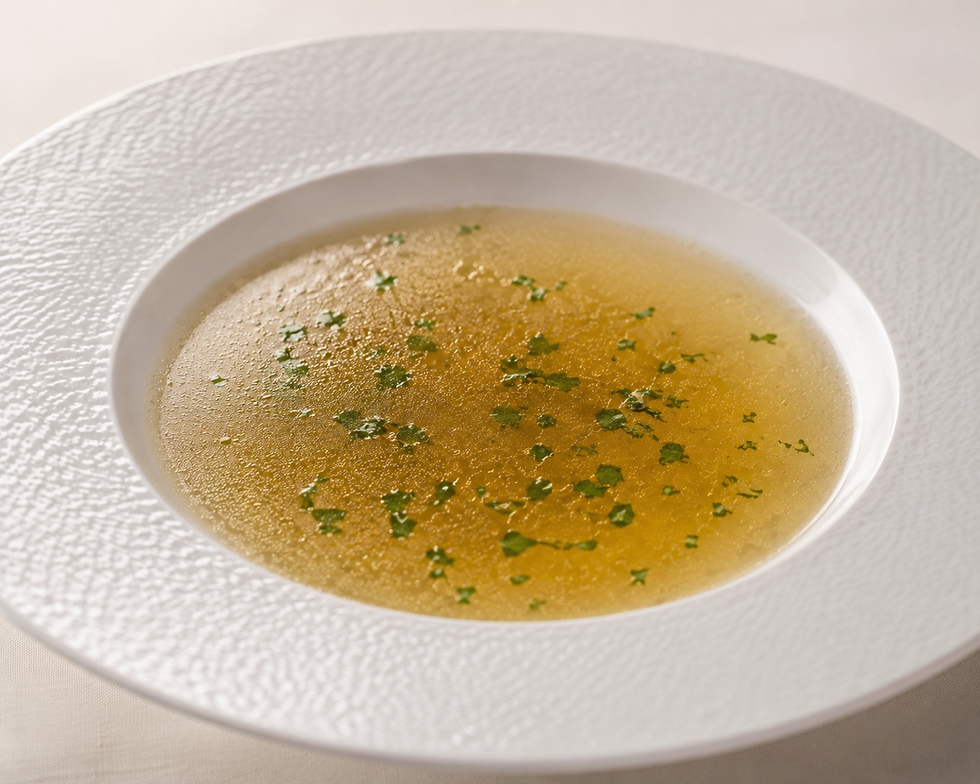
Brodo di Pecora is the broth a Sardinian shepherd makes from an animal that has finished working. Old ewe is tough, deeply flavoured and far too strong for a quick stock, so the island does the only thing that suits it: a long, barely moving simmer that pulls everything out of the meat and the bones. This is the broth itself, not a dish built on top of it.
Everything rests on technique rather than ingredients. What decides the result is the cold water start, the skimming in the first forty minutes, a temperature that never rises above a lazy blip, and the strain at the end. Get those right and the broth is clear, golden and clean tasting. Get them wrong and you have a cloudy grey liquid that smells of wet wool, which is the reputation sheep broth unfairly carries.
It is served in Sardinia on its own, in a warm bowl, with the meat pulled from the bones, and often nothing else. It is also the mother liquid for pane frattau, for su filindeu and for the winter soups of the Barbagia.
Yield: about 3 quarts (2.8 litres) of broth, 6 to 8 servings. Prep: 30 minutes. Cook: 4 hours. Rest and strain: 1 hour. Total: about 5 hours 30 minutes. Difficulty: intermediate. Course: primo piatto. Region: Sardinia, the Barbagia.
The Story
Sardinia has more sheep than people and has had for as long as anyone has counted, and the culture of the interior is built around them. The animal gives milk first, and that milk becomes pecorino sardo and fiore sardo, which is where the money is. The meat comes at the end of the working life, when a ewe stops producing, and it arrives tough, dark and unmistakably strong. Nothing about it suits a fast method, which is why the broth exists.
In the shepherding villages of the Barbagia, around Orgosolo, Fonni and Mamoiada, the pot went on in the morning over embers and was left alone. Wood fires hold a low steady heat and are bad at boiling hard, which is exactly the temperature a sheep broth wants, so the method was shaped by the fuel as much as by the cook. What came out at midday fed everyone: the broth first, poured over bread, the meat afterwards.
The version recorded here follows Alberto Piso, who cooked it the way it is cooked at home inland: shoulder rather than a fashionable cut, garden vegetables, dried tomato for depth and wild mint at the end. The mint is the Sardinian signature and not a modern flourish. Nepitella has been used with sheep meat on the island for centuries because it lifts the animal note without covering it, which parsley cannot do.
Ingredients
For the broth
Sheep or mutton shoulder, bone in, cut into large pieces, 3 1/4 lb (1.5 kg)
Sheep or mutton bones, marrow and neck, 1 1/4 lb (570 g)
Cold water, 5 quarts (4.7 litres), enough to cover by 2 inches (5 cm)
Coarse sea salt, 1 tbsp (18 g), added late
For the vegetables
Yellow onions, peeled and halved, 2 medium
Carrots, scrubbed and halved, 2 large
Celery stalks with leaves, 3
Potatoes, peeled and quartered, 2 medium, added late
Sun dried tomato, 2 pieces, or 1 tbsp (16 g) tomato paste
Garlic cloves, unpeeled, 2
For the aromatics
Fresh sage leaves, 6
Bay leaves, 2
Rosemary sprig, 1 small
Flat leaf parsley stems, 8
Black peppercorns, 10
For finishing
Wild mint or nepitella leaves, 2 tbsp (5 g)
Extra virgin olive oil, 1 tbsp (15 ml) per bowl
Fine sea salt, to taste
Freshly ground black pepper, to taste
Preparation
Step 1

Trim and rinse the meat. Cut the shoulder into pieces about 3 inches (8 cm) across, leaving the bone in, and trim the heavy outer fat but not all of it. Sheep fat carries both the flavour people object to and the flavour they love, so remove the thick slabs and leave what runs through the muscle. Rinse the meat and bones and drain. Do not brown anything: this is a white broth.
Step 2

Start in cold water. Put the meat and bones in a tall stockpot and cover with 5 quarts of cold water, standing about 2 inches above everything. Cold is not a detail: it lets the soluble proteins leach out slowly and rise as a single removable raft, while hot water seizes them into the liquid and clouds it permanently. Bring the pot up over medium low heat, taking 30 to 40 minutes.
Step 3

Skim, and keep skimming. As the water approaches a simmer a grey brown foam forms, and this is the moment that decides whether the broth is clear. Lift it off every few minutes, taking as little liquid as you can, and wipe the inside edge of the pot where the scum sticks. Expect 30 to 40 minutes of this. The foam turns paler and finer, and when it stops reforming the worst is behind you.
Step 4

Hold the temperature down. Once the scum stops, the surface should show one lazy bubble every second or two, around 185°F (85°C), never a rolling boil. A boil emulsifies the fat into the water and grinds the solids apart, and no straining fixes either. Leave the lid off or ajar, because a sealed pot pushes the liquid into a simmer without warning.
Step 5

Add the aromatics and vegetables. After the first hour, add the onions, carrots, celery, unpeeled garlic, sun dried tomato, sage, bay, rosemary, parsley stems and peppercorns. Adding them now matters: four hours turns vegetables to mush and dulls their sweetness, while three leaves them distinct. Push them under and let the pot settle back.
Step 6

Simmer and top up. Cook for another 3 hours, checking every 30 minutes that the temperature has not crept up and the meat is still covered. If the level drops, add hot water, never cold, which shocks the pot and drags out more scum. The broth is ready when the meat gives no resistance and slides off the bone.
Step 7

Add the potatoes and salt late. Put the quartered potatoes in for the last 30 minutes and salt the pot only now, about a tablespoon of coarse salt to start. Salt added early concentrates over four hours as the liquid reduces. The potatoes also give the broth a faint body without any thickening.
Step 8

Strain, rest and degrease. Lift out the meat and vegetables and set them aside covered. Ladle the broth through a fine mesh sieve lined with damp muslin, never pressing or tipping the last cloudy inch through. Let it stand 20 minutes, then lift the fat off, or refrigerate and take the set cap off the next day. Pull the meat from the bones in large pieces.
Plating
Serve in a warm deep bowl, and warm it properly, because a broth this lean loses heat faster than any sauce. Ladle about 1 1/2 cups (350 ml) into each bowl and set two or three pieces of meat in the centre, pulled along the grain, with a piece of potato and a length of carrot beside them.
Tear the wild mint over the surface at the last second, in the bowl. Cooked mint goes bitter within a minute, and the point of it is the lift of a raw leaf meeting hot liquid. A thread of olive oil, a grind of pepper, nothing else. No cheese, no crouton, no cream.
If the broth is to carry bread, put a sheet of stale pane carasau in the bottom of the bowl and pour over it, letting it soften for a minute. This is how it is eaten inland. Keep the bread underneath, never floating on top.
Professional Technique
The defining technique is the cold water start combined with disciplined early skimming, and the two are one method. Muscle proteins, chiefly albumin, dissolve into cold water and coagulate as the temperature climbs, rising to the surface where they can be lifted off in a single grey raft. Put the same meat into hot water and those proteins set instantly as microscopic particles that never rise and never settle. That is what cloudiness is, and no filter removes it.
The second technique is holding the pot below a simmer for the whole four hours. Collagen in an old animal converts to gelatin between roughly 160 and 190°F (70 and 88°C) on its own, given time. Higher heat does not speed it, it only agitates the pot: fat is beaten into droplets small enough to stay suspended and the meat fibres are shaken apart into the broth. A clear broth is a still broth.
The third is the handling of fat, which with sheep is not optional. Mutton fat is high in branched chain fatty acids, the compounds behind the strong smell that puts people off, and it also goes rancid faster than the broth. Removing it cold, as a set cap lifted off the next day, takes almost all of it away while leaving the flavour that dissolved into the water.
Texture and Moisture Control
A good sheep broth has body without thickness. That body is gelatin, from bones and connective tissue rather than reduction, so the test is not how concentrated it tastes but how it behaves cold. A proper broth sets to a soft jelly in the refrigerator and melts the moment it is warmed. If yours stays liquid when cold, the pot had too little bone or not enough time, and the answer is more neck and another hour, not a harder boil.
Clarity is the other texture, and it is decided in the first hour. Once the skimming is done, the enemy is movement. Keep the pot at one lazy bubble, never stir it and never push the meat around, since every disturbance lifts fine solids back into suspension. At the end, ladle the broth out rather than pouring the pot, and stop while an inch of cloudy liquid still sits over the sediment.
Temperature at the table matters more than usual. Serve at around 175°F (80°C) in a hot bowl. Below that, the fat left in it congeals on the surface and on the lips, which is the sensation people remember badly from sheep, and the aromatics fall silent. Hot bowls and a fast pass from stove to table are the whole trick.
Professional Mise en Place
This is a long unattended cook with two short windows of real work: the first hour of skimming and the strain at the end. Organise for those two windows.
Equipment and tools
Tall stockpot, at least 8 quarts (7.5 litres), narrow rather than wide
Fine skimmer or a shallow ladle, and a bowl for the scum
Probe thermometer, the only reliable way to hold the temperature
Fine mesh sieve and damp muslin, plus a spider for lifting the meat
Wide shallow containers for cooling the strained broth quickly
Prepared ahead
Meat cut, trimmed and rinsed the night before, kept cold
Vegetables washed and halved, held in water so they do not dry
Aromatics gathered and tied together for easy removal
Whole broth cooked, strained and refrigerated the day before, fat lifted cold
Meat pulled from the bones and stored in a little broth
Service setup
Broth held at 175°F (80°C), covered, never boiling
Meat warming separately in a ladle of broth, not in the main pot
Bowls hot, taken from the oven or a hot water bath
Wild mint picked but not torn until the bowl is in front of you
Olive oil and pepper mill on the pass
Chef Tips
Ask the butcher for an older animal and for bones. Shoulder from a mature ewe gives a broth with far more character than lamb, and neck and marrow bones are usually given away. A pot built only from lean meat tastes correct and feels thin, because gelatin comes from bone and connective tissue, not muscle.
Cook it the day before. The fat sets hard overnight and lifts off in one clean sheet, which no hot skimming matches, and the flavours settle and round out. Reheated carefully it tastes deeper and looks clearer than it did coming off the stove.
Use a thermometer rather than your eyes. The difference between 185°F and a genuine simmer is invisible from across the kitchen and decisive in the pot. Drop a probe in and check every half hour. This one habit separates a clear golden broth from a cloudy one.
If wild mint is unavailable, use a little spearmint with a leaf or two of fresh oregano, and less than you think. Nepitella is more aromatic and less sweet than garden mint, so a straight swap by volume makes the bowl taste sweet. Never use dried mint, which goes dusty in hot liquid.
Common Mistakes
Starting in hot water. This is the most common cause of a cloudy broth. Proteins that would have risen as a removable raft set instead into suspended particles, and no straining takes them out. Cover the meat with cold water and bring the pot up slowly.
Boiling instead of simmering. A rolling boil emulsifies the fat into the liquid and shakes the meat apart, giving a grey greasy broth. The surface should show one lazy bubble every second or two. If the pot runs away, move it off centre on the burner.
Skimming carelessly or not at all. The scum of the first 40 minutes is exactly what makes sheep broth taste of wet wool. Take it off patiently, wipe the inner rim of the pot where it clings, and never stir it back in.
Salting at the start. The pot loses a quarter of its volume over four hours, so salt added early ends up far too concentrated. Season in the last half hour and taste, remembering the broth is served on its own where any error is obvious.
Leaving the fat in. Mutton fat carries the compounds behind the strong smell and turns rancid faster than the broth. Chill the strained broth and lift the set cap off cold. Skimming hot fat removes perhaps half of it.
Cooking the mint. Mint boiled in the pot turns bitter and grassy within a minute. Tear it raw over the bowl at the table and keep the stems out of the broth.
Wine Pairing
Cannonau di Sardegna DOC: The island red that grew up beside this pot, and the pairing every shepherd would make without thinking. Its warm red fruit, dried herb note and soft ripe tannin meet the animal depth of sheep without the grip that would dry the palate against a lean broth. Choose a young unoaked bottling and serve it at around 60°F (16°C).
Campidano di Terralba DOC: Made from Bovale on the plains south of Oristano, the lightest genuinely Sardinian red here. Bright acidity, modest alcohol and very little tannin are what a clear broth wants: something that refreshes between spoonfuls rather than coating the mouth. This is the bottle for the broth served alone.
Etna Rosso DOC: Nerello Mascalese from volcanic slopes, pale and savoury rather than fruity, with a fine mineral acidity that cuts the fat still dissolved in the broth. Its faint smoky, iron tinged character runs alongside the mutton instead of arguing with it. Serve it slightly cool.
Aglianico del Vulture Superiore DOCG: The choice when the meat is the point rather than the liquid. Grown on volcanic soil in Basilicata, it is firm, dark and high in acidity, with tannin structured enough to carve through the gelatin and fat of slow cooked shoulder. Keep it for the pulled meat rather than the first bowl of broth.
Montepulciano d'Abruzzo DOC: A mainland everyday bottle that suits boiled meats better than its price suggests. Soft, generous and low in aggressive tannin, with dark plum fruit and a gentle herbal edge, it takes the saltiness of a well seasoned broth without turning bitter.
Storage & Reheating
Cool the strained broth fast, because a warm stockpot on the counter is the classic route to spoilage. Divide it between wide shallow containers so it drops below 40°F (4°C) within two hours, then cover and refrigerate. With its fat cap intact it holds 4 to 5 days. Once the cap is off, use it within 3.
It freezes extremely well and loses nothing, which is why it is worth making the full pot. Freeze it degreased in 2 cup (475 ml) portions, leaving headroom, and it keeps 4 months without loss of gelatin or flavour. An ice cube tray gives concentrated cubes for risotti. The cooked meat freezes separately for 2 months, submerged in a little broth.
Reheat the broth gently to 175°F (80°C) and stop there. Boiling it again drives off the aromatics, turns the bay and rosemary bitter and clouds the liquid you worked to clarify. Warm the meat separately in a ladleful of broth, never in the main pot, and add the mint only once the bowl is filled.
Nutrition
Per serving, based on 6 servings of degreased broth with a portion of the meat:
Calories: 310 kcal
Total Fat: 15 g
Saturated Fat: 6 g
Trans Fat: 0 g
Unsaturated Fat: 8.5 g
Cholesterol: 95 mg
Sodium: 640 mg
Total Carbohydrates: 9 g
Fiber: 1.5 g
Total Sugars: 3 g
Added Sugars: 0 g
Protein: 32 g
Lactose: 0 g
Principal micronutrients: iron, zinc, vitamin B12, niacin, selenium, phosphorus, collagen derived amino acids
These figures are estimates. Fat is by far the most variable number, since it depends on how thoroughly the broth was degreased.


Comments