
Sheep Ricotta and Saffron Ravioli with Butter and Sage | Ravioli di Ricotta di Pecora e Zafferano al Burro e Salvia

These are the ravioli of the Sardinian sheep country finished with the quietest sauce in the Italian repertoire. The filling is sheep milk ricotta, faintly sweet and grassy from the morning whey, loosened with egg yolk and pecorino and turned deep gold by saffron. The sauce is butter taken to the nut stage with sage dropped in at the end, thinned with a ladle of pasta water. No tomato, no cream, no stock.
The plate works because two Italian traditions meet on it. The filling is southern and pastoral, built on the dairy of a shepherding island and on saffron grown on the Campidano plain since the Middle Ages. The finish is northern, a burro e salvia lifted from Lombardy. Saffron and browned butter share the same warm toasted register, which is why the join is seamless rather than forced.
There is very little margin here. Sheep ricotta carries more water than the cow milk kind and wrecks a raviolo if it goes in wet. Saffron bleached in boiling liquid gives colour and no perfume. Butter taken thirty seconds too far turns bitter. Get those three things right and the rest is careful hands.
Yield: 4 servings, about 12 ravioli each. Prep: 1 hour. Rest: 45 minutes. Cook: 15 minutes. Total: about 2 hours. Difficulty: intermediate to advanced. Course: primo piatto. Region: Sardinia, the Campidano plain and the shepherding interior.
The Story
Saffron in Sardinia is not a flourish borrowed from Milan. It has been cultivated on the island since at least the fourteenth century, concentrated in a narrow band of the Campidano around San Gavino Monreale, Turri and Villanovafranca, where the autumn crocus is still picked by hand at dawn and stripped of its three red stigmas the same morning. Sardinian saffron carries protected status and a reputation for unusually high safranal content, which is why islanders use it with a confidence that looks careless elsewhere.
The ricotta is the other half of the island. Sardinia holds a large share of all the sheep in Italy, and the whey left from pecorino production has always been recooked into ricotta di pecora the same day. That ricotta is richer and more perfumed than the cow milk product, and it spoils fast, which is why every Sardinian filled pasta from the culurgiones of the Ogliastra to the seadas of the Barbagia was built around using it at once.
Ravioli travelled in from the mainland, and Sardinian cooks took the shape and filled it with what the island had. The butter and sage finish arrived later, through restaurant kitchens rather than farmhouses, since the traditional dressing here was tomato and mutton or simply more pecorino. It has earned its place: butter treats saffron better than tomato ever did.
Ingredients
For the pasta
Italian 00 flour, 1 3/4 cups (220 g)
Durum wheat semola rimacinata, 1/2 cup (80 g)
Whole eggs, large, 2
Egg yolks, large, 2
Extra virgin olive oil, 1 tsp (5 ml)
Fine sea salt, 1/2 tsp (3 g)
Water, only if needed, 1 to 2 tsp (5 to 10 ml)
For the filling
Sheep milk ricotta, drained, 14 oz (400 g) before draining
Saffron threads, 1/4 tsp lightly packed (0.2 g)
Whole milk, warm, 2 tbsp (30 ml)
Pecorino Sardo maturo, finely grated, 1/2 cup (45 g)
Egg yolk, large, 1
Freshly grated nutmeg, 1 small pinch
Finely grated lemon zest, from 1/4 lemon
Fine sea salt, 1/2 tsp (3 g)
Freshly ground white pepper, to taste
For the butter and sage
Unsalted butter, cold, cubed, 5 oz (140 g)
Fresh sage leaves, medium, 16
Reserved pasta cooking water, about 1/2 cup (120 ml)
Saffron threads, 1 small pinch, for the sauce
For finishing
Parmigiano Reggiano or Pecorino Sardo, grated, 1/3 cup (30 g)
Coarse sea salt for the pasta water, 1 1/2 tbsp (25 g) per 4 quarts (4 l)
Freshly ground black pepper, to taste
Preparation
Step 1

Drain the ricotta and bloom the saffron. Set the sheep ricotta in a fine mesh sieve lined with cheesecloth over a bowl, cover it and refrigerate at least 4 hours, ideally overnight. Sheep ricotta releases a surprising amount of whey, and that whey is the commonest cause of a burst raviolo. Meanwhile crush the saffron threads between your fingers into the warm milk, not hot milk, and infuse 20 minutes until the liquid is a strong orange.
Step 2
Make the pasta dough. Mound the 00 flour and the semola together, make a well and add the whole eggs, the yolks, the olive oil and the salt. Break the eggs up with a fork, pulling flour in from the walls until a shaggy mass forms, then knead with the heel of your hand for a full 10 minutes. The dough should finish smooth, elastic and distinctly firm, firmer than a bread dough. Add water a teaspoon at a time only if it refuses to come together. Wrap tightly and rest 45 minutes.
Step 3

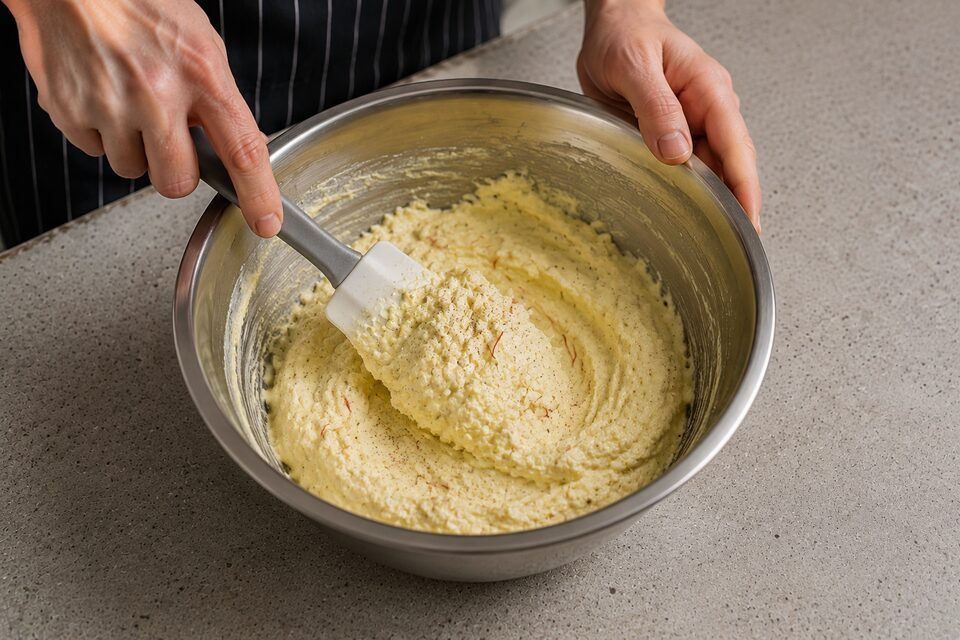
Build the filling. Turn the drained ricotta into a bowl and beat it briefly with a spatula until it loses its curd structure. Fold in the saffron milk, the pecorino, the egg yolk, the nutmeg, the lemon zest, the salt and the white pepper, working only until the colour is even. Overworking sheep ricotta breaks the fat out and the filling turns loose. Taste it: it should be clearly seasoned, since the sauce adds almost no salt. Chill 30 minutes, then load a piping bag.
Step 4

Roll the sheets. Cut the rested dough into four pieces and keep three covered. Pass one through the machine on the widest setting three times, folding it in thirds between passes, then work down notch by notch without folding to the second to last setting. The sheet should be thin enough to read the shadow of your hand through it but not translucent, because a filled raviolo needs a wall.
Step 5

Shape the ravioli. Pipe walnut sized mounds of filling, about 1 1/2 teaspoons each, along the centre of the sheet at intervals of 1 1/2 inches (4 cm). Mist lightly with water between the mounds, then lay a second sheet on top. Press outward from each mound with two fingers to drive every trace of air out before sealing the edge, then cut with a fluted wheel. A trapped bubble expands in the water and splits the pasta open.
Step 6
Rest and hold the ravioli. Transfer them to a tray dusted with semola, spaced so they do not touch, and let them dry uncovered 15 to 20 minutes while the water comes up. That short air drying firms the seal and stops them sticking. If you are not cooking within the hour, freeze them flat and bag them once solid. Never stack fresh filled pasta.
Step 7
Cook the ravioli. Bring 4 quarts (4 l) of water to a rolling boil and salt it with 1 1/2 tablespoons (25 g) of coarse sea salt. This is deliberately less salty than the usual rule, because the filling carries aged pecorino and the sauce is built from this same liquid. Drop the ravioli in two batches, bring the water back to a bare simmer rather than a violent boil, and cook 3 to 4 minutes from the moment they float. Bite the sealed edge of the first one to confirm the dough is cooked.
Step 8
Brown the butter and finish. While the pasta cooks, melt the cold butter in a wide pan over medium heat and let it foam, then subside. When the milk solids turn hazelnut brown and the smell turns nutty, drop in the sage and the pinch of saffron and take the pan off the heat within 20 seconds. Add a ladle of pasta water at once: it will spit, and it stops the browning dead and starts the emulsion. Lift the drained ravioli straight in, swirl the pan rather than stirring, and add more water in small amounts until the sauce is glossy and just coats the pasta.
Plating
Warm the plates properly for this one. Butter sauce sets the instant it meets a cold surface and the ravioli go from glossy to greasy before they reach the table. Shallow wide bowls at around 140°F (60°C) are right, and they matter more here than any decorative decision.
Serve about twelve ravioli per person in a single layer, never piled, so each keeps its own film of sauce. Spoon the remaining emulsion over them and set the crisped sage leaves on top, four to a plate, where they stay dry rather than sinking. Grate the cheese at the table so it arrives loose, and finish with black pepper and nothing else: extra oil only dulls the emulsion you just built.
Professional Technique
The technique that defines this dish is the control of water in three places at once. Sheep ricotta arrives holding whey, and draining it overnight removes perhaps a fifth of its weight in liquid that would otherwise turn the filling to soup inside a sealed pocket. The dough runs deliberately dry and firm, with two egg yolks replacing part of the liquid, so it rolls thin without tearing. The sauce moves the opposite way, water added back in amounts judged by eye.
The second technique is the saffron bloom. Saffron aroma sits in safranal, a volatile compound that boils away in seconds, while its colour comes from crocin, which is far more stable. Infuse threads at around 140°F (60°C) and you keep both. Drop them into boiling milk or hot butter and you keep the colour and lose the perfume, which is why so many saffron dishes look right and smell of nothing.
The third is the brown butter, a Maillard reaction on milk solids rather than a simple melt. The window between hazelnut and burnt is about half a minute, and the pan holds enough residual heat to cross it after you take it off the flame. Adding the pasta water immediately is therefore not only an emulsifying step, it is the brake.
Texture and Moisture Control
The finished raviolo has to read as three textures in one bite: a thin resilient pasta wall, a filling creamy without being runny, and a sauce that coats rather than soaks. The wall comes from a firm low hydration dough, since a sheet taken to the thinnest notch splits under the weight of a wet filling. The filling holds because the drained ricotta is bound with a single egg yolk and aged pecorino, both of which set slightly in the water.
The sauce is a starch stabilised emulsion and behaves like any other mantecatura, despite carrying no cheese. The reserved cooking water holds dissolved starch from the semola in the dough, and that starch keeps butterfat and water combined. Add it while the pan is very hot, swirl rather than stir, and keep going in small amounts until the sauce moves like thin cream. If it looks oily and separated, it is too hot or too dry.
Cooking temperature protects the shape. A rolling boil batters filled pasta and forces the seams apart, so drop the water to a bare simmer once the ravioli go in. Three to four minutes from floating is enough. Held beyond that, the pasta absorbs water through the wall, the filling thins and the whole thing goes slack.
Professional Mise en Place
The ravioli can be made entirely in advance and frozen, which leaves a service window of about six minutes.
Equipment and tools
Pasta machine or a long rolling pin and a large wooden board
Fine mesh sieve and cheesecloth for draining the ricotta
Piping bag with a plain tip, about 1/2 inch (12 mm)
Fluted pasta wheel and a spray bottle of water
Wide low sided saute pan for the butter, and a spider skimmer
Prepared ahead
Ricotta drained overnight, up to 1 day ahead, kept refrigerated
Filling mixed and chilled, up to 1 day ahead, in a piping bag
Ravioli shaped and frozen flat on trays, up to 1 month ahead
Sage leaves picked and dried on paper, on the day
Pecorino and Parmigiano grated, on the day, kept covered
Service setup
Salted water at a rolling boil, ready to be dropped to a simmer
Butter weighed and cold in the pan, sage and saffron beside it
Ladle and heatproof cup for lifting the starchy cooking water
Plates warming at around 140°F (60°C)
Cheese, pepper mill and serving spoon on the pass
Chef Tips
Buy the ricotta from somewhere that sells it fast. Sheep ricotta at three or four days old turns faintly sour and gritty, and saffron does nothing to cover it. If ricotta di pecora is unavailable, use a good cow milk ricotta with an extra tablespoon of aged pecorino, but do not pretend it is the same dish.
Weigh the saffron rather than judging it by eye. A quarter teaspoon of threads lightly packed is about 0.2 g, and the gap between that and half a gram is the gap between perfume and a medicinal bitterness that cannot be removed. Sardinian saffron is strong, so start low.
Cook the ravioli in two batches even for four people. Crowding drops the water temperature, stretches the cooking time and makes the pasta stick to itself at the moment it is most fragile.
If the sauce splits in the pan, do not add more butter. Pull the pan off the heat, add two tablespoons of hot pasta water and swirl hard by the handle. The starch picks the emulsion back up almost every time. More fat makes the separation permanent.
Common Mistakes
Using ricotta straight from the tub. Undrained sheep ricotta releases whey inside the sealed pasta, and the ravioli either split or arrive watery. Drain it in cheesecloth at least 4 hours and discard the liquid.
Blooming the saffron in boiling liquid. The aromatic compounds are volatile and boil off in seconds, leaving colour without perfume. Infuse the crushed threads in warm milk at around 140°F (60°C) for 20 minutes instead.
Trapping air inside the raviolo. Air expands in the cooking water and forces the seam apart. Press outward from the filling with two fingers to expel it, and seal the edge only once the pocket is flat.
Taking the butter too far. Hazelnut brown becomes acrid black in about thirty seconds, and the pan keeps cooking after you lift it off. Add the sage and the pasta water the moment the smell turns nutty.
Boiling filled pasta hard. A violent boil tears the seams and knocks the shapes against each other. Drop to a bare simmer as soon as the ravioli go in and lift them out with a spider rather than tipping them into a colander.
Finishing the sauce without pasta water. Plain browned butter has nothing to bind it, so it slides off and pools in the bowl. The dissolved starch in the cooking water is what turns fat and liquid into a sauce that clings.
Wine Pairing
Vermentino di Gallura DOCG: The island answer and the most complete one. Grown on decomposed granite in the far north of Sardinia, it has the saline finish and firm citrus acidity to cut 5 oz of butter without stripping the plate. Its faint bitter almond note sits alongside the browned milk solids, and a Superiore bottling has the weight to carry sheep ricotta rather than vanish under it.
Nuragus di Cagliari DOC: Grown on the same Campidano plain where the saffron is picked, which makes it the geographically exact pour. Lighter and more neutral than Vermentino, with high acidity, low alcohol and a green apple core, it resets the palate between rich mouthfuls instead of competing with the saffron.
Fiano di Avellino DOCG: A mainland white with unusual textural depth for its acidity. The hazelnut and dried pear register it develops after two or three years in bottle maps almost exactly onto brown butter, and it has the length to follow the saffron through the finish, which most crisp whites cannot manage.
Alto Adige DOC Pinot Nero: For a red on the table, this is the one that works. Alpine Pinot Nero is pale, high in acidity and low in tannin, and at around 57°F (14°C) its red fruit and undergrowth notes meet the sage without the astringency that clashes with sheep dairy. A tannic southern red would dry the butter out and make the ricotta taste chalky.
Storage & Reheating
Uncooked ravioli freeze extremely well and that is the correct way to store them. Spread them in a single layer on a semola dusted tray, freeze until solid, then bag them for up to 1 month. Cook from frozen, without thawing, adding about 1 minute. Thawed ravioli go sticky and the seams give way.
In the refrigerator uncooked ravioli hold a few hours at most, uncovered on a dusted tray. Beyond that the filling moisture works through the wall and the base welds down. The filling alone keeps 2 days in an airtight container, and the browned butter keeps 5 days refrigerated.
Cooked and dressed ravioli keep 1 day refrigerated in a sealed container. Reheat in a wide covered pan over low heat with 2 tablespoons of water and a small knob of butter, about 3 minutes, swirling to rebuild the emulsion. Never use a microwave, which boils the filling and splits the pasta, and never put them back into boiling water.
Nutrition
Per serving, based on 4 servings of about 12 ravioli each:
Calories: 810 kcal
Total Fat: 47 g
Saturated Fat: 26 g
Trans Fat: 1 g
Unsaturated Fat: 18 g
Cholesterol: 285 mg
Sodium: 780 mg
Total Carbohydrates: 62 g
Fiber: 3 g
Total Sugars: 4 g
Added Sugars: 0 g
Protein: 31 g
Lactose: 3 g
Principal micronutrients: calcium, phosphorus, vitamin A, vitamin B12, riboflavin, selenium, zinc
These figures are estimates. Most of the salt in the cooking water is discarded, and the final sodium depends on how mature the pecorino is and how much cheese is grated at the table.


Comments