
Vitello Tonnato Bonbon with Capers and Anchovy | Bonbon di Vitello Tonnato con Capperi e Acciughe
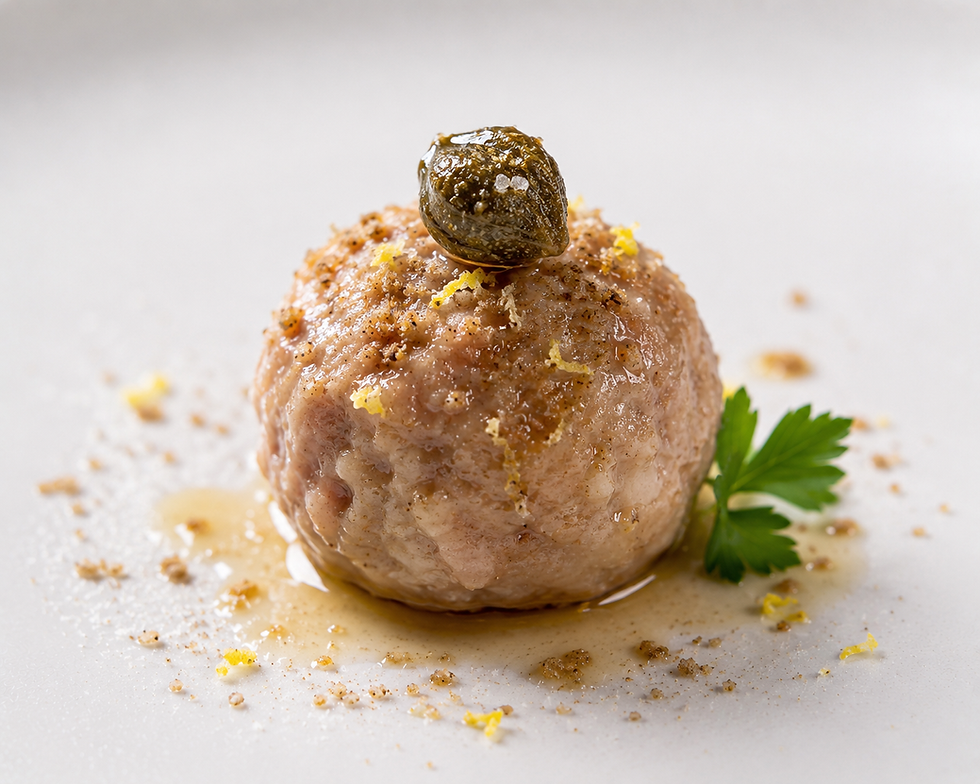
Vitello tonnato is the cold veal of Piedmont under a sauce of tuna, anchovy and capers, normally laid flat on a plate. Here the same flavours are folded into a small sphere: a core of tender veal bound with tonnato, frozen hard, then dipped in a dense tonnato glaze that sets into a smooth pale shell. One bite gives veal, sea salt, lemon and caper in the order the classic plate delivers them.
Yield: 12 bonbons, 4 servings of 3. Prep: 1 hour 15 minutes. Cook: 1 hour 10 minutes. Freeze and set: 3 hours. Difficulty: advanced. Course: antipasto. Region: Piedmont.
The Story
Vitello tonnato is one of the great cold dishes of Piedmont, and it belongs to the cooking of Turin, the Langhe and the Monferrato more than to any single restaurant. It sits in the antipasto piemontese that opens a festive lunch, beside vitello in insalata russa, peppers with bagna cauda and carne cruda all'albese. It appears at Christmas and on the August holiday of Ferragosto alike, because it is the dish a family makes the day before: it needs a night in the refrigerator to become itself.
Veal and tuna look like a strange pairing for a landlocked region, and the explanation is trade. For centuries salt travelled from the Ligurian coast over the mountain roads to Piedmont, and it came with barrels of anchovies and salted or oil packed tuna. Anchovy sellers from the Alpine valleys walked those routes, and Piedmont built a cuisine on preserved fish, from bagna cauda to tonnato. The sea reached the Langhe as a pantry ingredient, salty, deep and precious, and cooks spent it on the best meat they had.
That meat was young veal from the cattle of the Cuneo hills, lean and pale, cooked gently in broth with carrot, celery and onion. The cut is the girello or noce, eye of round or top round, chosen because it slices cleanly and carries almost no fat to turn waxy when cold. Early sauces were built on mashed tuna, anchovy and capers loosened with oil and broth. Mayonnaise entered the sauce in the twentieth century and made it creamier, and the version served in most Turin trattorie today is mayonnaise based.
In Turin the dish is sold by the etto from the gastronomie, slices fanned in white trays, and the sauce is the subject of quiet family rivalry. Some cooks add hard boiled egg yolk, some a spoon of pickled vegetables, some refuse mayonnaise altogether. This recipe follows the mayonnaise camp, because the emulsion gives the coating body and lets it set.
A bonbon is a modern idea, born in the cocktail hour and the tasting menu, where a dish must be eaten in one bite from a napkin or a spoon. The risk is obvious. A sauce that is perfect on a plate is far too loose to stay on a sphere, so the craft of this recipe is not the flavour, which is inherited, but the physics of making tonnato cling.
Ingredients
For the veal
Veal eye of round, 1 lb (450 g)
Water, 6 cups (1.4 L)
Dry white wine, 1 cup (240 ml)
Carrot, 1
Celery stalk, 1
Yellow onion, 1/2
Bay leaf, 1
Black peppercorns, 6
Kosher salt, 2 tsp (10 g)
For the tonnato
Italian tuna in olive oil, drained, 5 oz (140 g)
Anchovy fillets in oil, 5 (20 g)
Salt packed capers, rinsed, 2 tbsp (18 g)
Homemade mayonnaise, from below, 3/4 cup (180 g)
Lemon juice, 1 tbsp (15 ml)
Reduced veal broth, from 2 cups (480 ml)
Freshly ground black pepper, to taste
For the mayonnaise
Pasteurized egg yolks, 2
Dijon mustard, 1 tsp (5 g)
White wine vinegar, 1 tsp (5 ml)
Neutral oil, 3/4 cup (180 ml)
Fine sea salt, 1/4 tsp (1.5 g)
For the core
Poached veal, finely diced, about 10 oz (285 g)
Tonnato, 1/3 cup (80 g), taken from above
Caper berries, small, 12
For finishing
Capers, fried until crisp, 1 tbsp (9 g)
Finely grated lemon zest, from 1/2 lemon
Chives, finely chopped, 1 tbsp
Extra virgin olive oil, a few drops
Flaky sea salt, 1 pinch
Lemon juice, 1 tsp (5 ml), to loosen the plating sauce
Thin grissini, 12, to serve
Preparation
Poach the veal
Bring the water, wine, carrot, celery, onion, bay leaf, peppercorns and salt to a boil, then lower the heat until the liquid holds at 180°F (82°C) with only small bubbles breaking the surface. Add the veal and poach 50 to 60 minutes, until the center reads 140°F (60°C). Switch off and let the meat cool in the broth for 1 hour so it reabsorbs juices. Lift it out, wrap it tightly and refrigerate at least 2 hours. Strain the broth through a fine sieve and skim any fat from the surface; you need about 2 cups (480 ml) for the next step. Discard the vegetables, or eat them warm with a little oil.
Reduce the broth
Boil 2 cups (480 ml) of the strained broth hard, about 25 minutes, until 3 tbsp (45 ml) of dark syrupy concentrate remains. Cool it completely. This gives the sauce its veal depth without adding the water that would make it run. Watch the pan at the end, because a syrup scorches in seconds.
Make the mayonnaise
Whisk the yolks, mustard, vinegar and salt in a bowl set on a damp towel. Add the oil drop by drop at first, then in a thin stream, whisking until thick and pale. It should hold a soft peak and taste lightly sharp. Cover and chill it while you continue.
Blend the tonnato
Blend the tuna, anchovies, capers, lemon juice and reduced broth to a smooth paste. Add the mayonnaise and pulse only until combined, since long blending thins it. Season with pepper and taste for salt cautiously, because anchovy and capers carry plenty. Chill 1 hour, then set 1/3 cup (80 g) aside for the core.
Dice and bind the veal
Slice the cold veal thinly, then cut it into 1/8 inch (3 mm) dice, never a purée. Fold in the reserved 1/3 cup of tonnato until the mixture holds when squeezed in the palm. It should be firm and slightly tacky. Taste a little for seasoning. Chill 20 minutes so the mixture is easy to shape and stays cold in your hands.
Shape the spheres
Weigh 1 oz (30 g) portions. Press each around a caper berry, then roll between damp palms until perfectly round and free of cracks. Set the 12 spheres on a parchment lined tray, leaving a finger of space between them so they do not fuse. If the mixture warms and sticks, chill it again for 10 minutes.
Freeze the cores
Freeze the uncovered tray until the spheres are rock hard, as the technique section explains in detail. Keep them frozen until the moment you dip.
Thicken the coating sauce
Whisk the remaining tonnato in a narrow, deep bowl and test it with a spoon. If it runs, blend in 1 tbsp (10 g) more drained tuna. If it is stiff as paste, loosen it with 1 tsp lemon juice. Hold it at about 55°F (13°C) and stir before each dip.
Dip, set and dip again
Take 4 spheres from the freezer at a time, leaving the others frozen. Dip one on a fork for 2 seconds, let the excess fall for 3 seconds and rest it on a chilled rack in the freezer. After 10 minutes, dip a second time. Check that no bare spot shows, then patch it with a dab of sauce on a fingertip. Move the finished bonbons to the refrigerator for 30 minutes before serving.
Plating
Serve on chilled plates, three bonbons per person, set on a spoonful of the remaining tonnato loosened with a little lemon juice so the spheres sit on a pale pool rather than the bare porcelain. Leave space between them. The eye should read three clean pale shells with a soft gloss, nothing more, and the plate should stay almost empty.
Top each bonbon with a few fried capers, a pinch of lemon zest and chopped chives. Add two drops of olive oil beside, never over, the shell, and a few flakes of sea salt. Cut one bonbon open at the table if you want to show the caper berry at the center. Pass thin grissini and cold sparkling water alongside, so the palate resets between bites.
Professional Technique
The whole dish rests on one problem: a tonnato made for the plate is too fluid and slides off a sphere, leaving the bonbon naked. The solution is a coating sauce that is thick to begin with and meets a core that is freezing cold. Start by removing liquid. Reduce the veal broth to a concentrate so the sauce keeps flavour but loses the water that makes it run.
Judge the density with a spoon. Dip it in the sauce and lift: the sauce must coat the back in an opaque layer and fall from the edge in a slow, thick ribbon. Draw a finger down the coated spoon. The line should stay open for at least 3 seconds and close slowly, like Greek yogurt. If the line closes at once, the sauce is a plate sauce and will run. Correct it with drained tuna, never starch.
Now the core. Freeze the spheres in a blast chiller at minus 22°F (minus 30°C) for 60 to 75 minutes, or in a home freezer at 0°F (minus 18°C) for 3 hours, until the center reads about 5°F (minus 15°C) and the surface is hard, dry and dull. Dip straight from the freezer, one at a time. The cold stiffens the sauce within seconds, so the coating locks in place before gravity moves it and builds a shell of about 1/16 inch (2 mm).
Apply the second coat only after the first has set, about 10 minutes back in the freezer, when the surface turns matte. Dipped onto a wet first layer, the sphere would soften it and drag it off in a drip. On a set layer the second coat grips, freezes in turn and evens out every thin spot.
Texture and Moisture Control
The veal is cooked only to 140°F (60°C) and rested in its broth, so the fibers stay tender rather than stringy. Pat the sliced meat dry before dicing: surface water thins the tonnato binder and makes the core soft and pasty. The dice must be small and even, or the sphere crumbles when bitten.
The binder should be almost stiff, because the caper berry and the meat release a little moisture while the bonbon tempers. Drain the tuna on paper and rinse the capers well, otherwise brine slips into the sauce and loosens it. The mayonnaise is an emulsion, so keep every component below 60°F (16°C) and it will stay glossy and smooth. Warmth makes it separate into oily streaks and a grainy shell.
At service the shell should be creamy and slightly yielding, the core cool and meaty, with no ice crystals in the mouth. Twenty to thirty minutes in the refrigerator after dipping brings the center to about 40°F (4°C), which softens the frozen core without letting the shell slump or sweat. Fried capers add the only crisp note, so they go on at the last minute.
Professional Mise en Place
Equipment and tools
Instant read thermometer
Blender or food processor
Kitchen scale, fork and narrow deep bowl
Chilled wire rack and parchment lined trays
Blast chiller or freezer with room for a flat tray
Small offset spatula and fine mesh sieve for the broth
Ice bath for cooling the reduced broth quickly
Prepared ahead
Veal poached and chilled, up to 2 days ahead
Broth reduced, up to 3 days ahead, refrigerated
Tonnato blended, up to 2 days ahead
Cores shaped and frozen, up to 2 weeks ahead
Capers rinsed and dried, chives and lemon zest prepared on the day
Mayonnaise made fresh, no more than 1 day ahead
Service setup
Coating sauce whisked and held at 55°F (13°C)
Cores in the freezer, taken out four at a time
Rack and tray chilled before dipping
Plates chilled, garnishes chopped and capers fried last
A bowl of warm water for wiping the fork between dips
Timer set for the 10 minute wait between coats
Chef Tips
Buy tuna packed in olive oil in a jar and drain it well, because it has firmer flesh and cleaner flavour than tuna in brine. Rinse salt packed capers under cold water for one minute, then dry them thoroughly so no brine reaches the sauce.
Freeze the coating sauce in a small bowl for 5 minutes if it warms during dipping, stirring it back to a smooth ribbon. Warm sauce is the most common reason for a thin, patchy shell, so work in a cool kitchen and never near the stove.
Dip a test bonbon first. If the shell cracks, the core is too cold and needs 2 minutes on the counter. If it runs, the sauce needs more tuna. Adjust before you commit all twelve.
Make one extra core as insurance, since the first dip is often uneven, and eat the failure with a fork while you calibrate. Let the veal poach a day ahead: the flavour is better and slicing is easier.
Common Mistakes
Using plate tonnato as it is. It contains too much broth and runs off the sphere. Reduce the broth and test the density with the spoon before you dip anything.
Dipping a thawed core. A soft center warms the sauce, so the coat never sets and slides. Keep it frozen until the second it is dipped.
Skipping the wait between coats. A wet first layer is pulled off by the second, leaving drips. Let the first coat go matte for 10 minutes.
Dicing the veal too coarsely. Large pieces leave gaps and the sphere falls apart when bitten. Cut fine, even dice.
Overcooking the veal. Past 150°F (65°C) the eye of round turns dry and chalky. Poach gently and rest it in the broth.
Blending the mayonnaise too long. Over processing warms and thins the emulsion, and a thin sauce will not hold. Pulse briefly and chill it.
Salting before tasting. Anchovy and capers are already very salty and cured fish varies from jar to jar, and the reduced broth concentrates salt further. Taste the finished sauce before adding any.
Wine Pairing
A cold, salty, creamy bite calls for dry, fresh wines with acidity and little oak.
Roero Arneis DOCG: The Piedmontese classic for vitello tonnato. Its pear and almond fruit and crisp acidity cut through the mayonnaise, while a light bitter finish echoes the capers. The body is generous enough to match the veal without covering the tuna, and a chilled glass suits the cold bonbon perfectly.
Gavi DOCG: Made from Cortese, it is lean, citrusy and mineral, with a saline edge that meets the anchovy and tuna. Its brisk acidity cleans the palate after each rich shell, and the dry finish keeps the lemon in focus. Serve it very cold, in a slim glass, and pour small measures. Its clean profile never competes with the caper.
Alta Langa DOCG: A Piedmontese metodo classico with fine bubbles and brioche notes. The bubbles scrub the fat of the emulsion from the tongue and the dry, tight acidity refreshes the palate, which makes it ideal for a bonbon served as an aperitivo. Its fine mousse also lifts the caper and lemon notes, and the toasty depth answers the reduced veal broth in the shell.
Dolcetto d'Alba DOC: For a red, choose this one, served at 57°F (14°C). It is low in acidity but has soft tannins and bitter almond and cherry notes that suit lean veal, while its light body will not overwhelm the delicate sea flavours. It suits guests who prefer red with veal, and it improves the second glass.
Storage & Reheating
Finished bonbons keep in the refrigerator in a covered container, on a rack, for 24 hours at or below 40°F (4°C). Discard anything left out for more than 2 hours, since the mayonnaise contains raw yolk. Keep the sauce separate from the veal broth, and label everything with the day it was made. Taste the sauce again after storage, as the anchovy grows stronger.
The uncoated cores freeze for 1 month in an airtight box, and coated bonbons for 2 weeks, layered on parchment. Thaw them in the refrigerator for 30 to 40 minutes, never at room temperature. Do not refreeze. The sauce keeps 3 days refrigerated and the poached veal 3 days in its broth. These are cold dishes: never microwave or reheat them, and never soften them in warm water, which would melt the shell.
Nutrition
Per serving, based on 4 servings of 3 bonbons:
Calories: 430 kcal
Total Fat: 34 g
Saturated Fat: 5 g
Trans Fat: 0 g
Unsaturated Fat: 29 g
Cholesterol: 105 mg
Sodium: 640 mg
Total Carbohydrates: 2 g
Fiber: 0 g
Total Sugars: 1 g
Added Sugars: 0 g
Protein: 28 g
Lactose: 0 g
Principal micronutrients: vitamin B12, niacin, selenium, zinc, iron, omega 3 fatty acids
These figures are estimates.


Comments