
Italian Sardinian Modern Dogfish Burrida with Walnut Cream and Sweet and Sour Red Onion | Burrida Moderna di Gattuccio, Crema di Noci e Cipolla Rossa in Agrodolce
Updated: Sep 13
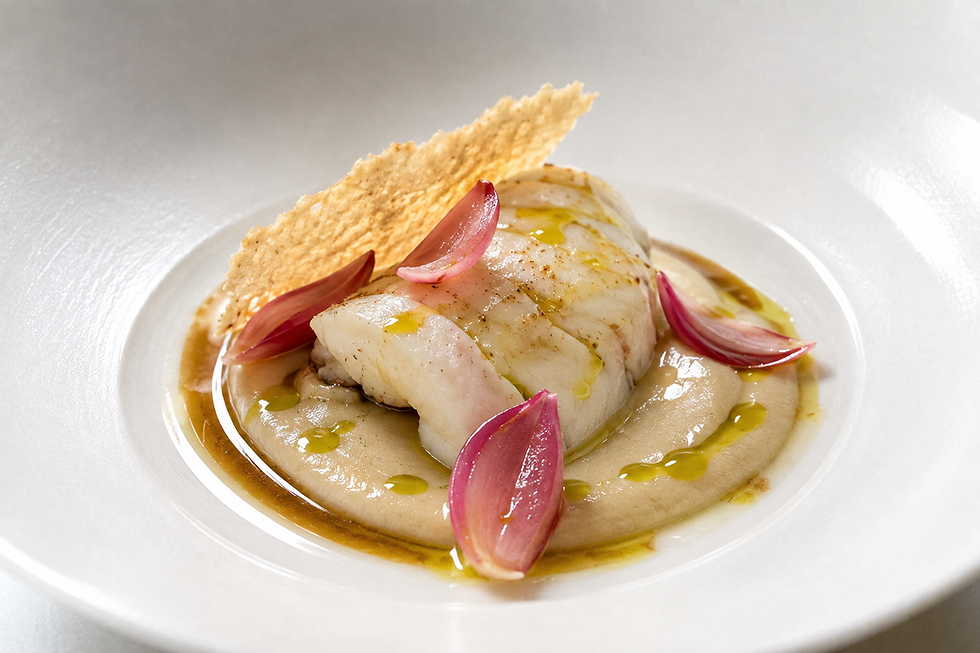
Burrida is one of the most characteristic seafood preparations of southern Sardinia, especially associated with the culinary tradition of Cagliari. The classic version, known as burrida a sa casteddaia, is built around gattuccio, a small shark traditionally cooked and dressed with a deeply flavored mixture of walnuts, vinegar, garlic, olive oil, and, in the most traditional preparations, the liver of the fish itself.
It is a dish with a strong personality.
The acidity is deliberate.
The walnut is not a decorative element.
The liver is not an optional luxury ingredient added for richness.
Together, these components create the unmistakable identity of the traditional preparation.
Historically, burrida was made ahead of time and allowed to rest so the fish could absorb the walnut-and-vinegar dressing. The result was rustic, intensely flavored, and particularly well suited to Sardinian coastal cooking, where preserving and marinating techniques were deeply rooted in everyday cuisine.
This reinterpretation keeps that structure intact but changes the way the flavors are presented.
The gattuccio is cooked very gently so that it remains moist and delicate.
The walnut sauce becomes a perfectly smooth cream.
The vinegar is distributed with greater precision between the walnut cream, the red onion, and the finishing jus.
The red onion introduces a controlled sweet-and-sour note.
Pane carasau gives the dish the dry, brittle crunch that contrasts with the softness of the fish and sauce.
Nothing is added simply to make the plate look more complicated.
The goal is to modernize burrida without removing the flavors that make it Sardinian.
This recipe is designed for four refined appetizer-sized portions.
Burrida Moderna di Gattuccio, Crema di Noci e Cipolla Rossa in Agrodolce is built around the balance of its principal ingredients, correct temperature control, and disciplined seasoning. The preparation should preserve the identity of the main ingredient rather than bury it under unnecessary garnish or excess sauce. The method below follows professional Italian kitchen logic: organize the mise en place first, cook each component to its proper texture, and bring the elements together only when they are ready for service.
History
Burrida is one of the best-known seafood preparations associated with Cagliari and southern Sardinia. Traditional versions are built around gattuccio, the small catshark commonly found in the Mediterranean, together with walnuts and an assertive sweet-sour element based on vinegar.
The dish belongs to a practical coastal cooking tradition in which lean fish is given depth through its liver, nuts and acidity. Sardinian tourism sources still identify burrida made with gattuccio and walnuts among the characteristic foods of Cagliari, linking the preparation to the island’s fishing culture.
This modern version keeps those identifying flavors but changes the presentation. The dogfish remains the central ingredient; walnut becomes a smooth cream, the liver is used with restraint, red onion provides controlled agrodolce contrast, and pane carasau adds a distinctly Sardinian crisp texture.
Ingredients
For 4 servings
For the dogfish
21.16 oz / approximately 1 lb 5 oz cleaned dogfish, cut into four thick portions
1 bay leaf
1 small garlic clove, lightly crushed
1.69 fl oz / approximately 3 tablespoons dry white wine
0.51 fl oz / 1 tablespoon extra-virgin olive oil
Fine sea salt
For the walnut cream
4.23 oz / approximately 1 cup shelled walnuts
1.41 oz cleaned dogfish liver
1 small garlic clove
0.85 fl oz / approximately 1 1/2 tablespoons white wine vinegar
2.71 fl oz / approximately 1/3 cup light fish stock
1.69 fl oz / approximately 3 tablespoons extra-virgin olive oil
Fine sea salt
For the sweet-and-sour red onion
1 small red onion
2.03 fl oz / 1/4 cup white wine vinegar
2.03 fl oz / 1/4 cup water
0.53 oz / approximately 1 tablespoon sugar
0.07 oz fine sea salt
For the acidulated jus
3.38 fl oz / approximately 7 tablespoons light fish stock
0.68 fl oz / approximately 1 tablespoon plus 1 teaspoon white wine vinegar
0.51 fl oz / 1 tablespoon extra-virgin olive oil
1 teaspoon finely ground toasted walnut
Fine sea salt, only if necessary
For the pane carasau
1 sheet pane carasau
Extra-virgin olive oil, only enough to brush very lightly
Fine sea salt
Ingredient Notes
Gattuccio (small catshark or dogfish) is lean and delicate. It must be skinned and cleaned correctly before cooking, and it should never be treated like an oily fish that can tolerate prolonged high heat.
The liver is traditional to the flavor logic of burrida, but in a modern plate it should deepen the sauce rather than dominate it. Use it fresh, cook it gently and balance its richness with vinegar and wine.
Walnuts provide the characteristic nutty depth. Toast them lightly enough to intensify aroma without developing bitterness. Red onion should remain recognizably onion-like after the agrodolce treatment rather than becoming jam.
Pane carasau is used as a crisp Sardinian counterpoint. Keep it dry until service so it breaks cleanly against the moist fish and walnut cream.
Preparation
Step 1 — Prepare the Dogfish
The success of the dish begins with the texture of the fish.
Gattuccio is firm enough to hold its shape, but it can become dry very quickly if treated with aggressive heat.
Cut the cleaned dogfish into four even portions.
Each portion should be thick enough to remain juicy during cooking.
Pat the fish completely dry with kitchen paper.
Season very lightly with fine sea salt.
Place a wide sauté pan over low to medium-low heat.
Add the extra-virgin olive oil.
Add the bay leaf and lightly crushed garlic.
Allow the garlic and bay leaf to perfume the oil gently for approximately one minute.
Do not allow the garlic to brown.
Place the dogfish portions into the pan.
Cook for approximately 60 to 90 seconds on the first side.
The surface should set but should not develop a heavy crust.
Turn the fish carefully.
Add the dry white wine.
Immediately lower the heat.
Cover the pan.
Allow the dogfish to cook gently for approximately 3 to 5 minutes, depending on the thickness of the portions.
The fish should be just cooked through.
The flesh should remain succulent, compact, and slightly glossy inside.
Remove the fish immediately from the pan.
Transfer it to a tray.
Cover loosely and reserve.
Do not leave the fish sitting in the hot pan because residual heat will continue cooking it.
Step 2 — Cook the Dogfish Liver
The liver is the component that gives the walnut cream its deepest connection to traditional burrida.
Clean the liver carefully.
Remove any membrane or visible connective tissue.
Place a small sauté pan over low heat.
Add approximately one teaspoon of extra-virgin olive oil.
Add the liver.
Cook gently for approximately 45 to 60 seconds on the first side.
Turn.
Cook for another 30 to 45 seconds.
The liver should be fully cooked but still soft.
It should not become aggressively browned or dry.
Transfer immediately to a plate.
Reserve.
Step 3 — Toast the Walnuts
Preheat the oven to 325°F / 329°F.
Spread the walnuts evenly over a small baking tray.
Toast for approximately 6 to 8 minutes.
They should become fragrant but should not become dark.
Remove from the oven.
Transfer the warm walnuts into a clean kitchen towel.
Rub them gently to remove some of the loose outer skin.
It is unnecessary to peel them completely.
The objective is simply to reduce excessive bitterness and obtain a cleaner finished cream.
Reserve one teaspoon of the toasted walnuts for the acidulated jus.
Step 4 — Prepare the Walnut Cream
Place the remaining toasted walnuts into a high-speed blender.
Add the cooked dogfish liver.
Add the garlic.
Add the white wine vinegar.
Add approximately half of the fish stock.
Begin blending.
Once the mixture starts to become smooth, gradually add the remaining fish stock.
Blend for approximately 2 minutes.
The walnuts must be completely broken down.
With the blender running, slowly drizzle in the extra-virgin olive oil.
Continue blending until the cream becomes glossy and emulsified.
Pass the mixture through a very fine sieve.
This step is important.
The finished cream should be completely smooth.
There should be no visible walnut pieces and no grainy texture.
Taste.
The walnut should appear first.
Then the richness of the liver.
Finally the vinegar should provide a clean acidic finish.
The vinegar should be clearly present but never aggressive.
Adjust the seasoning with a very small amount of salt if necessary.
Keep the cream warm.
Do not boil it.
The ideal consistency should be thick enough to hold its shape on the plate but soft enough to move naturally when touched by the fish or jus.
Step 5 — Prepare the Sweet-and-Sour Red Onion
Peel the red onion.
Cut it vertically into quarters.
Separate the natural onion petals carefully.
Choose the smaller inner petals for plating.
Place the vinegar, water, sugar, and salt into a small saucepan.
Bring to a gentle boil.
Remove from the heat.
Immediately add the onion petals.
Leave them in the hot liquid for approximately 10 to 12 minutes.
The onion should soften slightly while retaining some natural structure.
It must not become completely limp.
Drain carefully.
Reserve a small amount of the pickling liquid.
The onion should taste bright, slightly sweet, and clearly acidic.
It should refresh the palate rather than dominate the fish.
Step 6 — Prepare the Acidulated Jus
Place the fish stock into a small saucepan.
Bring to a gentle simmer.
Reduce until approximately 55 to 2.03 fl oz remain.
Add the white wine vinegar.
Simmer for another 20 to 30 seconds.
Remove the saucepan from the heat.
Whisk in the extra-virgin olive oil.
Finely grind the reserved toasted walnut.
Add only one teaspoon to the jus.
Whisk again.
The sauce should remain fluid.
It should not become a second walnut cream.
Taste.
The acidity should be slightly more pronounced than in the walnut cream because this sauce is designed to refresh the plate.
Add salt only if necessary.
Keep warm.
Step 7 — Prepare the Pane Carasau
Lower the oven temperature to 300°F / 302°F.
Break the pane carasau into four natural shards.
Do not cut them into perfectly identical geometric shapes.
Brush each piece with an extremely small amount of extra-virgin olive oil.
Add a very light touch of fine sea salt.
Place the carasau in the oven for approximately 2 to 3 minutes.
Remove.
Allow to cool completely.
The carasau must remain dry, brittle, and exceptionally crisp.
It should never appear greasy.
Step 8 — Finish the Dogfish
Immediately before plating, place a clean sauté pan over very low heat.
Add two tablespoons of the prepared acidulated jus.
Add the dogfish portions.
Warm for approximately 30 seconds.
Turn carefully.
Warm for another 15 to 20 seconds.
The objective is simply to restore temperature and lightly coat the surface of the fish.
Do not cook it a second time.
Remove immediately.
Allow any excess sauce to drain naturally.

Professional Technique
The principal technical risk is moisture loss in the gattuccio. Cook the portions gently and stop as soon as the flesh is opaque and just set; carryover heat will continue cooking after the fish leaves the pan.
Build the walnut cream separately and blend it until completely smooth. Its consistency should be spoonable and glossy, not stiff. The acidulated jus must remain brighter and thinner so the plate has two clearly different sauce textures.
Treat the liver as a seasoning component. Cook it slowly, combine it with the walnut element in measured quantity, and taste continuously. The finished dish should read first as dogfish, then walnut, then liver and acidity—not the reverse.
Chef Tips
Do not overcook the dogfish.
This is the single most important technical point.
Gattuccio has little internal fat, which means it can lose moisture quickly.
Gentle heat is essential.
The walnut cream should be blended longer than seems necessary.
The difference between a rustic walnut sauce and a refined walnut cream is largely texture.
Blend thoroughly and strain carefully.
Control the vinegar rather than reducing it excessively.
Burrida is supposed to have acidity.
The goal is not to hide it.
The goal is to distribute it intelligently across the plate.
Keep the pane carasau completely separate from wet components until the final seconds before serving.
Once it absorbs sauce, its crispness disappears quickly.
Warm the serving plate.
A cold plate will cool the dogfish and walnut cream immediately.
Common Mistakes
Do not fry the dogfish.
Do not heavily sear the exterior.
Do not eliminate the walnut.
Do not remove the acidic character of the dish.
Do not make the walnut cream excessively thick.
Do not make the red onion excessively sweet.
Do not drown the fish in sauce.
Do not cover the entire plate with walnut cream.
Do not use pane carasau as an exaggerated vertical decoration.
Do not introduce unrelated ingredients simply to make the dish look more elaborate.
The refinement must come from precision, not excess.
Plating and Service
Final Plating
Use a large warm white plate.
Place approximately two tablespoons of walnut cream slightly off-center.
Shape the cream into a controlled oval using the back of a spoon.
Do not make a long decorative smear.
Place one portion of dogfish partially over the walnut cream.
The fish should remain clearly visible and recognizable.
Do not break it into cubes.
Do not stack it artificially.
Place two or three sweet-and-sour red onion petals beside the dogfish.
Keep them grouped rather than scattered randomly around the plate.
Spoon approximately one tablespoon of warm acidulated jus around the fish.
Allow a small amount of the jus to touch the edge of the walnut cream naturally.
Place one shard of pane carasau beside the fish at a low angle.
The carasau should provide texture and a small amount of height, but it must never become a tall decorative structure.
Finish the fish with a few drops of excellent Sardinian extra-virgin olive oil.
The plate is complete.
No flowers.
No microgreens.
No random herbs.
No decorative powder.
No unnecessary sauce dots.
Every visible element must belong to the flavor structure of the dish.
The Balance of the Dish
This dish works because each component has a precise function.
The dogfish provides the marine sweetness and firm texture at the center of the plate.
The walnut cream gives richness and the characteristic nutty flavor of burrida.
The liver brings depth and links the reinterpretation directly to the original Cagliari preparation.
The vinegar gives the dish its essential acidic character.
The red onion adds freshness, a small amount of sweetness, and a clean bite.
The acidulated jus prevents the walnut cream from becoming heavy.
The pane carasau introduces a dry, brittle contrast that changes the texture of every bite.
The result should still taste like burrida.
It should simply taste cleaner, more controlled, and more refined.
Wine Pairing
High acidity, saline tension and citrus-herbal aromatics cut through the walnut cream and dogfish liver while matching the maritime character of the fish and the crisp pane carasau.
Its lean body, restrained fruit and slightly savory finish keep the pairing focused on the dogfish; the freshness is especially useful against the sweet-and-sour red onion and acidulated jus.
Carricante-driven acidity, mineral tension and subtle smoky notes give enough structure for the walnut cream without adding tannin, while the wine’s salinity reinforces the seafood character.
Fiano brings firm acidity, medium body and nutty-floral complexity that can stand up to walnut and liver while still remaining fresh enough for the onion agrodolce and delicate fish.
Traditional-method bubbles, brisk acidity and lees-derived complexity cleanse the palate after the walnut cream and liver, while the dry finish keeps the dish precise rather than heavy.
Storage & Reheating
Cooked dogfish is best served immediately. If necessary, refrigerate the cooked fish in an airtight container for up to 2 days. Store the walnut cream and sweet-and-sour onion separately so each component keeps its intended texture.
Reheat the fish very gently in a covered pan with a spoonful of water or light fish stock; do not fry or aggressively sear it a second time. Warm the walnut cream over low heat and loosen it with a small amount of water if it thickens. Pane carasau must be stored dry at room temperature and added only at service. Freezing the assembled dish is not recommended.
Nutrition per Serving
Estimated per serving, based on 4 servings: approximately 420 kcal; protein 30 g; carbohydrates 18 g; total fat 25 g; saturated fat 3 g; fiber 2 g; total sugars 8 g; cholesterol approximately 85 mg. Sodium varies with seasoning, pane carasau and the amount of reduced jus used.
Nutrition values are estimates and will change with the exact weight of dogfish, walnuts, liver, olive oil and pane carasau used.
Final Note
A modern burrida should still taste unmistakably Sardinian. Refinement comes from controlling texture and proportion, not from removing the ingredients that define the dish. When the fish stays moist, the walnut remains elegant, the acidity is precise and the pane carasau stays crisp, the plate keeps the identity of burrida while presenting it with contemporary discipline.




Comments