
Modern Italian Sardinian Burrida with Dogfish, Walnut Cream & Sweet and Sour Red Onion | Burrida Moderna di Gattuccio, Crema di Noci e Cipolla Rossa in Agrodolce

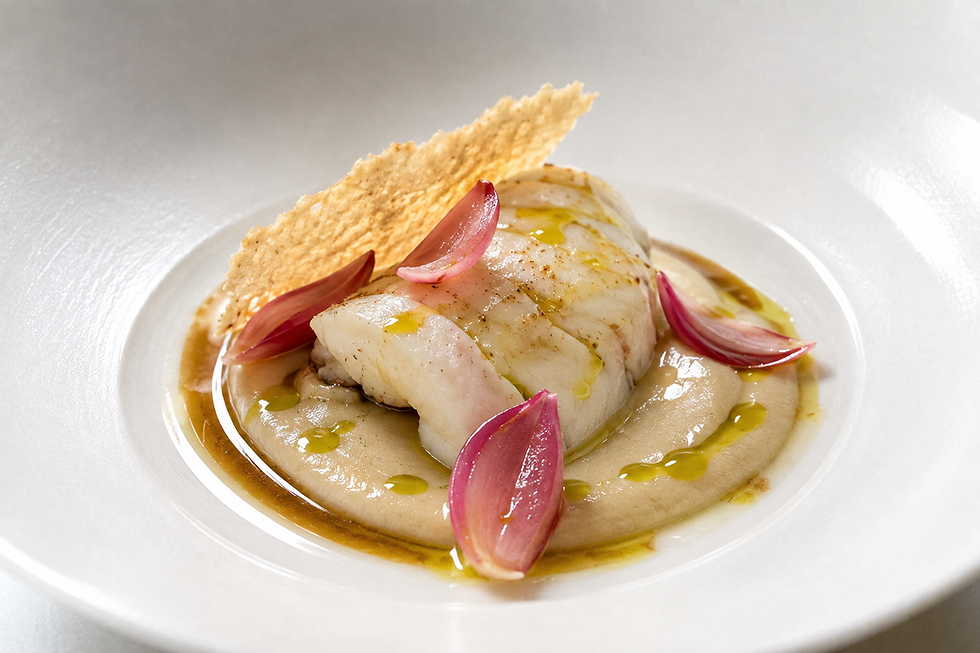
Burrida is the sharpest thing the Cagliari waterfront does with fish. Poached gattuccio, the small catshark English speakers call dogfish, meets a walnut and vinegar cream that the old cooks bound with the fish's own liver. This version keeps every flavour and rebuilds the plate: cool walnut cream underneath, warm fish on top, pickled red onion petals, a vinegar reduction and a shard of pane carasau.
Yield: 4 appetizer servings. Prep: 45 minutes. Cook: 30 minutes. Chill: 30 minutes. Difficulty: advanced. Region: Sardinia.
The Story
Burrida belongs to Cagliari the way few dishes belong anywhere. It is eaten across southern Sardinia, in Oristano and along the Sulcis coast, but the version built on gattuccio, walnuts and vinegar is the one the capital claims, sold for generations from the fish stalls of the Marina quarter behind the port. The name travelled from Liguria, where buridda means a mixed fish stew, yet the Sardinian dish that carries it has almost nothing in common with the Ligurian pot.
Its logic is preservation. Before refrigeration, an acid and fat dressing bought a cooked fish several extra days in a warm climate, and the walnut supplied both the fat and the body. The liver mattered most. Dogfish carry a large, oil rich liver, and cooks mashed it raw into the walnut paste because it did two jobs at once: it added richness and, thanks to the lecithin it holds, it kept the whole dressing together. Nothing edible on a cheap fish was thrown away, and nobody at the time called it technique.
Gattuccio itself was a poor man's catch, abundant, unglamorous and ignored by anyone who could afford something else, which is exactly why the recipe survives. Dishes built on expensive fish get reinvented. Dishes built on cheap fish get repeated year after year in the same kitchens, by the same hands, with the same bowl.
The walnut is the island's signature here. Sardinia has old walnut groves in the Barbagia and around Oliena, and walnut turns up in its cooking where other regions would use pine nuts or almonds. Combined with wine vinegar it tastes closer to northern Europe than to the Mediterranean, which is why burrida surprises people who expect Sardinian food to resemble the rest of Italy. Traditionally it was assembled in a large earthenware bowl, left to rest for hours and served cold with bread, as a fisherman's lunch or a feast day antipasto around the port.
The modern plate honours that inheritance without copying its bluntness. The liver is still the binder, the walnut is still the body, the vinegar still leads. What changes is that every element gets its own place on the plate, so the diner can read the tradition instead of being flattened by it.
Ingredients
For the dogfish
Skinless dogfish loin (gattuccio), trimmed, 1 1/4 lb (570 g)
Water, 4 cups (950 ml)
Dry white wine, 1/2 cup (120 ml)
Celery stalk, 1
Yellow onion, 1/2
Bay leaf, 1
Fine sea salt, 1/2 tsp (3 g)
Extra virgin olive oil, 1 tbsp (15 ml)
For the liver and walnut cream
Shelled walnuts, 4 1/2 oz (130 g), 4 oz for the cream and 1/2 oz for the garnish
Fresh dogfish liver, very cold, 1 oz (30 g)
Day old white bread, crusts removed, 1 oz (30 g)
Garlic clove, small, 1
White wine vinegar, 1 tbsp (15 ml)
Extra virgin olive oil, 2 tbsp (30 ml)
Ice cold water, 1/4 cup (60 ml)
Fine sea salt, 1/4 tsp (2 g)
For the sweet and sour red onion
Red onion, medium, 1
Red wine vinegar, 1/3 cup (80 ml)
Water, 1/3 cup (80 ml)
Granulated sugar, 1 tbsp (12 g)
Fine sea salt, 1/4 tsp (2 g)
For the vinegar reduction
Red wine vinegar, 1/2 cup (120 ml)
Honey, 1 tsp (7 g)
For finishing
Pane carasau sheets, 2
Extra virgin olive oil, for brushing and a few drops per plate
Lemon zest, finely grated, from 1/2 lemon
Flat leaf parsley leaves, small, 8
Freshly ground black pepper, to taste
Preparation
Step 1: Toast and chill the walnuts
Heat the oven to 325°F (165°C). Toast all the walnuts on a small tray for 7 to 8 minutes, until they smell sweet and nutty rather than dark. Stay close, because walnut oils turn bitter within about a minute. Set aside 1/2 oz (15 g) of the best looking pieces for the garnish. Spread the remaining walnuts on a plate and chill them in the refrigerator for at least 30 minutes. They must be properly cold when they meet the liver.
Step 2: Pickle the red onion
Cut the onion into petals, keeping the natural layers intact so each piece holds its curve. Bring the red wine vinegar, water, sugar and salt to a bare simmer in a small saucepan, add the onion and cook for 45 seconds only. Take the pan off the heat and let the petals cool completely in the liquid, at least 30 minutes. They should stay bright, flexible and slightly crisp. Drain them just before plating.
Step 3: Reduce the vinegar
Simmer the red wine vinegar and honey over low heat for about 8 minutes, until roughly one third remains and the liquid just coats the back of a spoon. Vinegar driven hard turns harsh and flat. Stop while it is still visibly fluid, because it thickens as it cools, then leave it at room temperature.
Step 4: Prepare the liver and the bread
Keep the liver on ice until the moment you use it. Peel away the thin membrane and any greenish tissue, rinse it briefly in ice water and pat it dry. Soak the bread in ice cold water for 5 minutes, then squeeze it firmly. Put a mortar, or the bowl of a small food processor, in the freezer for 15 minutes.
Step 5: Build the liver and walnut cream in order
Grind the chilled walnuts with the garlic and salt to a coarse paste. Add the liver and work it in for about a minute, until the mixture turns pale and thick. Add the squeezed bread and work again. Only then add the vinegar, a few drops at a time, and finish with the oil and the ice cold water in a thin stream. Stop the moment the cream is smooth and glossy, and check that it never passed 86°F (30°C). Push it through a fine mesh sieve, cover it and keep it cold.
Step 6: Poach the dogfish
Trim the loin into four portions of even thickness. Bring the water, wine, celery, onion, bay leaf and salt to a bare simmer, with the surface barely trembling. Slide in the fish and poach for 5 to 7 minutes, until just cooked through. Lift the pieces out with a slotted spatula and dry them completely on paper towels. Wet fish will not colour in the next step.
Step 7: Sear the fish
Heat the tablespoon of olive oil in a nonstick pan over medium high heat. Sear each portion for 30 to 45 seconds on the first side and 30 seconds on the second, then add pepper and take them straight out. You are giving a poached piece a light roasted surface, not cooking it again.
Step 8: Crisp the pane carasau
Break the sheets into narrow shards, brush them very lightly with olive oil and add a small pinch of salt. Crisp them in the 325°F (165°C) oven for about 2 minutes, until pale and brittle. The bread is already baked twice, so it burns in moments. Never fry it, because it drinks the oil and turns heavy.
Plating
Use wide white plates at room temperature. Spoon about 2 tablespoons of the cool cream slightly off centre and drag the back of the spoon through it once, in a single clean movement. Set one warm portion of dogfish partly over the cream, so the two read as connected rather than stacked.
Arrange three or four onion petals beside the fish, not on it. Add the vinegar reduction as a few deliberate dots around the plate, never poured over the sear, where it would dull everything. Lean one narrow shard of pane carasau against the dogfish so it stands slightly proud.
Finish with a little crushed toasted walnut, a few drops of olive oil, the lemon zest and two small parsley leaves. Serve at once, with the fish still warm and the cream still cool. Because three acidic elements are already in play, resist adding lemon juice.
Professional Technique
The technical heart of this dish is the dogfish liver, and its job is structure rather than flavour. Gattuccio liver is large, pale and rich in oil, and it carries phospholipids, lecithin among them, together with proteins that sit naturally at the boundary between fat and water. Worked into the walnut paste, it does what egg yolk does in mayonnaise: it coats the walnut oil in tiny droplets and holds them suspended in the vinegar and water, which is why traditional burrida never weeps oil.
That structure exists only while the liver stays raw and cold. Start the liver at 39°F (4°C) and never let the mixture pass 86°F (30°C). Above about 104°F (40°C) the liver proteins begin to tighten, and by 140°F (60°C) they set into firm grey granules that bind nothing. The cream then breaks into clear oil and grit and cannot be cooked back to smooth. Chill the walnuts, the mortar and the water beforehand, and stop the moment the cream turns glossy, because friction alone adds heat.
Order matters. Walnuts enter first, ground with garlic and salt, so their oil is released before anything else meets it. The liver follows and is worked until pale, which is the moment the emulsion base forms. Squeezed bread comes next, its starch swelling to thicken the water and steady the droplets. Vinegar goes in last, drop by drop, because acid added early pushes the liver proteins toward curdling before they have coated the oil.
If the cream begins to separate, with an oily sheen or a grainy edge, stop and set the bowl over ice for 5 minutes. In a clean chilled bowl whisk 1 tablespoon of ice water with a teaspoon of fresh squeezed bread, then whisk the broken cream in one spoonful at a time until it closes. If the granules are already grey and firm, the proteins have set. Strain out the oil, keep the walnut solids and rebuild with a fresh piece of cold liver.
Texture and Moisture Control
Four textures must reach the table: fish moist and firm, cream smooth and cool, onion yielding with a bite left, bread brittle. Each fails in its own direction. The fish dries if the poach boils or the sear passes a minute. The onion slackens if it stays over heat. The bread softens within seconds of touching anything wet.
Moisture keeps moving once the plate is built, so assembly order controls it. The cream goes down first and the fish sits on it. Drain the onions hard before plating, or their brine thins the reduction into a pink smear. The pane carasau touches the plate last and leans against the fish, because a minute in contact with the cream costs it the crack that justifies it.
Temperature is texture too. Serve the cream at 60 to 65°F (16 to 18°C), the fish just off the pan, and the onions and reduction at room temperature. Warmer cream turns loose and oily, colder cream stiffens and tastes of nothing. If it tightens, loosen it with a teaspoon of ice cold water, never a warm liquid.
Professional Mise en Place
Almost everything is done ahead. Only the fish and the assembly happen at the last minute.
Equipment and tools
Mortar or small food processor with a chilled bowl
Fine mesh sieve and an instant read thermometer
Wide shallow pan for poaching and a nonstick pan for searing
Slotted fish spatula and a small offset spatula
Prepared ahead
Pickled onions, up to 2 days ahead, refrigerated in their liquid
Vinegar reduction, up to 3 days ahead, in a sealed jar
Walnuts toasted and chilled, on the day
Dogfish trimmed into four even portions and kept cold
Liver kept on ice until the cream is made
Service setup
Cream in a bowl over ice, covered
Poaching liquid holding just below a simmer
Onions draining in a sieve, garnishes within reach
Pane carasau crisped last and kept dry
Chef Tips
Ask the fishmonger for gattuccio gutted that morning, with the liver kept separate on ice. The liver is the one ingredient you cannot replace, so order it in advance, and buy a little more fish than the recipe needs, since dogfish trims down more than it looks.
Taste the walnuts before building anything. Stale walnuts taste faintly of paint and no later correction hides it. Buy from a shop with turnover and toast them the same day.
Trust a thermometer, not your finger. Two degrees decide this cream, and a hand warm from the pan will read the bowl as cool when it is not. Take a reading before the vinegar goes in, and again before the oil.
Raw liver demands absolute freshness, so serve this dish only to healthy adults and leave it off the plate for pregnant guests. If gattuccio is unavailable, palombo works on the same timings, though you should call the result an adaptation.
Common Mistakes
Cooking the liver. Simmering it with the walnuts sets the proteins, and the cream splits into oil and grit. Keep it raw and cold.
Adding the vinegar too early. Acid before the emulsion forms curdles the liver and leaves a grainy cream. It goes in last, drop by drop.
Boiling the fish. A rolling boil squeezes out moisture and leaves the dogfish fibrous. Keep the poach barely trembling.
Substituting a soft fish. Cod or sole flake apart under the poach and the sear. Use a firm shark or change the dish.
Reducing the vinegar too far. Past one third of its volume it turns harsh and dominates the plate. Stop while it is still fluid.
Frying the pane carasau. It soaks up oil and loses its snap. Brush lightly and crisp it in the oven.
Working the cream in a warm kitchen. A bowl left on a hot counter climbs past 86°F (30°C) without anyone noticing. Set the bowl over ice whenever the room feels warm, and stop the machine early.
Wine Pairing
Vermentino di Gallura DOCG: The Sardinian choice and the safest one. Grown on decomposed granite, it carries a saline bite and firm citrus acidity that meets the vinegar reduction on equal terms. Its faintly bitter almond finish runs alongside the toasted walnut, and a good bottle has enough texture to sit under the cream. Serve it cold but not icy, at about 46°F (8°C), so the fruit stays open.
Nuragus di Cagliari DOC: The geographic match, from the plains around the city where this dish belongs. Light, high in acidity and modest in alcohol, with green apple fruit, it refreshes between mouthfuls of rich cream without adding another flavour to a plate that already has four. It is the bottle that would be poured with burrida in the old quarters of Cagliari.
Verdicchio di Matelica DOC: A mainland white with a mineral, almost saline spine and a lemony tension that cuts through the walnut fat. The bitter almond note on its finish echoes the nuts, while its acidity stands up to the agrodolce onion without being overwhelmed. It also gives the poached dogfish a clean, savoury companion, which suits a fish that is lean and quietly flavoured.
Vernaccia di San Gimignano DOCG: Firmer in structure than most Italian whites, with a dry, distinctly bitter almond finish that picks up the toasted walnut directly. Enough body to carry the richness of the liver cream, and enough acidity to keep the seared dogfish tasting clean. Pour it a little warmer than the others, near 50°F (10°C), to let the structure show.
Storage & Reheating
Never assemble this dish ahead. The pickled onions keep refrigerated in their liquid for up to 2 days and improve overnight. The vinegar reduction keeps in a sealed jar at cool room temperature for up to 3 days.
The liver cream is the fragile component. Make it within 4 hours of serving, cover it and hold it at 39°F (4°C). Do not freeze it, since thawing separates it for good, and never reheat it. If it tightens, loosen it with a teaspoon of ice cold water.
Poached dogfish keeps covered in the refrigerator for 24 hours. Bring it to room temperature for 20 minutes and sear it just before serving. Do not freeze the cooked fish. Pane carasau keeps for weeks in a dry cupboard but should be crisped fresh.
Nutrition
Per serving, based on 4 appetizer portions:
Calories: 470 kcal
Total Fat: 31 g
Saturated Fat: 5 g
Trans Fat: 0 g
Unsaturated Fat: 26 g
Cholesterol: 95 mg
Sodium: 420 mg
Total Carbohydrates: 18 g
Fiber: 3 g
Total Sugars: 5 g
Added Sugars: 4 g
Protein: 32 g
Lactose: 0 g
Principal micronutrients: omega 3 fatty acids, vitamin A, vitamin B12, selenium, copper
These figures are estimates and vary with the fish and with how hard the onions are drained.



Comments