
Italian Stuffed Artichokes with Toma, Hazelnuts and Turin Breadsticks | Carciofi Ripieni con Toma, Nocciole e Grissini Torinesi
Updated: 2 days ago

This is a stuffed artichoke built entirely out of Turin. The filling is young Toma Piemontese, Tonda Gentile hazelnuts from the Langhe, and grissini stirati crushed by hand in place of breadcrumbs. The artichokes are trimmed to the pale inner leaves, hollowed, packed tight and braised standing upright in white wine, in a pan just wide enough to hold them against each other.
The grissino is the part that makes it work. A breadstick is not bread that went stale: it was baked dry from the start, so it carries almost no moisture and fractures coarsely. Crushed into the filling it drinks the wine and the melting cheese fat without turning pasty, and scattered on top at the end it gives a crust you can hear under the fork.
Most of the time is unattended. The method demands only that the artichokes go in upright and touching, and that the lid stays on until a knife slides into the base without resistance.
Yield: 6 stuffed artichokes, serving 6 as a side dish. Prep: 40 minutes. Cook: 45 minutes. Total: about 1 hour 25 minutes. Difficulty: intermediate. Course: contorno. Region: Piedmont, Turin and the Langhe.
The Story
Turin is not artichoke country the way Rome or Sardinia are. The artichokes that fill the stalls of Porta Palazzo, the largest open air market in Europe and the daily larder of the city, come up from Liguria and the south. What Piedmont has instead is a tradition of verdure ripiene, running from the Ligurian border into the Monferrato: onions, courgettes, peppers and cardoons, hollowed and packed with whatever cheese, bread and egg the house kept. The artichoke was folded into that habit and took the same filling.
The grissino arrived first, and with a date attached. In 1679 the court baker Antonio Brunero, advised by the physician Teobaldo Pecchio, is said to have baked the first long thin sticks of dry bread for the young duke Vittorio Amedeo II, a sickly child who could not keep down the damp crumb of ordinary loaves. Napoleon later had them sent to Paris as les petits batons de Turin. Two families still divide the tradition: the rubata, rolled under the palm and knobbly, and the stirato, stretched by hand into a long brittle stick, the Turin form used here.
Toma and the Tonda Gentile complete the geography. Toma Piemontese is among the oldest Alpine cheeses, made from cow milk in the valleys above Turin and Cuneo, and its name comes from the dialect word for the round that drops out of the mould. The hazelnut is a younger crop than most people assume: the orchards of the Alta Langa and the Roero spread across hillsides where phylloxera had killed the vines, and the Tonda Gentile was prized because it roasts evenly and sheds its skin cleanly.
Ingredients
For the artichokes
Globe artichokes, large with tight heads, 6
Lemons, halved, 2
Cold water for the acidulated bowl, 8 cups (1.9 L)
For the filling
Young Toma Piemontese, rind removed and diced small, 5 oz (140 g)
Grissini stirati torinesi, 2 oz (60 g), about 8 sticks
Tonda Gentile hazelnuts, raw and unskinned, 2 1/2 oz (70 g)
Egg, large, 1
Grana Padano, finely grated, 1 oz (30 g)
Whole milk, 2 tbsp (30 ml)
Garlic clove, minced fine, 1
Flat leaf parsley, chopped, 2 tbsp (6 g)
Freshly grated nutmeg, 1 small pinch
Fine sea salt, 1/2 tsp (3 g)
Freshly ground black pepper, to taste
For the braise
Extra virgin olive oil, 3 tbsp (45 ml)
Dry white wine, 2/3 cup (160 ml)
Light vegetable stock or water, 1/2 cup (120 ml)
Garlic clove, lightly crushed, 1
Bay leaf, 1
Fine sea salt, 1/4 tsp (1.5 g)
For finishing
Unsalted butter, 1 tbsp (14 g)
Crushed grissini, 2 tbsp, reserved from the 2 oz above
Toasted hazelnuts, roughly chopped, 1 tbsp, reserved from the 2 1/2 oz above
Toma Piemontese, shaved thin, about 1/2 oz (15 g)
Extra virgin olive oil, a few drops per plate
Freshly ground black pepper, to taste
Preparation
Step 1: Trim the artichokes

Squeeze both lemons into the cold water and drop the spent halves in. Snap the outer leaves back sharply until they break at the base, further than instinct suggests: only the pale inner leaves should remain. Cut off the fibrous upper third, pare the stem and base, rub every cut face with lemon and drop each artichoke into the water, because cut surfaces bronze within a minute.
Step 2: Hollow out the chokes

One at a time, open the leaves outward from the centre with your thumbs and dig out the hairy choke with a teaspoon, scraping until the cavity is smooth and pale. Fibre left behind cannot be removed later. Press the leaves back into shape, return the artichoke to the lemon water, then drain all six upside down.
Step 3: Toast the hazelnuts and crush the grissini
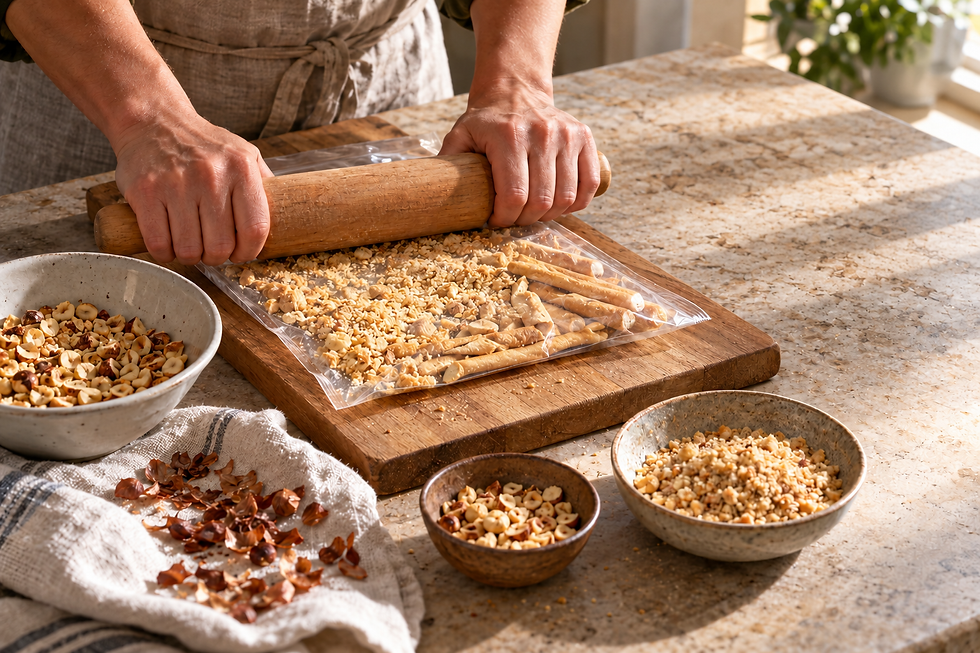
Heat the oven to 325°F (165°C) and toast the hazelnuts for 10 to 12 minutes, shaking the tray once, until the skins have cracked and the kitchen smells clearly of hazelnut, short of caramel. Tip them hot into a towel, rub hard for half a minute, chop them medium fine and set aside 1 tablespoon. Then break the breadsticks in a bag with a rolling pin into uneven crumbs, some coarse as rice grains and some almost dust. A processor makes a powder that behaves like flour and turns the filling dense. Reserve 2 tablespoons of the coarsest crumbs.
Step 4: Build the filling

Combine the crushed grissini, hazelnuts, diced Toma, Grana Padano, garlic, parsley, nutmeg, salt and pepper. Beat the egg with the milk, pour it over and fold with a fork until it just comes together, moist and crumbly. It should clump when squeezed and fall apart when nudged. Rest it 5 minutes, then correct with milk half a tablespoon at a time.
Step 5: Fill the artichokes

Pat each cavity dry, season it with salt, then pack the filling in with a teaspoon, pressing firmly so there are no air pockets and mounding it above the rim. Push a little down between the outer leaves too. Filled loosely, the stuffing floats out into the braising liquid.
Step 6: Brown the bases and start the braise

Choose a heavy pan just wide enough for the six artichokes to stand touching, which keeps them upright. Warm the olive oil over medium heat with the garlic and bay leaf, stand the artichokes in stem side down and colour the bases for 3 to 4 minutes. Pour the wine down the side, bubble it a minute, add the stock and salt and bring back to a bare simmer. The liquid should come no more than a third of the way up.
Step 7: Braise covered, then uncover and finish

Lid on, low heat, 35 to 40 minutes. Test by sliding a knife tip into the base through the side: it should meet no resistance. If the pan runs dry, add hot water down the side, never over the tops. Then take the lid off, scatter the reserved crumbs and hazelnuts over the filling, dot with butter and give them 8 to 10 minutes uncovered until the tops are deep gold.
Plating
Serve these ten minutes out of the pan rather than scalding, when the filling has firmed enough to hold under a fork. They are among the few braised vegetables genuinely good warm. Use warm plates, never hot ones.
Stand one artichoke slightly off centre on each plate and spoon the reduced pan juices around the base so they pool rather than run over the crust. If the juices have thinned, reduce them for a minute until they coat a spoon. Finish with two or three shavings of raw Toma laid against the hot crust, a few drops of olive oil and a turn of pepper. Nothing else belongs on the plate, and a serrated knife is a kindness, since the outer leaves are there to be scraped between the teeth.
Professional Technique
The artichoke here is a cooking vessel, not a garnish. Packed tight and stood upright with liquid a third of the way up, it cooks in two environments at once: the base braises in wine and stock while the filling above the waterline cooks in trapped steam. That is why the pan must be narrow enough for the artichokes to prop each other up, and why the lid matters more than the heat.
The filling is a starch stabilised cheese mixture. Young Toma is high in moisture and on its own would run out of the cavity as fat and whey. The crushed grissini absorb that fat as it releases, the egg sets around the mass at roughly 150°F (65°C), and the Grana Padano adds protein and calcium that hold the melt together. It is also why the Toma is diced: dice melt into pockets that stay distinct, while grated cheese disappears.
The uncovered finish does three jobs at once. It drives off the surface moisture that forty minutes under a lid deposits on the filling, it lets the butter and crumbs brown in dry heat, and it concentrates the braising liquid into something worth spooning onto the plate. The crust cannot be added later under a grill without overcooking the leaves.
Texture and Moisture Control
Three textures have to arrive together: the base yielding like a cooked potato, the leaves tender enough to scrape but still structured, and the crust dry and audible. The artichoke is a moisture problem in both directions. Trimmed too hard it dries out; left with tough outer leaves it needs so long under the lid that the filling turns to paste.
The filling has its own balance. Grissini sit at around 5 percent moisture against perhaps 35 percent in fresh breadcrumbs, and that dryness lets them take on the egg, the milk, the melting Toma and the ambient steam without collapsing. The mixture must be moist going in, or it pulls water out of the artichoke and leaves the cavity mealy. Too wet and it slumps into the pan juices.
Temperature protects the crust. The braise runs at a bare simmer, gentle enough that the cheese never breaks, and the uncovered stage needs slightly more heat so the butter and crumbs colour rather than dry. Once out of the pan the artichokes sit uncovered: foil traps rising steam and softens the crust in about ninety seconds.
Professional Mise en Place
Almost everything can be done in advance, so the artichokes are trimmed and filled early and the pan goes on forty five minutes before service.
Equipment and tools
Heavy casserole with a tight lid, just wide enough for 6 artichokes standing together
Small paring knife and a teaspoon for the chokes
Bowl of acidulated water and a towel for rubbing the hazelnuts
Rolling pin and a sturdy bag for the grissini
Soup spoon for basting the bases
Prepared ahead
Hazelnuts toasted, skinned and chopped, up to 2 days ahead, airtight
Grissini crushed and the topping set aside separately, up to 1 day ahead
Artichokes trimmed and hollowed, up to 6 hours ahead, in lemon water, refrigerated
Filling mixed, up to 4 hours ahead, loosened with milk before use
Artichokes filled and standing in the pan, up to 2 hours ahead, refrigerated
Service setup
Wine and stock measured and warm so the braise never drops temperature
Butter, crumbs and hazelnuts by the stove for the uncovered stage
Toma shaved at the last moment, never in advance or it dries and curls
Plates warm, not hot, and no foil near the finished artichokes
A serrated knife and a spare plate for discarded leaves
Chef Tips
Buy artichokes by weight in the hand, not by size. A good one feels heavy and the leaves squeak faintly when pressed. One that feels light has lost moisture in storage, and braising will not bring it back.
Use real grissini stirati and check the label for nothing beyond flour, water, olive oil, salt and yeast. Industrial breadsticks made with palm fat and malt syrup taste sweet in a savoury filling and crush into soft flakes instead of shards. Rubata gives a denser crumb and also works.
Taste the Toma before you dice it. It varies widely between producers and seasons, and a mild one vanishes under the hazelnut. If yours tastes gentle, push the Grana Padano up to 1 1/2 oz (45 g) and add pepper rather than salt, which would draw water out of the cheese and loosen the filling.
Keep the trimmings. The pared stems are the same flesh as the heart and are excellent simmered alongside the artichokes. The stripped outer leaves, simmered in water for twenty minutes and strained, make a light broth that replaces the vegetable stock. Nothing on an artichoke is waste except the choke.
Common Mistakes
Leaving the choke in. The hairy centre never softens and cannot be picked out once the cavity is full of filling. Scrape it with a teaspoon until the base is smooth and check by eye, not by feel.
Stripping too few outer leaves. Cooks who dislike waste stop at the first pale leaf and leave two rows of tough green ones behind. Those never become tender and the diner meets them first.
Using a pan that is too wide. Artichokes that cannot lean on each other fall over, empty their filling into the liquid and steam unevenly. Pick the narrowest pan they fit in standing, and wedge any spare space with a chunk of onion.
Braising at a hard boil. Rapid boiling agitates the artichokes, breaks the cheese emulsion and reduces the liquid before the base is cooked. Hold a bare simmer throughout.
Skipping the uncovered stage. Forty minutes under a lid leaves the top of the filling pale and damp. The last 8 to 10 minutes with the crumbs and butter on top is what builds the crust, and a grill afterwards only overcooks the leaves. Covering the finished artichokes to keep them warm undoes the same work in two minutes.
Wine Pairing
Erbaluce di Caluso DOCG: Grown on the moraine hills north of Turin, an hour from where this dish belongs. Its high acidity and stony austere finish are what let it sit beside artichoke, which flattens most whites and makes sweeter ones taste metallic. The dry still version carries enough weight for the melted Toma.
Roero Arneis DOCG: From the sandy left bank of the Tanaro, in the same hills as the hazelnut orchards. Arneis is softer than Erbaluce, with pear and white flower aromatics and a bitter almond close that runs straight into the toasted Tonda Gentile. Its gentler acidity suits this richness, and it wants drinking young and cold.
Gavi DOCG: Cortese from the south eastern corner of Piedmont, lean and mineral. Choose it when the artichokes are large and the filling generous, because it works as a cleaning agent between mouthfuls rather than a flavour partner. Its saline edge picks up the salt in the Grana Padano, which softer whites leave standing alone.
Alta Langa DOCG: The metodo classico of the high Langa hills, Pinot Nero and Chardonnay with long lees ageing, worth opening if these artichokes are the centre of the meal. The bubbles and firm acidity scour cheese fat from the palate, and the bready note the lees leave lines up with the grissino crust. Serve the brut.
Dolcetto d'Alba DOC: The red to reach for if the table wants one. Dolcetto has low acidity, soft tannin and dark plum fruit with a bitter almond finish, and the low tannin is the point: a Nebbiolo collides with artichoke and turns harsh in the glass. Serve it at around 59°F (15°C).
Storage & Reheating
Cooked stuffed artichokes keep refrigerated in an airtight container for up to 3 days, and the filling improves on the second day as the hazelnut and Toma settle into each other. Store the pan juices separately rather than letting the artichokes sit in liquid, which softens the leaves and turns the crust to mush.
Reheat dry, never in a microwave and never covered: a small dish at 350°F (175°C) for 12 to 15 minutes with a tablespoon of the reserved juices around the bases, and fresh crushed grissino over the tops for the last 4 minutes.
They freeze with one caveat: freeze them cooked but before the uncovered stage, wrapped individually, for up to 2 months, and thaw overnight in the refrigerator. Reheat at 350°F (175°C) for about 25 minutes, adding the butter and fresh crumbs for the last 10. Frozen after the crust is built, they thaw with a wet top. Raw filled artichokes should not be frozen, since the flesh turns grey and fibrous.
Nutrition
Per serving, based on 6 stuffed artichokes served as a side dish:
Calories: 340 kcal
Total Fat: 22 g
Saturated Fat: 7 g
Trans Fat: 0 g
Unsaturated Fat: 14 g
Cholesterol: 55 mg
Sodium: 490 mg
Total Carbohydrates: 23 g
Fiber: 7 g
Total Sugars: 3 g
Added Sugars: 0 g
Protein: 14 g
Lactose: 1.2 g
Principal micronutrients: folate, vitamin K, vitamin E, calcium, magnesium, potassium, copper, manganese
These figures are estimates. Artichokes are unusually high in fiber and folate for their calorie count, and most of the fat here comes from the hazelnuts and olive oil rather than the cheese. Much of the braising liquid stays in the pan, so the real sodium depends on how much of it reaches the plate.


Comments