
Italian Puglia Chickpea Pasta | Ciceri e Tria

Ciceri e Tria is the dish that explains Salento better than any other. One dough, made from nothing but semola and water, is used in two different ways in the same bowl. Most of it is boiled soft in the chickpea broth. The rest is fried in olive oil until it blisters and snaps. The two arrive together, and the contrast between them is the whole point.
It is also a dish with a passport. The word tria is not Italian at all, and neither the pasta nor the name began in Puglia. What began here is the frying, a solution invented by people who had chickpeas, flour and oil and nothing else to put in the pot, and who found a way to make that taste like a feast.
Cook it with the seriousness you would give a meat course. The chickpeas have to reach genuine creaminess, the dough has to be firm enough to survive the fryer, and the fried strips go into the bowl at the last possible second. Get those three right and it is one of the best plates of pasta in southern Italy.
Yield: 4 servings. Soaking: 12 hours. Prep: 45 minutes. Cook: 2 hours. Total: about 3 hours plus soaking. Difficulty: intermediate. Course: primo piatto. Region: Salento, Puglia.
The Story
The name carries the history. Tria comes from the Arabic itriyya, the word for dried pasta cut into strings, and itriyya itself came into Arabic from the Greek itrion, a thin flatbread. In 1154 the geographer al Idrisi, writing at the Norman court in Palermo, described a place near Trabia in Sicily where itriyya was made in great quantity and shipped by sea to Calabria and to Muslim and Christian lands alike. That is the earliest clear European record of an industry making dried pasta, and the word that describes it is still alive in the Salento, where the pasta is called tria and nothing else.
Salento had every reason to keep the word. The heel of Italy was Greek speaking long before it was Latin speaking, and Griko is still spoken in the villages of the Grecìa Salentina today. Between the Greek roots, the Byzantine centuries and the Arab trade along this coast, a Greek word that travelled through Arabic into a Lecce dialect is not an oddity. It is the ordinary shape of history here.
The frying is the local invention, and it comes straight out of poverty. Chickpeas and semola were what the land gave, meat was for other people, and a household that wanted flavour and richness had to find it in the oil. Frying a portion of the raw pasta produced something that crackled, smelled toasted and coated the tongue with fat, and the Salentini called the crisp strips frizzuli. They gave a plate of pulses the weight of a proper meal, which is exactly what they were for.
Ciceri e tria belongs above all to the table of San Giuseppe on 19 March, the great Salentine feast of the poor, when families prepare meatless dishes and share them with guests invited to represent the Holy Family. It is also eaten through the winter, and in the province of Lecce it turns up on the feast of Santa Lucia in December. Traditionally it carries no cheese at all, and it does not need any.
Ingredients
For the tria
Durum wheat semola rimacinata, 2 1/3 cups (350 g)
Warm water, about 3/4 cup (175 ml)
Fine sea salt, 1/2 tsp (3 g)
For the chickpeas
Dried chickpeas, preferably small Puglian ones, 1 1/2 cups (300 g)
Water for soaking, 6 cups (1.4 l)
Baking soda for the soak, 1/4 tsp (1 g)
Fresh water for cooking, 8 cups (1.9 l)
Celery stalk, 1
Yellow onion, small, peeled and left whole, 1
Bay leaves, 2
Fine sea salt, added late, 1 1/2 tsp (9 g)
For the soffritto and finishing
Extra virgin olive oil, 1/4 cup (60 ml)
Garlic cloves, lightly crushed, 3
Bay leaves, 2
Crushed peperoncino, 1/4 tsp (0.5 g)
Freshly ground black pepper, to taste
Flat leaf parsley, chopped, 1 tbsp (4 g)
For frying the tria
Extra virgin olive oil for shallow frying, 1 1/2 cups (360 ml)
Fine sea salt, a small pinch
Preparation
Step 1
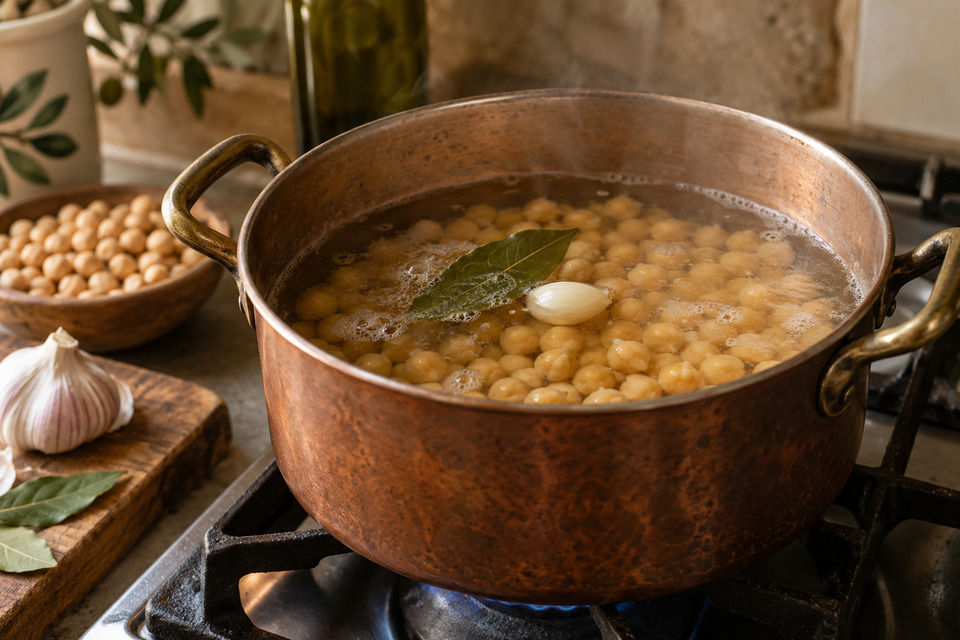
Soak the chickpeas for at least 12 hours in cold water with the baking soda, which softens the skins and shortens the cooking. Drain, rinse well and put them in a heavy pot with 8 cups (1.9 l) of fresh water, the celery, the whole onion and the bay. Bring them barely to a simmer and keep them there, never at a boil, for 1 1/2 to 2 hours depending on their age. Salt only in the last 20 minutes. They are ready when a chickpea crushes to a paste between two fingers with no chalky centre. Keep every drop of the cooking liquid.
Step 2

Tip the semola onto a board, make a well, add the salt and pour in the warm water a little at a time, drawing the flour in with your fingers. Work the dough hard for a full 10 minutes. It should end up firmer than a fresh egg pasta dough, smooth, and dry enough to leave the board clean. There is no egg and no oil, so the only thing holding it together is gluten, and gluten needs the time. Cover it and rest it 30 minutes at room temperature.
Step 3
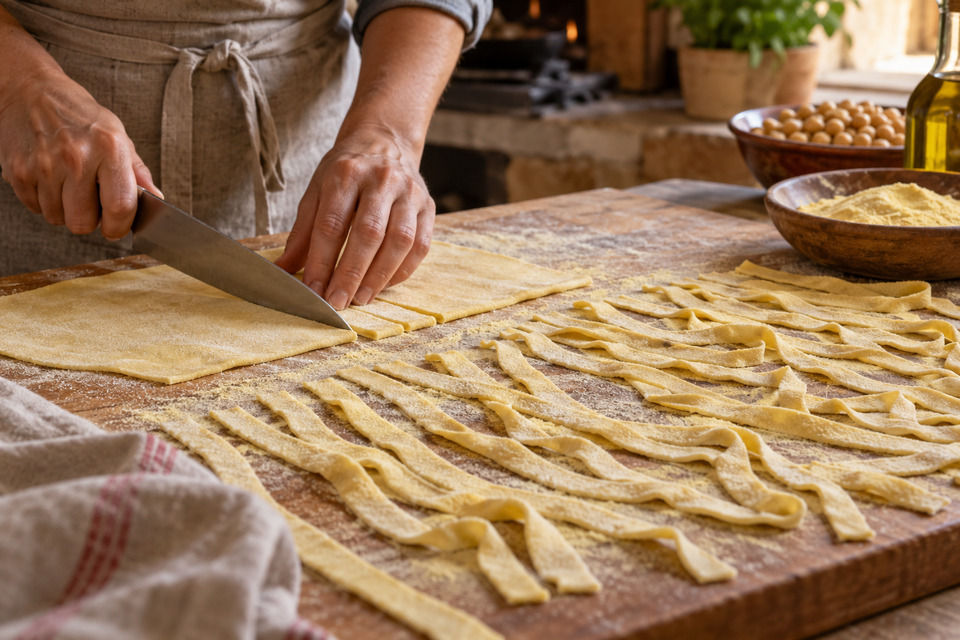
Roll the rested dough out to about 1/16 inch (2 mm), in two pieces if the board is small. Dust the sheet with semola, fold it loosely and cut it across into strips about 1/3 inch (8 mm) wide and 2 1/2 inches (6 cm) long. Shake them apart at once so they do not weld together and spread them on a semola dusted tray, uncovered. Set aside one third for frying.
Step 4

Heat the frying oil in a small deep pan to 340°F (170°C). Fry the reserved raw tria in small batches, never crowding the pan, for 40 to 60 seconds, until the strips blister, puff slightly and turn deep gold. They colour very fast at the end, so lift them out a shade before they look finished. Drain on paper, salt them lightly while hot, and leave them somewhere dry away from steam. These are the frizzuli.
Step 5

In a wide pan, warm the 1/4 cup (60 ml) of olive oil over low heat with the crushed garlic, the bay leaves and the peperoncino, and let them infuse for 3 to 4 minutes. The garlic must go no further than pale blond: browned garlic turns bitter and that bitterness cannot be lifted out of a dish with this few ingredients. Take the garlic out once the oil is perfumed, and leave the bay in.
Step 6

Add three quarters of the drained chickpeas to the infused oil with 3 cups (720 ml) of their cooking liquid and bring it to a gentle simmer. Crush about a quarter of them against the side of the pan with a wooden spoon. The starch they release is what makes this dish creamy, and it is the only thickener it will ever have. Simmer 10 minutes so the chickpeas take on the oil and the bay.
Step 7
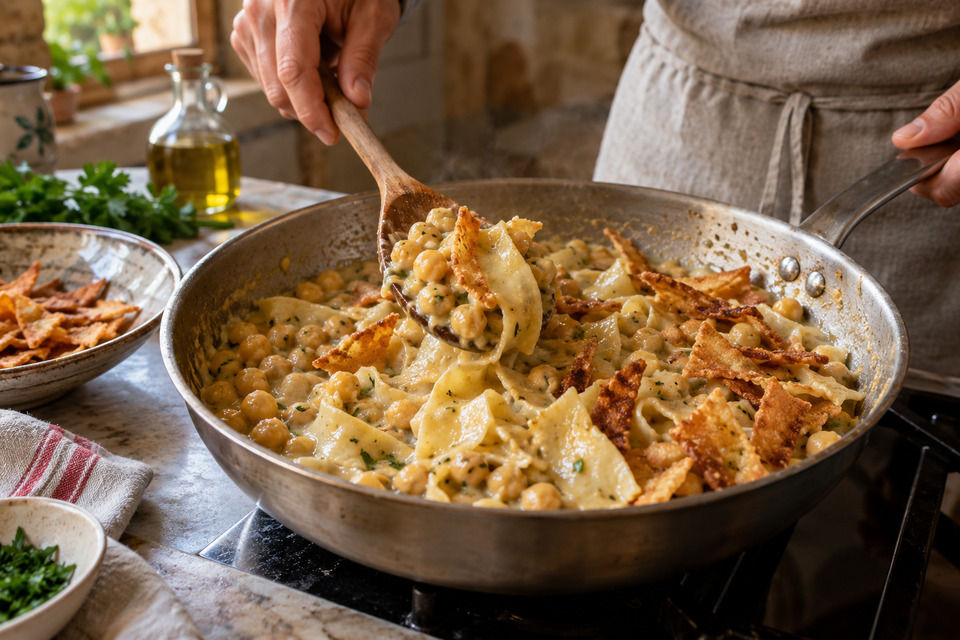
Bring the pan to a lively simmer and add the remaining fresh tria straight into the chickpea broth, without boiling it separately in water. Stir gently and often, because fresh semola pasta sticks in a crowded pan, and keep hot chickpea liquid beside you to add whenever the surface goes tight. It needs 4 to 6 minutes and should finish al dente, the broth reduced to a loose sauce that coats the pasta.
Step 8
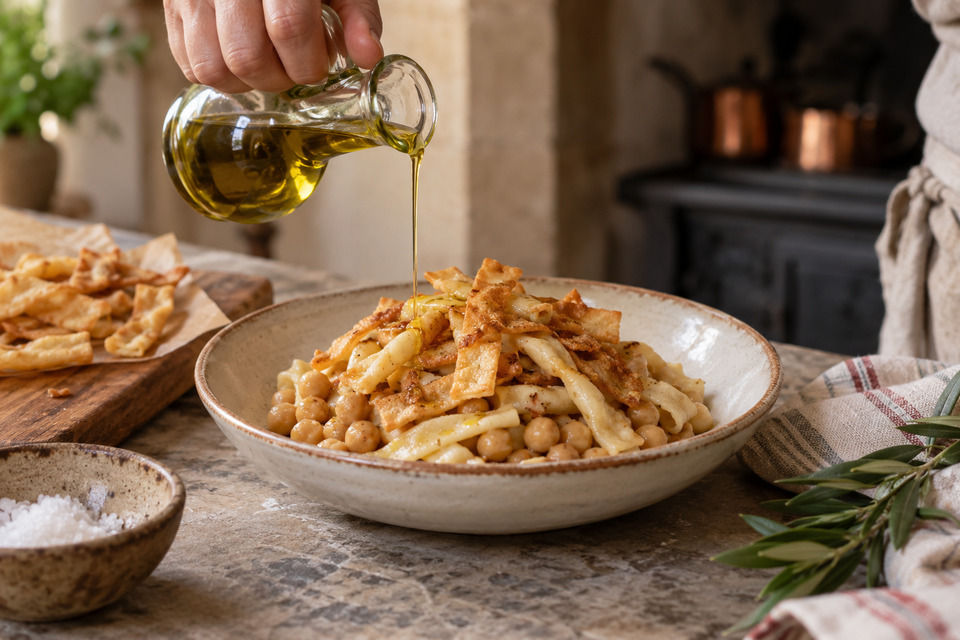
Take the pan off the heat, fish out the bay and taste for salt: the chickpea liquid will have concentrated, so check before adding any. Grind in black pepper, stir through the parsley and let the pan stand a minute so the sauce settles. Divide among warm bowls and only then scatter the fried tria over each portion, finishing with a thread of raw olive oil. The frizzuli go on at the table, never into the pan.
Plating
Warm the bowls, and use deep ones. This dish holds a lot of loose broth and cools faster than it looks as if it will, so a shallow plate sends it to the table lukewarm. Ladle the pasta and chickpeas in first and let the surface settle before anything goes on top.
Scatter the frizzuli across the surface at the last second, generously and unevenly, so some strips sit proud and dry and others begin to soften in the broth. That gradient is the dish. Finish with a thread of good raw olive oil and a turn of black pepper, and carry it out immediately. No cheese: Salento does not put cheese on this, and grated pecorino would smother the fried pasta it exists for.
Professional Technique
The technical heart of this recipe is that one dough is asked to do two opposite jobs. Boiled in broth, the tria has to hydrate evenly and stay whole; dropped in hot oil, the same raw dough has to dehydrate violently and set into a rigid blistered shape. Both depend on the dough being dry and worked hard. A soft wet dough boils into mush and goes limp in the fryer, absorbing oil instead of repelling it. Firm semola and a full 10 minutes of kneading serve both ends at once.
The second technique is cooking the pasta in the chickpea liquid rather than in water. That liquid already carries the starch and the soluble proteins that leached out of the pulses over two hours, and the semola releases more as it cooks. Together they build a sauce without a roux, without cream and without cheese. Boiling the tria separately and draining it throws away both halves of that mechanism and leaves you with pasta sitting in thin chickpea soup.
The third is the frying window. Raw semola strips at 340°F (170°C) pass from pale to gold to bitter in a handful of seconds, because there is no sugar or egg to buffer the colour. Fry them too cool and they drink oil and turn heavy; too hot and the outside sets before the inside dries, which gives a strip that looks right and goes soft within a minute of hitting the broth.
Texture and Moisture Control
There are three textures to protect and they pull in different directions. The chickpeas must be creamy to the centre, which means a long bare simmer, since a rolling boil breaks the skins and leaves the interiors chalky. The boiled tria must stay al dente in a pan that keeps thickening. The fried tria must stay brittle in a bowl of hot liquid, which it will only do for a couple of minutes, and that is why it is added at the table.
Moisture is managed through the chickpea broth, not added water. Keep it hot and use it to loosen the pan whenever the sauce tightens, a ladle at a time. Plain water dilutes both starch and flavour and the dish goes flat immediately. If the sauce ends up too loose, lift the pan off the heat for a minute: fresh semola pasta keeps absorbing liquid and usually corrects itself.
Professional Mise en Place
Most of this dish is done in advance. The final assembly takes under ten minutes and the fried tria is the last thing that moves, so set the station up around that.
Equipment and tools
Heavy pot for the chickpeas, wide pan for the finish, small deep pan for frying
Rolling pin, bench scraper and two trays dusted with semola
Frying thermometer, spider skimmer, paper lined tray for draining
Ladle for the chickpea liquid, kept hot beside the pan
Prepared ahead
Chickpeas soaked overnight and cooked, up to 2 days ahead, stored in their liquid
Tria rolled and cut on the day, spread on semola dusted trays uncovered
Frizzuli fried up to 3 hours ahead and held in a dry open container
Garlic peeled, bay counted out, parsley chopped just before service
Service setup
Chickpea liquid hot and within reach, never cold water
Fried tria on the pass, uncovered, away from all steam
Bowls warmed, olive oil and pepper mill at the pass
Chef Tips
Use small chickpeas if you can find them. The little Puglian and Sicilian varieties have thinner skins and a nuttier flavour than the big commercial ones, and they break down into creaminess far more willingly.
Never throw away the chickpea cooking water. It is the sauce, the cooking medium and the correction for a tight pan all at once. Cook the pulses in enough water to end with at least 4 cups (950 ml) of good liquid, and keep it hot throughout service.
Fry the tria in olive oil, not in a neutral seed oil. The flavour of the fat is one of the three things this recipe actually has, and a good Salentine olive oil brings a peppery bitterness to the crisp strips that nothing else reproduces.
If the dough fights you while rolling, stop and rest it for another 15 minutes. Semola dough tightens hard under work and will spring back no matter how much force you apply. The rest costs nothing and the sheet then rolls out thin without tearing.
Common Mistakes
Boiling the chickpeas hard. A rolling boil tears the skins and keeps the interiors chalky however long they cook. Hold the pot at a bare simmer with the surface barely moving for the full 2 hours.
Salting the chickpeas at the start. Salt added to the soaking or the early cooking water firms the skins and slows softening. Add it in the last 20 minutes, once they are already tender.
Cooking the tria in plain water. Boiling the pasta separately and draining it throws away the starch that builds the sauce. It cooks in the chickpea broth, from raw, and nowhere else.
Frying the tria too far ahead. The frizzuli are best within a couple of hours and must be kept uncovered and dry. Sealed in a container while still warm they steam themselves soft and lose the whole point.
Stirring the fried strips into the pan. They go over each bowl at the table. Folded into the hot broth in the pan they surrender within thirty seconds and the dish becomes an ordinary chickpea pasta.
Wine Pairing
Salice Salentino DOC: The bottle from the same few square miles as the dish, and the one to open first. Negroamaro gives a dry red with soft tannin, dark plum fruit and a bitter edge on the finish that meets the fried tria directly. It has enough body for the olive oil and enough freshness not to bury a plate of pulses.
Martina Franca DOC: The white answer, from the Valle d'Itria just north of the Salento. Verdeca and Bianco d'Alessano make a dry, low key wine with green apple acidity and a faint bitter almond close, and that quiet profile suits chickpeas, which are sweet and earthy and easily overwhelmed. It also cuts the frying oil cleanly.
Primitivo di Manduria DOC: For a winter version with a heavier hand on the peperoncino. The dry Manduria bottlings bring ripe black fruit, warmth and a rounded texture that sits well with the toasted flavour of the frizzuli. Keep it around 61°F (16°C), because served warm its alcohol amplifies the chilli instead of calming it.
Castel del Monte Nero di Troia Riserva DOCG: From northern Puglia and the most structured red on the list. Nero di Troia has firmer tannin and a distinct note of dried herb and pepper, which follows the bay and black pepper in the pan. Choose it when the chickpeas have been cooked long and dark and the dish leans savoury rather than bright.
Greco di Tufo DOCG: A step outside Puglia, into Campania, and worth it for the texture. Greco is broad and slightly waxy with a smoky mineral undertow, and that weight matches the creaminess the crushed chickpeas create. Its acidity stays high underneath, so it resets the palate between spoonfuls of fried pasta.
Storage & Reheating
Cooked chickpeas keep 3 days in the refrigerator submerged in their own liquid, and freeze for 3 months in the same liquid, which protects them from drying. Fresh tria can be dried completely on a semola dusted tray over 24 hours, then kept in a paper bag for a month. Frizzuli are best the day they are fried and must be stored uncovered.
The assembled dish keeps 2 days refrigerated in a sealed container, though the pasta drinks most of the broth overnight. Reheat it in a wide pan over medium low heat with a ladle of chickpea liquid, or hot water if none is left, stirring gently until it loosens and steams, about 4 minutes. Never microwave it and never let it boil, which breaks the pasta apart. Fry a fresh handful of tria for the top rather than reheating old frizzuli, which do not come back.
Nutrition
Per serving, based on 4 portions:
Calories: 710 kcal
Total Fat: 24 g
Saturated Fat: 3.5 g
Trans Fat: 0 g
Unsaturated Fat: 19 g
Cholesterol: 0 mg
Sodium: 640 mg
Total Carbohydrates: 100 g
Fiber: 15 g
Total Sugars: 9 g
Added Sugars: 0 g
Protein: 24 g
Lactose: 0 g
Principal micronutrients: folate, iron, manganese, magnesium, phosphorus, copper, zinc, vitamin K
These figures are estimates. The dish is naturally vegan and dairy free, and the fat total depends on how much frying oil the tria takes up.


Comments