
Italian Slow Braised Wild Boar in Red Wine | Cinghiale in Umido

Almost everything written about wild boar in Italy begins with the hunt and ends with the pot, and skips the part in between, where the dish is actually decided. Cinghiale in umido is a simple braise: wine, aromatics, long slow cooking. What makes one version extraordinary and another merely edible is not the recipe but the animal, how it was taken and how long it hung before anyone cut it up.
This version is written from that end. It assumes shoulder from a young animal, properly aged, and it treats the marinade as a tool rather than as penance for meat somebody is afraid of. The wine is strained and reduced instead of being thrown away or tipped in raw, the browning is done in a wide skillet, and the cooking happens in a low oven where nothing catches. There is no chocolate, no vinegar, no candied peel: those belong to dolceforte, another dish entirely.
Yield: 6 servings. Prep: 40 minutes. Marinade: 12 hours. Cook: 3 hours 30 minutes. Rest: 30 minutes. Difficulty: intermediate. Course: secondo. Serve with soft polenta, boiled potatoes or plain bread.
The Story
The Italian wild boar is not a relic of an older countryside. It is the result of one of the most dramatic wildlife recoveries in modern Europe. After the war the animal had almost vanished from large parts of the peninsula, and from the 1950s onward it was reintroduced for hunting, often with stock from central and eastern Europe that was larger and more prolific than the small native form. Those animals bred, spread and interbred with what remained, and the population is now counted in the high hundreds of thousands, from the suburbs of Rome to the slopes of Etna.
Everything that reaches a kitchen passes through that reality. Italian hunting law distinguishes the braccata, the driven hunt in which teams and dogs push animals towards a line of guns, from the caccia di selezione, in which a single hunter waits, identifies an animal by age and sex and takes it with one shot. The difference matters enormously on the plate. An animal that has run for an hour ahead of dogs dies with its muscles flooded with lactic acid, and the meat is darker, drier and more strongly flavoured. An animal taken cleanly and unaware is simply meat. Any boar destined for sale must then pass through a centro di lavorazione della selvaggina, inspected by a veterinarian and tested for trichinella, which is why legally sold Italian boar is traceable.
The last step is the one Italians call frollatura. Game is hung at around 34°F to 38°F (1°C to 3°C) for five to eight days, long enough for rigor to resolve and for muscle enzymes to break down the proteins that make fresh game tough and flatly flavoured. Boar aged properly braises to tenderness in three hours. Boar butchered and frozen the day it was shot can sit in the oven for five and still be chewy. In umido exists precisely because it forgives whatever animal the season gave you.
Ingredients
For the wild boar
Boneless wild boar shoulder, aged, in 2 inch (5 cm) pieces, 3 lb (1.35 kg)
Fine sea salt, 2 tsp (12 g)
Freshly ground black pepper, 1 tsp (2 g)
Extra virgin olive oil, 4 tbsp (60 ml)
For the marinade
Dry red wine, medium bodied, 3 cups (720 ml)
Yellow onion, quartered, 1
Carrot, cut into chunks, 1
Celery stalk, cut into chunks, 1
Garlic cloves, crushed, 3
Juniper berries, lightly crushed, 10
Black peppercorns, 1 tsp (3 g)
Bay leaves, 2
Rosemary sprig, 1
Sage leaves, 4
For the braise
Pancetta, diced, 3 oz (85 g)
Yellow onion, chopped, 1 large, 7 oz (200 g)
Carrot, chopped, 1 large, 3 oz (85 g)
Celery stalks, chopped, 2, 3 oz (85 g)
Garlic cloves, finely chopped, 2
Tomato paste, 2 tbsp (32 g)
Peeled plum tomatoes, crushed, 1 cup (240 g)
Light meat broth, hot, 2 cups (480 ml)
Bay leaf, 1
Rosemary sprig, 1
Juniper berries, crushed, 6
For finishing
Unsalted butter, cold, 1 tbsp (14 g), optional
Flat leaf parsley, chopped, 2 tbsp
Fine sea salt and black pepper, to taste
Extra virgin olive oil, for the plate
Preparation
The marinade runs overnight and the braise most of an afternoon, but the work itself is under an hour.
Trimming and portioning the shoulder
Wild boar shoulder carries sheets of silverskin and a little hard fat, and both come off first. Work along the natural seams with a boning knife and cut the meat into pieces of about 2 inches (5 cm), keeping them even, because a mix of large and small pieces guarantees that some are dry before the rest are tender. Boar fat is strongly flavoured and does not soften the way pork fat does, so trim it hard and rely on the pancetta for richness.
Setting the overnight marinade
Put the meat in a nonreactive container, add the wine, quartered vegetables, garlic, juniper, peppercorns, bay, rosemary and sage, and press it down so it is covered. Refrigerate for 12 hours, or 18 if the animal was mature. The purpose is not to tenderise, since wine barely penetrates a few millimetres, but to draw out the blood that carries the strongest gamey notes.
Draining, drying and saving the wine
Lift the meat onto a rack over a tray, pat every piece thoroughly dry and leave it uncovered at room temperature for 30 minutes. Strain the marinade into a saucepan and discard the spent vegetables. Bring the wine to a boil, skim the grey scum that rises in the first two minutes and reduce it by a third. Raw marinade tastes harsh and metallic, and this step turns it into an ingredient.
Browning the meat in batches
Heat 3 tablespoons of the olive oil in a wide skillet over medium high heat until just short of smoking. Season the meat and lay it in with clear space around each piece, in three or four batches. Leave each batch undisturbed for 3 to 4 minutes before turning, aiming for a deep crust on two faces. Use the skillet, not the braising pot, because a wide surface holds its temperature while a tall pot traps steam.
Building the soffritto
Wipe out the braising pot, add the last tablespoon of oil and the pancetta and render it over medium heat for 5 minutes. Add the onion, carrot and celery and cook for 12 to 15 minutes until soft and lightly golden, then the garlic for a minute more. Stir in the tomato paste and cook it out for 2 minutes, until it darkens from bright red to brick, which removes its raw sharpness and deepens the colour of the sauce.
Setting the braise in the oven
Heat the oven to 300°F (150°C). Return the boar with any juices from the tray, pour in the reduced wine and let it bubble for 2 minutes, scraping the base. Add the crushed tomatoes, hot broth, bay, rosemary and juniper. The liquid should reach three quarters of the way up the meat and no further. Bring to a bare simmer, cover with the lid slightly ajar and transfer to the oven for 2 hours 45 minutes to 3 hours 15 minutes.
Judging doneness and finishing the sauce
The meat is ready when a fork slides in and twists without force but the pieces still hold their shape. Lift them out and rest them covered for 20 minutes. Meanwhile reduce the liquid over medium heat until it coats a spoon. Taste and correct the salt now, not earlier. Return the meat, warm it through for 5 minutes off a hard boil and whisk in the cold butter if you want gloss.
Plating
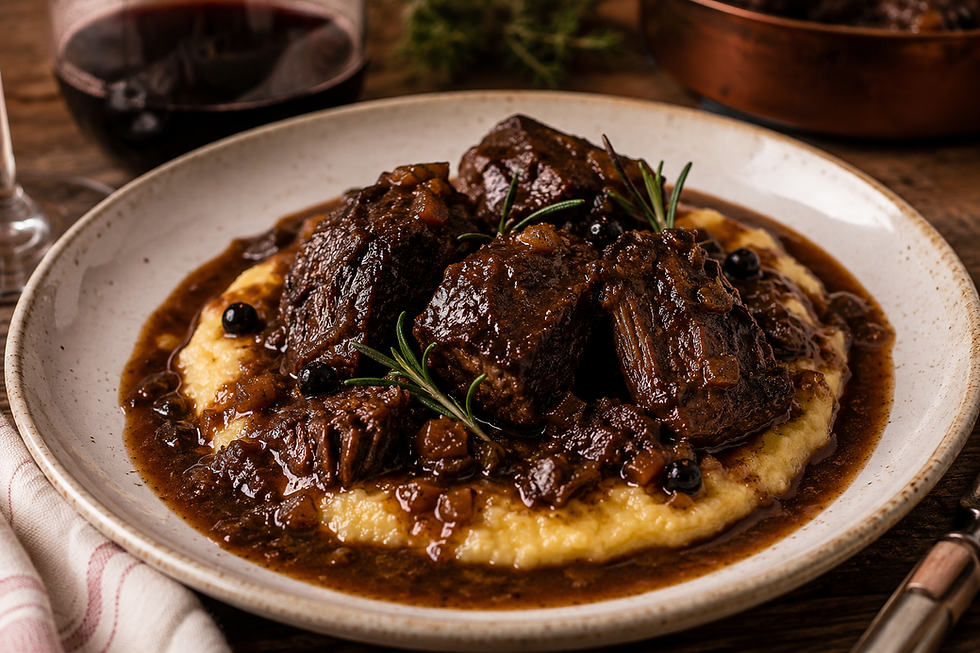
This is a bowl dish. Use warmed shallow bowls, because boar sauce is heavy with gelatin and sets into a skin on a cold surface within a minute. Spoon soft polenta or boiled potatoes slightly off centre, lay three or four pieces of meat against them and ladle sauce over the join rather than over everything.
Keep the pieces whole. Shredding turns the dish into a ragù, and the pleasure here is in cutting through a piece that holds together and then gives way. Finish with chopped parsley and a thread of raw olive oil, and nothing else: no cheese, which fights the game, and no extra herbs, which have already had three hours to say what they had to say.
Professional Technique
The technique that defines this version is the treatment of the marinade as two separate things. Most home recipes either discard the wine or pour it in as it is, and both choices cost the dish. Discarded, it takes with it a great deal of flavour and all of the juniper infusion. Poured in raw, it brings dissolved blood proteins that coagulate into grey scum and a sharp acidity that never integrates. Boiling and skimming it first, then reducing it by a third, removes the proteins and concentrates what is worth keeping.
The second is the separation of browning from braising. Searing in the braising pot is why so many stews taste flat: the pot is too tall, steam accumulates above the meat, the surface never dries and the crust never forms. A wide skillet and three or four batches cost fifteen extra minutes and produce Maillard compounds a braise cannot generate later.
The third is oven braising rather than stovetop. A burner heats one spot at the bottom of the pot, and boar, being very lean, scorches there long before it is tender. A 300°F (150°C) oven surrounds the pot so the liquid sits at 180°F to 190°F (82°C to 88°C) without boiling, the exact range where collagen converts to gelatin while the fibres stay intact. The lid is left ajar so slow evaporation half concentrates the sauce before the final reduction.
Texture and Moisture Control
Wild boar is far leaner than farmed pork, with intramuscular fat often under three per cent, so there is almost no internal fat to keep the meat moist. All of the succulence comes from converted collagen, which makes the cooking a race: the muscle fibres contract and expel moisture from around 140°F (60°C) upward, while the collagen sheathing them only begins to hydrolyse into gelatin above roughly 160°F (71°C) and needs hours there. Held low and long, the gelatin arrives and lubricates the dried fibres. Pushed hot and fast, the fibres are wrung out before any gelatin exists.
That is why the visible cue matters more than the clock. You want the surface barely trembling, with a bubble breaking every few seconds. If the pot is rolling, the oven is too hot or the lid too tight. Age and sex change the timing by as much as an hour, so start testing at two and a half hours.
The liquid level is the other control. Covering the meat completely gives boiled boar in a thin sauce, because no surface is left above the water line to concentrate. Three quarters of the way up leaves the tops exposed, and with the lid ajar they glaze while the submerged parts stay protected. The 20 minute rest lets pressure inside the fibres equalise, so the pieces reabsorb liquid instead of bleeding it into the sauce.
Professional Mise en Place
Almost all of this can be done ahead, and the dish is better on the second day.
Equipment and tools
Heavy enamelled cast iron pot of 6 quarts (6 litres) with a lid, oven safe
Wide skillet of at least 12 inches (30 cm) for browning
Nonreactive container big enough for the meat and 3 cups of wine
Fine mesh sieve, wire rack over a tray, slotted spoon
Warmed shallow bowls for service
Prepared ahead
Boar trimmed and portioned 1 day ahead, held cold
Marinade assembled and the meat submerged, 12 to 18 hours ahead
Soffritto vegetables chopped and covered, 1 day ahead
Wine strained, boiled, skimmed and reduced, up to 2 days ahead
The whole braise cooked 1 or 2 days ahead, so the set fat lifts off
Service setup
Braise reheating slowly, never at a boil
Polenta or potatoes timed to finish with the meat
Bowls warming, parsley chopped at the last moment
Hot broth held back to loosen a sauce reduced too far
Chef Tips
Ask the butcher two questions: the age of the animal and how long it hung. A young boar under two years aged five days needs under three hours. An older animal, or one frozen the day it was taken, can need four and a half.
Choose the wine for structure, not prestige. A medium bodied dry red with real acidity and moderate tannin does the job. Very tannic wine concentrates over three hours into something astringent, and an oaky wine leaves a vanilla note that sits strangely against juniper.
If the sauce tastes flat at the end, it needs salt rather than more herbs. Boar absorbs a surprising amount, and the braise is deliberately under seasoned early so the final reduction does not turn briny.
Farmed boar, sold in much of Europe and increasingly in Italy, is fattier and milder and cooks about 45 minutes faster. Shorten the marinade to 6 hours and start checking for tenderness at two.
Common Mistakes
Pouring the raw marinade into the pot. It carries dissolved blood proteins that coagulate into grey scum and a sharp acidity that never integrates. Strain it, boil it, skim and reduce it by a third before it goes near the meat.
Browning in the braising pot. A tall narrow pot traps steam, the surface never dries, and you get grey pieces and no crust. Use a wide skillet and three or four batches.
Marinating for two or three days. Twelve to eighteen hours is enough. Beyond a day the wine acid breaks the outer layer into a soft mushy band that stays that way through the braise, and the juniper turns medicinal.
Braising on the stove. Boar is too lean to sit over a single hot spot for three hours. A 300°F (150°C) oven heats the pot from all sides and holds the liquid just below a simmer without attention.
Adding chocolate, vinegar or raisins. Those belong to cinghiale in dolceforte, a separate historic preparation. Added here they bury the juniper and the game and leave you with neither dish.
Wine Pairing
Aglianico del Taburno DOCG: Boar country in Campania, and a wine built for this weight of cooking. Aglianico from the volcanic slopes of the Taburno has high acidity and a firm tannic spine that scours the gelatin off the palate, while its dark plum and smoky mineral character meets the juniper head on. Give it an hour open.
Montepulciano d'Abruzzo Colline Teramane DOCG: From the hills below the Gran Sasso, where boar hunting is part of the calendar. These bottlings have more grip than standard Montepulciano, with sour cherry acidity and a velvety tannin that suits a sauce carrying tomato. The acidity keeps a rich braise from feeling heavy by the third piece.
Valtellina Superiore DOCG: Alpine nebbiolo grown on terraces above the Adda, and the elegant choice here. Its tannin is fine and dusty rather than broad, and its dried rose and tar aromatics run alongside juniper and rosemary better than any fruit driven red.
Etna Rosso DOC: Nerello Mascalese from volcanic soil, pale in the glass and far more structured than it looks. The Nebrodi and the slopes of Etna hold some of the densest boar populations in Sicily, so the pairing is local. Its saline edge and bright acidity cut the fat of the pancetta, while a smoky ash note picks up the browned surfaces of the meat.
Refosco dal Peduncolo Rosso Friuli DOC: The northeastern answer, from a region where game braises are cooked all winter. Refosco is dark, firm and herbal, with a bitter almond finish and brisk acidity that handles both the tomato and the reduced wine. It is the least fruit forward wine here, which is why it works against a dish that is savoury throughout.
Storage & Reheating
This dish improves with a night in the refrigerator. Cool it within two hours, then keep the meat submerged in its sauce in a sealed container for up to 4 days. The fat sets on top and lifts off in one disc, and the gelatin firms the sauce to a jelly, which is a good sign.
Reheat on the stove over low heat with the lid on and stop at a bare simmer. Never use a microwave and never let it boil: reheated boar that has boiled goes stringy in minutes. If the sauce has set too firm, loosen it with hot broth rather than water.
It freezes for up to 3 months. Freeze the meat fully covered in sauce with an inch of headspace, since any piece exposed to air will dry and turn grey. Thaw overnight and reheat slowly. Leftover meat chopped small and stretched with a little tomato makes a good sauce for pappardelle.
Nutrition
Per serving, based on 6 servings, sauce included and set fat removed:
Calories: 480 kcal
Total Fat: 22 g
Saturated Fat: 7 g
Trans Fat: 0.2 g
Unsaturated Fat: 14 g
Cholesterol: 150 mg
Sodium: 690 mg
Total Carbohydrates: 11 g
Fiber: 2.5 g
Total Sugars: 5 g
Added Sugars: 0 g
Protein: 50 g
Lactose: 0 g
Principal micronutrients: iron, zinc, selenium, vitamin B12, niacin, vitamin B6, phosphorus
These figures are estimates. Wild boar varies widely in fat content with the age of the animal and the season, and most of the marinade is discarded rather than eaten.




Comments