
Italian Red Wine Braised Wild Boar | Cinghiale Brasato al Vino Rosso
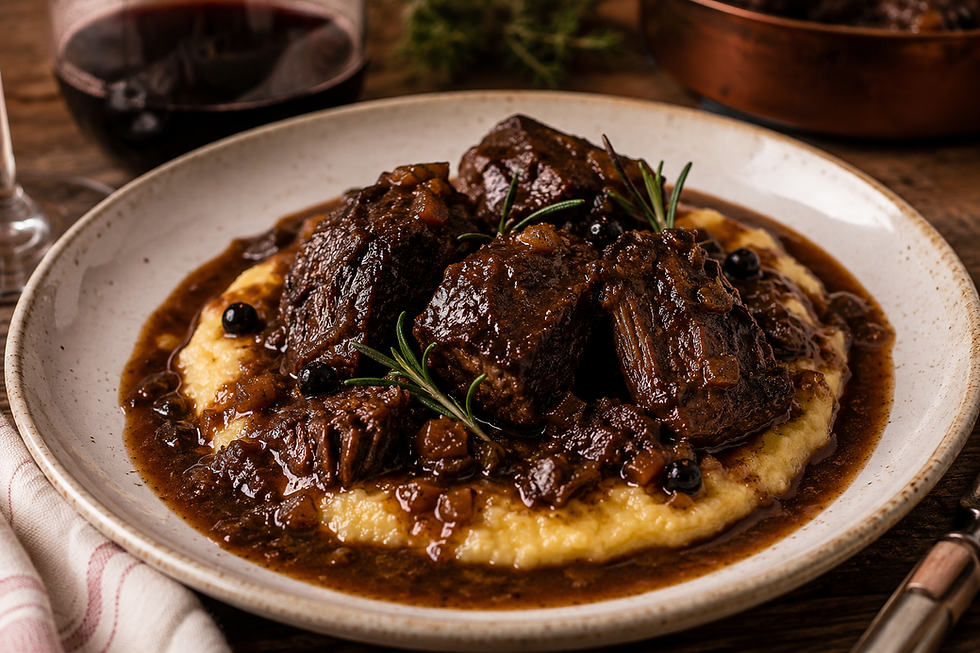
Cinghiale brasato al vino rosso is what the Tuscan and Umbrian hills build around an animal nobody farms. Wild boar is hunted, and everything in the recipe answers that: the long bath in red wine, the juniper, the added pork fat, four hours of low heat a farmed shoulder would never need.
What reaches the table is dark, glossy and deeply savoury, with a gamey edge that never takes over. The meat gives way under a fork without falling into threads, and the sauce is the marinade wine itself, reduced apart and thickened only by the gelatin the boar releases. Two decisions made before any heat set the result: how long the meat marinates, and whether it is blanched first.
Yield: 6 servings. Marinade: 12 to 24 hours. Prep: 45 minutes. Cook: 3 1/2 to 4 1/2 hours. Rest: 30 minutes. Difficulty: intermediate. Course: secondo di carne. Region: Tuscany, Umbria, Lazio and Sardinia.
The Story
Wild boar is the oldest meat in central Italian cooking, and for most of that history a windfall rather than a delicacy. The Maremma, the scrub and oak woods running down the Tyrrhenian coast of Tuscany into northern Lazio, is where the dish is most at home, and the Umbrian hills around Norcia and the Sardinian Barbagia claim it just as strongly. The boar belonged to whoever shot it, and a hundred pounds of dense dark meat arriving at once in a peasant kitchen was a gift and a problem at the same time.
Marinating in wine was the answer, and it predates any notion of flavour balance. A hunted animal reached the kitchen unbled and sometimes days old, tasting stronger the longer it hung. Wine, vinegar, onion, bay and juniper made it acceptable. In Tuscany the same meat also went into cinghiale in dolceforte, an older preparation finished with bitter chocolate, pine nuts, raisins and candied peel, the sweet and sour sauce Renaissance kitchens used on game and which survives mostly in Siena and Florence.
The context has now reversed. Italy holds more wild boar than at any point in recorded history, well over a million animals pushing into suburbs and vineyards and damaging crops. Culls and control programmes make the meat more available than ever, and often cheap. A recipe that once made a rare windfall edible is now the practical answer to an animal there is too much of.
Ingredients
For the meat
Wild boar shoulder, leg or neck, boneless, in 2 inch (5 cm) cubes, 3 1/2 lb (1.6 kg)
Pancetta or unsmoked guanciale, diced, 5 oz (140 g)
Lard or extra virgin olive oil, 3 tbsp (45 ml)
Coarse salt, for the optional blanch, 1 tbsp (18 g)
For the marinade
Dry red wine, structured, 4 cups (950 ml)
Red wine vinegar, 2 tbsp (30 ml)
Yellow onion, quartered, 1 large (7 oz, 200 g)
Carrot, cut in thick rounds, 1 large (5 oz, 140 g)
Celery stalk, cut in thirds, 2 (4 oz, 115 g)
Garlic cloves, crushed, 4
Juniper berries, lightly crushed, 12 (6 g)
Black peppercorns, 12
Bay leaves, 3
Rosemary sprigs, 2
Whole cloves, 3
For the braise
Yellow onion, finely diced, 1 medium (5 oz, 140 g)
Carrot, finely diced, 1 medium (3 oz, 85 g)
Celery, finely diced, 1 stalk (2 oz, 60 g)
Tomato paste, 2 tbsp (32 g)
Canned peeled tomatoes, crushed, 1 cup (240 g)
Beef or game stock, hot, 2 cups (480 ml), plus more
Fine sea salt, 2 tsp (12 g), in stages
Freshly ground black pepper, to taste
For finishing
Extra virgin olive oil, 2 tbsp (30 ml)
Rosemary, finely chopped, 1 tsp (1 g)
Coarse cornmeal for soft polenta, 1 1/2 cups (250 g)
Preparation
Trimming and cutting the meat
Boar has almost no fat inside the muscle, and the hard outer layer holds most of the gamey compounds. Trim it away completely with any silverskin. Cut cubes of about 2 inches (5 cm), no smaller, since dense boar fibre shreds in small pieces. A shoulder loses close to a fifth of its weight here, so weigh it after trimming.
Blanching, if the meat is strong
The old country trick, and optional. Cover the cubes with cold water, add the coarse salt, bring slowly to a boil, skim the grey scum hard for 2 minutes, then drain, rinse and dry. That scum is blood and soluble fat, where the strongest gamey notes live.
Marinating in wine for twelve hours or more
Put the meat in a nonreactive bowl or a food bag with the onion, carrot, celery, garlic, juniper, peppercorns, bay, rosemary and cloves. Pour over the wine and vinegar, press the meat under the surface and refrigerate 12 hours for a young animal, 24 for an older one. Never at room temperature, never in aluminium.
Draining and drying thoroughly
Blot every surface on a rack until it feels dry. Strain the marinade, keeping liquid and vegetables apart, and discard the bay, rosemary and cloves. Wine soaked meat steams and greys in a hot pan instead of browning, and the colour of the dish depends on this.
Browning in batches with added fat
Render the pancetta in the lard or oil in a heavy casserole over medium heat until pale gold, then lift it out. Raise the heat and brown the boar in three or four batches, 6 to 8 minutes each, turning only once a crust has formed. Crowding drops the temperature and the meat boils.
Reducing the marinade separately
Boil the strained marinade wine in a wide saucepan until reduced by half, skimming the greyish foam. Raw marinade poured into a braise tastes sharp and metallic, since it carries dissolved blood and raw alcohol. Reducing it apart drives off the alcohol, coagulates those proteins into the foam and concentrates the fruit.
Building the soffritto and the braising liquid
Lower the heat, add the fresh diced onion, carrot and celery with the marinade vegetables and cook 10 minutes until soft. Stir in the tomato paste, let it darken 2 minutes, add the crushed tomatoes. Return the meat and pancetta, pour in the reduced wine and add hot stock to two thirds up the meat.
The long braise at low temperature
Bring to a bare simmer, add half the salt, cover and cook at 300°F (150°C), or on the smallest flame, for 3 1/2 to 4 1/2 hours. It must never boil: one lazy bubble every few seconds. Stir once an hour, topping up with hot stock if the level falls below halfway. A young boar is often ready at three and a half hours, an old one needs six.
The fork test and the final sauce
The meat is ready when a fork meets no resistance and a lifted cube begins to break under its own weight while holding its shape. Lift it out, let the liquid settle 10 minutes, skim the fat. Reduce the sauce until it coats a spoon, correct the salt, return the meat with the raw oil and rosemary for 5 minutes, then rest 30 minutes.
Plating
Serve in warm shallow bowls, never flat plates. Spoon soft polenta into the base, loose enough to spread on its own without being watery, and hollow the centre with the back of the spoon. Set three or four cubes of boar into that hollow rather than on top, so the sauce runs into the polenta.
Spoon about 3 tablespoons (45 ml) of sauce over and around the meat, leaving a little braised soffritto visible. No garnish belongs here: raw herbs read as decoration on a dish whose whole character is depth. Warm the bowls to about 140°F (60°C), because this sauce sets fast in a cold one.
Professional Technique
What defines this dish is the handling of game, a different material from butcher meat before any cooking decision is made. A wild boar spends its life moving: rooting, ranging over miles of ground, fighting. That work builds dense fibre in thick connective tissue and leaves almost no fat marbled inside the muscle, because the animal burns what it stores. A farmed pork shoulder of the same weight carries intramuscular fat that melts and bastes from within. A boar shoulder carries none, so a braise that keeps pork succulent leaves boar dry and stringy unless fat is put back.
That is why the pancetta, the lard and the olive oil are here, and none of them is seasoning. They are structural. The rendered pork fat coats every cube during browning and stays in the liquid, carrying the fat soluble aromatics of juniper and rosemary and giving the sauce body the meat cannot supply. Without it the same recipe gives a thin sauce and meat that tastes chalky, whatever the cooking time.
The gamey flavour has a physical location, and knowing where it sits is what lets you control it. It comes from branched chain fatty acids and compounds carried in the fat and the blood, not in the lean muscle, which is why trimming the external fat hard is the first and most effective correction. Wine works on what remains: acidity and alcohol dissolve those compounds out of the surface layers and phenolics bind some of them, which is why 12 to 24 hours softens the flavour while a two hour soak does nothing. Blanching attacks the same target from the other side, pulling blood and soluble fat out as scum.
Age beats every timing in the recipe, and it is the variable most cooks ignore. A boar under two years has finer fibre and thinner connective tissue and is often tender in three and a half hours. An old male carries collagen so dense it needs six hours at the same temperature, and raising the heat only squeezes the fibres tighter and dries the meat while the collagen is still intact. If nobody can tell you the age, assume old: marinate 24 hours, blanch, and treat every stated time as a minimum.
Texture and Moisture Control
The transformation you are waiting for is collagen turning into gelatin, and it happens on a curve rather than at a point. Collagen starts breaking down above about 160°F (71°C) and converts steadily between 180°F and 190°F (82°C and 88°C), which is what a covered pot at a bare simmer holds. A rolling boil pushes the liquid to 212°F (100°C) and the fibres expel their water before the connective tissue dissolves, which is how a braise ends up dry and tough at once.
Gelatin also thickens the sauce, which is why no flour appears here. Every hour of gentle cooking sends more into the liquid, and a sauce that feels slightly sticky between finger and thumb has enough. Since the boar gives no fat of its own, what you skim at the end is almost all the pork fat you added. Skip the skim and the sauce reads greasy rather than glossy.
The liquid level matters as much as the temperature. Two thirds of the way up leaves the exposed tops in steam while the rest stews; cover the cubes completely and the dish tastes boiled and pale. The 30 minute rest is not optional either, since the meat reabsorbs sauce as it cools.
Professional Mise en Place
One long unattended stretch and two busy ends: everything is done the day before, or while the oven works.
Equipment and tools
Heavy cast iron or enamelled casserole with a tight lid, 6 qt (5.5 liters) or larger
Wide saucepan for the marinade, second pot for the optional blanch
Nonreactive bowl or food bag, never aluminium, for the marinade
Fine mesh sieve, ladle, tongs and trays for drying the meat
Prepared ahead
Meat trimmed, cut and marinating, 12 to 24 hours ahead
Marinade strained, liquid and vegetables apart
Soffritto diced and covered, a day ahead
Stock hot, since cold stock stalls the braise
Service setup
The braise finished a day early, cooled, refrigerated, reheated gently
Sauce skimmed cold, far easier than skimming it hot
Polenta to order, or held over a bain marie
Bowls warm at about 140°F (60°C), sauce at a bare simmer
Chef Tips
Ask two questions when you buy: how old the animal was, and whether it passed veterinary inspection. Wild boar in Italy is checked for Trichinella and legally sold meat carries that check. Never take an untested animal from a hunter, and never serve boar rare.
Cook it the day before. This braise is better on the second day: the gelatin sets, the fat rises in one clean layer you lift off cold, and the wine and juniper settle into the meat instead of sitting on it.
Use a wine you would drink, and pour the same one at the table. Four cups of thin cooking wine reduced by half only concentrates what was wrong with it, and nothing in a sauce this simple will hide it.
If the sauce still tastes too strongly of game, do not reach for sugar or more wine. Add a spoonful of crushed tomato and a tablespoon of raw olive oil off the heat: acidity and fresh fat lift the finish.
Common Mistakes
Treating boar like pork. A farmed shoulder has intramuscular fat that keeps it moist. Boar has none, so a recipe written for pork gives dry meat and a thin sauce. The pancetta and the lard are the fat the animal never had.
Calling a two hour soak a marinade. The compounds you want to reduce sit in the fat and the blood and move slowly. Twelve hours is the minimum for a young animal, twenty four for an older one, always refrigerated.
Letting the braise boil. Above a bare simmer the fibres contract and squeeze out water faster than the collagen converts, giving meat that is dry and tough at once. One bubble every few seconds, no more.
Cooking to the clock instead of the fork. Age changes the required time by hours. Test from three and a half hours onward and keep going until a fork meets no resistance, even if that takes six.
Wine Pairing
Montefalco Sagrantino DOCG: The most tannic red in Italy and the natural partner for boar in its own Umbrian territory. Sagrantino carries a tannin load that would flatten most dishes, but the gelatin and the rendered pork fat bind to it and soften it, which is the whole mechanism here. Its dark plum and bitter cherry meet the reduced wine on equal terms. Look for five years of age.
Torgiano Rosso Riserva DOCG: Sangiovese with Canaiolo from the hills above the Tiber, and the more measured Umbrian answer. Higher acidity and finer tannin than Sagrantino mean it cuts the fat instead of absorbing it, leaving the palate clean between mouthfuls. Its dried herb and tobacco run alongside the juniper and rosemary.
Taurasi DOCG: Aglianico from volcanic soil in Campania, austere and slow to open, with tannin that grips rather than spreads. It brings a savoury, almost iron like depth that meets the gamey side of the meat head on instead of softening it, and high acidity keeps the braise from tasting heavy. Decant an hour.
Tintilia del Molise DOC Riserva: A near forgotten mountain grape from high inland Molise, grown where boar still come down into the villages. Deeply coloured and peppery, with a wild scrubby aroma that mirrors the juniper. Ripe tannin and generous alcohol stand up to the reduced sauce, and the finish picks up the marinade pepper.
Cannonau di Sardegna DOC: The Sardinian version of this dish deserves the Sardinian bottle, and a riserva from the Barbagia, boar country itself. Cannonau gives warmth, dried fig and myrtle over softer tannin than the mainland reds, so it wraps the meat rather than scouring it. Serve at 61°F (16°C).
Storage & Reheating
This is one of the braises that genuinely improves overnight, so cooking a day ahead is a choice, not a compromise. Cool it fast in a wide shallow container, uncovered until it stops steaming, then seal and refrigerate up to 4 days. Keep the meat in its sauce: stored apart the cubes dry out within a day.
Skim the fat cold, when it has set into a firm disc that lifts off in one piece, and keep the jelly underneath: that gelatin is the body of the sauce and melts back as soon as it warms.
It freezes for up to 3 months, submerged in its sauce in portion sized containers. Thaw overnight in the refrigerator, never in a microwave, which cooks the outer cubes while the centre is frozen. Reheat slowly to a bare simmer, covered, with a splash of stock, about 20 minutes. Never uncovered in an oven, which reduces the sauce past saving.
Nutrition
Per serving, based on 6 servings, including the sauce and the pancetta but without the polenta:
Calories: 520 kcal
Total Fat: 26 g
Saturated Fat: 9 g
Trans Fat: 0 g
Unsaturated Fat: 16 g
Cholesterol: 150 mg
Sodium: 780 mg
Total Carbohydrates: 12 g
Fiber: 2.5 g
Total Sugars: 6 g
Added Sugars: 0 g
Protein: 52 g
Lactose: 0 g
Principal micronutrients: iron about 6 mg, zinc about 8 mg, vitamin B12 about 3 mcg, niacin, selenium, phosphorus, potassium
These figures are estimates. Wild boar is far leaner than farmed pork, so the fat comes mostly from the pancetta and the oil, and the numbers shift with how hard the sauce is skimmed. Add about 190 kcal and 30 g of carbohydrate for a portion of polenta.


Comments