
Tuscan Wild Boar in Umido | Cinghiale in Umido alla Toscana

Cinghiale in umido is what Tuscan hunting families cook the week after the drive, and it contains one instruction that sounds like sabotage. After the meat has spent a night in red wine, you put it in cold water, bring it to the boil, skim the grey foam that rises, and then throw that water down the sink. Liquid that smells of wine and juniper and meat, gone, on purpose.
Every instinct a cook has says the opposite. We spend our working lives concentrating flavour, saving trimmings, reducing stock, guarding every drop of fond in a pan. This recipe asks you to make a broth and discard it early, while the meat still tastes of everything you paid for. It is the one step that separates wild boar you want to eat again from wild boar that dominates a table.
What follows is the version cooked in the hills between Siena and the Maremma: the overnight wine marinade, the discarded first boiling, then a patient rebuild with soffritto, fresh wine, tomato and two hours of very low heat. The flavour you throw away comes back. What you lose is only the part nobody wanted.
Yield: 6 servings. Marinade: 12 hours. Prep: 40 minutes. Blanching: 20 minutes. Cook: 2 hours 30 minutes. Difficulty: intermediate. Course: secondo. Region: Tuscany, the Chianti hills and the Maremma.
The Story
Tuscany has more wild boar than any region in Italy, and it has not always been the same animal. The native boar of the Maremma was a small, dark, short legged creature, rarely over 120 lb (55 kg), that lived in the coastal scrub and tasted of it. From the 1950s onward, larger boar from central and eastern Europe were released across the peninsula to improve hunting, and they interbred with the local population until the small Maremmano was effectively gone. The boar a hunter brings home today is heavier, fattier and considerably stronger in flavour than the one his grandfather cooked.
That change matters for the recipe. The old handling methods, a night in wine and a first boiling thrown away, were already in the repertoire, but they became essential rather than optional once the animals got bigger. A mature male taken in December, after weeks of rutting, carries a smell no amount of tomato will cover. The countryside answer was not seasoning. It was subtraction.
The dish belongs to the season, November to January, when the braccata takes place: a squad of hunters and dogs drives the boar toward a line of standing guns across a marked stretch of woodland. Afterwards the animal is divided among everyone who took part, which is why so many Tuscan households end up with three pounds of shoulder and no plan. Umido is the plan. It absorbs a difficult cut, it stretches with tomato, and it feeds ten with polenta under it.
Every village between Greve and Montalcino runs a sagra del cinghiale in autumn, and the pot at the centre of it is this one, cooked by people who learned the sequence from a mother rather than a book. Ask why the first water goes down the sink and most will say only that it is what you do. The reason is real, and worth knowing.
Ingredients
For the meat and marinade
Wild boar shoulder, boneless, 3 lb (1.35 kg) after trimming
Dry red Sangiovese, 3 cups (720 ml)
Yellow onion, quartered, 1 large
Carrot, cut in chunks, 1
Celery stalk, cut in chunks, 1
Garlic cloves, crushed, 3
Juniper berries, lightly crushed, 10
Black peppercorns, 12
Bay leaves, 3
Fresh rosemary sprig, 1
Red wine vinegar, 2 tbsp (30 ml)
For the blanching
Cold water, enough to cover by 2 in (5 cm)
Bay leaf, 1
For the umido
Extra virgin olive oil, 1/4 cup (60 ml)
Pancetta, finely diced, 3 oz (85 g)
Yellow onion, finely diced, 1 medium
Carrot, finely diced, 1
Celery stalk, finely diced, 1
Garlic cloves, minced, 2
Fresh rosemary, chopped, 1 tbsp (2 g)
Fresh sage leaves, chopped, 6
Dry red Sangiovese, fresh, 1 1/2 cups (360 ml)
Canned peeled tomatoes, crushed by hand, 2 cups (480 g)
Tomato paste, 1 tbsp (16 g)
Meat or vegetable broth, hot, 2 cups (480 ml), plus more as needed
Fine sea salt, 2 tsp (12 g), divided
Freshly ground black pepper, to taste
For finishing
Flat leaf parsley, chopped, 2 tbsp (6 g)
Extra virgin olive oil, 2 tsp (10 ml)
Preparation
Step 1
Trim and cut the shoulder. Take off the silverskin and heavy sinew but leave the soft intramuscular fat, since boar has little of it. Cut the meat into pieces of about 1 1/2 in (4 cm), larger than for a stew, because they lose volume over two and a half hours and small cubes finish as threads in the sauce.
Step 2
Marinate overnight. Put the meat in a deep glass or ceramic bowl with the onion, carrot, celery, garlic, juniper, peppercorns, bay, rosemary and vinegar, and pour over the 3 cups (720 ml) of red wine until it is submerged. Cover and refrigerate 12 hours, turning once. The wine loosens the surface proteins and draws out blood held in the muscle. Past 18 hours the outside turns woolly.
Step 3
Blanch the meat and throw the water away. Drain the meat, discard the marinade with all its vegetables and rinse the pieces briefly. Put them in a large pot, cover with cold water by 2 in (5 cm), add a bay leaf and bring slowly to the boil. A dense grey foam collects at the surface as it comes up: skim it off and keep skimming. From the moment of a full boil count 5 to 6 minutes, no longer, then drain the pot into the sink, rinse the meat under warm water and pat every piece dry.
Step 4
Build the soffritto. Wipe out the pot, set it over medium low heat with the olive oil and pancetta and render the pancetta 4 minutes without hard colour. Add the onion, carrot and celery and cook gently 12 to 15 minutes, stirring, until soft and sweet and just beginning to colour. This is where the first layer of the flavour you discarded gets replaced, so do not rush it. Add the garlic, rosemary and sage for a final minute.
Step 5
Brown the boar. Raise the heat to medium high and brown the dried meat on all sides in two batches, about 8 minutes each, so the pot never crowds. Blanched meat browns more reluctantly than raw because the surface has already set, so give it time and do not move it about. Season with 1 teaspoon of the salt as it colours.
Step 6
Deglaze with fresh wine. Return all the meat to the pot, pour in the 1 1/2 cups (360 ml) of fresh Sangiovese, scrape the base clean and let it bubble hard 5 minutes, until the raw alcohol smell is gone and the liquid has reduced by a third. Fresh wine here, never the marinade. Stir in the tomato paste, cook it 2 minutes until it darkens, then add the tomatoes and the hot broth.
Step 7
Simmer, reduce and rest. Hold the pot at a bare simmer, partly covered, over the lowest workable heat: one or two bubbles at the surface for 2 hours 15 minutes, topping up with hot broth whenever the meat is no longer half submerged. When the pieces yield completely to a spoon, add the remaining salt and taste. Uncover and reduce 10 to 15 minutes until the sauce coats the meat, then stir in pepper, parsley and the finishing oil and stand it 15 minutes off the heat.
Plating
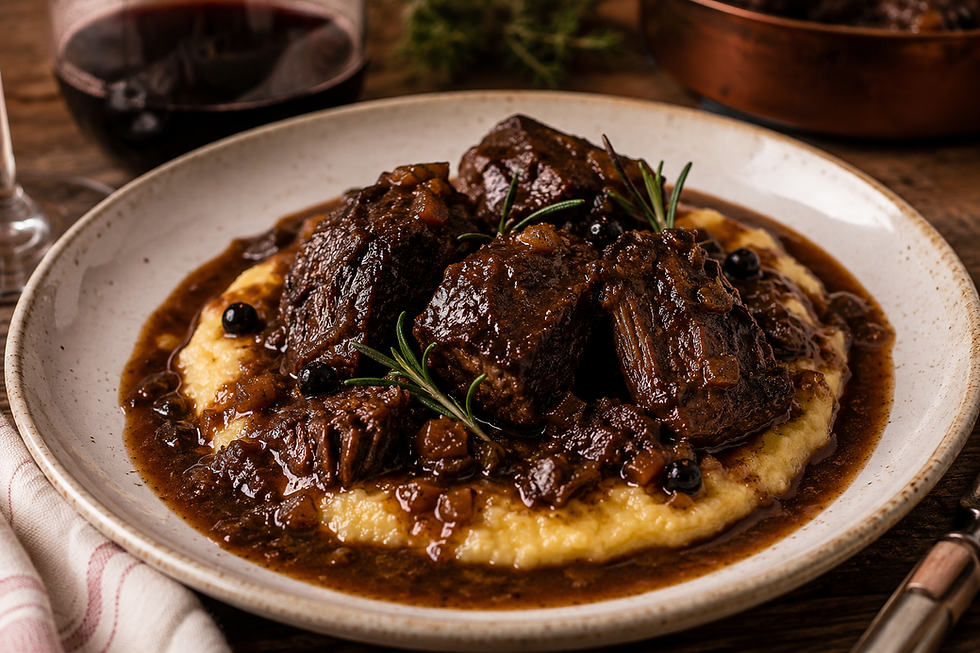
This is a bowl dish, served hot in bowls warmed in a low oven for 5 minutes, never on a flat plate where the sauce escapes to the rim. Boar sauce is rich in gelatin and stiffens the moment it meets cold china.
Put the starch down first and the meat over it, not beside it. Soft yellow polenta is the Tuscan default; cannellini beans stewed with sage are the Sienese alternative; a thick slice of grilled unsalted Tuscan bread rubbed with garlic keeps the plate simpler. Spoon three or four pieces per person over the base with a generous amount of sauce and let it sit thirty seconds so the starch takes some of it up.
Finish with chopped parsley and a thread of raw olive oil, nothing else. No grated cheese on boar in Tuscany, no cream. Serve wilted cavolo nero alongside.
Professional Technique
The technique that defines this dish is the sbianchitura, the preliminary blanching, and it is a deliberate act of loss. You throw away a pot of liquid that smells like dinner. Every instinct in professional cooking runs the other way, so it is worth being precise about what is in that water.
What rises into the water is not flavour in any useful sense. It is the residual blood left in the muscle after field dressing, and specifically the haemoglobin and myoglobin proteins that coagulate at around 160°F (71°C) and surface as that dense grey scum. With them come the volatile compounds responsible for the sharp note people call gamey: short chain fatty acids from the animal's fat, skatole and the amines concentrated in a mature male, and the products of blood breaking down between the shot and the kitchen. These are the parts of wild boar that build up rather than cook off. Simmer them three hours in tomato and they are still there at the end, over everything else. An adult boar cooked without this step stays overbearing however long you give it.
The timing is what people get wrong, in both directions. Five or six minutes from the boil is enough, because the scum surfaces almost immediately and once you have skimmed it the work is done. Keep the pot going twenty minutes and you are no longer removing impurities, you are boiling meat in water, leaching out the soluble protein and salt that give the sauce its depth and setting the exterior so hard it resists browning.
And the flavour genuinely returns. The slow soffritto, the pancetta fat, fresh wine reduced properly, tomato and two and a half hours of gentle heat rebuild more than the blanching took, in the register you want: sweet and deep rather than sharp and animal. You give up an hour of borrowed intensity and you get a dish people finish.
Texture and Moisture Control
Wild boar shoulder is leaner and denser than pork and threaded with far more connective tissue, a problem for the first ninety minutes and an advantage afterwards. Collagen only begins converting to gelatin above about 160°F (71°C) and needs sustained time there, so the meat passes through a stage around the hour mark where it has tightened but not yet given. The temptation is to raise the heat. Heat does not shorten that conversion, only time does, and a hard boil squeezes out moisture while the collagen is still intact.
Hold the pot at a bare simmer and the dissolved gelatin thickens the sauce for you. A properly finished umido needs no flour, and a thin sauce calls for more reduction rather than a thickener. Blanching helps here in a way that is easy to miss: the albumin that would otherwise cloud the liquid and grey its surface came off at the start, so the finish is glossy instead of muddy. Keep the meat half submerged, topping up with hot broth and never cold water, and leave the pot partly covered so it reduces at roughly the rate the meat softens.
Professional Mise en Place
The marinade and the blanching both happen well before service, which makes this an easy dish to organise and a good one to cook a day ahead.
Equipment and tools
Deep glass or ceramic bowl for the marinade, never aluminium
Large heavy pot or enamelled cast iron casserole, 6 qt (5.7 l) or more
Second large pot for the blanching, and a colander
Ladle for skimming, wooden spoon
Prepared ahead
Meat trimmed, cut and in the wine marinade, 12 hours ahead
Blanched, drained and dried meat, up to 6 hours ahead, refrigerated
Soffritto vegetables diced and covered, on the day
Broth hot, or the whole umido cooked the day before
Service setup
Umido held just under a simmer, partly covered, thinned with hot broth if it tightens
Polenta kept soft over a bain marie
Bowls warming in a low oven
Parsley chopped at the last minute, finishing oil and pepper mill ready
Chef Tips
Ask the butcher the age of the animal. A young boar under a year wants five minutes of blanching at most, a mature male shot in December the full six and a longer marinade. If you cannot find out, treat it as mature: blanching a young animal costs little, not blanching an old one costs the dish.
Cook it a day early. Umido di cinghiale is markedly better on the second day, when the sauce has set and the meat has taken up everything around it.
Use a wine you would drink in both the marinade and the pot. A rough young Sangiovese is ideal in both, and anything oxidised or sold as cooking wine shows up sharply after two hours of reduction.
If you are substituting pork shoulder because boar is unavailable, skip the blanching entirely. Farmed pork has none of the compounds the step exists to remove, and boiling it first only costs flavour you have no reason to lose.
Common Mistakes
Keeping the marinade and using it as the braising liquid. This undoes the whole method: the marinade holds the extracted blood and the volatile game compounds, and pouring it into the pot puts every one of them back. Discard it, vegetables and all.
Skipping the blanching because it seems wasteful. Nothing you want is lost in those six minutes, and an adult boar cooked straight from the marinade stays aggressively strong however long it simmers and however much tomato goes in.
Blanching for twenty minutes instead of six. Once the scum stops rising you are just boiling meat in water, leaching out soluble protein and hardening the surface so it will not brown. Count from the boil and stop.
Boiling the umido instead of simmering it. A rolling boil tightens the fibres and forces out moisture while the collagen is still intact, which is how boar ends up both dry and tough. One or two bubbles, throughout.
Browning wet meat. Blanched pieces come out soaked and already set on the surface, so they steam rather than brown unless dried thoroughly. Pat every piece and work in two batches.
Wine Pairing
Chianti Classico DOCG: The default and the correct one. Sangiovese tannin is firm without being heavy and cuts the pancetta fat and the gelatin cleanly, while the sour cherry acidity sits alongside the cooked tomato instead of arguing with it. The dried herb note in an older bottle picks up the rosemary and sage.
Chianti Rufina DOCG: The cooler, higher Chianti zone northeast of Florence and the sharper choice. Its acidity cuts harder and its tannin is finer grained than Classico, which suits a sauce reduced for two and a half hours. Good bottles keep a mineral bite that resets the palate.
Carmignano DOCG: Sangiovese with a required proportion of Cabernet, a blend in place near Prato since the eighteenth century. The Cabernet adds a leafy blackcurrant edge and a tighter tannic frame that handles game better than pure Sangiovese does.
Vino Nobile di Montepulciano DOCG: Fuller and rounder than Chianti, with darker plum fruit and a softer tannic attack from its time in wood. That weight earns its place when the umido goes over polenta, since the starch dulls the palate and a leaner wine disappears. Serve at 64°F (18°C).
Rosso di Montalcino DOC: The younger Sangiovese of Montalcino and the most immediately drinkable bottle here. Bright red fruit, moderate tannin and high acidity make it right for a large informal table, and its lighter frame is an advantage where people eat two helpings.
Storage & Reheating
This is one of the dishes that genuinely improves overnight. Cool it within two hours, then refrigerate it in an airtight container with the meat fully covered by its sauce, where it keeps 4 days. The sauce sets to a soft jelly, which is the collagen gelatin and a sign the simmer was right.
Reheat it covered over low heat, loosening it with hot broth, and never in a microwave, which cooks the edges dry. Bring it just to a bare simmer for two minutes, no more, since the meat is already cooked and further boiling shreds it. It freezes well for 3 months: freeze meat and sauce together in portions, leaving headspace, and thaw overnight in the refrigerator.
Nutrition
Per serving, based on 6 servings, sauce included and starch not counted:
Calories: 480 kcal
Total Fat: 26 g
Saturated Fat: 8 g
Trans Fat: 0 g
Unsaturated Fat: 17 g
Cholesterol: 135 mg
Sodium: 690 mg
Total Carbohydrates: 11 g
Fiber: 2 g
Total Sugars: 6 g
Added Sugars: 0 g
Protein: 46 g
Lactose: 0 g
Principal micronutrients: iron, zinc, selenium, vitamin B12, niacin, potassium, phosphorus
These figures are estimates. Wild boar varies widely in fat content with the age and season of the animal, and the marinade wine and blanching water are discarded rather than eaten.



Comments