
Vegan Italian Green Beans and Potatoes Stewed in Tomato | Fagiolini e Patate in Umido Vegani

Fagiolini e patate in umido is the kind of dish that defines Italian home cooking: fresh green beans and waxy potatoes stewed slowly in a light tomato sauce with onion, garlic, sage and olive oil, until the beans are tender to the core and the potatoes have absorbed every drop of flavor. "In umido" means cooked in a moist, gentle braise, and that method turns two humble vegetables into a contorno rich enough to be a light meal with good bread. The dish is vegan by tradition. This version controls every stage, from the blanching of the beans to the reduction of the sauce, so the beans stay deep green, the potatoes hold their shape and the sauce coats them like a glaze.
Yield: 6 servings. Prep: 25 minutes. Cook: 45 minutes. Rest: 10 minutes. Course: contorno. Region: found throughout Italy.
The Story
Cooking vegetables in umido is one of the oldest techniques of the Italian kitchen. The word describes anything cooked slowly with a little liquid in a covered or half-covered pan: meat, legumes, mushrooms and above all vegetables. In the homes of central and southern Italy, where summer gardens produced more green beans, tomatoes and potatoes than a family could eat fresh, vegetables in umido were the daily answer: inexpensive, filling, easy to reheat and even better the following day. Every grandmother had her own proportions, and the dish rarely appears in restaurants, which is exactly why it tastes of home.
Both main ingredients came to Italy from the Americas. The common bean, Phaseolus vulgaris, arrived in the sixteenth century and Italy soon grew dozens of varieties, eaten fresh as green pods or dried as beans. Potatoes were slower to win favor: for a long time they were viewed with suspicion and spread widely in Italian fields only from the eighteenth and nineteenth centuries, often encouraged as a protection against famine. Within a few generations both had become pillars of the Italian peasant table.
Italian markets still sell several kinds of green beans, and the choice changes the dish. Thin round beans cook quickly and stay elegant; flat, wide beans, called piattoni or romano beans, have a meatier texture and a sweeter taste that suits long braising particularly well. Many families use whatever the garden gives, and in late summer the dish is made with beans picked that morning, tomatoes that are almost too ripe and the first new potatoes of the season.
The classic preparation contains no animal ingredients: olive oil, vegetables, tomato and herbs are all it needs, which is why the dish has always been a staple of the meatless days of the Catholic calendar. Some cooks finish it with grated cheese, but tradition does not require it. This recipe keeps the home version intact and adds technique: a brief blanching that fixes the green color, a soffritto cooked slowly for sweetness, potatoes cut to cook in exactly the same time as the beans and a final reduction that makes the sauce cling.
Ingredients
Choose green beans that snap cleanly when bent, with smooth, firm pods and no brown spots: limp beans are old and stringy. Flat romano beans are ideal if you find them; thin round beans work well with slightly shorter cooking. For the potatoes, use a waxy or all-purpose variety such as Yukon Gold, which keeps its shape in a braise; starchy baking potatoes fall apart. Ripe plum tomatoes in summer, good canned peeled tomatoes in winter, and a fruity extra virgin olive oil complete the list.
For the vegetables
Green beans or flat romano beans, trimmed, 1 1/2 lb (680 g)
Waxy potatoes such as Yukon Gold, 1 lb (450 g)
Coarse salt, for blanching, 2 tbsp (30 g) per 4 quarts (3.8 l) of water
Ice water, for cooling
For the sauce
Extra virgin olive oil, 1/3 cup (80 ml)
Yellow onion, finely chopped, 1 medium, 6 oz (170 g)
Garlic, 2 cloves, peeled and thinly sliced
Fresh sage leaves, 6
Double concentrated tomato paste, 1 tbsp (16 g)
Ripe plum tomatoes, peeled, seeded and chopped, 1 lb (450 g), or canned peeled tomatoes, crushed by hand
Hot water or light vegetable broth, about 1 cup (240 ml)
Fine sea salt, 1 tsp (6 g), plus more to taste
Dried red chili, crumbled, 1 pinch (optional)
Freshly ground black pepper, to taste
For the finish
Fresh basil leaves, 8, torn
Flat leaf parsley, chopped, 1 tbsp (4 g)
Extra virgin olive oil, best quality, 2 tbsp (30 ml)
Flaky sea salt, 1 pinch
Preparation
Step 1

Prepare the vegetables. Rinse the green beans, snap off the stem end of each pod and pull away any string along the seam; leave the thin tail if it is tender. Cut romano beans into pieces about 2 inches (5 cm) long; leave thin beans whole. Peel the potatoes and cut them into wedges or chunks about 1 inch (2.5 cm) across, then keep them in a bowl of cold water so they do not darken. Even sizes are essential: in a braise every piece must reach the right tenderness at the same moment.
Step 2

Blanch the green beans. Bring 4 quarts (3.8 l) of water to a rolling boil with 2 tbsp (30 g) of coarse salt. Add the beans and cook for 4 minutes for thin beans, 5 to 6 minutes for romano beans, until they turn bright green and lose their raw snap. Drain them and plunge them at once into ice water for 2 minutes, then drain well. The quick boil sets the chlorophyll and removes the grassy taste of raw pods; the ice water stops the cooking, so the beans keep a vivid color even after the long braise in tomato.
Step 3
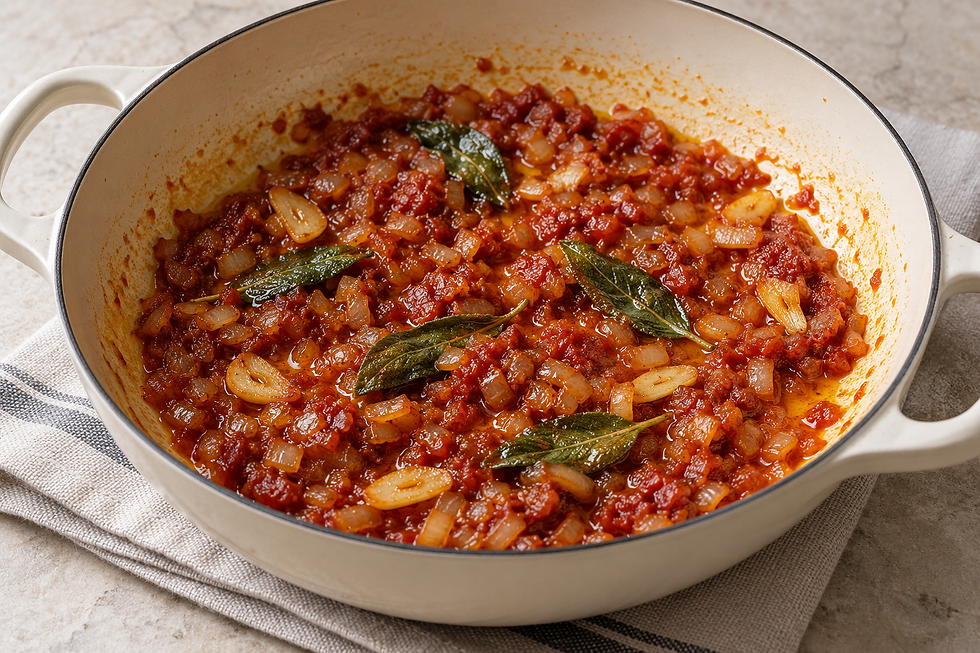
Make the soffritto. In a wide, heavy pan of about 12 inches (30 cm), warm 1/3 cup (80 ml) of olive oil over medium low heat. Add the onion with a pinch of salt and cook for 8 to 10 minutes, stirring often, until it is soft, translucent and sweet. Add the garlic, the sage leaves and the chili, if using, and cook for 2 minutes more, until the garlic is fragrant and pale gold. Stir in the tomato paste and let it fry in the oil for 1 minute: this step removes its raw, metallic edge and deepens the color of the sauce.
Step 4

Start the potatoes in the sauce. Drain the potatoes and add them to the pan, stirring for 2 minutes so they are coated in the flavored oil. Add the chopped tomatoes, 1 tsp (6 g) of salt and about 1/2 cup (120 ml) of hot water. Bring to a simmer, cover with the lid slightly ajar and cook over medium low heat for 12 minutes. The potatoes need a head start because they take longer than the blanched beans; cooking them in the tomato from the beginning lets them absorb its flavor right to the center.
Step 5

Add the green beans. Add the blanched beans to the pan and fold them gently into the potatoes and sauce. Add a little more hot water if the sauce has become too thick, enough to come about halfway up the vegetables, not to cover them. Cover again with the lid ajar and simmer for 15 to 18 minutes, stirring gently every 5 minutes, until a knife slides into the potatoes without resistance and the beans are tender all the way through but still whole. Stir carefully with a wide spoon, lifting from the bottom, so the potatoes do not break.
Step 6

Reduce the sauce. Remove the lid, raise the heat to medium and cook for 5 to 7 minutes, shaking the pan rather than stirring, until the liquid has reduced to a thick, glossy sauce that coats the vegetables and the oil begins to separate slightly at the edges. Taste and adjust the salt and black pepper. This final reduction concentrates the tomato and transforms a watery stew into a true umido, where every bean and potato is glazed with sauce.
Step 7

Rest and finish. Take the pan off the heat, discard the sage leaves if they have darkened, and let the dish rest for 10 minutes. The potatoes absorb part of the sauce and the flavors settle. Just before serving, fold in the torn basil and the parsley. Vegetables in umido are best served warm rather than piping hot, when the aromas of tomato, olive oil and herbs are fully open.
Plating
Serve in warm, shallow bowls or on a deep platter heated to about 120°F (50°C). Arrange the potatoes first, then lay the green beans across them in loose bundles and spoon the remaining sauce over and around, so a thin red pool forms at the base of the dish.
Finish with a drizzle of your best olive oil, a few small basil leaves and a pinch of flaky salt. As a contorno, it accompanies white beans, grilled vegetables or a chickpea farinata; as a light main course, serve it with thick slices of toasted country bread, so guests can mop up the sauce.
Professional Technique
The key ratio is beans to potatoes to tomato. About 1 1/2 lb (680 g) of beans, 1 lb (450 g) of potatoes and 1 lb (450 g) of tomatoes, roughly three to two to two by weight, gives a dish in which the green beans lead, the potatoes provide body and the tomato coats everything without drowning it. With more tomato the dish becomes a sauce with vegetables; with less, it turns dry and the potatoes stay pale.
The hidden variable is the amount of liquid. The vegetables should braise, not boil: the liquid must reach about halfway up and never cover them. A shallow braise lets the top of the vegetables steam while the bottom simmers in sauce, and the regular gentle stirring exchanges the two. Too much water dilutes the flavor and makes the potatoes waterlogged; too little and the sauce catches on the bottom before the vegetables are tender.
The doneness test is double. A knife must slide into a potato chunk with no resistance at all, and a bean should bend without snapping and feel soft on the tongue, with no squeak against the teeth. The sauce is ready when it clings to the back of a spoon and no watery liquid collects at the edges of the pan.
Color and Moisture Control
Green beans contain chlorophyll, which turns olive drab when heated for a long time in an acid environment like tomato sauce. Blanching in heavily salted boiling water and cooling in ice water sets the color and shortens the time the beans need in the sauce, so they stay greener than in the traditional home version. Their color will soften during the braise, and that is expected; the aim is a deep green, never gray.
Moisture management is what separates a fine umido from a watery stew. Tomatoes and beans both release liquid as they cook, so the pan starts loose and must end thick. The lid kept ajar lets steam escape slowly throughout the braise, and the final uncovered reduction removes the last excess water. If you need to add liquid, always add it hot, so the simmer is never interrupted.
Potatoes also play a part in the sauce. As they cook, their surface releases a little starch that naturally thickens the tomato and helps it cling to the beans. That is why the potatoes are not rinsed again after soaking and why waxy varieties are better: they release just enough starch to thicken without dissolving into the sauce.
Professional Mise en Place
Fagiolini e patate in umido can be prepared entirely ahead and reheated, and it improves after a night in the refrigerator. For service, blanch the beans and cut the potatoes in advance, so the final cooking takes about 40 minutes.
Equipment and tools
Large pot for blanching, slotted spoon or spider, bowl of ice water
Wide, heavy sauté pan of about 12 inches (30 cm) with a lid
Paring knife, chef's knife and cutting board
Wide wooden or silicone spoon for gentle stirring
Prepared ahead
Green beans trimmed, blanched, cooled and dried, up to 1 day ahead, refrigerated
Potatoes peeled and cut, kept in cold water, up to 4 hours ahead
Onion chopped and garlic sliced, within 2 hours of cooking
Tomatoes peeled and chopped, up to 1 day ahead
Service setup
Dish warmed gently in a covered pan, with a little hot water on the side
Shallow bowls or platter warmed to about 120°F (50°C)
Best olive oil in a small jug, flaky salt and pepper mill on the pass
Basil leaves and chopped parsley in small bowls
Chef Tips
Use the whole season. In early summer, make the dish with the first thin green beans and new potatoes, unpeeled and simply scrubbed; in late summer, use flat romano beans and very ripe tomatoes, cooking a few minutes longer. The method stays the same, only the timing changes.
For a deeper flavor, add half a teaspoon of fennel seeds or a small sprig of wild fennel to the soffritto with the garlic, as some southern families do. The anise note works beautifully with green beans and tomato.
Turn leftovers into a pasta sauce. Chop the vegetables roughly, loosen them with a little pasta water and toss them with short pasta such as penne or mezze maniche, finishing with olive oil and fresh basil.
For a complete one-dish meal, add a can of drained cannellini or borlotti beans in the last 5 minutes of braising. They warm through in the sauce and add protein, turning a contorno into a satisfying main course.
Common Mistakes
Using old, limp beans. Old beans are stringy and never become tender, however long they cook. Choose beans that snap cleanly when bent.
Skipping the blanching. Raw beans braised in tomato take much longer, turn gray and keep a grassy taste. Blanch them in salted boiling water and cool them in ice water first.
Using starchy potatoes. Baking potatoes break down and turn the sauce into a mash. Use waxy or all-purpose potatoes, which hold their shape.
Cutting uneven pieces. Small pieces fall apart while large ones stay hard. Cut potatoes to about 1 inch (2.5 cm) and beans to an even length.
Covering the vegetables with water. Too much liquid boils the vegetables instead of braising them, and the flavor is diluted. Add liquid only halfway up.
Stirring too hard. Vigorous stirring breaks the tender potatoes into crumbs. Fold gently with a wide spoon, or shake the pan.
Skipping the final reduction. Without it the sauce stays thin and watery. Cook uncovered at the end until it clings to the vegetables.
Wine Pairing
Chianti Classico DOCG: The Sangiovese red of the hills between Florence and Siena, with red cherry, violet and a firm, refreshing acidity. That acidity mirrors the tomato and cuts through the olive oil, while the moderate tannins sit well with the potatoes. Serve it at about 60°F (16°C).
Vernaccia di San Gimignano DOCG: A Tuscan white with notes of apple, almond and a slightly bitter, mineral finish. Its freshness and herbal side suit the green beans and sage, and it is perfect when the dish is served warm in summer. Serve it at about 50°F (10°C).
Romagna Sangiovese DOC: A juicy, approachable Sangiovese from Romagna, with ripe red fruit and soft tannins. Lighter and fruitier than Chianti, it pairs easily with an everyday dish of vegetables and tomato. Serve it slightly cool, at about 58°F (14°C).
Riviera Ligure di Ponente Pigato DOC: A Ligurian white with aromas of peach, Mediterranean herbs and a saline finish. Its herbal character meets the basil and parsley and refreshes the palate between bites of the warm, savory vegetables. Serve it at about 50°F (10°C).
Storage & Reheating
Refrigerator: keep fagiolini e patate in umido in an airtight container for up to 4 days. The flavors deepen on the second day, though the beans lose a little of their color. Freezer: not recommended, because potatoes become grainy and watery after thawing and green beans turn soft and stringy. If you want to freeze part of the dish, freeze only the tomato sauce with the beans, without potatoes, for up to 2 months.
Reheat in a covered pan over low heat with 2 to 3 tbsp (30 to 45 ml) of hot water, shaking the pan gently, for 6 to 8 minutes, until hot throughout. In the microwave, cover and heat at 60 percent power for 2 minutes, stir carefully and heat 1 minute more. Finish with fresh basil and a drizzle of olive oil to restore the aroma.
Nutrition
Per serving, based on 6 servings:
Calories: 230 kcal
Total Fat: 16 g
Saturated Fat: 2 g
Trans Fat: 0 g
Unsaturated Fat: 14 g
Cholesterol: 0 mg
Sodium: 480 mg
Total Carbohydrates: 21 g
Fiber: 5 g
Total Sugars: 6 g
Added Sugars: 0 g
Protein: 4 g
Principal micronutrients: vitamin C, vitamin K, potassium, folate, vitamin B6, manganese
These figures are estimates, calculated on the quantities listed and rounded to the nearest whole number, assuming that most of the blanching salt stays in the water. They vary with the type of beans, the potatoes and the amount of oil absorbed.



Comments