
Italian Charred Green Beans | Fagiolini alla Brace con Mandorle, Capperi e Limone
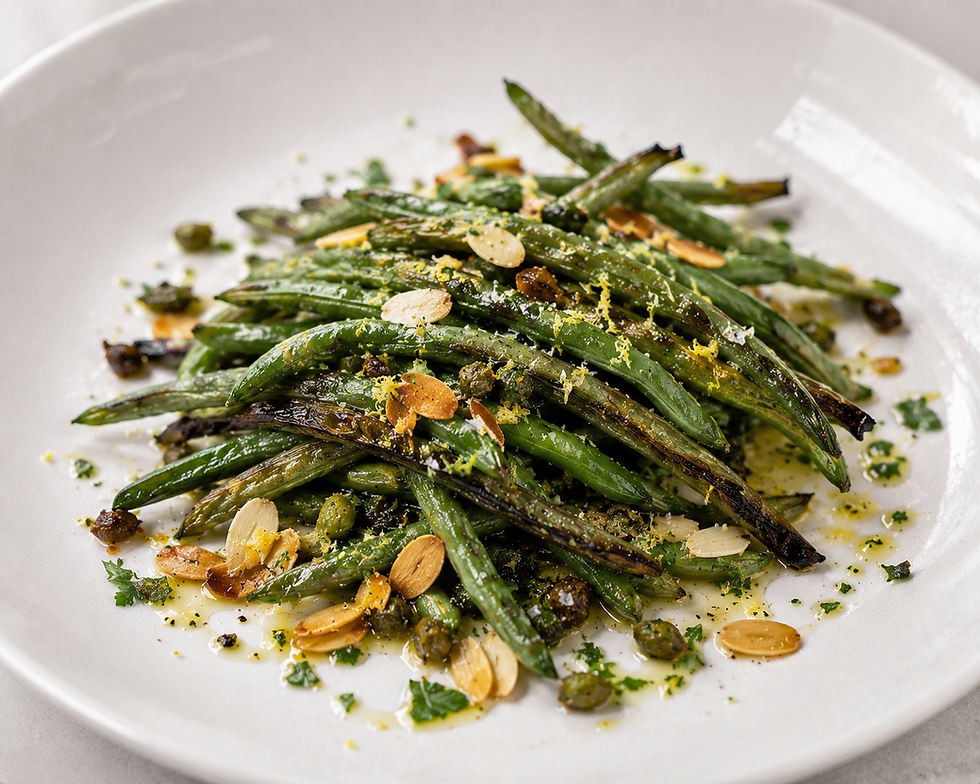
Boiled green beans are the most forgettable thing on an Italian table. Put the same beans over live coals until the skin blisters and blackens in patches and they become something else: smoky, sweet at the centre, with a bitterness on the burnt edges that behaves like char on grilled meat. The vegetable does not need rescuing, it needs fire.
Everything that goes on them afterwards is southern and salty. Almonds toasted and crushed coarsely, so some pieces crunch and some turn to sand that clings to the beans. Capers packed in salt, rinsed and left whole, floral in a way brined capers never manage. Lemon twice, zest for perfume and juice at the end, with garlic softened in oil rather than raw.
It works hot off the grill, warm twenty minutes later, or at room temperature on a buffet, which is how it is eaten across Sicily and Puglia in summer. It is one of the few grilled dishes that genuinely improves while it sits.
Yield: 4 side servings. Prep: 25 minutes. Fire: 30 to 40 minutes to coal. Cook: 8 minutes. Rest: 10 minutes. Total: about 1 hour 15 minutes. Difficulty: intermediate. Course: contorno. Region: Sicily and the southern coast.
The Story
The green bean is not an old Italian vegetable. Phaseolus vulgaris crossed from Mesoamerica in the sixteenth century, and the varieties eaten whole in the pod took another two hundred years to become common in Italian gardens. By the nineteenth century fagiolini were everywhere in the kitchen garden because they crop fast and repeatedly, and they arrive in the gap between spring greens and late summer vegetables.
Cooking them over the brace is older than the bean itself. Long before gas, southern Italian cooking put vegetables straight onto dying embers: peppers, onions, aubergines, whole heads of garlic, laid on the grate after the meat came off. Nothing was wasted, least of all heat. The habit survives at every sagra from Palermo to Bari, and it gives vegetables a flavour no pan reproduces.
The dressing comes from the same geography. Capers grown on Pantelleria and Salina are preserved in sea salt rather than vinegar, a method that keeps the mustard oil aroma of the flower bud intact. Almonds from Avola and Noto are sweeter and fatter than Spanish or Californian ones and have carried Sicilian cooking since the Arab period, from pesto trapanese to cassata. Put the three together with lemon and you have the flavour base of half the island.
Ingredients
For the beans
Green beans, thin and very firm, 1 1/2 lb (680 g)
Coarse sea salt for the blanching water, 2 tbsp (36 g)
Extra virgin olive oil, 2 tbsp (30 ml)
Fine sea salt, 1/2 tsp (3 g)
For the almond and caper dressing
Whole blanched almonds, 3 oz (85 g)
Capers packed in salt, 2 tbsp (20 g)
Garlic cloves, thinly sliced, 2
Extra virgin olive oil, 1/3 cup (80 ml)
Red wine vinegar, 2 tsp (10 ml)
Crushed red pepper flakes, 1/4 tsp (0.5 g)
For finishing
Lemon, 1, for zest and juice
Flat leaf parsley, chopped, 2 tbsp (6 g)
Mint leaves, torn, 8
Flaky sea salt, to taste
Freshly ground black pepper, to taste
Preparation
Light the fire and let it burn down to coals.
Start a chimney of hardwood charcoal or a small wood fire at least 30 minutes before you cook. You want an even bed of embers glowing grey under a thin ash coat, not flames. Spread the coals so one side of the grate is hot and one cool, giving yourself somewhere to move beans that colour too fast. Set the grate about 4 in (10 cm) above the coals and let it heat through.
Rinse the salted capers and dry them.
Soak the capers in cold water for 10 minutes, changing the water once, then drain and pat dry. An unrinsed tablespoon oversalts the whole dish, but a long soak strips the floral note too, so 10 minutes is the working compromise. Leave them whole: chopped capers vanish into the oil and lose the bursts of flavour that make the dressing.
Toast and crush the almonds.
Toast the almonds in a dry pan over medium heat for 5 to 6 minutes, shaking often, until they smell sweet and show gold. Tip them onto a cold plate at once, since they keep cooking in a hot pan and go from toasted to bitter in under a minute. When cool, crush them under the flat of a knife into an uneven mix of halves, coarse pieces and a little dust.
Blanch the beans briefly and shock them.
Top the beans but leave the tails on, which look better and give something to hold on the grate. Bring a large pot to a rolling boil, add the coarse salt and cook the beans for 2 minutes only. Lift them straight into iced water until completely cold. This sets the colour and takes the raw squeak out while leaving them firm enough for the fire.
Dry the beans completely and oil them.
Drain the beans and spread them on a towel, then roll them gently until every surface is dry. This step decides whether the dish works: wet beans steam over the coals and turn olive coloured and limp without charring. Once dry, toss them with the 2 tablespoons of oil and the fine salt, by hand, so each bean is barely filmed rather than dripping.
Grill the beans hard and fast.
Lay the beans across the grate in a single layer, in two batches rather than crowded, or use a grill basket and shake it. Give them about 4 minutes in total, turning once, until blisters and black patches cover perhaps a third of the surface. They should still be firm. Beans left until uniformly black taste of ash and nothing else.
Warm the garlic and build the dressing off the fire.
While the beans grill, warm the 1/3 cup of oil in a small pan over low heat with the garlic and chilli flakes for about 3 minutes, until the garlic is pale gold but not coloured at the edges. Take the pan off the heat, stir in the capers and vinegar and let it sit. Residual heat opens the capers without frying them and softens the vinegar.
Dress the beans while they are still hot and let them rest.
Tip the hot beans into a wide bowl, pour over the warm garlic and caper oil and turn them thoroughly. Add most of the almonds, the lemon zest and a squeeze of juice, then taste before adding salt, since the capers brought plenty. Let the bowl stand 10 minutes: the beans absorb the dressing as they cool and the dish is better for the wait.
Plating
Serve on a room temperature platter, never a warmed one. Hot plates drive moisture out of the beans and dull the lemon within minutes, and this dish is meant to be eaten warm rather than hot. Pile the beans loosely and high rather than flat, so the charred sides stay visible and the dressing collects underneath.
Scatter the reserved almonds over at the last second, keeping the larger pieces on the surface where they stay crisp. Add parsley, torn mint, flaky salt, black pepper and a final grating of zest, then a thread of raw olive oil. Serve within 20 minutes, or hold the platter at room temperature for up to an hour and refresh it with zest and herbs before it goes out.
Professional Technique
The dish turns on the difference between blanching and cooking. Two minutes in heavily salted boiling water sets the chlorophyll, seasons the bean through the skin and takes it three quarters of the way, and the ice bath stops it there. The fire does the last quarter in four minutes while it builds char. Skip the blanch and the outside burns before the inside softens; blanch to full tenderness and the bean collapses on the grate. Time it with a clock, not by eye.
The second technique is the warm oil infusion, which is a different thing from frying garlic. Held at low heat for three minutes the garlic gives its aroma to the oil without browning, so the dressing tastes rounded rather than acrid. Adding capers and vinegar off the heat matters as much: vinegar in a hot pan flashes off its aromatics and leaves only sourness, and capers in hot oil toughen and turn salty instead of floral.
Texture and Moisture Control
Char is a dry heat reaction and water is its enemy. A bean carrying surface moisture spends its time on the grate boiling that water off, and by the time the surface is dry enough to blister the inside is overcooked. Drying the blanched beans on a towel is the central technical step of the recipe, and the one most people skip.
The almonds are the other texture at risk. Crushed almonds in an oily dressing go soft within half an hour, which is why two thirds go in while the beans are hot and one third goes on at the pass. Toasting helps: a well toasted almond has lost enough internal moisture to resist softening far longer than a raw one.
Rest is what makes the beans taste seasoned rather than dressed. Hot beans take up oil, lemon and caper brine readily, and ten minutes is enough for the dressing to move into the bean rather than sit on it. Push it to an hour and the acid dulls the green, so if the platter must wait, dress it lightly and add the juice at the end.
Professional Mise en Place
The fire dictates the timing, so everything else should be finished before the coals are ready. Blanched beans and prepared dressing components can wait for hours. Coals cannot.
Equipment and tools
Charcoal grill or a wood fire with a grate that sets about 4 in (10 cm) above the coals
Grill basket or a fine grate, since thin beans fall through standard bars
Large pot and a bowl of iced water for blanching and shocking
Clean kitchen towels for drying the beans
Wide serving platter kept at room temperature, plus long tongs
Prepared ahead
Beans topped, blanched, shocked and dried, up to 6 hours ahead, refrigerated on a towel lined tray
Almonds toasted and crushed, up to 2 days ahead in an airtight jar
Capers soaked, drained and dried, up to 1 day ahead
Garlic sliced and lemon zested, on the day
Herbs picked and kept between damp paper, up to 4 hours ahead
Service setup
Two heat zones built on the grate, hot side and cool side
Oiled beans in a bowl beside the grill, tongs and grill basket ready
Garlic and caper oil warm in a small pan off to one side
Reserved almonds, herbs, lemon and flaky salt lined up at the platter
Platter at room temperature, never warmed
Chef Tips
Choose the thinnest beans you can find and reject any that bend without snapping. A bean that flexes has been stored too long and goes leathery on the grate. Fine French style beans work beautifully; flat romano beans need an extra minute in the blanch.
Buy capers packed in salt, not in vinegar. The salt cured ones keep the mustard oil character of the bud and taste of flowers and sea rather than of pickle, and they are the single ingredient that most changes this dish. Any Italian grocer sells them in jars from Pantelleria or Salina.
With no fire, a cast iron griddle heated until it just begins to smoke gets most of the way there. Work in small batches, do not move the beans for the first 90 seconds, and accept char without smoke. A gas burner with a wire rack over it is the better improvisation.
Taste for salt only after the dressing has been on a few minutes. Capers, blanching water and almonds all contribute, and beans seasoned as they leave the grill are almost always oversalted once everything comes together. Flaky salt at the pass is easier to control than fine salt in the bowl.
Common Mistakes
Putting wet beans on the grate. They steam rather than char, the skins turn dull olive and the surface never blisters no matter how long you leave them. Roll the blanched beans in a towel until completely dry before they are oiled.
Crowding the grate. Beans piled on top of one another trap steam between them and cook unevenly, with some burnt and some raw. Work in two batches in a single layer, or shake them constantly in a grill basket.
Grilling over flames instead of coals. Live flame deposits soot and burns the outside long before the bean is warm at the centre, and the result tastes of lighter fuel. Wait for an even bed of embers under a coat of grey ash.
Using capers in vinegar straight from the jar. Brined capers bring an acetic sharpness that fights the lemon and flattens the almond, and the floral quality is already gone. Buy salt packed capers and soak them for 10 minutes.
Adding the vinegar to hot oil. It boils off its aromatics on contact and leaves nothing but raw acidity in the dressing. Take the pan off the heat first, then stir the vinegar in with the capers.
Dressing the beans cold. Cold beans do not absorb the oil or the lemon, and the dressing sits on the surface and slides to the bottom of the platter. Dress them straight off the grate while they are still steaming.
Wine Pairing
Grillo Sicilia DOC: The home match, from the same island as the capers and the almonds. A modern dry Grillo has citrus and white peach over a firm saline finish, and that salinity is what lets it sit beside salt cured capers without tasting sweet by comparison. There is enough weight to handle the oil and the toasted almond.
Vermentino di Gallura DOCG: Grown on decomposed granite, it carries a bitter almond note on the finish that lines up exactly with the crushed almonds, and a brisk acidity for the lemon. It also has a herbal, faintly resinous edge that picks up the mint and parsley, which most crisp whites simply do not offer.
Cirò Bianco DOC: Greco Bianco from the Calabrian coast, dry and lean with green almond and citrus peel character and a slightly bitter close. The bitterness is useful against the char on the beans, where a softer wine would taste flabby, and the low price makes it a sensible bottle to open beside a grill.
Locorotondo DOC: A light Verdeca based white from the Valle d'Itria, delicate and floral with modest alcohol and clean acidity. It is the choice for a table eating this at room temperature on a hot day, since it refreshes without adding a fourth or fifth flavour to a dish that already has smoke, salt, lemon and nut.
Cerasuolo d'Abruzzo DOC: The rosato option and a very good one with grilled vegetables. Deeply coloured, dry and structured, with red cherry fruit and a savoury almost saline finish, it has the substance to meet smoke that most rosati lack. Serve it at 54°F (12°C), and it will also carry whatever came off the grill before the beans.
Storage & Reheating
Dressed beans keep 2 days in an airtight container in the refrigerator, though the green fades and the almonds soften. Hold the reserved almonds and herbs separately and add them fresh, which restores most of what is lost. Undressed grilled beans keep better, 3 days refrigerated, and can be dressed at the moment of serving.
Do not reheat this dish. It is meant to be eaten warm or at room temperature, and a hot pan drives off the lemon and turns the beans limp. Take the container out 40 minutes before serving, let it come up on its own, then wake it with fresh zest, a spoon of olive oil and new herbs.
Freezing is not worth it. Blanched beans freeze acceptably before they see the grill, but once charred and dressed they thaw into a wet colourless pile. To work ahead, blanch, shock and dry the beans the morning of service and keep them cold on a towel lined tray.
Nutrition
Per serving, based on 4 side portions:
Calories: 330 kcal
Total Fat: 27 g
Saturated Fat: 3 g
Trans Fat: 0 g
Unsaturated Fat: 23 g
Cholesterol: 0 mg
Sodium: 520 mg
Total Carbohydrates: 15 g
Fiber: 6 g
Total Sugars: 5 g
Added Sugars: 0 g
Protein: 8 g
Lactose: 0 g
Principal micronutrients: vitamin K, vitamin C, vitamin E, folate, manganese, magnesium
These figures are estimates. The dish is naturally vegan and dairy free. Sodium depends on how long the capers were soaked and how much salt goes on at the platter, and most of the blanching salt goes down the drain.


Comments