
Italian Ham and Cheese Fagottini | Fagottini di Prosciutto e Formaggio
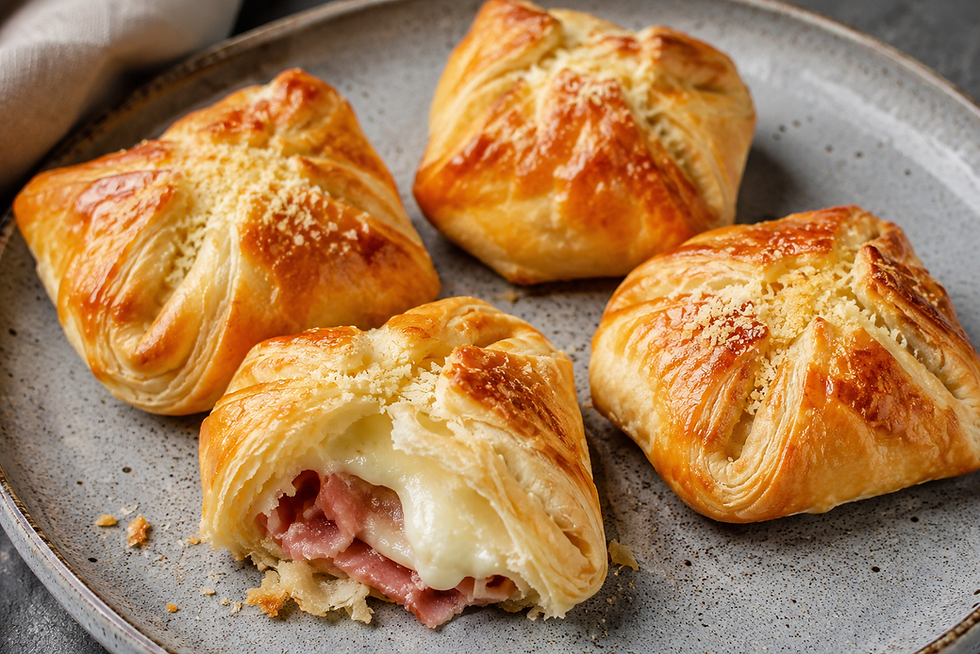
A fagottino is a small parcel of pastry folded over a filling and closed at the edges, made to be eaten standing up with a glass in the other hand. This one holds Prosciutto di Parma and Fontina, and it has one job that matters: the cheese must melt inside the pastry and stay there. Crisp buttery layers outside, a thread of molten cheese and salty ham within, and nothing leaking onto the tray.
Yield: 12 parcels, 6 appetizer servings. Prep: 35 minutes. Chill: 35 minutes. Bake: 17 minutes. Difficulty: intermediate.
The Story
Fagotto means a bundle, the kind a traveler ties up in a cloth and carries over one shoulder, and in Italian to "fare fagotto" is to pack your things and leave. The pastry version borrows the image: a square of dough gathered around something precious and tied shut at the edges. Filled parcels of this kind sit in the glass counters of bakeries and bars across northern Italy, sold warm at aperitivo hour alongside olives and small glasses of wine, and they have been part of the everyday repertoire for as long as puff pastry has been sold by the sheet.
The pairing inside them is older than the pastry. In the Aosta Valley, the alpine region on the French and Swiss border, Fontina has been made for centuries from the raw milk of Valdostana cows grazing high summer pastures, and it is aged in cool mountain caves for at least 80 days. It is a semi soft cheese with a supple paste, a buttery sweetness and a faint wild note of hay and mushroom, and it melts without turning greasy or watery. That is why the valley built fonduta around it, and why its most famous cutlet, the cotoletta alla valdostana, hides a slice of Fontina and a slice of ham inside a breaded veal chop.
Prosciutto di Parma completes the pair. Cured on the hills south of Parma with nothing but pork, sea salt and slow, dry air for at least twelve months, it is sweet, savory and almost silky, and its thin fat renders into the cheese as it warms. Together they are the northern Italian answer to a ham and cheese sandwich, wrapped in butter pastry instead of bread. Simple, but only when the cheese is chosen with care, because a parcel that leaks is just a mess on a baking sheet.
Puff pastry itself is a borrowed technique. The folding of butter into dough, turn after turn, came to Italian kitchens through French and Austrian influence, and Italian pastry cooks adopted it for savory work as readily as for sweet. In Piedmont, Lombardy and the Veneto, the small savory parcel became a fixture of the bar counter, cut to a size that fits the hand and baked in the hours before the evening crowd arrives. Home cooks now buy the sheet ready made, and that is no shame: a good all butter sheet is exactly what a working baker would use, and the skill lies in the filling and the folding.
Ingredients
For the parcels
All butter puff pastry, thawed overnight in the refrigerator and kept cold, 2 sheets, about 9 oz (255 g) each
Fontina Val d'Aosta, aged at least 80 days, rind removed, cut into cubes, 9 oz (255 g)
Prosciutto di Parma, sliced very thin, in whole slices that can wrap the cheese, 12 slices, about 6 oz (170 g)
All purpose flour, for dusting the work surface, 1 tbsp (8 g)
Cold water, for brushing the borders before sealing, 2 tbsp (30 ml)
For the rocket salad
Baby rocket, washed and dried, 2 oz (55 g)
Fresh lemon juice, 2 tsp (10 ml)
Extra virgin olive oil, 1 tbsp (15 ml)
Fine sea salt, 1 pinch
For the egg wash
Large egg, at room temperature, 1
Whole milk, 1 tbsp (15 ml)
Fine sea salt, 1 pinch
For finishing
Parmigiano Reggiano, shaved, 1 oz (30 g)
Fresh thyme leaves, 1 tsp
Freshly ground black pepper, to taste
Extra virgin olive oil, a few drops
Preparation
Cube and freeze the Fontina.
Cut the Fontina into cubes of 1/3 inch (8 mm) with a sharp knife, discarding any hard edge. Do not grate it. Spread the cubes on a small plate and freeze them for 15 minutes, until firm to the touch but not frozen through. Cold cubes hold their shape while you work and give the pastry time to set before the cheese softens. While they chill, take the prosciutto out of the refrigerator so the slices separate without tearing.
Cut the pastry squares.
Unfold each sheet of pastry onto a lightly floured surface and cut it into 6 squares of about 4 1/2 inches (11 cm). Keep them cold on a tray lined with parchment paper, covered with a towel. If the pastry turns soft or sticky at any point, slide the tray into the refrigerator for 10 minutes. Cutting the squares first and filling them second is faster than rolling out a large sheet, and it keeps the butter layers cold and separate. Do not roll the sheets thinner: the factory has already set the thickness you need.
Wrap the cheese in ham.
Lay a slice of prosciutto on the center of each square, on the diagonal. Pile 5 or 6 cubes of Fontina, about 3/4 oz (20 g), in the middle of the ham. Fold the ends of the ham over the cheese so the cubes are fully covered, leaving a clear border of at least 3/4 inch (2 cm) of bare pastry all around. If a slice tears, overlap two pieces rather than leaving a gap. Check that no cube touches the pastry edge before you close the square, and pull any stray cube back toward the middle.
Fold and seal with your fingertips.
Brush the bare border with cold water and fold each square corner to corner into a triangle. Press from the filling outward to push out the air, then press along both open edges with the pads of your fingers, twice. Use a light hand, so the layers stay intact. Cut one small slit of 1/2 inch (1 cm) in the top layer only, above the ham, so steam has an exit that does not run through the seam. Look at each edge once more: a seam that looks thin or stretched should be pressed again now, not after the oven has found it.
Chill and glaze.
Whisk the egg, milk and salt. Arrange the parcels on parchment, refrigerate for 20 minutes, then brush the tops with egg wash, keeping it off the cut sides. Wait 5 minutes and brush a second coat. Egg wash that runs down the edges glues the layers together and stops the pastry rising. The refrigerator time is not optional: it firms the butter, relaxes the dough so it does not shrink, and lets the cold cheese stay solid while the oven comes up to temperature.
Bake hot and rest.
Set a heavy sheet pan in the oven and heat it to 425°F (220°C) for 20 minutes. Slide the parchment with the parcels onto the hot pan and bake for 16 to 18 minutes, until deep golden and well risen. Rest for 5 minutes on a rack. Finish with shaved Parmigiano, thyme, black pepper and a few drops of olive oil. Toss the rocket with the lemon juice, oil and salt only at the last moment, so it stays bright and does not wilt.
Plating
Serve the parcels warm, not scalding, on a warm plate, two per person. The molten cheese needs about five minutes to settle, and a parcel bitten too early burns the mouth and floods the plate. Set them side by side, slightly overlapping, on a folded linen napkin or a slate board, so the base stays crisp rather than steaming. Never cover the plate with a lid or foil.
Scatter the shaved Parmigiano, a little thyme and a few drops of olive oil over the tops and put a small bowl of dressed rocket or a spoonful of onion jam alongside. Cut one parcel in half for the first table so the guests can see the thread of Fontina and the ham lining. Keep the rest whole. The plate should look generous and simple, with the pastry as the star and the garnish kept small.
Professional Technique
This recipe is an exercise in containing a cheese that melts. Molten cheese is a liquid, and a liquid always looks for the nearest way out, so every decision here is structural. The cheese has to melt, string and stay whole in its fat and protein network. Fontina does exactly that, while fresh mozzarella or fior di latte release whey and turn the filling into steam and soggy dough.
The cheese is cut into cubes and never grated. Grated cheese has a huge surface area, melts at once into an oily film and spreads to every gap. Cubes melt from the outside in and keep a solid core until the pastry is set. They are also kept well away from the edges, with a border of bare dough, because the seam is the weakest point of the parcel and any cheese that touches it will find the smallest gap.
The prosciutto is a barrier. Wrapped around the cubes, its fat and cured proteins form a second skin between the cheese and the pastry, so the melting cheese meets ham rather than raw dough and cannot soak into the layers or reach the seam.
Edges are sealed with fingertips. A fork crushes and cuts the layers, and every prong hole is a leak for cheese and steam. Fingers press the two layers into one weld without tearing them. The oven is hot and the bake short, because the pastry must set and brown before the cheese has time to fully liquefy and pressure the seams. A slow bake gives the cheese the time to escape.
Texture and Moisture Control
Puff pastry rises because hundreds of thin butter layers turn to steam in the oven and push the dough layers apart. That only works if the butter is cold when the parcel enters the oven, which is why the shaped parcels are refrigerated and the tray is preheated. Warm butter melts into the dough and produces a flat, dense, greasy shell instead of a flaky one. A hot pan under the parcels gives the base an immediate blast of heat, so it browns and crisps before it can absorb any fat.
Moisture is the enemy of crispness. Prosciutto is dry enough to sit against the pastry without wetting it, and Fontina holds far less free water than fresh cheeses. The egg wash browns the surface through the Maillard reaction and seals the top so the layers dry into a shell, but it must stay off the cut edges. Resting on a rack, never on a plate, lets steam escape from underneath so the base stays crisp.
The filling should be soft and flowing at about 140°F (60°C), not scalding. Above that the cheese turns stringy and oily, and below it the paste firms up. Five minutes of resting brings the parcel to the right point, and a probe thermometer pushed gently through the slit will read about that temperature. Serve promptly after that, because the filling firms as it cools.
Professional Mise en Place
Almost the whole recipe can be prepared ahead, and only the bake and the final garnish are à la minute. Work in this order and service stays calm.
Equipment and tools
Heavy sheet pan and parchment paper
Sharp chef's knife and a pastry wheel for clean cuts
Pastry brush, small bowl of cold water, cooling rack
Small bowl for the egg wash and a fine mesh sieve to strain it, so no streaks show on the crust
Prepared ahead
Fontina cubed and refrigerated in a covered container, up to 1 day
Parcels shaped, unglazed, covered on a tray in the refrigerator, up to 8 hours
Parmigiano shaved and thyme picked, ready in small bowls
Rocket washed, dried and kept cold in a towel, dressing whisked separately
Pastry squares cut and stacked between sheets of parchment, chilled, up to 4 hours
Service setup
Oven and sheet pan at 425°F (220°C) for a full 20 minutes
Egg wash brushed just before baking
Warm plates, rack and timer within reach
Parcels rested exactly 5 minutes out of the oven, then plated two at a time
Salad tossed only when the first plates are called
Chef Tips
Choose Fontina with a supple, slightly springy paste and a natural brown rind. If you cannot find it, use young Taleggio without the rind or a mild young Asiago, and avoid anything fresh or pre shredded, which contains starch and behaves badly.
Cut the pastry with a very sharp knife and press straight down rather than dragging it. A dull blade pinches the layers together at the edge and stops the parcels rising evenly.
Bake one tray first as a test. Ovens vary, and one parcel opened after the rest will tell you if the cheese is flowing freely and the pastry is deep gold, before you commit the whole batch.
Save the trimmings. Stack them flat, never balled up, chill them, roll them once and cut small rounds to bake as crackers with the leftover Parmigiano. Balled up, the layers are destroyed and the dough bakes flat.
Common Mistakes
Using a watery cheese. Fresh mozzarella, ricotta and fior di latte weep whey as they heat and turn the filling into steam. Choose a semi hard melting cheese such as Fontina.
Overfilling the parcel. More than about 3/4 oz (20 g) of cheese per parcel pushes against the seam, and it will burst. Less filling gives a better parcel, and the cheese still reads clearly in every bite.
Skipping the chill. Warm pastry and soft cheese go into the oven together, the butter melts before it can make steam, and the parcels spread and leak. Twenty minutes in the refrigerator prevents both.
Sealing with a fork. The prongs cut the layers and leave holes for cheese to escape, and the crushed edge stays flat while the rest of the pastry rises. Use your fingertips instead.
Baking in a cool oven. A moderate oven gives the cheese time to melt and push through the seam before the pastry sets. Preheat fully, and preheat the pan as well. Open the door as little as possible during the bake.
Wine Pairing
Trento DOC: The best all round choice. Its fine, persistent bubbles and bright acidity cut through the butter in the pastry and the fat of the Fontina, and the yeasty, toasted notes of a Metodo Classico echo the browned crust. It stays dry and clean beside the salt of the prosciutto, and a well chilled bottle refreshes the palate between parcels. Choose a Brut for the best balance with the cheese.
Valle d'Aosta Petite Arvine: The local match, from the same valley as the cheese. It is a dry white with lively acidity, a saline finish and a citrus and pear fruit that lifts the richness of the melted Fontina. The salinity mirrors the ham without adding weight, and its alpine freshness suits the mountain character of the whole dish. Serve it well chilled in a small tulip glass.
Lugana DOC: A white with more body and a soft almond finish. Its rounded texture stands up to butter pastry and molten cheese, while a fresh, mineral acidity keeps every bite from feeling heavy. Serve it cool, not cold, and expect it to be especially good with the parcels straight from the rest.
Alto Adige DOC Pinot Nero: For those who want a red. Light in body, with fine tannin, red cherry fruit and a savory earthiness, it does not overwhelm the delicate ham and the acidity refreshes the palate after each rich bite. Serve it slightly cool, at around 57°F (14°C), to keep its fruit lively and its tannin gentle against the melting cheese.
Storage & Reheating
Baked parcels keep in the refrigerator for up to 2 days in a shallow airtight container, with a sheet of paper towel between layers to absorb moisture. Unbaked, shaped parcels can be frozen solid on a tray, then bagged, for up to 1 month, and baked straight from frozen at 425°F (220°C) for 20 to 22 minutes.
Reheat baked parcels on a rack over a sheet pan in a 350°F (175°C) oven for 8 to 10 minutes, until the cheese flows again and the crust crackles. Never use a microwave, which softens the pastry and makes the filling rubbery. They do not improve the next day, so bake only what you plan to serve. Let frozen parcels go straight into the oven without thawing, because thawed pastry sweats and the cheese starts to run before the crust sets.
Nutrition
Per serving, based on 6 servings of 2 parcels:
Calories: 720 kcal
Total Fat: 50 g
Saturated Fat: 27 g
Trans Fat: less than 1 g
Unsaturated Fat: 21 g
Cholesterol: 100 mg
Sodium: 1330 mg
Total Carbohydrates: 38 g
Fiber: 1.5 g
Total Sugars: 1 g
Added Sugars: 0 g
Protein: 26 g
Lactose: less than 1 g
Principal micronutrients: calcium, phosphorus, vitamin B12, zinc
These figures are estimates and vary with the pastry brand.




Comments