
Italian Roman Style Gratin Gnocchi | Gnocchi alla Romana Rivisitati Gratinati

Gnocchi alla Romana contain no potato at all, and almost every cook outside Rome discovers this at the wrong moment. They are made from durum wheat semolina cooked in milk into a thick golden porridge, enriched off the heat with egg yolk and grated cheese, then spread on a tray and left to set. Only when the cold slab is cut into discs with the rim of a drinking glass does it become gnocchi.
This revisited version changes nothing about that method and sharpens everything around it. The semolina is cooked longer than most home recipes allow, so the slab slices cleanly. The discs are laid in overlapping rows like roof tiles rather than side by side, which gives two textures instead of one: a lacquered crust where the edges face the heat, a soft custard centre underneath. Brown butter and sage replace plain melted butter, and warm pecorino cream goes on the plate rather than into the dish.
The result is still a Roman trattoria plate and still costs almost nothing to make. What it gains is precision: a crisp top over a yielding middle, cheese that is salty rather than merely present, and a gratin that comes out gold instead of pale.
Serves 4. Prep: 30 minutes. Cook: 45 minutes. Rest: 1 hour 30 minutes. Total: about 2 hours 45 minutes. Difficulty: intermediate. Course: primo. Region: Lazio, city of Rome.
The Story
Rome eats by the calendar, and the old rhyme that governed the trattorie of Testaccio and Trastevere put gnocchi on Thursday, fish on Friday and tripe on Saturday. Thursday gnocchi were the heavy plate that carried a working man through to the lean Friday, and in the city that plate was the semolina one. The potato version belongs to the north. Rome perfected a way of turning cheap durum wheat and a litre of milk into something rich enough to count as a feast.
The ancestry runs further back than the trattorie. Ancient Rome lived on puls, a boiled grain porridge of farro that was the staple food of the republic long before bread took over, and the habit of cooking a ground cereal into a thick mass never left the peninsula. Semolina replaced farro, milk replaced water in richer households, and by the nineteenth century the habit of cooling the porridge and cutting it into shapes was common across central Italy. Rome gave it butter, pecorino and an oven.
The recipe was fixed in print in the first half of the twentieth century, in the Roman domestic cookbooks that standardised so much of the city's repertoire, and it has barely moved since. The one detail every Roman grandmother insists on is the cutting tool: not a pastry cutter but a thin drinking glass, pressed straight down through the cold slab, which is why the discs in old photographs are never quite the same size and why nobody in Rome considers that a fault.
Ingredients
For the semolina gnocchi
Whole milk, 4 cups (950 ml)
Durum wheat semolina, fine grind, 1 1/2 cups (250 g)
Unsalted butter, 4 tbsp (57 g)
Egg yolks, large, 2
Grated Parmigiano Reggiano, 3/4 cup (75 g)
Grated Pecorino Romano, 1/3 cup (35 g)
Fine sea salt, 1 1/2 tsp (9 g)
Freshly grated nutmeg, 1 small pinch
Freshly ground black pepper, to taste
For the gratin
Unsalted butter, 3 tbsp (43 g)
Fresh sage leaves, 6
Grated Parmigiano Reggiano, 1/2 cup (50 g)
Grated Pecorino Romano, 2 tbsp (12 g)
For the pecorino cream
Heavy cream, 1/2 cup (120 ml)
Grated Pecorino Romano, 1/2 cup (50 g)
Freshly ground black pepper, 1/4 tsp (0.5 g)
For finishing
Grated Parmigiano Reggiano, 2 tbsp (12 g)
Extra virgin olive oil, a few drops per plate
Freshly ground black pepper, to taste
Preparation
Setting up the tray before you start
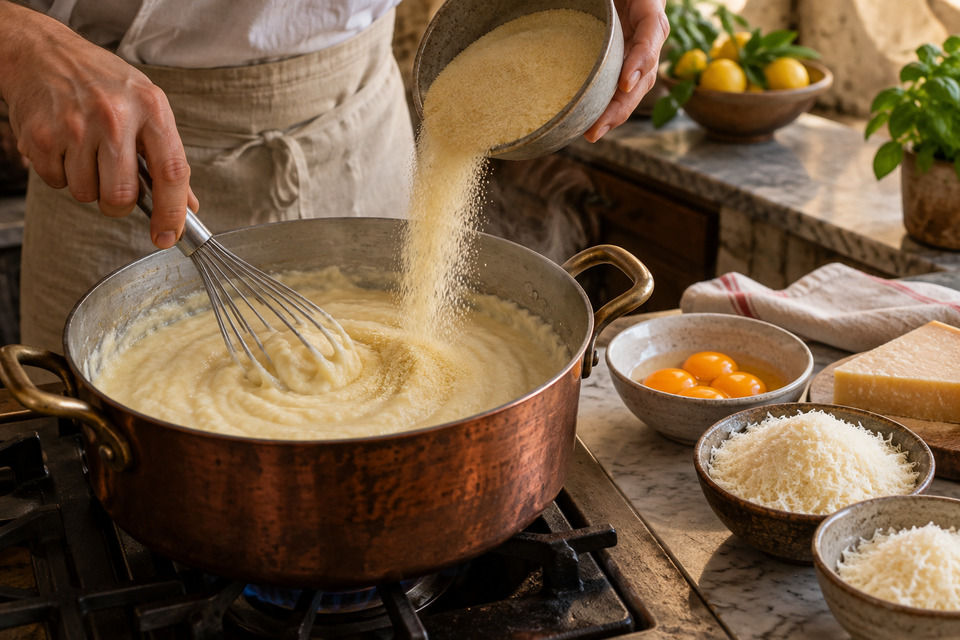
Line a rimmed baking sheet with parchment and set it on a level surface, because the slab takes the shape of whatever it sets on and a tilted tray gives discs of two thicknesses. Have the yolks, both cheeses and the butter weighed out within reach of the stove. Once the semolina thickens there is no free hand and no spare minute, and stiffening porridge left alone for thirty seconds catches on the bottom.
Raining the semolina into the milk

Bring the milk, the salt, the nutmeg and the 4 tbsp (57 g) of butter to a bare simmer in a heavy saucepan, stirring until the butter has melted. Drop the heat to low. Pour the semolina in a thin steady stream from one hand while whisking hard with the other. It must rain in, never go in as one addition, because semolina hydrates the instant it meets hot milk and a lump formed here is still a lump an hour later.
Cooking the semolina to the pull away point

Swap the whisk for a sturdy wooden spoon and cook over low heat for 10 to 12 minutes, stirring the whole time and pushing the spoon right into the corners of the pan. The mass goes from pourable to heavy to genuinely stiff. It is ready when it comes away from the sides in one piece and holds the trace of the spoon. Most home versions stop at 5 minutes, which leaves raw starch and a slab that crumbles under the glass.
Enriching off the heat with yolk and cheese

Pull the pan off the stove and let it stand for 2 minutes. This wait is not optional: semolina straight off the heat sits well above 175°F (80°C) and will scramble the yolks into visible threads. Beat in the yolks one at a time, working fast, then the 3/4 cup (75 g) of Parmigiano and the 1/3 cup (35 g) of Pecorino Romano. Grind in pepper and taste: it should already be properly seasoned and faintly sweet from the milk.
Spreading and setting the slab

Tip the mixture onto the lined tray and spread it to an even 1/2 inch (1.5 cm) with an offset spatula dipped in cold water, which stops it dragging. Work fast while it is hot and pliable. Lay parchment directly on the surface so no skin forms, cool for 30 minutes, then refrigerate at least 1 hour. The slab must be cold and firm right through or the discs slump the moment you lift them.
Cutting the discs with a glass
Choose a thin walled drinking glass about 2 1/2 inches (6 cm) across, dip the rim in cold water and press straight down without twisting. Twisting compresses and seals the edge, and a sealed edge takes no colour in the oven. Cut in tight rows, rewetting the rim every few cuts. Keep every scrap: they go underneath the discs and nobody sees them.
Browning the butter and building the tiles
Melt the 3 tbsp (43 g) of butter in a small pan over medium heat with the sage and let it foam, subside and turn hazelnut brown, about 3 minutes. Butter a gratin dish, scatter the trimmings across the base and press them flat. Arrange the discs on top in overlapping rows, each covering about a third of the one before, like roof tiles. Brush the brown butter over the surface and scatter both gratin cheeses evenly.
Making the pecorino cream and gratinating
Heat the oven to 400°F (200°C) and bake for 20 to 25 minutes, until the surface is gold and the exposed edges have darkened. Meanwhile warm the cream to just below a simmer, take it off the heat, whisk in the 1/2 cup (50 g) of Pecorino Romano and the pepper until smooth, and hold it warm. Finish under the broiler for 90 seconds if you want more colour, then rest 5 minutes before serving.
Plating
The five minute rest out of the oven is part of the plating, not a delay before it. Straight from the heat the centres are molten and a lifted portion collapses into a pale heap. Five minutes later the custard has set just enough to hold its shape while staying soft, and the crust is still crisp. Warm the plates to around 140°F (60°C) in the meantime, because semolina and butter turn waxy on a cold surface faster than almost any other primo.
Spoon a tablespoon of the warm pecorino cream onto each plate and spread it into a shallow pool rather than a stripe. Lift three or four discs together with a wide spatula, keeping the overlap intact, and set them onto the cream so the gratinated side faces up. Never pour the cream over the top, which softens the crust within seconds and undoes the whole point of the tiles. Finish with a light dusting of Parmigiano, a few drops of olive oil around the edge and a grind of black pepper.
Professional Technique
Everything in this dish rests on full starch gelatinization, which is why the cooking time in step three is longer than most recipes admit. Durum granules absorb hot milk, swell and burst, releasing amylose that sets into a firm gel as it cools. Stop early and some granules stay intact: the slab looks set but has no internal structure, crumbles at the edge of the glass and weeps milk in the oven. Cooked to the pull away point, the same mixture slices like semi firm cheese.
The overlapping tile arrangement is the second technical choice and it is a deliberate departure from the flat single layer of the classic. Laid edge to edge, every disc gets identical heat and the dish comes out uniform. Overlapped, each disc has an exposed crescent that browns and a covered portion that steams under the one above, so a forkful delivers both. The covered area never dries out, which is why the dish tolerates the 400°F (200°C) it needs for real colour.
The third is the split of the cheese between two roles. What is beaten into the hot semolina dissolves and seasons the body from within; what is scattered on top exists to build a crust. Adding it all at one stage sacrifices one of the two. Brown butter sits between them, adding nutty Maillard notes that plain melted butter cannot, without wetting a surface that must stay dry.
Texture and Moisture Control
The ratio of milk to semolina is the single number that decides the texture, and here it is 4 cups (950 ml) to 1 1/2 cups (250 g). More milk gives a creamier slab that slumps once cut, and the discs spread into ovals in the oven. Less milk gives a dense slab that cuts beautifully and eats like a brick. Measure the semolina by weight if you can: a cup of fine grind and a cup of coarse grind differ by a good 20 g, enough to move the dish out of range.
Moisture then has to be managed in two opposite directions at once. The interior must stay moist, which the covered portion of each tile guarantees and which is why the dish should not sit in the oven past 25 minutes. The surface must dry, which is why the butter is brushed rather than poured and why the cream goes under the gnocchi. The 1/2 inch (1.5 cm) thickness is the compromise: thinner and the centre dries out, thicker and the top browns long before the middle is hot.
Professional Mise en Place
The long rest makes this convenient to serve: the slab does its waiting a day ahead and the only live work is the gratin.
Equipment and tools
Heavy saucepan of at least 3 quarts (3 litres), balloon whisk, sturdy wooden spoon
Rimmed baking sheet, parchment, and an offset spatula
Thin walled drinking glass about 2 1/2 inches (6 cm) across, bowl of cold water beside it
Shallow gratin dish, wide spatula, two small pans
Prepared ahead
Semolina slab cooked, spread and chilled, up to 2 days ahead
Discs cut and trimmings kept separately, up to 1 day ahead
Both cheeses grated fresh on the day, kept covered
Brown butter up to 4 hours ahead, rewarmed to brushing consistency
Service setup
Oven fully preheated to 400°F (200°C), broiler ready
Gratin dish assembled and brushed, in the oven 25 minutes before service
Pecorino cream warm off the heat, whisked smooth, never boiled
Plates at around 140°F (60°C), dish resting 5 minutes before the first plate
Chef Tips
Buy fine grind semolina and read the bag. The Italian label is semola di grano duro rimacinata, milled twice and almost powdery. Coarse semolina hydrates slowly, stays gritty however long you cook it, and gives a slab with a sandy cut edge.
Rest the cut discs at room temperature for 20 minutes before they go into the gratin dish. Straight from the refrigerator they brown on top while the centre is still cold, and you end up choosing between a burnt crust and a cool middle.
Weigh the pecorino more carefully than the Parmigiano. Pecorino Romano carries roughly twice the salt, and the 1 1/2 tsp (9 g) in the milk assumes the quantity used here. Increase it by a third and the dish tips into salty, with no way back.
If you have plenty of trimmings, save them rather than burying them in the dish. Cut into cubes, fried in butter until crisp and scattered with pecorino, they are the reason Roman kitchens never throw a scrap of this away.
Common Mistakes
Reaching for potatoes. Gnocchi alla Romana are semolina gnocchi and always have been, with no potato and no flour dough anywhere in the method. The semolina slab is what allows the discs to be cut and gratinated at all.
Adding the semolina all at once. Dropped into hot milk in one go it seizes into lumps immediately, and no later whisking breaks them down. Rain it in slowly while whisking hard, and keep the heat low.
Stopping the cooking too soon. Five minutes gives a mixture that looks thick and is not gelatinized. It sets in the refrigerator, then crumbles at the rim of the glass and releases milk in the oven. Cook until it pulls cleanly from the sides of the pan.
Beating in the yolks while the pan is still hot. Above 175°F (80°C) the yolks coagulate on contact and leave threads of cooked egg through the slab. Let the pan stand off the heat a full 2 minutes, then work them in one at a time.
Twisting the glass when cutting. A twist seals the cut edge, and a sealed edge stays pale and rubbery while everything around it browns. Press straight down, lift straight up, rewet the rim often.
Pouring the cream over the gratin. A crust that took 25 minutes to build softens in under a minute under warm cream. The cream goes on the plate first, the gnocchi on top of it, gratinated side up.
Wine Pairing
Orvieto Classico DOC: The closest dry white to Rome here, grown on volcanic tuff an hour north of the city. Its quiet green apple fruit and low aromatic profile leave the pecorino alone, while a firm mineral finish resets the palate between forkfuls of butter and cheese.
Verdicchio dei Castelli di Jesi Classico Riserva DOCG: A riserva has the weight to stand under a baked dish where a lighter white vanishes. Its texture matches the custard centre of the discs, and the bitter almond finish lands exactly where the brown butter and toasted crust sit, extending them rather than cutting them off.
Greco di Tufo DOCG: Chosen for structure rather than region. Greco has the body and grip to meet aged pecorino head on, and its smoky edge from the tufo soils plays against the gratinated surface. High acidity keeps a rich plate from closing down by the third bite.
Trento DOC: The metodo classico answer and the most effective palate cleanser here. Fine persistent bubbles and a bracing dry finish scrub away the butter fat, while the bready character from long lees ageing echoes the toasted cheese crust. Serve at 46°F (8°C).
Bardolino DOC: For anyone who wants a red with a butter and cheese primo, this is the one that works. Pale, light bodied and almost tannin free, served cool at 55°F (13°C), it brings sour cherry acidity and a wisp of pepper without the weight that would flatten the dish.
Storage & Reheating
The uncooked slab is the component worth storing. Wrapped tightly it keeps refrigerated 2 days with no loss of quality, and cut discs keep 1 day on a lined tray under film. It freezes well: cut the discs, freeze them in a single layer, bag them for up to 2 months and gratinate from frozen, adding 10 minutes. Never freeze the finished gratin, which turns grainy as cheese and milk separate on thawing.
A baked gratin keeps refrigerated for 3 days in a covered dish. Reheat in a 375°F (190°C) oven for 12 to 15 minutes, uncovered, with a knob of butter dotted over the top to bring the crust back. A microwave turns the discs rubbery and the crust to paste. The pecorino cream keeps 2 days refrigerated and must be rewarmed over the lowest heat, whisked, never boiled or it splits.
Nutrition
Per serving, based on 4 portions:
Calories: 690 kcal
Total Fat: 39 g
Saturated Fat: 23 g
Trans Fat: 0.8 g
Unsaturated Fat: 13 g
Cholesterol: 205 mg
Sodium: 1290 mg
Total Carbohydrates: 55 g
Fiber: 2 g
Total Sugars: 13 g
Added Sugars: 0 g
Protein: 30 g
Lactose: 11 g
Principal micronutrients: calcium, phosphorus, vitamin A, vitamin B12, riboflavin, selenium, zinc
These figures are estimates. Sodium is high because Pecorino Romano is a heavily salted cheese, and the real total depends on the brand and on how generously the finishing cheese is scattered.



Comments