
Italian Friulian Gubana | Gubana delle Valli del Natisone
Updated: Sep 15
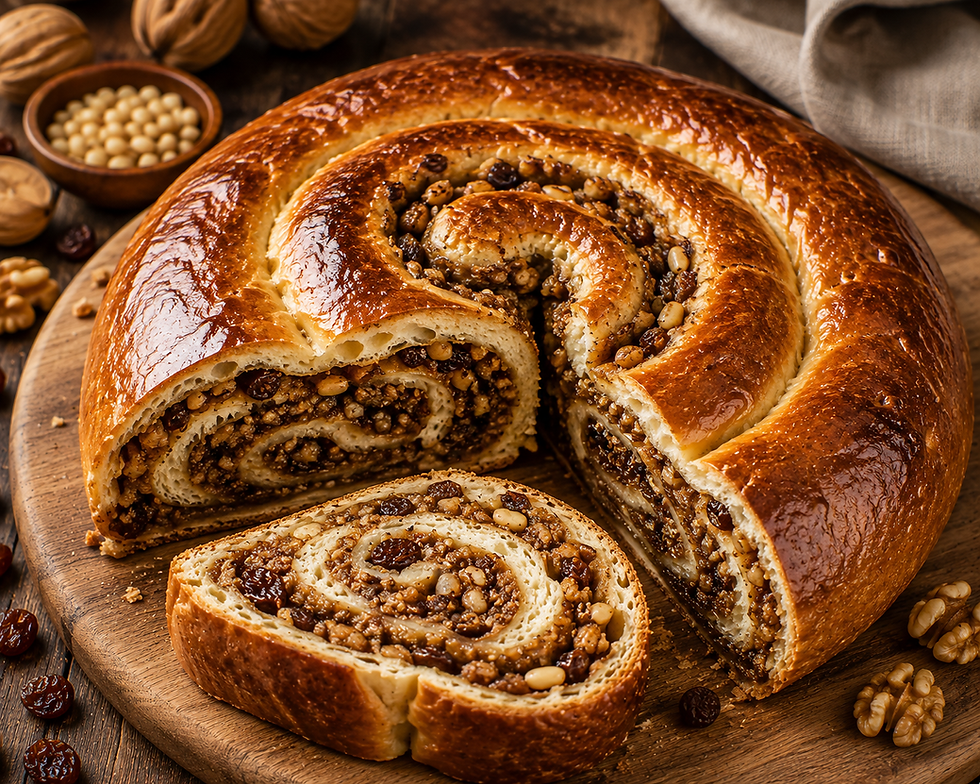
Gubana is the great festive cake of the Natisone Valleys, the narrow green corridor of eastern Friuli that runs up to the Slovenian border above Cividale del Friuli. A rich leavened dough is rolled thin, spread with a dense mixture of walnuts, raisins, pine nuts and candied peel, rolled into a long rope and coiled into a spiral that bakes to a domed snail shape. Cut across, every slice shows the coil.
It is neither bread nor pastry. The dough carries eggs, butter and sugar in quantities closer to panettone than to a loaf, but it is rolled and filled like a strudel, which is what a valley passed between Venetian, Austrian and Slavic influence would produce. The grappa or slivovitz in the filling is not decoration: it carries aroma through the bake and keeps the nut mixture from tasting flatly sweet.
Yield: 1 large gubana, 12 slices. Prep: 1 hour. First rise: 2 hours. Shaping and proof: 1 hour 30 minutes. Bake: 50 minutes. Rest: 3 hours. Difficulty: advanced. Course: dessert. Region: Friuli Venezia Giulia, Valli del Natisone.
The Story
Gubana belongs to a handful of villages above Cividale del Friuli: San Pietro al Natisone, Savogna, Pulfero, Grimacco and the hamlets around them, a Slavic speaking pocket of Italy where the local name matches the word used across the Slovenian border for a folded, filled cake. The dialect root means fold, which is a fair description of the method. It was baked for Christmas, Easter and weddings, in wood ovens, in quantities large enough that a family could give portions away and still eat it for a week.
The cake was rural before it was urban. Cividale sells a great deal of gubana today and a consortium now protects the name, but it was made where the walnut trees were: those valleys had walnuts, honey and orchards and very little money, so the festive cake rested on what grew behind the house plus a small amount of costly sugar and candied citrus saved for the feast. It is worth separating it from its neighbours. Presnitz, from Trieste, is an unleavened short pastry crescent, and strucchi are small parcels of the same filling. Gubana is the leavened one, and the leavening is the point.
Ingredients
For the dough
All purpose flour, 3 1/2 cups (440 g)
Whole milk, lukewarm, 1/2 cup (120 ml)
Active dry yeast, 2 1/4 tsp (7 g)
Granulated sugar, 1/3 cup (65 g)
Large eggs, 2, plus 2 egg yolks
Unsalted butter, soft, 7 tbsp (100 g)
Fine sea salt, 1 tsp (6 g)
Finely grated lemon zest, from 1 lemon
Vanilla extract, 1 tsp (5 ml)
For the filling
Shelled walnuts, 2 1/2 cups (280 g)
Raisins, 1 cup (150 g)
Pine nuts, 1/3 cup (45 g)
Candied orange peel, chopped fine, 1/3 cup (60 g)
Dry plain breadcrumbs, 1/2 cup (55 g)
Granulated sugar, 1/2 cup (100 g)
Honey, 3 tbsp (65 g)
Unsalted butter, melted, 3 tbsp (45 g)
Grappa or slivovitz, 1/4 cup (60 ml)
Dry Marsala, 2 tbsp (30 ml)
Ground cinnamon, 1/2 tsp (1.5 g)
Ground nutmeg, 1/4 tsp (0.5 g)
Finely grated orange zest, from 1 orange
Large egg, 1, lightly beaten
For finishing
Large egg yolk, 1, beaten with 1 tbsp (15 ml) milk
Grappa, 2 tbsp (30 ml), for brushing after baking
Granulated sugar, 2 tbsp (25 g), for the crust
Preparation
Starting the yeast and the first dough
Warm the milk to 100°F (38°C), stir in the yeast and a teaspoon of the sugar and leave it 10 minutes until it foams. If it does not foam the yeast is dead and nothing later will rescue it. Beat 1 cup (125 g) of the flour into the yeast mixture to a smooth loose batter, cover, and leave 45 minutes until doubled and bubbled. This preferment gives the dough the strength it needs to hold a heavy filling.
Building the enriched dough
Add the remaining flour, the rest of the sugar, the whole eggs, the yolks, the salt, the lemon zest and the vanilla and mix to a shaggy mass. Knead 8 minutes by hand or 5 in a mixer, until it pulls from the sides. Only now add the soft butter, one tablespoon at a time, waiting until each piece disappears. Butter added earlier coats the flour and the gluten never develops.
Kneading to a windowpane and first rise
Knead another 8 to 10 minutes after the last butter goes in. The dough looks broken and greasy for several minutes, then suddenly comes together smooth and faintly shiny. Stretch a piece between your fingers: it should thin to a translucent membrane before tearing. Round it into a buttered bowl, cover, and leave at 75°F (24°C) for 2 hours until doubled.
Soaking the raisins and toasting the nuts
While the dough rises, cover the raisins with the grappa and Marsala for at least 45 minutes. Toast the walnuts at 325°F (165°C) for 8 minutes and the pine nuts for 4, on separate trays, since pine nuts burn far faster. Chop the walnuts by hand to the size of coarse gravel. A processor turns them to oily paste and the filling loses the texture that makes a slice interesting.
Binding the filling
Combine the walnuts, drained raisins, pine nuts, candied peel, breadcrumbs, sugar, cinnamon, nutmeg and orange zest. Stir in the honey, melted butter, beaten egg and 2 tablespoons of the soaking liquor. The mixture should clump when pressed in the hand without releasing liquid; if it looks wet, add breadcrumbs a spoonful at a time. The crumbs are there to absorb the spirit and the nut oil during the bake.
Rolling and spreading
Knock the dough back gently and roll it to a rectangle of 14 by 20 inches (35 by 50 cm), about 1/8 inch (3 mm) thick. Spread the filling evenly, leaving a clear border of 1 inch (2.5 cm) on all four sides, and press it down with the flat of your hand so it adheres. An even layer gives an even spiral; a mound in the middle gives a slice with a hollow at one side.
Rolling the rope and coiling the spiral
Roll the dough from a long side into a tight rope with steady pressure and pinch the seam firmly shut. Roll it under your palms to even out the thickness. Butter a 9 inch (23 cm) round pan with a high side, lay the rope seam down and wind it from the centre outward, leaving 1/2 inch (1 cm) between the turns so the coil can expand rather than tear itself apart.
Final proof and baking
Proof loosely covered for 1 hour 15 minutes, until the gaps have closed and a fingertip leaves a dent that fills back slowly. Heat the oven to 350°F (175°C), brush with the yolk and milk wash and scatter the sugar over. Bake 45 to 55 minutes, covering with foil at about 30 minutes when the top is already deep gold. The centre should read 195°F (90°C).
Finishing and resting
Brush the hot cake with the 2 tablespoons of grappa the moment it leaves the oven, while the crumb is open enough to absorb it. Rest 20 minutes in the pan, then turn out onto a rack. Do not cut for at least 3 hours and preferably not until the next day. Gubana genuinely improves overnight as moisture redistributes and the spirit settles from sharp to fragrant.
Plating
Serve it in slices cut across the coil so the spiral shows. Use a long serrated knife with a slow sawing motion and almost no downward pressure, wiping the blade between cuts, because pressing compresses the crumb and drags the filling into a smear. Slices of about 3/4 inch (2 cm) hold together; thinner ones fall apart at the outer turn.
Always at room temperature, never chilled and never warm. Cold mutes the walnut and citrus completely; warm makes the spirit volatile and slightly harsh. Keep the plate plain: a slice and a small glass of the same grappa used in the filling is how it is eaten in the valleys. A restaurant version can take a quenelle of lightly whipped unsweetened cream and a few toasted walnut halves beside it, never a sauce poured over the slice.
Professional Technique
The technical heart of this cake is building a dough strong enough to suspend more than a pound of wet nut filling in a spiral, and that strength comes from gluten developed before the fat arrives. The preferment gives the yeast a head start in a lean hydrated environment, the intensive kneading builds the network, and adding butter in small increments afterwards lubricates it without preventing it forming. Reverse the order and you get a short crumbly dough that cannot hold a coil.
The second technique is moisture management inside a closed spiral. Unlike a strudel, where the filling sits in one layer, a gubana traps it between several concentric walls of dough and the steam from the raisins and the spirit has nowhere to go. That is why the breadcrumbs and the egg are structural rather than economical: the crumbs absorb free liquid and the egg sets during the bake, binding the mixture into a solid band instead of a paste that soaks the dough around it.
The third is the spacing of the coil. A leavened rope expands sideways during the proof and again during oven spring. Coiled tight, the turns push against each other, seams split and filling escapes onto the pan and burns. Coiled with a deliberate gap, they meet during the proof and fuse into one mass, with the spiral still readable on the cut face.
Texture and Moisture Control
Three textures must arrive together: a crumb that is soft and slightly stringy, a filling that is moist but granular, and a thin crisp crust. The crumb turns dense if the final proof is cut short and dry if it is pushed too far and collapses. The filling turns pasty if the walnuts are machine ground. The crust turns leathery if the cake is wrapped while still warm.
Dough temperature controls the whole process and should sit between 75°F and 78°F (24°C and 26°C) from mixing to shaping. Enriched doughs are unresponsive below that, and above roughly 82°F (28°C) the butter leaks out of the gluten network and the dough goes slack and greasy. In a warm kitchen use cold eggs and cold milk and keep the butter at cool room temperature rather than fully soft.
After baking, moisture migrates from the filling outward into the crumb for hours, which is why resting is not optional. A gubana cut after an hour tastes dry at the edge and damp at the centre; the same cake next morning is uniform.
Professional Mise en Place
This is a long recipe with three waiting periods and two moments that cannot be paused, the shaping and the transfer into the pan. The filling can be made a day ahead, which shortens the active work considerably.
Equipment and tools
Stand mixer with dough hook, or a solid bench and patience
Instant read thermometer for the milk, the dough and the finished crumb
Heavy rolling pin and a bench scraper
Round pan of 9 inches (23 cm) with a side at least 3 inches (7.5 cm) high
Long serrated knife and a cooling rack
Prepared ahead
Filling, complete except the beaten egg, up to 2 days ahead and refrigerated
Raisins soaking in grappa and Marsala, from the night before
Walnuts and pine nuts toasted and cooled, on the day
Butter brought to soft but still cool, 1 hour before mixing
Pan buttered and lined at the base before the first rise ends
Service setup
Cake fully cooled and rested at least 3 hours, ideally overnight
Serrated knife and a damp cloth for wiping between slices
Plates at room temperature, no refrigeration before service
Grappa for brushing beside the oven, ready the moment the cake comes out
Any surplus wrapped only when stone cold
Chef Tips
Chop the walnuts with a knife and accept that it takes ten minutes. A processor breaks the cell walls and releases the oil, turning a granular filling into a dark paste that bakes to a solid wet band. The difference is visible on the cut face and obvious in the mouth.
Taste the walnuts first. They go rancid faster than any other common nut, and a rancid batch gives a cake that tastes faintly of old paint whatever citrus and spirit you add.
Use the soaking liquor rather than discarding it. Two tablespoons go into the filling and the rest can replace the fresh grappa in the finishing brush, carrying raisin sugars along with the spirit.
If the dough springs back while you roll it, stop and let it rest under a cloth for 15 minutes. Forcing a contracted dough thins it unevenly, and the thin patches are exactly where the filling breaks through during the roll.
Common Mistakes
Adding the butter too early. Fat added before the gluten network exists coats the flour and stops it forming. The dough looks fine in the bowl, then proves weak, tears under the filling and gives a crumbly slice.
Grinding the nuts in a processor. Walnuts release their oil instantly under a blade and the filling bakes into a heavy wet layer. Chop by hand to coarse gravel and keep the texture visible in the slice.
A filling that is too wet. Excess liquor or undrained raisins release steam inside a closed spiral and the dough around them stays grey and raw. Bind with breadcrumbs until the mixture clumps in the hand without weeping.
Coiling the rope too tightly. The turns have nowhere to expand during proof and oven spring, so seams split and filling runs onto the pan and burns. Leave 1/2 inch (1 cm) between turns and let the proof close the gaps.
Cutting the cake warm. The crumb is still setting and the filling has not finished redistributing moisture, so the slice tears and tastes dry at the edge and damp at the centre. Three hours minimum, overnight better.
Wine Pairing
Ramandolo DOCG: The local answer and the correct one, made from dried Verduzzo Friulano on steep slopes within sight of the valleys where gubana is baked. It shares the cake's vocabulary of walnut, dried fig and honey, and its sweetness stays moderate rather than syrupy. Unusually for a white it carries a faint tannic grip, which cuts the fat of the nut filling instead of layering sugar on sugar.
Colli Orientali del Friuli Picolit DOCG: The aristocratic Friulian sweet wine, more delicate and more floral than Ramandolo, with apricot, acacia honey and very fine acidity. It suits a gubana made with a light hand on the spirit, since the wine is easily overwhelmed. Serve it at 50°F (10°C) in a small glass and let the perfume meet the orange zest and the candied peel rather than the walnuts.
Vin Santo del Chianti Classico DOC: A move outside the region justified entirely by its oxidative character. Long ageing in small barrels gives roasted almond, dried apricot and a faintly bitter nutty finish that runs alongside the toasted walnuts rather than contrasting with them. It also has the alcohol and acidity to handle the grappa in the filling, which lighter sweet wines simply do not.
Recioto di Soave DOCG: The choice when you want freshness against the density of the cake. Dried Garganega gives candied citrus, white peach and almond blossom over a bright line of acidity that resets the palate between slices. Less obviously nutty than the other three, it lifts the lemon and orange zest in the dough and stops the pairing turning heavy.
Storage & Reheating
Once completely cold, wrap it in parchment and then in a sealed tin at cool room temperature for up to 5 days. It is genuinely better on days two and three than on the day it is baked. Do not refrigerate: the starch in an enriched crumb retrogrades fastest between 35°F and 45°F (2°C and 7°C), and a refrigerated gubana tastes stale within a day.
It freezes well, whole or in thick slices, double wrapped, for up to 3 months. Thaw it still wrapped at room temperature over 4 to 6 hours so condensation forms on the wrapping rather than the crust. To refresh a dried slice, give it 5 minutes at 300°F (150°C) and let it stand 10 minutes. Never microwave it: the filling goes molten while the crumb is still cold.
Nutrition
Per serving, based on 12 slices:
Calories: 520 kcal
Total Fat: 26 g
Saturated Fat: 8 g
Trans Fat: 0 g
Unsaturated Fat: 17 g
Cholesterol: 90 mg
Sodium: 220 mg
Total Carbohydrates: 62 g
Fiber: 3 g
Total Sugars: 32 g
Added Sugars: 22 g
Protein: 10 g
Lactose: 1 g
Principal micronutrients: copper, manganese, magnesium, phosphorus, vitamin E, folate
These figures are estimates. Most of the alcohol evaporates during baking, and the sugar total depends on the sweetness of the candied peel and on how much goes onto the crust.



Comments